

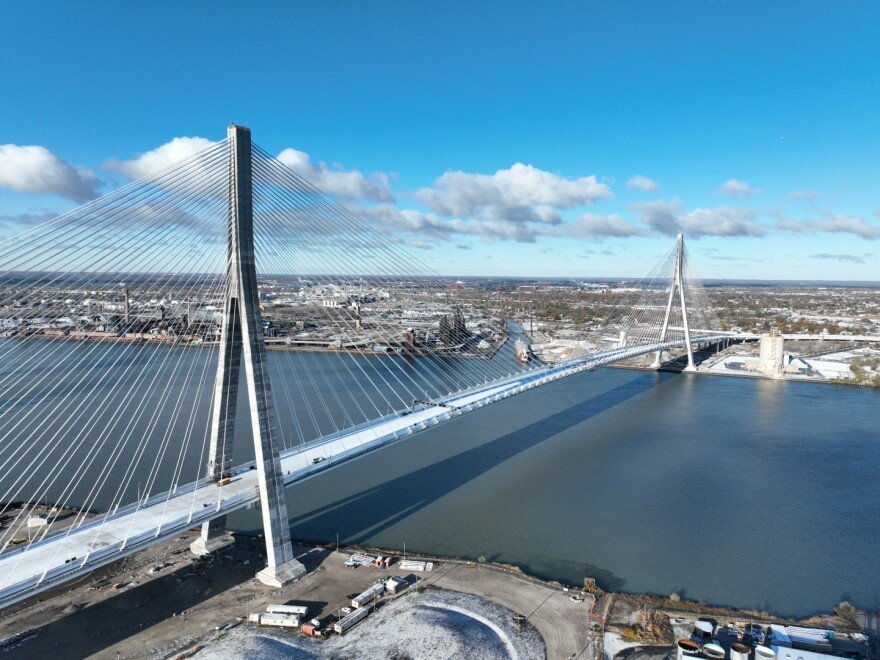
After more than two decades of planning, environmental review, political fighting, and eight years of construction, the Gordie Howe International Bridge is set to open to traffic on July 27, 2026 — becoming the fourth vehicle crossing between Detroit, Michigan, and Windsor, Ontario, and the longest cable-stayed span in North America.
For a construction industry that has watched this project since the first pilings went into the Detroit River in 2018, the opening date is the final milestone in one of the most closely followed binational infrastructure builds in recent memory.
Here’s a detailed look at what got built, what it cost, who built it, and why it sat finished — but closed — for nearly seven weeks this summer.
Project Snapshot
- Location: Spanning the Detroit River between Windsor, Ontario, and Detroit, Michigan
- Type: Cable-stayed bridge
- Main span: 853 meters (2,800 feet) — the longest cable-stayed main span in North America and the 10th-longest in the world
- Total length: Approximately 2.5 km (1.5 miles)
- Traffic lanes: Six lanes of vehicle traffic (three in each direction), plus a separated multi-use path for pedestrians and cyclists
- Towers: Twin towers roughly 220 meters (722 feet) tall, anchored deep into bedrock
- Deck clearance: The roadway hangs well above the river, providing clearance for commercial shipping traffic below
- Cable stays: 216 stay cables supporting the deck
- Owner: Jointly owned by the Government of Canada and the State of Michigan
- Delivery model: Design-Build-Finance-Operate-Maintain (DBFOM) public-private partnership
- Builder/operator consortium: Bridging North America
- Opening date: July 27, 2026
A Project Two Decades in the Making
Talk of a new Detroit River crossing dates back to the early 2000s, when planners on both sides of the border grew concerned that a single privately owned span — the Ambassador Bridge, built in 1929 — was handling roughly a quarter of all merchandise trade between the United States and Canada.
A disruption at that one crossing, officials reasoned, could stall automotive supply chains and broader cross-border commerce on both sides of the river.
The path from concept to steel and concrete was long. Environmental approvals cleared in both countries by 2009.
Canada and Michigan signed the Canada-Michigan Crossing Agreement in 2012, and the Windsor-Detroit Bridge Authority (WDBA), a Canadian Crown corporation, was created that same year to oversee delivery.
Because Michigan’s legislature would not commit state funding, Canada agreed to cover the state’s share of costs upfront, to be recovered later through toll revenue — an arrangement that made this fundamentally a Canadian-financed project built partly on U.S. soil.
In 2015, the crossing was formally named for Gordie Howe, the Saskatchewan-born hockey legend who spent 25 seasons with the Detroit Red Wings and became one of the sport’s most enduring symbols of cross-border connection. Howe died in 2012, two years before construction began.
The Build: Consortium, Timeline, and Engineering
In July 2018, WDBA awarded the design-build-finance-operate-maintain contract to Bridging North America, a consortium bringing together some of the heaviest hitters in transportation megaprojects:
- AECOM — lead design
- Dragados Canada, Fluor Corporation, and Aecon — construction
- ACS Infrastructure, Fluor, and Aecon — 30-year operations and maintenance following completion
Under the DBFOM structure, Bridging North America will receive monthly availability payments from WDBA for operating and maintaining the crossing over three decades — a financing model increasingly common on large North American toll infrastructure, shifting long-term performance risk onto the private consortium.
Groundbreaking took place on July 17, 2018. Construction unfolded in overlapping phases: foundation and tower construction from 2018 to roughly 2022, deck erection from 2022 into 2024, and systems integration, technology testing, and commissioning running through 2025 and into 2026.
The Canadian tower topped out first, in 2021, followed by the U.S. tower in 2022. In June 2024, crews connected the two halves of the bridge deck reaching out from the Windsor and Detroit banks — a visible milestone that drew crowds on both sides of the river and signaled the structure was, in engineering terms, essentially whole.
The COVID-19 pandemic complicated an already complex binational logistics and permitting effort, pushing the original 2024 target opening into 2025 and eventually into 2026.
By late 2025, major construction was substantially complete, with the remaining work centered on technology testing and the buildout of the ports of entry.
Signature Design: Towers Shaped Like a Slap Shot
The bridge’s twin A-frame towers were deliberately designed to evoke the curved blade of a hockey stick captured mid-slap shot — a nod to its namesake that has become the project’s visual signature.
At roughly 722 feet, the towers are tall enough to anchor the record-setting main span, and their cable-stay system is rated to carry tens of millions of pounds of deck load.
The bridge also incorporates thousands of individually programmable LED lights, first tested in September 2025, allowing the structure to be lit for holidays and civic occasions on both sides of the border.
Heavy Lift Equipment
Given the scale of the tower and deck elements, the project relied on specialized high-capacity tower cranes throughout construction — including a matched pair of large-capacity luffing cranes, one positioned on each riverbank, each finished in national colors (blue on the U.S. side, red on the Canadian side) as a nod to the binational partnership.
The cranes were capable of hook heights approaching 800 feet to service the towers as they rose.
What It Cost
Megaproject cost figures tend to move as scope, currency conversion, and schedule shift over an eight-year build, and the Gordie Howe bridge is no exception.
Early estimates in the $4.5–4.7 billion (USD) range were cited when the Bridging North America contract was awarded in 2018.
As the project neared completion, Canadian officials cited a total project cost of roughly CA$6.4 billion, encompassing the bridge itself, the two new ports of entry, and the Michigan interchange connecting to Interstate 75 — figures that reflect the full binational program rather than the bridge structure alone.
Whichever figure is used, Canada is footing essentially the entire bill, with Michigan’s share to be reimbursed through future toll revenue.
More Than a Bridge: Ports of Entry and the Michigan Interchange
Industry observers sometimes forget that the bridge itself is only one of four major components in the program. The project also includes:
- A U.S. Port of Entry in Detroit’s Delray neighborhood, housing customs and border inspection facilities
- A Canadian Port of Entry on the Windsor side
- The Michigan Interchange, rebuilding the connection between the bridge and Interstate 75
- The Rt. Hon. Herb Gray Parkway, an extension linking the crossing to Ontario’s Highway 401
Combined, the crossing will offer 16 toll lanes and 60 U.S. and Canadian inspection lanes — full highway-to-highway connectivity that neither the Ambassador Bridge nor the Detroit-Windsor Tunnel can offer, since both currently route commercial and passenger traffic through city streets before reaching the interstate or provincial highway network.
Jobs and Labor
Bridging North America has said the project generated roughly 2,500 direct construction jobs at peak activity, with total employment across the multi-year build cited at more than 3,900 workers when subcontractors and specialty trades are included — a workforce Michigan Governor Gretchen Whitmer has repeatedly credited for delivering the crossing on both sides of the border.
The Delay: A Finished Bridge Sitting Idle
For a construction audience, one of the more unusual chapters in this project’s history came after the concrete and steel work was essentially done. By early June 2026, the bridge was structurally complete and had passed inspections.
A ribbon-cutting ceremony was scheduled for June 12 on the Windsor side. The day before the event, WDBA canceled it, saying the two federal governments needed “the necessary time to resolve any outstanding issues.”
The dispute centered on toll revenue and trade politics rather than engineering. U.S.
President Donald Trump had pushed for a share of future toll income and raised objections related to broader U.S.-Canada trade tensions, while representatives for the Ambassador Bridge’s ownership — long-time opponents of the publicly owned crossing — were reported to be in discussions with U.S. officials during the standoff.
Canadian officials, including Prime Minister Mark Carney, said the delay had been requested by the U.S. side.
The impasse was resolved on July 10, 2026, when Canada’s Department of Housing and Infrastructure and Governor Whitmer jointly announced an opening date of July 27.
As part of the deal, the two governments agreed to a series of measures on how tolls will be administered going forward, including an arrangement to direct a share of net toll profits to a regional development fund.
Tolls: Undercutting the Competition
WDBA released toll rates in March 2026, positioning the new bridge as the cheapest of the three vehicle crossings on the Detroit River:
| Crossing | Passenger Vehicle Toll | Commercial Vehicle Toll (Per Axle) |
|---|---|---|
| Gordie Howe International Bridge | Standard: $5.75 USD / $8 CAD Breakaway Program: $4.35 USD / $6 CAD |
Standard: $8.75 USD / $12 CAD Breakaway Program: $6.90 USD / $9.60 CAD |
| Ambassador Bridge | ~$10 USD / ~$14 CAD | ~$15 USD per axle |
| Detroit–Windsor Tunnel | ~$9 USD | ~$10–$44 USD (depending on number of axles) |
The bridge’s own electronic toll program, branded Breakaway, offers a 25 percent discount to enrolled accounts and is designed to let vehicles pass through open lanes without stopping.
Pedestrians and cyclists will be able to cross the dedicated multi-use path toll-free — a first among the region’s Detroit River crossings.
Why It Matters for the Construction and Trade Industries
The Windsor-Detroit corridor remains the busiest land border crossing in North America by trade value, carrying a large share of the automotive parts and finished-vehicle traffic that moves between U.S. and Canadian manufacturing plants.
For decades, that volume has funneled through the aging Ambassador Bridge and the Detroit-Windsor Tunnel, both of which route traffic through city streets before reaching the interstate or provincial highway system.
The Gordie Howe bridge is the first crossing in the corridor built with direct highway-to-highway connectivity, six full lanes, and on-site inspection facilities sized for future growth.
For the construction sector, it stands as a case study in binational DBFOM delivery — one that combined a record-setting cable-stayed structure, two full port-of-entry campuses, and a highway interchange rebuild into a single, decade-spanning program, all while navigating a pandemic, cross-border legal challenges from a competing bridge owner, and — in its final weeks — a dispute over tolls that played out at the highest levels of two national governments.
With the July 27 opening now confirmed, the bridge is expected to begin easing congestion at the Ambassador Bridge and the tunnel almost immediately, giving the region a second full-capacity, highway-connected route for the auto parts, manufactured goods, and daily commuter and commercial traffic that keep the Detroit-Windsor economy moving.
Also Read
- Wall Street Is Pouring Billions Into AI Data Center Construction. Here’s Why
- EACOP at 80%+ and Nearing First Oil — But a London Lawsuit Could Still Reshape Its Timeline

With years of experience covering infrastructure projects, equipment, and engineering solutions, Yvonne brings in-depth analysis and practical insights to contractors, engineers, and industry stakeholders.
She is passionate about highlighting sustainable construction practices and the latest advancements that drive efficiency and safety on worksites.
- Why America’s Grid Expansion Is Creating a New Construction Boom - July 31, 2026
- U.S. Housing Starts Surge 19% in June, Signalling Strong Construction Activity Despite Decline in Building Permits - July 23, 2026
- 10 Benefits of Smart Buildings: How Intelligent Buildings Are Transforming Commercial Real Estate - July 21, 2026
