

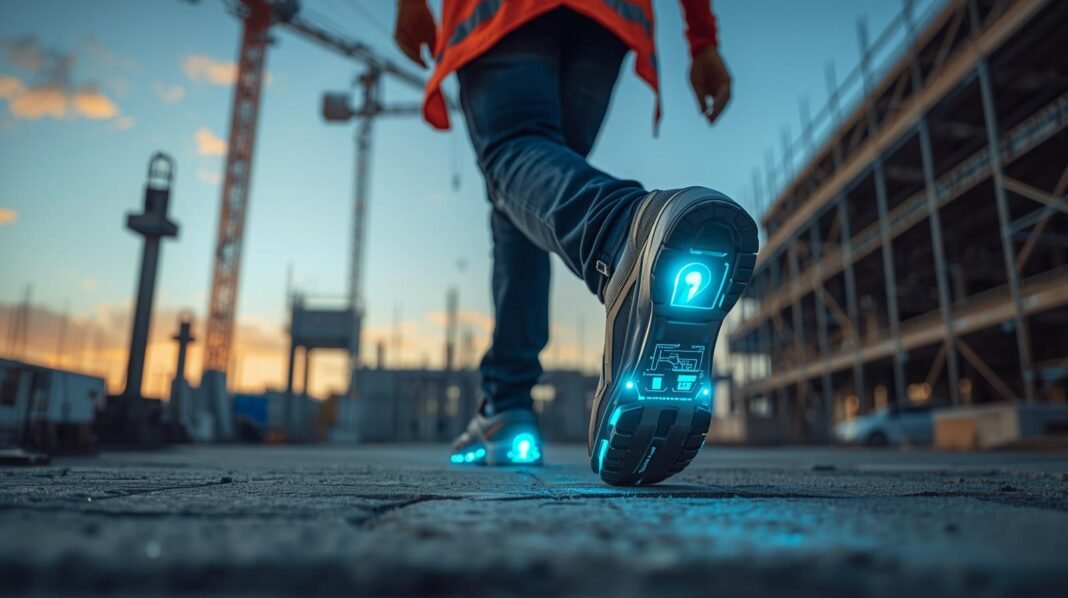
For more than a century, the primary mission of safety footwear was straightforward: create a physical barrier between a worker’s foot and whatever hazard lay underfoot — a falling steel beam, a slippery surface, a puncture-prone floor.
That mission has not changed. What has changed, dramatically and irrevocably, is the technology embedded within the shoe itself.
In 2026, the most advanced safety footwear on the market is no longer a passive protective shell.
It is a connected sensing platform, capable of detecting slip risks in real time, monitoring signs of worker fatigue, transmitting GPS location to safety dashboards, alerting wearers when they approach geofenced hazard zones, and even assessing whether the shoe itself is still providing its rated level of protection.
The boot that once simply shielded your toes is now, in its most sophisticated incarnation, a mobile data node in the broader connected-worker ecosystem.
This shift is being driven by converging forces: stricter occupational health and safety regulations across major industrial economies, rapid advances in miniaturised sensor technology, the maturation of cloud-based analytics platforms, and a growing body of evidence linking wearable monitoring to measurable reductions in workplace injuries and fatalities.
The global smart shoes market, valued at USD 357.9 million in 2024, is projected to reach USD 1.19 billion by 2033, growing at a compound annual rate of 13.5 percent.
The broader smart PPE market is expected to expand from USD 1.38 billion in 2025 to USD 3.77 billion by 2032.
At the same time, the global safety footwear market — which sits at USD 4.02 billion in 2024 and is on a trajectory toward USD 6.93 billion by 2033 — is itself undergoing a fundamental technological upgrade, as the boundary between conventional protective footwear and smart wearables continues to blur.
CCE News has surveyed the market, reviewed the latest industry developments, and tracked new product launches to bring you a definitive guide to the smart safety shoes and connected footwear innovations that matter most for construction, mining, manufacturing, and heavy industry in 2026.
Market Context: Why 2026 Is a Watershed Year
Several structural developments have converged to make 2026 a defining moment for smart safety footwear.
Regulatory Pressure Is Mounting
Workplace safety regulators across North America, Europe, and increasingly Asia-Pacific are tightening enforcement of occupational footwear standards.
In the United States, slips, falls, and object-related foot injuries accounted for a significant portion of the 2.8 million nonfatal occupational illnesses and injuries recorded in 2025, according to Bureau of Labor Statistics data.
In China, the Ministry of Emergency Management allocated USD 1.2 billion in September 2025 specifically for workplace safety equipment upgrades, including footwear.
The European EN ISO 20345:2022 standard, now in full effect, has raised the bar for slip resistance, energy absorption, and electrostatic discharge (ESD) performance across the entire industry.
The Connected Construction Site Is Arriving
The construction wearable technology market is expected to grow from USD 4.6 billion in 2025 to USD 5.09 billion in 2026, at a CAGR of 10.7 percent, on its way to USD 7.55 billion by 2030.
Smart hard hats, smart vests, exoskeletons, and connected boots are no longer experimental.
Global contractors including Skanska, Gilbane, and CCC have deployed IoT wearables on active project sites, reporting faster emergency response times and a measurable reduction in incidents.
The footwear layer of this ecosystem is increasingly critical — because the feet are where the most granular movement, fatigue, and positioning data is generated.
Key Technology Advances
Three technological developments are particularly consequential for smart safety footwear in 2026:
- Miniaturised multi-sensor insoles: Pressure sensors, accelerometers, gyroscopes, GPS modules, and temperature sensors can now be integrated into a standard insole without meaningfully altering the footwear’s weight, profile, or certified protection characteristics.
- AI-driven analytics platforms: Raw sensor data from footwear is now processed by machine learning algorithms that can distinguish normal fatigue from early signs of heat stress, identify slip-prone gait patterns before a fall occurs, and flag when a worker has entered a restricted area.
- Energy-return sole engineering: The new generation of polyurethane and TPU sole technologies — Uvex’s i-PUREnrj being the most technically advanced example currently on the market — delivers energy return levels that actively combat musculoskeletal fatigue over 10-to-12-hour shifts.
Market Data At A Glance
| Market Segment | 2024 Valuation | Projected Growth |
|---|---|---|
| Smart Shoes (Global) | USD 357.9 million | USD 1.19 billion by 2033 (CAGR 13.5%) |
| Safety Shoes (Global) | USD 4.02 billion | USD 6.93 billion by 2033 (CAGR 6.8%) |
| Smart PPE (Global) | USD 1.38 billion | USD 3.77 billion by 2032 |
| Construction Wearables | USD 4.6 billion (2025) | USD 7.55 billion by 2030 (CAGR 10.7%) |
| Asia-Pacific Safety Footwear | USD 4.3 billion (2022) | USD 8.5 billion by 2030 (CAGR 7.9%) |
Sources: IMARC Group, Grand View Research, ResearchAndMarkets, DataM Intelligence, Verified Market Reports (2025–2026)
Top Smart Safety Shoes to Watch in 2026
The following profiles cover the leading brands and models generating the most significant industry attention in 2026, spanning both dedicated smart PPE platforms and the most technologically advanced conventional safety footwear.
1. Uvex 1 Techware — The Industry’s Most Advanced Smart Safety Shoe
Key Specification: S1–S3, ESD, IoT-Integrated Smart Insole Platform
Germany’s Uvex Safety Group took the industry by surprise in October 2025 when it formally launched a smart safety shoe with fully integrated IoT sensors for real-time hazard detection — a development confirmed by DataM Intelligence’s Asia-Pacific Safety Footwear Market report.
But the foundations of that capability had been under development for years. Uvex’s techware platform, which underpins the smart version of the Uvex 1, is built around what the company calls a ‘meta-sensor’ smart insole system.
The Uvex 1 Techware smart insoles are designed to detect and evaluate hazardous situations in real time — most notably, the risk of slipping — and alert the wearer before a fall occurs.
Beyond immediate hazard detection, the meta-sensor system monitors the safety-related properties of the shoe itself, tracking wear-related changes and identifying when protection characteristics may have degraded, enabling proactive replacement scheduling rather than reactive failure management.
Uvex’s Digital Business Innovation division continues to develop the techware platform in collaboration with technology partners and key clients from high-risk industries.
The broader Uvex 1 line — including the 1 G2, which uses the company’s i-PUREnrj energy-return sole technology delivering 100 percent higher energy absorption than the EN ISO 20345 standard requires — represents the most technically sophisticated family of safety footwear currently available from a single manufacturer.
- Smart insole: slip risk detection, real-time alerts to wearer
- Meta-sensors: monitor shoe protection integrity over time
- i-PUREnrj sole: 68 percent energy return in forefoot, 65 percent at heel
- Shock absorption: 44 joules — 2.2 times the standard minimum
- Available in S1, S2, and S3 protection classes with ESD certification
- x-dry knit collar: breathable + water-repellent construction
Best suited for: Electronics manufacturing, precision engineering, laboratories, maintenance, installation, and any environment where ESD risk combines with prolonged standing or walking.
2. Uvex 3 Quatro — Heavy-Industry Performance with Anti-Fatigue Engineering
Key Specification: S3, SRC, ESD, i-PUREnrj Planet Sole
For construction sites, mining operations, and heavy manufacturing — where workers spend 10 to 12 hours per day on their feet in demanding physical conditions — the Uvex 3 Quatro represents the current state of the art in sole technology engineering.
The shoe’s i-PUREnrj planet midsole, which incorporates up to 20 percent recycled PU from Uvex’s own production processes, delivers the same energy-return system as the Uvex 1 G2 but in a more robust S3-certified platform built for harsh outdoor and industrial environments.
The Uvex 3 Quatro’s MACSOLE rubber outsole technology provides outstanding resistance to heat, chemicals, and cutting, while delivering unparalleled slip resistance even in cold conditions.
The shoe’s use of recycled materials — including up to 38 percent recycled polyester in the insole board and up to 72 percent recycled materials in the innersole — reflects Uvex’s growing emphasis on sustainable PPE manufacturing, a trend that is increasingly influencing procurement decisions among larger contractors and mining operators.
The Uvex 3 Quatro’s GFRP protective toe cap, combined with a scuff cap and heel basket, makes it one of the most structurally robust safety shoes in the S3 class, while its integration of D3O impact protection material in the collar provides measurable ankle protection that conventional safety boots do not offer.
- i-PUREnrj sole: 44 joules shock absorption, 2.2× EN ISO 20345 minimum
- MACSOLE rubber outsole: heat, chemical, and cut resistant
- D3O collar: advanced impact protection for ankle area
- Water-resistant leather upper: 4× longer than standard requirement
- Sustainability credentials: recycled PU, polyester, and GRS-certified materials
Best suited for: Construction, civil engineering, quarrying, heavy manufacturing, and mining where robust S3 protection meets prolonged fatigue risk.
3. Honeywell MTS Sporty Range — Precision Industry Comfort in a Sports-Inspired Shell
Key Specification: S1P / S3S, ESD, HI-CI, Silicone-Free
Honeywell’s industrial footwear stable — which includes the Oliver, Otter, MTS, and King’s brands, backed by more than 135 years of manufacturing experience and 107 granted patents — entered a new product generation in October 2025 with the launch of a composite toe safety shoe delivering a 30 percent weight reduction versus its predecessor.
The MTS Sporty Range, however, has already been earning strong reviews for its combination of athletic-inspired design with industrial-grade protection.
The six-model MTS Sporty Range was designed with a specific industrial challenge in mind: automotive and electronics manufacturing environments, where paint-shop contamination from silicone compounds in conventional safety shoes can ruin entire production batches.
Every model in the Sporty Range features a dual-density injected PU outsole that is explicitly certified silicone-free and free from paint-wetting impairment substances (PWIS) — a critical requirement for tier-1 automotive suppliers. The outsole also carries HI-CI certification, meaning it is resistant to hot contact and cold insulation.
The modular three-width Insock Fitting System — available in standard, wide, and XXL — addresses one of the most persistent complaints about safety footwear: poor fit leading to musculoskeletal fatigue.
A composite toe cap, ESD marking, and the sporty visual language make these shoes as appropriate for the quality control office as for the production floor.
- Composite toe cap: impact and compression protection without metal
- Silicone-free, PWIS-free outsole: automotive and electronics environments
- Dual-density PU outsole: lightweight + oil, slip, and hot surface resistant
- Modular fit system: three width options for personalised comfort
- ESD certified across all six models in the range
- S1P and S3S variants available, including XXL width options
Best suited for: Automotive manufacturing, electronics assembly, light manufacturing, warehouse logistics, and any industrial environment with paint or chemical contamination risk.
4. Honeywell MTS Construction Range — Built for the Harshest Job Sites
Key Specification: S3, SRC, ARTICO Lining, 300°C Hot Contact
While the Sporty Range targets precision manufacturing, Honeywell’s MTS Construction Range is engineered for the punishment of active construction sites.
The range’s defining engineering achievement is its PU/Rubber outsole combination, which provides the lightweight comfort benefits of PU with the thermal resistance of rubber — specifically certified to 300°C hot contact protection under EN specification, a critical requirement for site workers near welding operations, hot asphalt, or foundry environments.
The ARTICO lining system, developed specifically for demanding outdoor and construction applications, delivers a combination of high abrasion resistance, enhanced elasticity, and improved heat conductivity that keeps the internal temperature of the shoe stable across a wider range of external conditions.
Heel stiffeners and padded collar construction ensure that ankle support does not degrade even after prolonged use on uneven terrain, while the scuff cap protects the toe area from the abrasive wear that is endemic to construction environments.
For site managers procuring PPE across large workforces, Honeywell’s MTS Construction Range offers a commercially significant advantage: consistent performance data, verified against EN standards, from a manufacturer with decades of documented compliance history and a global distribution and servicing infrastructure.
- ARTICO lining: abrasion resistant, elastic, heat-conductive for climate management
- PU/Rubber outsole: 300°C hot contact certification
- Ankle protection tested to EN standard
- Scuff cap: enhanced toe area durability for construction environments
- Kevlar anti-puncture midsole options available
- Water-resistant upper
Best suited for: Construction, civil engineering, demolition, road work, and infrastructure projects where toe, ankle, and thermal protection are simultaneously required.
5. CAT (Caterpillar) Safety Footwear — Trusted Heritage, Modern Anti-Fatigue Engineering
Key Specification: ASTM F2413, Steel and Composite Toe Options, DuraShocks Technology
Caterpillar’s safety footwear line occupies a unique position in the market: built on the same brand equity as the world’s best-known heavy construction and mining equipment, the CAT safety boot is a familiar sight on sites from copper mines in Chile to high-rise construction in the Gulf.
The brand’s enduring popularity is built on its DuraShocks absorbing system — a proprietary shock-absorption technology that targets the specific fatigue patterns of workers who spend long shifts operating machinery, walking across rough terrain, or standing on concrete.
The CAT Second Shift, consistently one of the best-selling steel-toe safety boots in the North American and international markets, combines Goodyear welt construction — which allows the boot to be resoled, extending its working life significantly compared to cemented alternatives — with an anti-fatigue footbed that continues providing energy return even as the outer boot weathers hard use.
The newer Threshold model incorporates a composite toe option that is increasingly popular among safety inspectors and site engineers who move frequently between indoor office environments and outdoor hazard zones.
- DuraShocks absorbing system: targeted anti-fatigue engineering
- Goodyear welt construction: resoleable for extended service life
- Steel and composite toe options across the range
- Anti-fatigue footbed with energy return
- iCS (Individual Comfort System) customisation insole
- Metatarsal guard options available for highest-risk applications
Best suited for: Construction plant operators, mining site workers, heavy equipment maintenance crews, and general industrial applications requiring ASTM-certified toe protection.
6. Under Armour Industrial Safety — The Sports Brand’s Industrial Play
Key Specification: ANSI Z41 / ASTM, Smart Sensor Insole, IoT Hazard Detection
Under Armour’s November 2024 acquisition of a smart sensor technology company specialising in industrial safety footwear marked one of the most strategically significant moves in the PPE industry in recent years.
The acquisition — confirmed by HTF Market Intelligence — gave Under Armour immediate access to proprietary sensor technology designed specifically for occupational safety applications, including real-time hazard detection and alert systems.
The resulting smart safety footwear platform brings Under Armour’s considerable expertise in athletic performance materials and biomechanical footwear design to a new audience: industrial workers.
The integration of IoT hazard detection into a boot that already benefits from Under Armour’s sports-science heritage in cushioning, breathability, and motion analysis creates a compelling combination for industries where worker performance and safety must be addressed simultaneously.
The product is still in its early commercial rollout phase, but the combination of an established performance brand and acquired specialist sensor IP has positioned Under Armour’s industrial safety line as one of the most closely watched new entrants in the smart safety footwear sector heading into 2026.
- Acquired smart sensor technology: IoT hazard detection and worker alerts
- Sports-science heritage: advanced cushioning and breathability materials
- Real-time biomechanical feedback capability
- ANSI/ASTM certified for core safety requirements
- Bluetooth connectivity to safety management platform
Best suited for: Logistics, warehousing, manufacturing environments where worker performance metrics and hazard proximity alerts need to be managed simultaneously.
7. Engelbert Strauss ESD S3 Series — German Engineering Meets Sustainable Safety
Key Specification: S3, ESD, SRC, Eco-Sustainable Materials, Metal-Free
Engelbert Strauss has built a reputation as one of Germany’s premium workwear and protective footwear brands, with particular strength in the precision engineering, technical trades, and utility sectors.
The company’s ESD S3 series represents its most technically advanced footwear offering, combining full S3 certification — which requires anti-penetration midsole, anti-static properties, energy absorption, waterproof upper, and slip resistance simultaneously — with chrome-free tanning, ESD-certified outsole compounds, and a strong commitment to eco-friendly materials and sustainable manufacturing processes.
Engelbert Strauss is also leading the industry in integrating automation into its distribution chain, enabling highly responsive replenishment for large workforces — an operational advantage that is increasingly valued by corporate safety managers procuring footwear at scale for hundreds or thousands of workers across multiple sites.
The brand’s anti-fatigue insole system, combined with S3-certified multi-layer sole construction, delivers the kind of all-day comfort that reduces the temptation for workers to remove or misuse their PPE during long shifts.
- Full S3 + ESD + SRC triple certification: comprehensive hazard coverage
- Chrome-free tanning: allergen-safe leather upper
- Anti-fatigue insole with multi-layer cushioning
- Eco-friendly materials and sustainable supply chain
- Metal-free construction across the range
- Strong distribution infrastructure for large-scale procurement
Best suited for: Precision engineering, electrical work, technical trades, and large corporate procurement where sustainability credentials complement safety requirements.
8. Redbrick Motion and ProTec Series — Where Sneaker Comfort Meets PPE Certification
Key Specification: S1P / S3, SRC, Lightweight Sneaker-Style Platform
The fastest-growing trend in European safety footwear is the normalisation of sneaker-style design within certified PPE platforms.
Redbrick, the Dutch brand that has become the most-sold safety shoe in its home market, has been at the forefront of this shift with its Motion and ProTec collections.
Updated in 2025 with new cushioning materials and lighter construction, these shoes look and feel like modern athletic trainers — but carry full S1P or S3 certification with SRC slip resistance.
The significance of this development for safety managers should not be underestimated. Research consistently shows that worker compliance with PPE requirements improves substantially when the PPE is comfortable and does not impose a social or physical cost on the wearer.
Safety shoes that look like sports shoes — and weigh as little as sports shoes — are worn correctly for more hours per shift, replaced more regularly, and cause fewer musculoskeletal complaints.
For industries like warehousing, logistics, retail, and light manufacturing, where the risk profile does not demand the full weight and bulk of a traditional S3 safety boot, the Redbrick approach represents a compelling safety and business case.
- Sneaker-style design: high compliance, all-day comfort
- S1P and S3 variants with SRC slip resistance certification
- 2025 update: new cushioning materials and 15% lighter construction
- Low-abrasion TPU outsole with modern visual language
- Ideal for mixed indoor/outdoor environments
Best suited for: Warehousing, logistics, retail, light manufacturing, and any environment where S1P certification suffices and worker comfort drives PPE compliance.
Smart Safety Shoe Comparison: 2026 Quick-Reference Guide
Smart Safety Footwear: Brand & Tech Comparison
| Brand / Model | Protection Class | Smart Technology | Industry Focus | Key Innovation | Approx. Price Range (USD) |
|---|---|---|---|---|---|
| Uvex 1 Techware | S1–S3 / ESD | Smart insoles, meta-sensors, slip-risk alerts, property monitoring | General Industry, Electronics | Real-time hazard detection & PPE health monitoring | $150–$220 |
| Uvex 1 G2 | S1–S2 / ESD | i-PUREnrj energy-return sole; x-tended grip TPU outsole | Indoor / Service | 100% higher energy absorption than EN ISO 20345 standard | $130–$180 |
| Uvex 3 Quatro | S3 / SRC / ESD | 44-joule shock absorption; 68% forefoot energy return | Heavy Industry, Construction | 2.2× standard shock absorption via i-PUREnrj planet sole | $160–$240 |
| Honeywell MTS Sporty Range | S1P / S3S / ESD | Composite toe; dual-density PU outsole; modular fit system | Manufacturing, Automotive | HI-CI certified; silicone-free for paint-shop environments | $100–$160 |
| Honeywell MTS Construction | S3 / SRC | Kevlar composite toe; ARTICO lining; scuff cap; ankle protection | Construction, Infrastructure | PU/Rubber outsole with 300°C hot contact protection | $120–$180 |
| CAT (Caterpillar) Second Shift | ASTM F2413 | Steel or composite toe; DuraShocks absorbing system | Heavy Industry, Mining | Anti-fatigue footbed + metatarsal guard options | $110–$170 |
| Under Armour Industrial Safety | ANSI Z41 / ASTM | Smart sensor insole with hazard detection & alert system | Occupational Safety | Acquired smart sensor tech in Nov 2024; IoT hazard alerts | $150–$230 |
| Engelbert Strauss ESD S3 Series | S3 / ESD / SRC | Metal-free composite cap; ESD-certified sole; anti-fatigue insole | Precision Engineering, Technical | German-engineered; eco-friendly materials; auto-fit lacing | $170–$260 |
| Redbrick Motion / ProTec | S1P / S3 / SRC | Sneaker-style build; lightweight cushioning; low abrasion sole | Logistics, Warehousing | Sneaker comfort in a certified PPE platform | $90–$150 |
| Adidas x AI Smart Platform | Performance | AI pressure sensors; real-time biomechanical analytics via app | Sports / Industrial crossover | Strategic AI partnership for gait analytics (Sept 2024) | $200–$350 |
Note: Prices are indicative retail/distributor ranges and vary by region, specification, and order volume. Always verify current pricing and exact specifications with suppliers. IoT-enabled models may carry additional software platform licensing costs.
The Technology Behind Smart Safety Footwear: What Actually Works in 2026
Smart Insole Sensor Systems
The insole is the technological core of any smart safety shoe. Modern smart insoles incorporate arrays of pressure sensors distributed across the plantar surface of the foot, capturing data on gait patterns, weight distribution, and step dynamics at sampling rates sufficient to detect anomalies in real time.
These sensors communicate via Bluetooth Low Energy (BLE) to a paired smartphone or gateway device, which forwards data to a cloud-based analytics platform.
Partner Opportunity
Are You a Safety Gear or Smart Footwear Brand?
Get featured in our next issue and reach thousands of construction professionals actively seeking innovative safety solutions. Boost your visibility and connect with the right audience.
The Uvex techware meta-sensor system goes further than simple gait tracking. It monitors the physical properties of the shoe’s safety-critical components — toe cap integrity, penetration-resistant midsole performance, ESD properties — and can alert maintenance managers when these properties fall below safe thresholds.
This transforms safety shoe management from a calendar-based replacement cycle into a condition-based maintenance regime, potentially delivering significant cost savings while improving protection.
IoT Connectivity and Geofencing
The ability to know, in real time, where a worker is on a large site — and whether that worker is in proximity to a designated hazard zone — is one of the most practically valuable applications of connected safety footwear.
Smart safety shoes equipped with GPS and integrated with site management platforms can automatically trigger alerts when a worker enters a geofenced restricted area, whether that is a live traffic zone on a mining haul road, an area where overhead crane operations are active, or a section of a construction site currently undergoing structural testing.
This capability is particularly significant for lone worker protection. In mining, oil and gas, and utilities, workers routinely operate in isolated locations where conventional supervision is impractical.
A smart safety boot that continuously reports location and movement data — and that triggers an emergency alert if no movement is detected for a defined period, or if an accelerometer reading consistent with a fall is registered — provides a safety net that no number of supervisory walkthroughs can replicate.
Fatigue Monitoring: The Hidden Safety Dividend
Worker fatigue is one of the most underaddressed contributors to workplace accidents. Wearable technology in connected footwear can monitor movement patterns throughout a shift, identifying the subtle changes in gait and weight distribution that precede fatigue-related incidents — heel dragging, reduced step height, altered balance dynamics.
This information can feed directly into shift planning systems, enabling supervisors to rotate workers before fatigue reaches a critical threshold rather than responding to incidents after they occur.
AI and Predictive Safety Analytics
The 2024 strategic partnership between Adidas and an AI startup to co-develop smart shoes with enhanced pressure-sensor technology and AI analytics represents the direction the entire market is moving.
When AI algorithms are applied to the continuous data streams generated by smart safety footwear across a workforce, patterns emerge that no human observer could detect: correlations between specific gait signatures and injury risk; the influence of site conditions, weather, or shift duration on fall probability; the early indicators of repetitive strain injury developing in a specific muscle group.
This is the frontier of smart safety footwear, and it is closer to commercial deployment than many procurement managers realise.
Smart Safety Shoe Buying Guide for 2026: Key Considerations
1. Match Certification to Actual Hazard Profile
The most common procurement mistake in safety footwear is either over-specifying (buying S3 boots for a warehouse environment where S1P suffices, adding cost and discomfort) or under-specifying (using S1P in an environment where anti-penetration midsole S3 is required).
The foundation of any smart safety shoe procurement decision must be a documented workplace risk assessment. In Europe, this must reference DIN EN ISO 20344–20347. In North America, ASTM F2413-18 or ANSI Z41 apply.
Global operators should verify which standards apply in each jurisdiction where workers will be deployed.
2. Evaluate Smart Features Against Operational Context
IoT-enabled footwear generates significant value in environments where: the workforce is large enough to justify platform software investment; workers operate in geographically distributed or isolated locations; fatigue monitoring is operationally relevant; and site management infrastructure can act on real-time data.
For a small crew on a short-duration project, a premium conventional safety shoe with advanced energy-return technology may deliver better practical safety value than a connected device whose platform features cannot be fully utilised.
3. Total Cost of Ownership vs. Purchase Price
Smart safety shoes typically carry a 30 to 70 percent price premium over equivalent conventional footwear.
But Uvex’s meta-sensor platform introduces an argument for lower total cost of ownership: if condition monitoring extends the average shoe replacement cycle from 12 months to 18 months, and if the fall-prevention capability prevents even one recordable incident per year across a workforce, the economic case for the premium is strong.
Procurement teams should model TCO across a three-year horizon, factoring in replacement cycles, platform licensing, training, and incident costs.
4. Comfort and Compliance Are Safety Metrics
A safety shoe that is not worn correctly — or removed during breaks and then not replaced — provides no protection. Worker compliance is a safety outcome.
The rise of sneaker-style safety footwear, energy-return sole technology, and women-specific last designs from manufacturers including Uvex reflects a growing industry consensus: comfort drives compliance, and compliance drives safety performance. Smart features add value, but only if the shoe is being worn.
5. Integration with Existing Safety Management Systems
If your organisation already uses a connected-worker or site safety platform — solutions from Guardhat (now Aatmunn), Triax, or enterprise platforms from Honeywell, 3M, or Kinetic — verify whether the smart safety shoe you are evaluating integrates with your existing dashboard infrastructure before purchasing.
A closed-ecosystem smart shoe that cannot share data with your existing safety management tools will create additional operational complexity rather than reducing it.
Outlook: Where Smart Safety Footwear Is Heading
The smart safety footwear market in 2026 is at an inflection point analogous to where industrial hard hat technology was when the first smart helmet platforms emerged: a proof-of-concept phase giving way to commercial scaling, with early adopters gaining a measurable competitive advantage in workforce safety metrics, insurance premiums, and regulatory compliance positioning.
Several developments will shape the category over the next three to five years.
Self-powered sensor systems — which harvest energy from walking movement to charge embedded electronics, eliminating the charging requirement that currently limits continuous monitoring capability — are actively under development and are expected to reach commercial certification in the 2027–2028 window.
Battery technology improvements are extending continuous monitoring capability on current platforms toward the 16-to-20-hour range that full-shift coverage demands.
The convergence of safety footwear with broader connected-worker platforms — where boot, helmet, vest, and glove data streams are aggregated into a single AI-driven safety dashboard — will make the value proposition of individual device investment increasingly compelling, particularly for large contractors and mine operators managing workforces in the thousands.
“As more workplaces adopt digital technologies, real-time risk assessments will be accessible to everyone, empowering more people to work safely.”
Sustainability is also becoming a structural driver. Uvex’s i-PUREnrj planet midsole, incorporating up to 20 percent recycled PU, and the MACSOLE planet outsole, using up to 30 percent recycled rubber, signal a direction the entire industry is following — driven by corporate procurement sustainability requirements, EU regulation, and consumer demand.
By 2028, the expectation is that sustainability credentials will be a baseline procurement requirement rather than a differentiating feature.
For CCE News readers — whether site managers procuring PPE for a construction workforce, procurement officers evaluating next-generation safety equipment, or equipment buyers looking ahead to the technologies that will define the next decade of industrial safety — the message from 2026’s smart safety footwear market is clear: the era of the passive safety shoe is ending.
The connected, intelligent, data-generating safety boot is here. The question is no longer whether to adopt it, but which platform best fits your workforce, your site, and your safety management infrastructure.
Reference: Key Safety Footwear Standards in 2026
| Standard | Scope | Key Markets |
|---|---|---|
| EN ISO 20345:2022 | European safety footwear: toe cap, slip resistance, ESD, penetration protection — updated 2022 version now in full effect | EU, UK, Middle East, Africa |
| ASTM F2413-18 | U.S. standard for impact/compression toe protection, electrical hazard, puncture resistance, and metatarsal protection | USA, Canada |
| ANSI Z41 | Predecessor U.S. standard still referenced in some procurement specifications | USA |
| ISO 20347 | Occupational footwear without mandatory toe cap — lighter-duty applications | Global |
| EN 61340-4-3 | ESD footwear testing — critical for electronics, pharmaceuticals, and chemical environments | EU, Global |
| DGUV 112-191 | German statutory accident insurance footwear requirements — highest level of German market compliance | Germany, DACH region |
Also Read
Safety tips for working at heights: Protecting your crew
How Smart Safety Shoes Are Revolutionizing Construction Site Safety

- From Operator to Algorithm: Bedrock Puts Autonomous Excavators to Work on Live Construction Sites - September 7, 2026
- Built For The Rough Stuff: Inside Titan’s new ForestEDGE™ Tyre Line - September 4, 2026
- South Africa Has R395 Billion in Infrastructure Projects — But Can the Industry Deliver Them? - August 26, 2026
