Mexico City, June, 12 2026-When the FIFA World Cup 2026 kicked off on 11 June with the opening ceremony and first match at Estadio Azteca in Mexico City, it made history in a way no previous edition of football’s showpiece has managed: staging the entire tournament — 104 matches across 48 nations — without a single purpose-built new stadium.
With the tournament now underway, the scale of the infrastructure transformation that made yesterday’s opening possible is coming into sharp focus.
Every one of the 16 host venues is an existing facility, and each has undergone a programme of upgrades, modernisation, and engineering works to meet FIFA’s exacting standards for the largest sporting event in the planet’s history.
The scale is genuinely unprecedented. Spread across 16 cities in the United States, Mexico, and Canada, the renovation and infrastructure investment programme associated with the 2026 tournament represents an aggregated spending figure that analysts and construction industry observers estimate in the range of $1.5 billion to $2 billion when stadium-specific capital works are counted together across all venues.
That figure, which reflects publicly reported renovation budgets and does not include broader city-level infrastructure or security spending, makes FIFA World Cup 2026 one of the most ambitious adaptive reuse and sports venue modernisation exercises ever attempted.
For architects, engineers, contractors, and infrastructure investors, the tournament is far more than a football competition.
It is a live demonstration of what the next generation of stadium engineering looks like: natural-grass conversion, 5G connectivity, IoT sensor networks, AI-assisted security, large-format LED systems, accessible design, and sustainability-driven construction all converging under tournament deadline pressure across dozens of concurrent projects in three countries simultaneously.
This article examines the engineering and construction dimensions of that investment—stadium by stadium, technology by technology, and city by city—and draws out the lessons that will define sports infrastructure development for the next decade.
The Adaptive Reuse Strategy: Why No New Stadiums Were Built
The decision to rely exclusively on existing venues was both deliberate and economically significant.
Previous World Cups—most notably Brazil 2014 and Qatar 2022—required enormous expenditure on new or near-new stadium construction, much of it criticised for producing venues poorly matched to the long-term needs of host nations and cities.
Brazil’s Arena da Amazonia in Manaus and Qatar’s 974 Stadium represented opposite poles of that debate: one a costly white elephant, the other a modular construction experiment that was ultimately dismantled.
North America 2026 adopted an explicitly different philosophy.
All three host nations already possessed a deep inventory of large-capacity professional stadiums, including NFL venues with capacities exceeding 70,000, MLS facilities with strong football heritage, and established Latin American league grounds.
The core FIFA requirement—a minimum usable capacity typically above 40,000—was already met or closely approximated by nearly every candidate venue before renovation began.
The sustainability argument reinforces the economic one. Building a new stadium generates significantly higher embodied carbon than renovating an existing structure.
Reusing foundations, structural steel, and concrete frames avoids the emissions associated with new material production, while extending the useful life of facilities already embedded in urban infrastructure networks.
As one widely cited principle in adaptive reuse puts it: the greenest building is the one that already exists.
The renovation-first model also aligns with the broader trajectory of post-pandemic construction economics, in which labour shortages, supply chain volatility, and elevated material costs have made greenfield stadium development increasingly difficult to justify on purely financial grounds.
Renovation programmes, while complex, can be phased, financed through existing venue ownership structures, and timed to preserve normal operations during the construction period.
“The renovation-first model is not a compromise—it is a statement about the future of sports infrastructure investment.”
The Major Renovation Projects: Venue by Venue
Estadio Azteca, Mexico City — The Tournament’s Historic Heart
No stadium in this World Cup carries more symbolic weight than Estadio Azteca. Designed by architects Pedro Ramírez Vázquez and Rafael Mijares Alcérrega and opened in 1966, it will become the first stadium in history to host matches at three separate FIFA World Cups, having previously staged games in 1970 and 1986.
The opening ceremony and the tournament’s first match—Mexico versus South Africa on 11 June—are scheduled here.
The renovation programme, which closed the stadium in May 2024, carries a reported cost of approximately $150 million (around 2 billion Mexican pesos at prevailing exchange rates).
The scope is substantial: structural repairs to address years of deferred maintenance, complete replacement of the seating bowl, a new LED lighting system throughout the venue, high-resolution LED screens installed across the stadium, rebuilt player tunnels and dressing rooms, and a comprehensive Wi-Fi infrastructure upgrade. Capacity is being increased from just over 83,000 to approximately 90,000 seats.
The project has not been without difficulty. Stadium officials acknowledged that underlying structural conditions required more extensive remedial work than initially anticipated, pushing timelines beyond early projections.
A test event—a friendly between Mexico and Portugal—was scheduled to serve as a live commissioning exercise before final FIFA handover.
The renovation preserves Azteca’s iconic exterior bowl character while integrating modern operational infrastructure beneath the historic façade: a textbook adaptive reuse challenge in one of the world’s most recognisable sports buildings.
MetLife Stadium, East Rutherford, New Jersey — The Final Venue
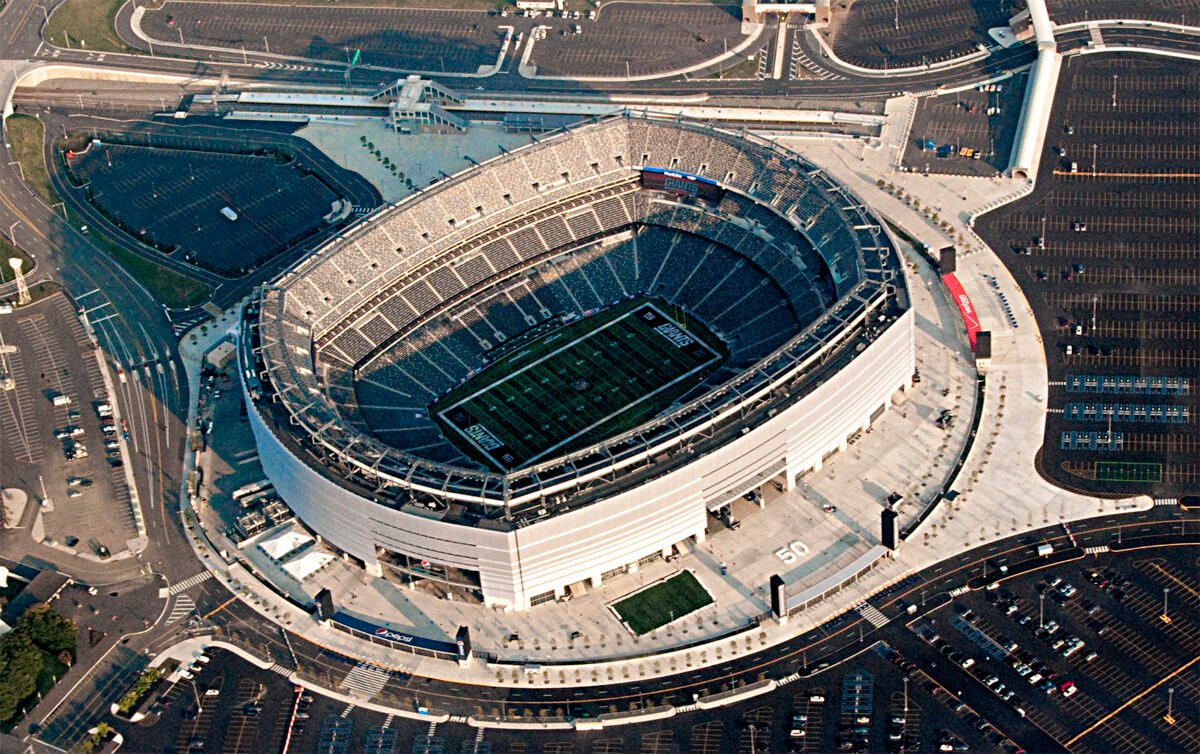
MetLife Stadium—renamed New York New Jersey Stadium for the duration of the tournament—will host the World Cup Final on 19 July 2026, making it arguably the most scrutinised venue in the entire programme.
The home of both the New York Giants and New York Jets in the NFL received a renovation programme led by Skanska and EwingCole, funded in part by $30 million in public money from the New Jersey Sports and Exposition Authority.
The engineering challenge at MetLife was precise: reconfiguring the lower bowl to accommodate a FIFA-standard pitch within a stadium designed primarily for the narrower dimensions of American football.
Skanska demolished four corner sections of existing seating and installed a new modular steel composite seating system, creating retractable configurations that allow rapid switching between NFL and FIFA formats.
The entire two-phase programme was executed while the stadium remained in full operation—hosting NFL matches, concerts, and other major events throughout construction—a logistical achievement that required meticulous phasing and coordination with stadium management.
Mechanical, electrical, audiovisual, and plumbing systems were adjusted throughout the renovated sections.
MetLife was also the first NFL stadium to join the United Nations Sports for Climate Action Framework, and its operators have committed to ongoing greenhouse gas reduction targets as part of the venue’s long-term sustainability strategy.
AT&T Stadium, Arlington, Texas — Nine Matches, Maximum Investment
AT&T Stadium in Arlington—home of the Dallas Cowboys and renamed Dallas Stadium for the World Cup—is hosting nine matches, more than any other venue in the tournament.
The stadium was designed by HKS Architects, the same firm engaged to advise FIFA on conversion requirements, giving the renovation team a uniquely intimate knowledge of the building’s original engineering logic.
A renovation programme reported at approximately $300 to $350 million has delivered a comprehensive upgrade of the stadium’s premium environments. Suites and club areas have been reimagined with new finishes and technology integration.
The world’s largest centre-hung HDTV video board has been upgraded. Concession and bar infrastructure has been expanded.
The renovation also addressed the FIFA requirement for a natural grass pitch—AT&T Stadium’s existing artificial surface was replaced with a temporary natural grass system to meet the federation’s field standards.
The sheer scale of the premium investment reflects the stadium’s ambition to serve as a global showcase venue for the tournament.
SoFi Stadium, Inglewood, California — Engineering the Pitch Expansion
SoFi Stadium, completed in 2020 at a construction cost of $5.5 billion, is one of the newest and most technologically sophisticated sports venues in the world.
Its preparation for the World Cup—it will host eight matches—focused on a specific structural challenge: the stadium’s lower bowl corners, configured for NFL dimensions, were insufficiently wide to accommodate a full-size FIFA regulation pitch.
The solution was elegant in its engineering logic. Existing precast concrete corner sections were replaced with retractable bleacher riser systems that roll back during soccer matches to expand the available field envelope.
The natural grass pitch itself—grown offsite under controlled conditions and transported for installation—is elevated approximately 30 inches above the standard field level to align with existing stadium infrastructure, creating a dramatically visible field presentation.
The entire playing surface is then extended outward as the retractable corners open, transforming the venue’s geometry for football. SoFi’s 70,000-seat capacity, its translucent fixed canopy roof, and its massive 4K video board infrastructure make it one of the tournament’s most photogenic venues.
Mercedes-Benz Stadium, Atlanta, Georgia — Grass, Technology, and a Halo Board
Mercedes-Benz Stadium, opened in 2017 at a construction cost of approximately $1.6 billion, is one of the tournament’s most architecturally distinctive venues.
Its eight-panel retractable roof, which opens like a camera aperture, and its 360-degree Halo Board video display wrapping the entire upper bowl have defined the stadium as a benchmark in sports architecture. It will host eight matches, including a semi-final.
The primary renovation challenge was the pitch. The stadium’s sub-surface was completely rebuilt: the existing artificial turf was removed, crews excavated 7 to 8 inches of substrate, installed a new irrigation and aeration system, laid a thick sand layer, and finally installed a hybrid pitch combining natural Kentucky bluegrass and perennial ryegrass grown in Colorado over the preceding year.
Synthetic fibre reinforcement was woven into the natural grass root zone for additional durability under tournament match density. The roof remains closed for all World Cup matches, managing Atlanta’s summer heat and providing controlled conditions for both players and spectators.
Levi’s Stadium, Santa Clara, California — A $200M Upgrade for Two Events
Levi’s Stadium, opened in 2014 as the home of the San Francisco 49ers, entered 2026 having just completed a $200 million renovation programme designed by Populous. The project was timed to serve both Super Bowl LX in February 2026 and the World Cup matches scheduled for June and July.
The renovation delivered the largest outdoor 4K video boards in the NFL—some 40% larger than their predecessors—along with a comprehensive upgrade of premium suites, club areas, lounge spaces, and interior finishes throughout high-traffic zones.
New sound systems and sponsorship signage infrastructure were also installed across the venue.
Levi’s Stadium holds LEED Gold certification, supported by an on-site solar panel installation and a green roof system, making it one of the tournament’s strongest sustainability performers.
BC Place, Vancouver — Canada’s Flagship Venue
BC Place in Vancouver, originally opened in 1983 and significantly upgraded with a retractable roof in the years prior to the 2010 Winter Olympics, is hosting seven World Cup matches.
The renovation programme for 2026, managed by BC Pavilion Corporation, carries a combined capital and operational budget estimated between C$171 million and C$181 million (approximately $124 to $133 million USD).
Upgrades at BC Place focus substantially on accessibility, inclusivity, and technology. A new hybrid sod grass pitch replaces the venue’s regular artificial surface.
Player locker rooms, showers, and bathrooms have been comprehensively renovated.
A new large-format video board, a permanent merchandise store, and expanded hospitality and hosting spaces have been installed.
Accessibility improvements are a particular emphasis, reflecting British Columbia’s commitment to a legacy of inclusion that extends beyond the tournament period.
BMO Field (Toronto Stadium), Toronto — Canada’s Largest Renovation
BMO Field in Toronto—the home of Toronto FC and the Toronto Argonauts, designated Toronto Stadium for the tournament—has undergone one of the most complex renovation programmes of any host venue.
The stadium’s seating capacity is being expanded from approximately 30,000 to 45,000 through the addition of 17,000 temporary seats on grandstands at the north and south ends of the field.
The total investment is approximately $157.9 million, funded primarily by the City of Toronto ($132.9 million) with Maple Leaf Sports and Entertainment contributing $25 million.
Permanent improvements include four new videoboards, upgraded locker rooms, broadcast infrastructure, stadium Wi-Fi, audio systems, and lighting.
A rooftop patio adds hospitality capacity. The project represents a long-term legacy investment: even after the temporary seating is removed, the permanent infrastructure improvements will serve the venue’s regular tenants and position it for future major events.
Economic analysts at Deloitte Canada have projected that hosting the World Cup could generate up to $940 million in economic value for the Greater Toronto Area.
Engineering Challenges: Construction Without Closing
The defining engineering challenge across virtually every World Cup venue renovation was the requirement to complete construction work on venues that remained in active operation throughout the process.
NFL stadiums in particular host 8 to 10 home games per season plus events including concerts, college football, and other major gatherings. A typical NFL venue generates hundreds of millions of dollars in annual revenue, making full closure economically impractical.
At MetLife Stadium, Skanska structured the renovation across two phases timed around the NFL calendar: the first wrapping in May before the football season, the second running from January to May 2025 during the off-season.
Corner demolition and modular steel seating installation were sequenced around match days, requiring detailed coordination between construction management and stadium operations teams.
Structural reinforcement of aging facilities presented a separate category of challenge. Estadio Azteca, built in 1966 and subject to Mexico City’s seismic environment, required more extensive remedial structural work than initially scoped once detailed investigations were undertaken after closure.
This kind of discovery-driven scope evolution is inherent in renovation programmes on buildings of significant age, and it underscores the importance of comprehensive pre-design investigation including ground-penetrating radar surveys, structural load assessments, and material sampling in renovation project planning.
Integrating modern digital infrastructure into legacy buildings required coordination between low-voltage specialists, IT network contractors, and broadcast infrastructure engineers working in parallel with civil and structural trades.
High-density Wi-Fi antenna arrays, fibre backbone installation, 5G small-cell deployment, LED display rigging, and building management system integration all required careful routing through existing structural and architectural fabric.
Crowd flow and emergency evacuation planning received heightened attention given the scale of match attendance.
FIFA’s technical requirements mandate defined evacuation time benchmarks, and several venues required modifications to egress routes, turnstile configurations, and entry plaza layouts to meet those standards.
Bollard and barrier systems were installed at perimeter approaches across multiple venues as part of security hardening programmes.
Smart Stadium Technology: The Digital Infrastructure Behind the Event
Perhaps the most significant long-term legacy of the 2026 renovation programme is the digital infrastructure layer installed across all 16 venues.
The technology investment embedded in these stadiums will define the fan experience, operational capability, and revenue potential of these venues for the next decade.
5G and High-Density Connectivity
Verizon, the official telecommunications partner for the US venues, has reported that it expects individual stadiums to handle more than 50 terabytes of mobile data per match.
The operator has increased network capacity by an estimated three to five times across host stadiums through a combination of macrocell upgrades, distributed antenna system densification, and private 5G campus network deployment.
Private 5G is being used for tournament-specific operational connectivity including referee body cameras, broadcast workflows, and security communications.
AT&T is implementing similar upgrades across venues in its service territory, while Rogers Communications has taken on responsibility for connectivity infrastructure at the two Canadian host stadiums.
The combined deployment represents one of the largest concentrated 5G infrastructure programmes ever undertaken at a sporting event, and it is being watched closely by network operators globally as a reference model for high-density venue connectivity.
IoT Sensor Networks and Building Intelligence
Beyond connectivity, stadium IoT platforms have been deployed across multiple venues to provide continuous monitoring of crowd density and movement patterns, structural loads on seating and roofing systems, energy consumption across mechanical and electrical systems, and environmental conditions including temperature, humidity, and air quality.
These sensor networks feed building management dashboards that allow operations teams to respond in real time to developing conditions across the venue—adjusting HVAC output, redirecting crowd flow, or escalating maintenance alerts before issues become incidents.
Deutsche Telekom IoT, drawing on the 2026 tournament as a reference architecture, has articulated the concept of the stadium as part of a temporary smart city district: an integrated operational environment in which parking areas, access roads, service zones, energy systems, transport links, and visitor guidance tools all become part of a unified event infrastructure platform.
This framing—positioning the smart stadium not as a standalone technology installation but as a node in a broader urban system—is increasingly influential in sports venue design thinking.
AI-Assisted Security and Ticketing
AI-powered security systems are deployed across all 16 venues, integrating facial recognition capabilities, crowd behaviour analysis, and anomaly detection into centralised security operations centres.
Smart ticketing and access control systems use mobile NFC verification and biometric cross-referencing to accelerate entry throughput and reduce queuing. LED perimeter systems and dynamic wayfinding displays integrate with real-time crowd data to distribute foot traffic more evenly across entry points.
Broadcast and Visual Technology
The LED display programmes across the 16 venues represent one of the single largest concentrated investments in large-format display infrastructure in commercial history.
AT&T Stadium’s upgraded centre-hung board, Levi’s Stadium’s new 4K outdoor panels (the largest in the NFL), SoFi’s 4K Oculus display, and Mercedes-Benz Stadium’s 360-degree Halo Board collectively set a new benchmark for in-venue visual experience.
Broadcast infrastructure upgrades including fibre backbone expansion, mobile production compound facilities, and commentary booth installations have been completed at all venues to meet FIFA’s global broadcast requirements for delivering matches to an estimated audience exceeding five billion viewers.
Sustainability and Green Construction: Building Responsibly at Scale
FIFA’s 2026 sustainability strategy has established common environmental goals across all host venues, requiring venues to demonstrate progress on energy efficiency, water conservation, waste management, low-carbon operations, and climate resilience.
The renovation-first model itself is the programme’s single most significant sustainability choice, avoiding the embodied carbon of new construction entirely.
Within individual venue programmes, the most consistent sustainability investments involve the transition from artificial turf to natural grass.
While this might appear counterintuitive—natural grass requires irrigation and maintenance that artificial surfaces do not—the FIFA requirement for natural playing surfaces has driven investment in precision irrigation systems, rainwater collection infrastructure, and water-efficient maintenance regimes that deliver meaningful long-term water management improvements across multiple venues.
LED lighting replacement has been completed at all venues, delivering energy consumption reductions typically in the range of 50 to 70% compared to legacy high-intensity discharge lighting systems.
Levi’s Stadium’s existing solar panel array and green roof system exemplify the more advanced end of venue sustainability investment, while the LEED Gold certification framework has provided a consistent measurement and verification standard across US host venues.
Waste management programmes targeting zero-waste or high-diversion rates from landfill have been implemented across all venues. At MetLife Stadium, the United Nations Sports for Climate Action commitment established greenhouse gas reduction targets that extend beyond the tournament into the stadium’s long-term operational profile.
Stadium IoT energy monitoring platforms provide the measurement infrastructure necessary to track and verify these reductions over time.
The material reuse dimension of the renovation programmes is an often-overlooked sustainability benefit.
Demolition waste from seating replacements, surface removals, and structural modifications has been subject to recycling and materials recovery programmes, reducing the volume of construction waste directed to landfill.
Modular systems—particularly the temporary natural grass pitches, which in some cases were grown off-site and transported under refrigeration—reflect a supply chain approach to construction sustainability that minimises on-site waste and maximises reuse potential.
Beyond the Stadium: The Infrastructure Ecosystem
Stadium renovation represents only one layer of the infrastructure investment associated with FIFA World Cup 2026. In every host city, the tournament has accelerated public investment in transportation, utilities, communications networks, and urban realm improvements that extend well beyond the venue perimeter.
The US federal government allocated $625 million to host cities for safety and security costs and $100 million specifically for transit operations, passed through the FY2026 Transportation, Housing and Urban Development spending bill.
This federal transit investment was designed to fund capital and operating expenses for equipment and facilities supporting match day transportation across 11 US host cities.
Individual host cities have layered additional investment on top of federal support. Atlanta committed $120 million in infrastructure bonds for street resurfacing, streetlight upgrades, and walkability enhancements in downtown areas adjacent to Mercedes-Benz Stadium.
Seattle’s Sound Transit opened the Crosslake Connection light rail line across Lake Washington in March 2026, a major transit infrastructure project whose timing was partly accelerated by World Cup readiness requirements.
Kansas City expanded transit services, established temporary diplomatic offices, and built dedicated healthcare infrastructure for an event expected to attract 650,000 visitors.
Port and airport infrastructure has been upgraded in multiple host cities to handle the influx of international visitors.
Communications networks have been hardened beyond stadium perimeters to cover fan zones, public viewing areas, transport hubs, and accommodation corridors.
Security infrastructure—from bollard systems around stadium approaches to mobile command centres for law enforcement coordination—represents a substantial parallel investment stream that complements the physical venue upgrades.
“The $17.2 billion in projected GDP impact and 185,000 estimated jobs make FIFA World Cup 2026 the largest construction-adjacent economic catalyst in North American sporting history.”
Economic and Construction Industry Impact
The construction industry dimensions of the 2026 programme extend across a wide supply chain.
General contractors—Skanska at MetLife, Populous at Levi’s, HKS across AT&T and SoFi—have led complex multi-phase renovation programmes under extreme time and operational pressure.
Structural steel fabricators, precast concrete specialists, modular seating manufacturers, low-voltage technology contractors, landscaping and sports turf specialists, mechanical and electrical subcontractors, and broadcast infrastructure firms have all participated in a concentrated burst of sports venue construction activity across the continent.
The federal government’s own economic projections estimate the World Cup will generate 185,000 jobs and $17.2 billion in GDP across the United States.
City-specific projections are similarly striking: Atlanta anticipates a $1 billion economic surge from its eight matches, and the Dallas-Fort Worth region—boosted by AT&T Stadium’s nine matches including a semi-final—projects comparable impact.
The combined economic value projected for the Greater Toronto Area by Deloitte Canada reaches $940 million.
For facility management firms and smart infrastructure technology providers, the tournament represents a commercial proving ground.
IoT platforms, AI security systems, high-density connectivity infrastructure, and digital ticketing solutions deployed across 16 venues constitute a live reference portfolio for technologies seeking adoption in sports venues and large public facilities globally.
The 2026 programme has already attracted significant interest from European and Asian stadium operators benchmarking their own technology investment programmes against the North American installations.
For building materials companies and specialist sports surface suppliers, the grass pitch conversion programme across nearly all 16 venues has been a notable procurement event.
FIFA’s multi-year grass research investment, totalling more than five million dollars to develop optimal varieties and installation techniques, has created a validated technical specification that will influence pitch installation programmes across professional venues worldwide for years to come.
Lessons for Future Mega Events
FIFA World Cup 2026 will leave a rich body of transferable knowledge for cities, venue operators, and construction professionals planning future international sporting events.
Several themes recur across the 16-venue programme with sufficient consistency to constitute emerging best practice.
Phase renovation around operational calendars
The two-phase structure pioneered at MetLife Stadium—sequencing demolition and installation around the sports calendar—represents a practical template for renovating operational venues.
Early and detailed dialogue between construction management teams and venue operations is essential to defining work windows, establishing temporary facility arrangements, and protecting revenue-generating events throughout the construction period.
Invest in pre-design investigation
The scope surprises encountered at Estadio Azteca, where structural conditions required more extensive work than initially projected, illustrate a universal renovation risk.
Comprehensive pre-design investigation—ground-penetrating radar, structural assessment, materials testing, services surveying—reduces the likelihood of discovery-driven scope growth and improves budget reliability. The lesson is particularly relevant for any project involving buildings over 30 years old.
Design for post-event use from the outset
The most successful venue investments in the 2026 programme are those designed primarily for the venue’s long-term operational needs, with the tournament as an accelerant rather than the sole justification.
BMO Field’s permanent infrastructure upgrades will serve Toronto FC and the Argonauts for decades. Levi’s Stadium’s 4K video boards and premium suite renovations add permanent value to the 49ers’ home ground.
This alignment between event requirements and long-term venue needs is the single most important design principle for mega-event infrastructure investment.
Treat connectivity as structural infrastructure
The scale of 5G and high-density Wi-Fi investment across 2026 venues signals a fundamental shift in how telecommunications infrastructure is classified in venue design. Connectivity is no longer a finish or a service—it is structural.
Fibre backbone, distributed antenna systems, and private 5G campus networks need to be designed into stadium renovation programmes at the same level of integration as mechanical and electrical systems.
Coordinate city-level infrastructure alongside venue programmes
The transit and public realm investments across host cities demonstrate that stadium renovation programmes deliver maximum value when embedded within broader urban infrastructure programmes.
The most successful host city preparations—Atlanta’s infrastructure bonds, Seattle’s light rail opening, Kansas City’s transit expansion—used the World Cup deadline as a catalyst to accelerate urban improvements that will benefit residents and businesses long after the tournament ends.
Conclusion: The Stadium as a Living Infrastructure Asset
FIFA World Cup 2026 will be remembered as a sporting spectacle of extraordinary scale. But for the construction, engineering, and infrastructure industries, it will be remembered as something else: the moment when the adaptive reuse model became the defining paradigm for mega-event sports infrastructure.
Across 16 venues in three countries, engineers and contractors have demonstrated that existing stadiums can be transformed—structurally, technologically, and experientially—to meet the most demanding requirements of global sport without a single new building being constructed.
The programme has mainstreamed natural grass conversion technology, accelerated the deployment of private 5G and IoT sensor networks in large assembly venues, set new benchmarks for accessible design, and established sustainability frameworks that will govern venue operations long after the final whistle.
The aggregated renovation investment, estimated in the range of $1.5 to $2 billion across all 16 venues when publicly reported figures are combined, does not include the billions more spent on transit, security, and urban realm improvements that the tournament has catalysed across North America’s host cities.
The total construction and infrastructure footprint of the 2026 programme—including all supporting investment—is significantly larger, and its legacy will shape how sports venues, cities, and major event organisers approach infrastructure investment for the next generation of international tournaments.
For contractors, engineers, and investors tracking the next wave of sports venue development—the FIFA World Cup 2030, the Los Angeles 2028 Olympics, the Salt Lake City 2034 Winter Games—the 2026 programme is the essential reference. The stadium of the future, it turns out, is the one that already exists.
Frequently Asked Questions
Q: How much has been spent on stadium renovations for FIFA World Cup 2026?
Publicly reported renovation budgets across the 16 host venues aggregate to an estimated $1.5 to $2 billion. Individual venue investments range from around $19 million at Seattle’s Lumen Field to reported figures of $300 to $350 million at AT&T Stadium in Dallas. These figures cover stadium-specific capital works and do not include city-wide infrastructure, security, or transit investment.
Q: Why were no new stadiums built for the 2026 World Cup?
FIFA and the three host nations elected to use existing venues to reduce costs, limit environmental impact, and avoid the risk of creating post-tournament white elephant facilities. All three host nations already possessed large-capacity professional stadiums capable of meeting FIFA’s requirements with appropriate renovation. This approach has also been widely praised as a more sustainable model for mega-event infrastructure.
Q: What is the most significant engineering challenge across the 2026 venue programme?
The conversion of NFL stadiums—designed for American football’s narrower field dimensions—to accommodate a FIFA regulation natural grass pitch represents the most consistent technical challenge. Solutions ranged from modular seating reconfiguration at MetLife and SoFi to complete sub-surface reconstruction at Mercedes-Benz Stadium, where the entire playing surface was rebuilt from scratch.
Q: How are smart technologies being used in 2026 World Cup stadiums?
All 16 venues have received significant upgrades to connectivity and digital infrastructure, including high-density Wi-Fi, private 5G campus networks, IoT sensor arrays for crowd monitoring and energy management, AI-assisted security systems, and smart ticketing with biometric access control. Verizon alone anticipates over 50 terabytes of mobile data per match at US venues, reflecting the scale of connectivity investment.
Q: What sustainability measures are in place across 2026 host venues?
FIFA’s 2026 sustainability strategy requires progress on energy efficiency, water conservation, waste management, and low-carbon operations at all 16 venues. LED lighting replacement, precision irrigation for natural grass pitches, LEED certification frameworks, renewable energy installations, and waste diversion programmes are the most widely implemented measures. MetLife Stadium participates in the United Nations Sports for Climate Action Framework with formal greenhouse gas reduction commitments.
Q: What is the broader economic impact of the World Cup on the construction industry?
The US federal government projects the tournament will generate 185,000 jobs and $17.2 billion in GDP. Beyond venue renovation, the programme has driven investment in transit infrastructure, urban realm improvements, airport upgrades, and communications networks across all host cities. Technology suppliers, building materials companies, sports turf specialists, and facility management firms across North America and globally have participated in the programme.
Q: What lessons does the 2026 programme offer for future mega-event planning?
Key transferable lessons include: phase renovation programmes around operational calendars to preserve venue revenue; invest comprehensively in pre-design investigation to manage discovery-driven scope growth; design for long-term post-event use rather than optimising solely for the event; treat connectivity infrastructure as structural rather than service; and coordinate stadium renovation within broader city-level infrastructure programmes to maximise legacy value.
Also Read
Next-Gen Stadiums: Innovative Designs Shaping Africa’s Sporting Venues
Inside Estadio Azteca: The Architectural Marvel That Opened Three FIFA World Cups

- SODECA Highlights Industrial Ventilation Technology at Mega Clima Expo Kenya 2026 - October 14, 2026
- How They Were Built: Inside the Engineering of the Lesotho Highlands Water Project - October 11, 2026
- Africa’s Water Reuse Opportunity: Building the Infrastructure for a Water-Secure Future - September 28, 2026