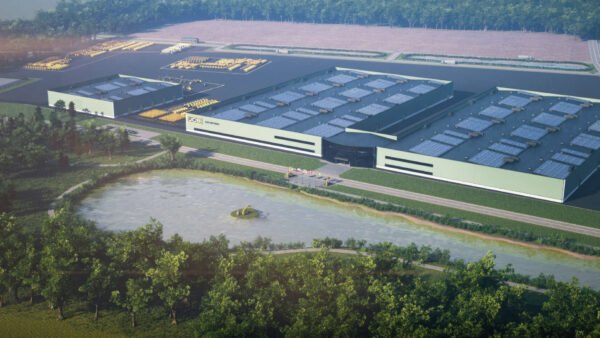
June 2026: When JCB first sketched plans for a factory in San Antonio, Texas, a 500,000-square-foot plant seemed ambitious enough.
Then Donald Trump announced tariffs on imported goods, and JCB tore up the blueprint.
The new number was 1 million square feet — making this not just JCB’s largest American facility, but the single biggest investment in the company’s 80-year history.
Today, structural steel is rising from a 400-acre site on San Antonio’s south side. The building taking shape will be JCB’s most automated factory anywhere in the world, producing Loadall telescopic handlers and aerial access equipment for the North American market.
And when production begins in October 2026, it will quietly rewrite JCB’s global supply chain: instead of building machines in Britain and shipping them west, JCB will build them in Texas and ship capacity the other way.
A Bet on North America, Long Before the Tariffs
To understand the San Antonio factory, you have to go back further than April 2025, when JCB formally announced it was doubling the facility’s footprint in response to the Trump administration’s tariff regime.
The groundbreaking happened in June 2024, and preconstruction began in February of that year — well before tariffs entered the conversation.
“Construction equipment manufacturers sell more than 300,000 machines every year in North America, making it the single largest market in the world,” chairman Lord Bamford said at the groundbreaking. “JCB has been growing its share of this important market steadily over the past few years and the time is now right to invest.”
JCB’s North American headquarters has been in Savannah, Georgia, since 2001, employing around 1,000 people.
The San Antonio plant will add 1,500 jobs over five years, effectively tripling the company’s US workforce.
Richard Fox-Marrs, president and CEO of JCB North America, notes that the Loadall telescopic handler — JCB’s top-selling product on the continent — and aerial access equipment make obvious candidates for local production: North America is the largest single market for both product lines worldwide.
The Tariff Accelerant
If the strategic logic predated tariffs, the tariffs certainly accelerated the ambition. When the Trump administration announced sweeping import levies in early 2025, CEO Graeme Macdonald acknowledged they would have a “significant impact” on the business in the short term. JCB’s response was not to wait and see — it was to double down.
The decision to expand the factory from 500,000 to 1,000,000 square feet was formalised in April 2025.
Ben Emery, JCB’s senior manager of engineering projects and the on-the-ground point person since preconstruction, frames the scale as consistent with a longer vision rather than a panicked reaction. The tariffs provided a catalyst; the conviction was already there.
The numbers make the logic clear. Currently, roughly 80% of what JCB sells in North America is imported.
Once San Antonio is fully operational, that figure is projected to reverse: 85% of North American sales will be manufactured locally.
That freed-up capacity at JCB’s UK plants, meanwhile, can be redirected toward growing European and export markets — a structural gain that has nothing to do with tariff arbitrage.
Engineering at Scale: What 1 Million Square Feet Looks Like
The sheer scale of the project deserves unpacking. One million square feet is roughly 17 American football fields under a single roof. Sited on 400 acres — an expanse of former San Antonio farmland — it will be JCB’s largest factory globally, second only to the company’s ancestral headquarters in Rocester, Staffordshire.
Before a single structural column went up, the groundwork was staggering. Site preparation moved more than 1 million tonnes of dirt and 119,000 tonnes of select fill. Nearly 19,300 linear feet of sewer, water, and storm drainage lines were installed.
R&S Excavation Ltd handled mass grading; Ella Contracting led utility work. Architectural design is being led by RVK, a women-owned Texas firm with a track record in large-format industrial projects.
Joeris General Contractors — a San Antonio-based construction manager at risk with deep roots in industrial work — was brought on at what they describe as the “napkin-sketch stage.”
Rusty Medlin, Joeris vice president of industrial, says that early involvement shaped everything: the site layout, construction sequence, and the ability to absorb the footprint expansion without derailing the schedule.
By October 2025, the project had gone vertical. Structural steel and building envelopes were climbing out of the ground on schedule.
The factory is designed to produce close to 150 machines per day at first-phase capacity, according to operations director David Carver — with infrastructure already in place for further expansion into additional product lines.
Automation: JCB’s Most Advanced Plant
What makes San Antonio notable is not just size, but sophistication. JCB describes it as the most automated factory in the company’s history — a significant claim for a manufacturer that operates 22 plants across the UK, India, Brazil, and China.
The facility’s welding shop is central to the production process. When hiring opens, welding is identified as a priority skill — reflecting the capital-intensive but labour-skilled nature of equipment fabrication.
The plant will have the infrastructure to expand into other product categories beyond telehandlers and aerial access equipment as production volumes and market demand justify.
A Ripple Effect Across the Region
JCB’s arrival in San Antonio is already generating secondary economic activity. The Greater San Antonio economic development body notes that the Toyota Motor Manufacturing Texas plant — which opened in 2006 — attracted at least 20 on-site suppliers and pulled a cluster of related manufacturers to the region.
JCB’s plant, officials suggest, could generate a similar gravitational effect for construction and agricultural equipment suppliers, including from northern Mexico.
Texas Governor Greg Abbott noted at the groundbreaking that the state had been named the best state for business for a record-breaking 20th year — a statistic JCB’s presence only reinforces.
Bexar County, where San Antonio sits, stands to gain 1,500 direct jobs and an unknown multiple in indirect employment from supplier relationships, logistics, and services.
What It Means for JCB Globally
JCB is a privately held British company — majority owned by the Bamford family — that turns over in excess of £4 billion annually and operates across construction, agriculture, and defence sectors.
It is not a publicly traded company obliged to explain every strategic move to quarterly-oriented shareholders.
That private ownership structure has, historically, allowed it to take longer-view bets than competitors constrained by capital market cycles.
San Antonio fits that pattern. The factory does not merely reduce tariff exposure. It repositions JCB as a genuine American manufacturer at a moment when “made in America” carries both political salience and commercial value.
Alice Bamford, daughter of the chairman, struck that note at the groundbreaking: “We’re not just going to be American-made, we’re going to be Texas-made. For the next 80 years, we’re writing the next chapters from here.”
For the heavy equipment industry globally, the factory signals something broader: that reshoring is not a short-term tariff dodge but a durable structural shift in where capital-intensive manufacturing happens.
JCB has committed $500 million and one million square feet to that thesis. By October 2026, it will have its answer.
Also Read
The Rise of Equipment Rental in Africa: Why Ownership Is Declining
The Hidden Cost of Poor Respiratory Protection on Construction Sites

- PV Guangzhou 2027 to Highlight Solar and Energy Storage Technologies - October 22, 2026
- Accurate and Reliable Measurement and Monitoring of Industrial Plant Water Treatment - October 21, 2026
- SODECA Highlights Industrial Ventilation Technology at Mega Clima Expo Kenya 2026 - October 14, 2026