
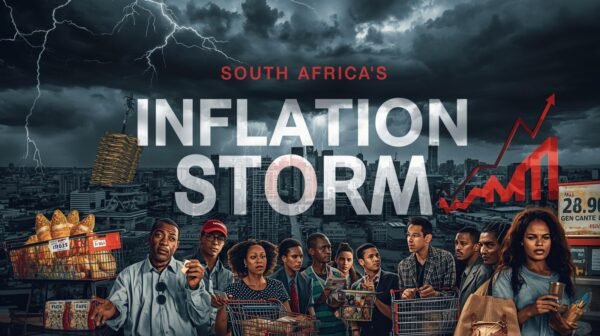
MAY 21, 2026-South Africa’s consumers are staring down a multi-front inflation crisis.
Official data released by Statistics South Africa (Stats SA) on 20 May 2026 confirmed that the headline consumer price index (CPI) jumped to 4.0% year-on-year in April — up sharply from 3.1% in March — driven primarily by one of the most severe monthly fuel price surges on record.
The April reading is the highest since August 2024 and arrives at a particularly sensitive moment: it marks the first full-month CPI print after the outbreak of the Iran war, which has sent oil prices surging and disrupted global shipping through the Strait of Hormuz.
It is also the first test of South Africa’s revised inflation targeting framework, adopted in November 2025, which set a tighter 3% point target with a ±1 percentage point tolerance band.
At 4.0%, South Africa is sitting at the very top edge of that band.
The South African Reserve Bank’s Monetary Policy Committee (MPC) meets on 28 May. Economists are increasingly pricing in a pre-emptive rate hike — a move that, just three months ago, would have seemed unlikely given that inflation had briefly touched the 3% target in February.
April 2026 CPI Breakdown: Category by Category
The following table, based on Stats SA data, captures the dramatic shift from March to April across key CPI categories:
| Category | March 2026 | April 2026 | Change |
| Transport | -1.6% | +4.9% | ▲ 6.5pp |
| Housing & Utilities | +5.1% | +5.2% | ▲ 0.1pp |
| Food & Non-Alcoholic | +3.6% | +2.9% | ▼ 0.7pp |
| Core CPI | +3.2% | +3.6% | ▲ 0.4pp |
| Headline CPI | +3.1% | +4.0% | ▲ 0.9pp |
Source: Statistics South Africa (Stats SA), May 2026. pp = percentage points.
The transport category’s swing — from deflationary territory (-1.6% in March) to a 4.9% year-on-year increase in April — tells the core story.
This was not a gradual drift; it was an abrupt shock, with fuel prices rising 18.2% on a month-on-month basis in April alone, the steepest single-month jump since the current CPI measurement framework was introduced in 2008.
“Consumer inflation jumped to 4.0% in April from 3.1% in March, driven mainly by sharp fuel price increases. This is the highest inflation print since August 2024. — Statistics South Africa, May 2026”
The Fuel Shock: Iran’s War Reaches South African Petrol Stations
The proximate cause of the April CPI spike is unmistakable: South Africa’s petrol price rose by R3.06 per litre and diesel by R7.33 per litre in April, in direct response to the disruption of oil shipping through the Strait of Hormuz following the outbreak of the Iran war.
These were not administrative adjustments — they were pass-throughs from a global oil market thrown into turmoil.
The impact cascaded immediately through transport costs. Air fares, taxi fares, and long-distance bus fares all surged.
For the construction and heavy equipment sector — which relies heavily on diesel for machinery, plant operations, and logistics — this is particularly damaging.
Diesel, now over R7 per litre more expensive than a month earlier, is a direct input cost for every excavator hour, every truck delivery, and every concrete pour on a South African site.
May’s numbers will be worse. Petrol rose a further R3.27/litre and diesel another R6.19/litre in May. Global oil prices remain elevated with no resolution to the Iran conflict in sight.
Economists at Standard Bank, Investec, and other major institutions are warning that the April data has not yet captured the full second-round effects — the pass-through of higher transport and energy costs into the prices of every other good and service.
Three Converging Threats: War, El Niño, and Municipal Rate Hikes
What makes this inflation cycle structurally different from a simple fuel spike is the convergence of three simultaneous pressures that interact and amplify one another:
| Three Forces Driving South Africa’s Inflation Surge |
| • 1. Iran War & Oil Prices — Disrupted Strait of Hormuz shipping driving global crude higher; R10+ per litre combined petrol/diesel hikes in April–May 2026 |
| • 2. El Niño — A potential Super El Niño developing; drought risk for Southern Africa threatens crop output and food prices in coming months |
| • 3. Municipal Rate Hikes — Electricity tariff increases already embedded in April data (Housing & Utilities: +5.2%); further hikes likely through 2026 |
Each force feeds the others. Higher fuel prices raise the cost of food production, processing, and distribution — putting upward pressure on food CPI, which currently provides a temporary cushion at 2.9%.
If El Niño reduces crop yields as feared, that cushion disappears.
And as municipal tariff increases filter through to commercial and industrial consumers, the cost base of virtually every South African business rises — ultimately passed on to end consumers.
Dr Elna Moolman, Standard Bank’s head of South Africa Macroeconomic Research, noted that while second-round effects were not yet fully visible in the April dataset — because such pressures take time to develop — they are already materialising in transport costs.
The concern at the Reserve Bank is that these pressures will broaden into core inflation — and core CPI has already moved higher, from 3.2% in March to 3.6% in April.
The Reserve Bank’s Dilemma: Hike Into a Struggling Economy
The SARB held its repo rate at 6.75% at both its January and March 2026 meetings — the second consecutive pause after a 25bp cut in November 2025.
At the time, inflation was on a downward trajectory and the Bank’s models were projecting gradual further easing. That picture has changed sharply.
Chief Investec economist Annabel Bishop has stated that the Bank is likely to pre-emptively hike interest rates by 25 basis points at the 28 May meeting.
A hike would push the prime lending rate from 10.25% to 10.50% — raising the cost of mortgages, vehicle finance, and business loans at a time when South Africa’s unemployment rate has already deteriorated to 32.7% in Q1 2026.
“The Reserve Bank may unfortunately hike interest rates to ensure that this increase under way in inflation will not lead to secondary inflation pressure. — Dr Elna Moolman, Standard Bank”
The rationale for a pre-emptive hike extends beyond domestic inflation control. A widened interest rate differential between the rand and the dollar would help support the currency, limiting the inflationary impact of rand weakness on imported goods — including fuel.
This is the classic central bank dilemma: using a blunt instrument to fight a supply-side shock, while knowing it risks suppressing already-weak demand.
What This Means for Construction, Infrastructure and Mining
For the sectors CCE News Africa covers closely, the implications of a sustained high-inflation, potentially rising-rate environment are significant:
- Diesel costs for plant and equipment operations are a direct hit to project margins. Contractors operating on fixed-price contracts signed before April face immediate cost pressure.
- Material costs — cement, steel, aggregates — all have fuel-sensitive transport components. Construction materials price inflation is likely to re-accelerate in the months ahead.
- A potential rate hike adds to the cost of project financing. Infrastructure projects that depend on variable-rate borrowing or contractor credit lines will feel the squeeze.
- Government infrastructure budgets are typically fixed in nominal terms. Rising input costs effectively reduce the volume of construction that public capital budgets can deliver.
- Mining operations, particularly those using heavy diesel-powered fleets, face similar margin pressure — at a time when global commodity prices provide limited cushion for many operations.
Outlook: More Pain Before Relief
The SARB’s own March 2026 forecasts — made before the full impact of April’s fuel hike was measured — projected headline inflation rising to around 4% in Q2 2026, before gradually easing back toward 3% by late 2027.
That was the optimistic scenario. The Iran conflict adding a prolonged supply shock, combined with a developing El Niño, means upside risks to that forecast are significant.
The key dates to watch: The MPC decision on 28 May will set the tone. If the Bank hikes, it signals that inflation has escaped its comfort zone and that further tightening cannot be ruled out.
If it holds, markets will look closely at the accompanying statement for any upward revision to the inflation forecast path.
Either way, South Africa’s consumers and businesses should plan for a cost environment that remains elevated through at least the end of 2026.
Also Read
South Africa’s July Fuel Cliff: What Construction Companies Must Plan For Now

- How They Were Built: Inside the Engineering of the Lesotho Highlands Water Project - October 11, 2026
- Africa’s Water Reuse Opportunity: Building the Infrastructure for a Water-Secure Future - September 28, 2026
- Why Water Reuse Is Becoming a Business Imperative for African Industry - September 28, 2026