
For more than a decade, renderings of gleaming towers, driverless shuttles and glass-walled data centres have accompanied almost every announcement of a new African city.
Few of those images have matched what eventually rose from the ground.
In 2026, the gap between the concept art and the concrete is the real story of Africa’s smart city movement, wide enough to sort the continent’s flagship projects into two clear camps: those where contractors are pouring foundations, and those that exist only as press releases.
That divide is not about ambition — every project examined here launched with comparable rhetoric about leapfrogging into a digital future.
What actually separated success from stagnation is far more mundane: financing structures, phased delivery, utility infrastructure, and whether a developer was disciplined enough to build roads and sewers before selling a vision.
State-led flagships: Konza and Cairo’s new capital
Konza Technopolis, Kenya
Overview: Konza Technopolis is Kenya’s flagship smart city project and the cornerstone of the country’s Vision 2030 strategy to build a knowledge-based economy. Located approximately 64 kilometres southeast of Nairobi, the 5,000-acre development is designed to become a hub for technology, innovation, research, education, manufacturing and digital services.
Latest progress: After years of gradual development, Konza has entered a more visible construction phase.
The Konza Technopolis Development Authority (KoTDA) has completed major horizontal infrastructure, including trunk roads, utility corridors, water reclamation systems and a Tier III National Data Centre serving both government agencies and private-sector clients.
The Konza Complex headquarters is fully operational, while affordable housing developments, educational facilities and healthcare infrastructure continue to advance.
Speaking recently, John Paul Okwiri, Chief Executive Officer of the Konza Technopolis Development Authority, said the project’s Export Processing Zone (EPZ) is emerging as one of its key economic drivers.
“The Konza EPZ is taking shape and is projected to create up to 10,000 jobs,” Okwiri said.
Investment: Konza has attracted significant public investment in core infrastructure while leveraging private-sector participation across commercial, residential and technology developments.
One of the landmark investments includes a South Korean-supported Digital Media City initiative valued at more than US$284 million, alongside continued investment in housing and digital infrastructure.
Why it matters: Unlike many proposed smart cities that struggle to move beyond planning, Konza has successfully established the essential infrastructure required to attract long-term private investment.
Government funding has focused on roads, utilities, digital infrastructure and public facilities, creating a platform for businesses, research institutions and property developers to build within the technopolis.
Challenges: Despite steady progress, Konza has developed more slowly than originally envisioned, and substantial portions of the master-planned city remain undeveloped.
Maintaining investor confidence, attracting anchor tenants and accelerating commercial development will be critical as the project moves into its next phase.
What’s next: The coming years are expected to focus on expanding the Export Processing Zone, delivering additional affordable housing, growing the innovation ecosystem and attracting more technology, manufacturing and research companies.
Continued infrastructure investment is also expected to strengthen Konza’s position as Kenya’s flagship smart city and one of Africa’s most ambitious technology-led urban developments.
Egypt’s New Administrative Capital
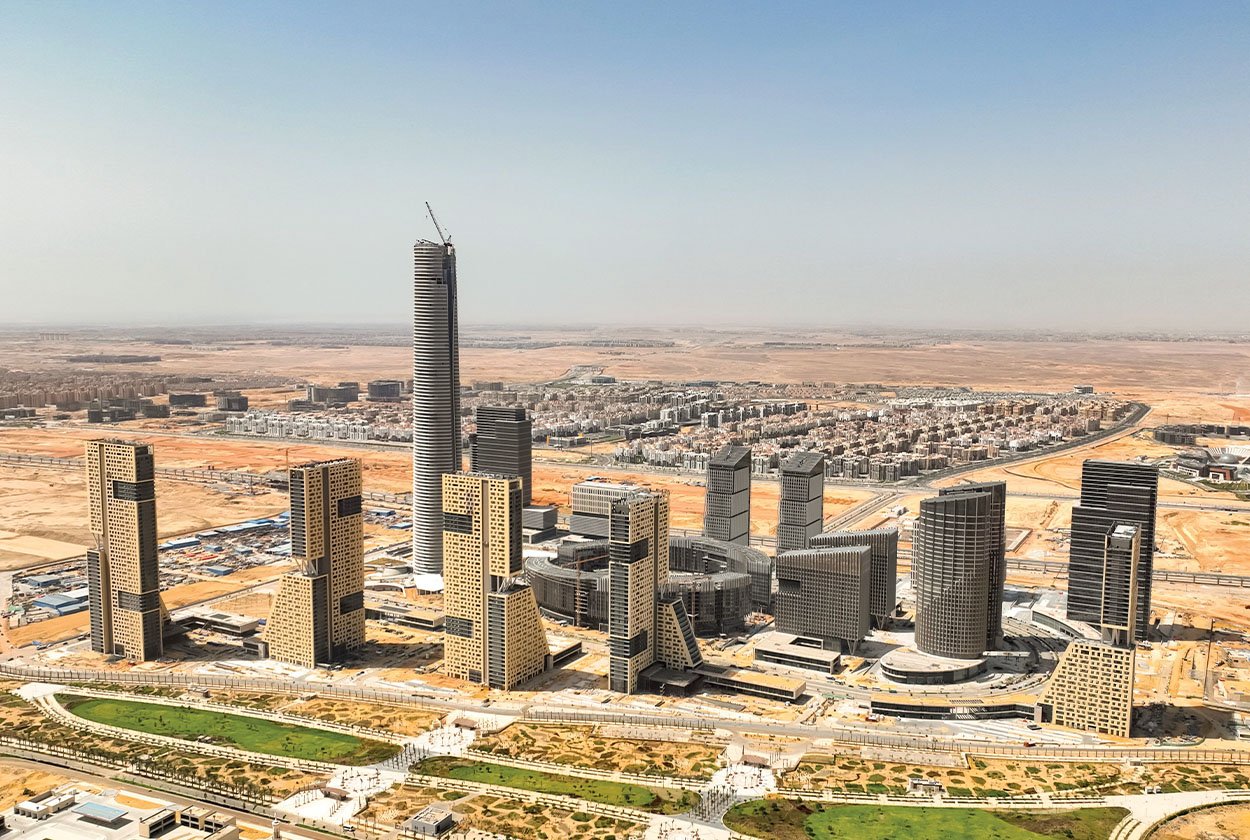
Overview: Egypt’s New Administrative Capital (NAC) is one of the world’s largest greenfield urban developments and the centrepiece of the country’s strategy to relieve congestion in Cairo while creating a modern administrative, financial and residential hub. Located approximately 45 kilometres east of Cairo, the city is designed to accommodate government institutions, businesses, educational facilities, healthcare services and millions of residents over several decades.
Latest progress: Construction has advanced rapidly across government districts, commercial centres and residential neighbourhoods.
Ministries and public agencies have relocated in phases, while the Central Business District continues to expand around the Iconic Tower, Africa’s tallest building.
Residential occupancy is also increasing. Khaled Abbas, Chairman and CEO of the Administrative Capital for Urban Development (ACUD), said during a recent television interview that the city is now home to more than 30,000 residents, with that figure expected to climb to between 50,000 and 60,000 by the end of the year as more homes are connected to essential utilities.
Investment: The New Administrative Capital represents one of Africa’s largest infrastructure investments, with development costs estimated in the tens of billions of dollars. The project is being delivered through the Administrative Capital for Urban Development (ACUD), with financing drawn from land sales, strategic partnerships and public-sector investment.
Why it matters: Unlike many large-scale urban developments, the New Administrative Capital has progressed from concept to occupation within a relatively short period. The relocation of government ministries and public institutions has helped establish the city as Egypt’s new administrative centre while encouraging private investment in commercial, residential and hospitality developments.
Challenges: Despite its rapid progress, the project continues to attract debate over affordability, long-term occupancy and the scale of public investment required. Questions remain about how quickly residential communities and private businesses will grow to match the city’s extensive infrastructure and government presence.
What’s next: Development will continue across residential districts, business parks, cultural institutions and transport networks as additional government agencies, companies and residents relocate to the capital. The next phase is expected to focus on increasing occupancy, expanding commercial activity and strengthening the city’s role as Egypt’s primary administrative and economic hub.
Private capital with its own discipline: Waterfall
Overview: Waterfall City is one of Africa’s largest privately funded mixed-use urban developments, strategically located in Midrand between Johannesburg and Pretoria.
Developed over more than two decades through a partnership involving the Waterfall City Landowners and multiple private-sector developers, the precinct integrates commercial offices, logistics facilities, retail centres, residential communities, healthcare, education and hospitality within a single master-planned environment.
Latest progress: Waterfall City retained its Best Masterplan Africa title at the 2026 International Property Awards. Construction continues on Gateway East, additional logistics facilities and new residential developments, while plans for a R750 million conference centre and hotel underline continued investment in the precinct.
In comments provided to CCE News, Willie Vos, CEO of Waterfall City Management Company, said the project’s vision has evolved significantly since development began.
“Since its inception, Waterfall City has been envisioned as a mixed-use development, but its master plan has evolved significantly in response to changing priorities and a deeper understanding of the site’s strategic potential,” Vos said.
He noted that earlier concepts, including a smaller shopping centre and golf courses, gave way to the development of Mall of Africa as a regional retail destination and a stronger focus on connectivity, accessibility and resilient infrastructure.
Investment: The wider development represents a cumulative investment estimated at more than R100 billion, making it one of South Africa’s most significant privately funded urban projects.
Attacq’s investment portfolio within Waterfall City alone is valued at approximately R14.3 billion.
Development partners: Waterfall City has been delivered through a partnership involving the Waterfall City Landowners and multiple private-sector developers operating under a shared master plan.
Attacq has developed a significant portion of the precinct’s commercial offices, retail and logistics assets, while Century Property Developments delivered the Waterfall Equestrian Estate, Waterfall Country Estate, Waterfall Country Village Estate, Waterfall Hills Mature Lifestyle Estate and Waterfall Valley Mature Lifestyle Estate.
Balwin Properties is developing The Polofields Waterfall, Kikuyu Waterfall and Munyaka residential estates, while Calgro M3 developed the affordable housing-focused Waterfall View estate.
The Waterfall City Landowners have also delivered key social infrastructure, including Netcare Waterfall City Hospital, Reddam House Waterfall, Curro schools, STADIO, a heliport, retail centres and supporting infrastructure.
Why it matters: Waterfall City demonstrates how coordinated private-sector investment can deliver an integrated urban district combining employment, housing, logistics, education, healthcare and retail.
Developed in phases over more than two decades, the precinct illustrates how multiple developers and landowners can contribute to a single long-term master plan while creating a balanced mix of residential, commercial and community infrastructure.
Vos said the project’s evolution has also been shaped by investment in digital and physical infrastructure.
“Although Waterfall City was not originally conceived as a smart city, the timely arrival of high-speed connectivity created an opportunity to incorporate the latest technologies and digital infrastructure into its planning. This enabled the development to embrace smart-city principles, enhancing efficiency, sustainability, and the overall experience for residents, businesses, and visitors.”
Challenges: Continued growth depends on sustaining demand for premium office, logistics and residential space while expanding supporting infrastructure. Maintaining resilient infrastructure and delivering new transport links will remain important as the precinct expands.
What’s next: Looking ahead, Waterfall City’s next phase will focus on improving transport connectivity and unlocking new development opportunities. According to Vos, completion of the K60 road and related infrastructure will pave the way for a future Gautrain station, sports facilities and a new transport-oriented development on the eastern side of the precinct.
“The completion of the K60 and other new road infrastructure are key development priorities over the next few years, as they will enable us to build a Gautrain station and other amenities such as sports facilities on the eastern side of Waterfall City, in a new Transport Oriented Development,” he said.
Reclaimed land, real buildings, real doubts: Eko Atlantic
Nigeria’s Eko Atlantic sits between these categories — genuinely under construction, but still short of the self-sustaining city its planners envisioned.
Land reclamation from the Atlantic Ocean is well advanced, with more than 80 percent of the site filled, and the protective Great Wall of Lagos has curbed the coastal erosion that motivated the project.
Towers are rising: Arkland Properties’ Phoenix Tower and A&A Towers, South Energyx’s mixed-use development The One, and FirstBank’s 40-storey headquarters are all active sites, and a large new US consulate compound under construction has added diplomatic weight to the district.
Luxury residential take-up has been healthier than sceptics expected, with developers reporting subscription rates around 50 percent on newer launches.
Yet independent assessments still describe large sections of Eko Atlantic as under-occupied relative to its master plan, with much of the announced pipeline still conceptual.
The project illustrates a pattern seen across the continent: a strong initial engineering achievement — marine works overseen by China Communications Construction Company and Royal Haskoning — does not automatically translate into a functioning urban economy.
Eko Atlantic is not stalled; it is slow, still years from the density and affordability needed to be more than a high-end enclave.
Modest, unglamorous, and finished: Vision City and Kigali Innovation City
Rwanda offers a useful counterpoint to the mega-vision model. Vision City, a 158-hectare residential development in Kigali’s Gacuriro area built by Ultimate Developers for the Rwanda Social Security Board, was never marketed as a “smart city” in the futuristic sense.
Its first phase of 504 units, completed in 2017, struggled initially — only around 140 had sold by 2020 — before price cuts and mortgage incentives moved the inventory.
A second phase of roughly 1,497 units is now under construction alongside the taller Kigali Green Complex nearby.
It is a modest, occasionally troubled project compared with Konza or Eko Atlantic, but it is finished, occupied and expanding — a reminder that “smart” is often less about sensors than about a functioning pension-fund balance sheet and a government prepared to backstop demand.
Kigali Innovation City, a $300 million, 60-hectare project co-sponsored by Africa50 and the Rwandan government, has taken a narrower but equally deliberate approach: build the anchor institutions first.
The African Leadership University, Carnegie Mellon University Africa and a University of Rwanda biomedical engineering centre are already operating on site, with construction of further innovation and office space continuing since works began in 2024.
It is a fraction of Konza’s scale, but its sequencing — institutions before infrastructure speculation — has kept it credible.
When the vision outruns the money: Hope City and Akon City
Two projects illustrate the opposite failure mode. Ghana’s Hope City, unveiled in 2013 as a $10 billion ICT park anchored by what would have been Africa’s tallest tower, never broke ground in any meaningful sense.
Its lead developer, RLG Communications, became mired in financial scandal, the original site was abandoned for a new one that also went nowhere, and by 2026 the project has no active construction timeline.
It stands as the clearest cautionary tale of the smart-city era: a launch event, celebrity endorsements and a striking rendering are not a delivery plan.
Senegal’s Akon City has now joined it. After nearly seven years in which the site produced little beyond a youth centre, a basketball court and a reception hall, the government’s tourism agency, Sapco, formally terminated the $6 billion crypto-powered city in 2025, reclaiming most of the allocated land for a smaller, conventionally financed $1.2 billion tourism development ahead of the 2026 Dakar Youth Olympic Games.
Akon has publicly acknowledged that the project was poorly managed. Its failure is instructive for a specific reason: it tied urban delivery to an unproven and, in Senegal’s CFA franc zone, effectively unusable currency, compounding ordinary construction-finance risk with a speculative one.
What actually separates delivery from vaporware
Set side by side, the successful and stalled projects point to the same handful of variables.
Financing structure matters more than headline investment figures: projects backed by a pension fund, a state development authority or a listed property group with recurring rental income (Vision City, Waterfall, Konza) have kept building through downturns, while those dependent on a single promoter’s ability to raise fresh capital (Hope City, Akon City) collapsed the moment that capital dried up.
Government support has to be structural, not ceremonial — gazetting land, building trunk roads and guaranteeing utilities, as Kenya and Rwanda have done, rather than simply attending a groundbreaking ceremony.
Infrastructure sequencing is the clearest technical signal of seriousness. Every project still standing in 2026 built roads, water, sewerage and power before marketing towers; every project that stalled tried to sell towers first.
Fibre and data-centre investment has become a parallel test of credibility — Konza’s national data centre, Tatu City’s colocation facility and Waterfall’s hyperscale campus all signal that developers now treat connectivity as core infrastructure, on par with roads and water, rather than an add-on.
Anchor investors — FirstBank and the US government at Eko Atlantic, Deloitte and BMW at Waterfall, FullCare at Tatu, Carnegie Mellon at Kigali Innovation City — have proven more reliable demand generators than retail pre-sales to individual buyers, which is precisely where Vision City initially struggled and where much of Eko Atlantic’s residential pipeline remains stuck.
Finally, market demand has to be realistic about who a city is for. Waterfall and Tatu succeeded partly because Gauteng and Nairobi already had the commuting, industrial and consumer base to fill logistics parks and factories quickly.
Hope City and Akon City assumed a global tech or crypto workforce would materialise around a rendering; it never did.
The construction reality behind the renderings
Strip away the marketing and every viable African smart city is, at root, a conventional heavy-civils project executed well: graded roads and interchanges, bulk water and reclamation works, sewer and stormwater networks, a fibre backbone laid in the same trenches as power cabling, and a phased electricity supply — increasingly with renewable and embedded generation, as at Tatu City, which now draws on-site renewables for the bulk of its power.
The buildings that follow are unremarkable by international standards; what is difficult, and what most failed projects skip, is the unglamorous utility work that has to be substantially complete before a single tenant moves in.
Contractors on the projects actually being built — from China Communications Construction Company’s marine works at Eko Atlantic to the local firms delivering Konza’s affordable housing blocks — are, in the end, doing ordinary infrastructure construction.
The “smart” layer of sensors, data platforms and digital governance sits on top of that base, and is only as credible as the civil works beneath it.
Africa’s Major Smart City Projects at a Glance (2026)
| Project | Country | Estimated Investment | Status (2026) | Main Focus |
|---|---|---|---|---|
| Konza Technopolis | Kenya | ~US$14.5bn (masterplan) | Under construction — horizontal infrastructure, data centre and affordable housing advancing | ICT, data centres, education |
| Eko Atlantic | Nigeria | Multi-billion (phased private investment) | Under construction — reclamation largely complete; towers rising | Financial district, luxury residential |
| Waterfall City | South Africa | Multi-billion rand | Substantially built and occupied; new phases continuing | Mixed-use development |
| Vision City | Rwanda | ~US$250m | Phase 1 complete; Phase 2 under construction | Upscale residential |
| Tatu City | Kenya | US$1.5bn+ | Under construction — businesses operating, expansion continues | SEZ, industrial, residential |
| Kigali Innovation City | Rwanda | ~US$300m | Under construction — anchor universities operating | Technology & research |
| New Administrative Capital | Egypt | Tens of billions | Government relocation progressing in phases | Government, finance, residential |
| Hope City | Ghana | US$10bn (announced) | Stalled indefinitely | ICT / technology park |
| Akon City | Senegal | US$6bn (announced) | Terminated in 2025 | Crypto-powered city (unrealised) |
Source: CCE News analysis based on official project updates, government announcements and publicly available project information (2026).
Masterplans are giving way to sequencing
Africa’s smart city story in 2026 is not one of failure or triumph, but of a market correcting itself.
The projects still standing — Konza, Waterfall, Tatu, Vision City, Kigali Innovation City, Egypt’s new capital — all abandoned, in practice if not in messaging, the idea of a single masterplan delivered in one leap.
They built horizontally before vertically, financed construction with income-generating anchors rather than speculative pre-sales, and treated connectivity and utilities as foundational rather than decorative.
The projects that collapsed did the opposite: they sold a finished vision before laying a road.
For Africa’s construction and engineering sector, the lesson for the years ahead is straightforward.
The next generation of urban megaprojects on the continent will be judged less by the scale of their renderings and more by the mundane metrics that have always determined whether a city gets built — utility capacity, phased financing, and a realistic account of who is actually going to live and work there.
And as one researcher puts it, “Smart cities in Africa struggle to advance primarily due to a severe lack of basic physical infrastructure, prohibitive borrowing costs and debt burdens, and a persistent disconnect between high-tech elite developments and the needs of an urban majority living in informal settlements.”
Also Read

She brings insightful analysis and in-depth reporting to the sector, highlighting innovations and developments that shape Africa’s built environment.
- Moldtech: Engineering Africa’s Next Generation of Precast Concrete Production - September 23, 2026
- How They Were Built: Inside the Construction of the Grand Ethiopian Renaissance Dam - September 4, 2026
- CNH Construction Sales Rise 12% as North American Demand Offsets Tariff Headwinds - August 3, 2026