

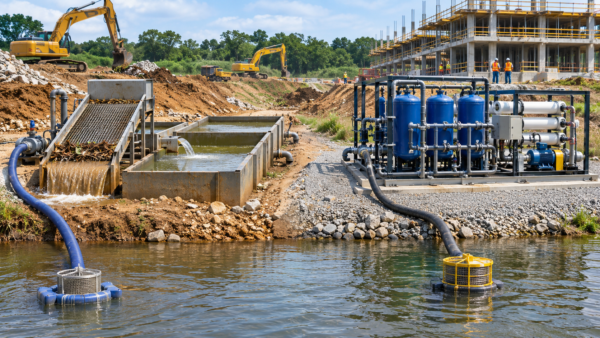
Two construction sites can draw water from the same source yet require different filtration setups. Debris loads and downtime limits can vary, so no single setup suits every process.
Looking at various supplier case studies demonstrates how particle size and operating constraints can shape filtration equipment design a nd fabrication.
The Process Comes Before the Equipment
The industrial water management publication Water Technology recommends establishing the operating parameters as the first step in filter selection.
Its cooling tower example illustrates why. Existing separators struggled with fine particles and variable flow, so the application required a different filtration technology. Several inputs define the operating requirements for custom industrial filtration systems:
- Fluid properties: The liquid’s viscosity and chemical composition establish the conditions that components must accommodate.
- Contaminant profile: Particle sizes and solids concentration describe the material entering the equipment.
- Hydraulic conditions: Required flow and operating pressure define the system’s expected operating range.
- Temperature: Normal temperatures and anticipated extremes form part of the equipment specification.
Available utilities and installation space further constrain the configuration. Access for servicing matters, as well as whether the process can stop for maintenance. A filter that meets the outlet quality target must still function within those operating limits.
Solids Load Shapes the Filtration Stages
One industrial process produced abrasive chunks alongside fine particles, creating different problems along the same flow path.
Large debris threatened the pump, while smaller particles required finer removal downstream. Industrial filtration solutions provider SC Industrial Sales developed a custom pumping and filtration system around both conditions.
The configuration began with an inlet filter that intercepted particles larger than 1/4 inch. SC Industrial Sales then selected an air-operated double-diaphragm pump capable of handling debris.
This arrangement accounted for both the material entering the pump and the solids that filtration would remove after pumping.
On the discharge side, the company installed a two-stage system using a 25-micron bag filter followed by a 1-micron depth filter.
The bag filter removed the initial solids before the fluid reached the finer depth filter. Each component occupied a specific position because the material required different handling before and after the pump.
SC Industrial Sales’ design connected pump selection with the full particle size range in the process.
The final filtration rating described the downstream requirement, but it could not address inlet protection or the pump’s debris handling duty.
For comparable dewatering or slurry applications, those upstream conditions can distinguish systems that otherwise share the same outlet filtration target.
Continuous Operation Requires a Different Filter Design
Repeated fouling forced a hydrogenation operator to stop production and open its sintered metal filters for manual maintenance. Process filtration equipment manufacturer DrM Group describes how the operator rented a CONTIBAC pilot unit to test whether filtration could continue without those interruptions.
The trial uncovered two problems. Hydrogen gas accumulated inside the filter, while tar deposits fouled the membrane.
The team added a gas purge loop and liquid flushing, resulting in a continuously operating filter that resolved the fouling without stopping the process.
At a separate new facility, another CONTIBAC installation encountered a different operating challenge. After 12 hours of filtration, pressure across the membrane began to rise. The installed backflush system restored flow while filtration continued. The customer later received a second system at another site.
In both installations, maintaining production required a way to restore filter performance during operation. The equipment’s ability to remove particles addressed only part of the requirement, since stopping for maintenance would interrupt the process it supported.
Site Constraints Shape the Treatment System
At the Plaquemines liquefied natural gas plant project in Louisiana, construction crews worked on saturated wetland beside the Mississippi River.
Hurricane Ida had flooded the site in 2021. Construction water systems provider Rain for Rent developed a construction water supply system to support dust control and concrete batch plants as work progressed.
River water passed through bag filtration and, later, sand filtration units before entering storage. From there, the water moved into trucks for use across the site.
The system supplied over 50 million gallons, drawing from the Mississippi River and the Parish water line as needed.
At this Federal Energy Regulatory Commission site, Rain for Rent also conducted daily equipment inspections.
Filtration formed one part of a water supply operation that included storage and distribution. The equipment had to fit the construction workflow, with access for servicing and attention to the surrounding environment.
Process Constraints Become a Supplier Brief
A brief translates these differences into requirements for filtration equipment design and fabrication. Suppliers of build-to-spec filtration equipment use those requirements to define each component’s role.
In the SC Industrial Sales example, the configuration addressed oversized debris upstream of the pump and finer particles after it. DrM Group’s cases centered on maintaining filtration through regeneration.
Rain for Rent integrated filtration with storage and construction water distribution. Each example explains a different reason for the resulting equipment arrangement.
A proposal is easier to assess when it explains why each component suits the process. It also needs to show how much the flow or solids load can change before the system needs modifications.
Those limits help project teams see whether future operating changes would require new equipment or further engineering.
Frequently Asked Questions on Process-Driven Filtration
Common questions about process-driven filtration include why designs differ and what happens when equipment does not suit the application.
Others concern maintenance signals, the information suppliers need up-front and whether a system can adapt as operating conditions change.
Why does the same industry need different filtration designs?
Processes in the same industry can handle different particle sizes or need different flow rates. Available power and the amount of downtime each process allows can also affect the equipment design.
What happens when a filtration system is not matched to the process?
A poorly matched system may allow abrasive debris to reach pumps or force a continuous process to stop for maintenance. Removing the required particles is only one part of the system’s job.
What signals that a filtration system’s backwash or changeout cycle needs attention?
A rise in pressure drop or shorter intervals between backwashes or filter changes can signal a change in performance. These trends help determine when maintenance needs attention, since the timing depends on the process.
What information does a filtration supplier need up-front?
Suppliers must know the fluid type and what particles the system must remove. They also need the required flow rate and pressure, temperature range and available power or compressed air. Space constraints and how long the process can be stopped for maintenance also affect the design.
Can a filtration system be adjusted as a process changes?
Some changes may fall within the system’s existing operating limits. Larger changes in flow or contaminant load may require equipment modifications or additional engineering.
The Filtration Setup Follows the Process
The right filtration setup depends on what enters the system and how the process runs. Project teams evaluating build-to-spec filtration equipment can document those conditions and ask suppliers to explain how each proposed component addresses them. Supplier proposals also need to make clear when maintenance will interrupt flow and what process changes would require equipment modifications.
Also Read
- Africa’s Water Reuse Opportunity: Building the Infrastructure for a Water-Secure Future
- Why Water Reuse Is Becoming a Business Imperative for African Industry
- Africa’s Water Reuse Opportunity: Why Treatment Plants Must Be Designed as Complete Systems

- Why the Right Filtration Setup Depends on What the Process Sends Through It - November 23, 2026
- How Wind Farms Affect Clouds: Scientists Discover a Two-Way Atmospheric Interaction - November 19, 2026
- Nigeria Accelerates Solar Mini-Grid Construction with New 17.7MW and 16MW Projects - November 13, 2026