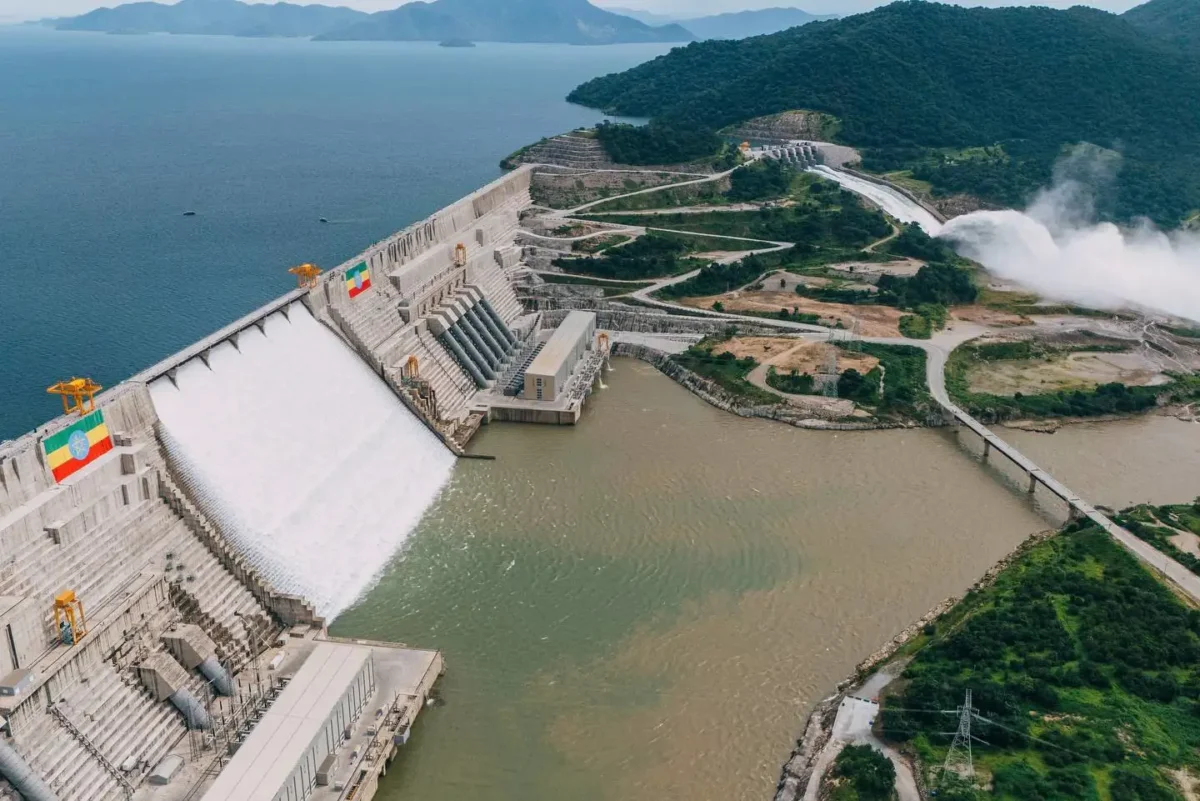
Building the Grand Ethiopian Renaissance Dam required far more than pouring millions of cubic metres of concrete.
Engineers first had to create roads, bridges and construction facilities in a remote part of western Ethiopia, excavate the foundations, control the Blue Nile and establish an industrial-scale system capable of producing and moving enormous quantities of aggregate and roller-compacted concrete.
Behind the finished structure was a vast fleet of excavators, bulldozers, dump trucks, crushers, batching plants, conveyors and heavy lifting equipment.
The Grand Ethiopian Renaissance Dam, commonly known as GERD, stands on the Blue Nile in Ethiopia’s Benishangul-Gumuz region, close to the country’s border with Sudan.
The project was launched in 2011 and became one of Africa’s most ambitious infrastructure developments, combining a massive concrete dam with powerhouses, water-control structures and a reservoir capable of storing around 74 billion cubic metres of water.
Today, attention naturally falls on the scale of the completed structure.
But the more revealing story is what happened before the reservoir could ever be filled: thousands of workers and a large construction fleet had to transform a remote river valley into a functioning industrial site capable of producing the materials needed to build the dam.
Building the site before building the dam
GERD was constructed in a relatively remote location, which created an immediate logistical challenge for the contractors.
Heavy equipment, fuel, cement, steel and other construction materials had to reach the site, while excavated rock and aggregate had to be moved continuously between different parts of the project.
The construction operation therefore began by developing the infrastructure needed to support the much larger work that would follow.
Roads were constructed around the site, a bridge was built across the Blue Nile and extensive facilities were established to accommodate workers and construction activities.
This early infrastructure was more than a supporting exercise. The roads became the arteries of the project, allowing excavators to feed dump trucks, trucks to move material to processing plants and processed aggregate to reach the concrete-production facilities.
In effect, the contractors had to build a temporary industrial city before they could build the permanent infrastructure that would eventually dominate the landscape.
Taking control of the Blue Nile
The next major challenge was the river itself. A dam cannot simply be constructed across a major river while the full force of the river continues to flow through the area where workers need to excavate and build.
Engineers therefore developed a diversion system that allowed the Blue Nile to be controlled while construction progressed.
The diversion works were central to the construction sequence because they created the conditions required for excavation and the construction of the main dam structures.
Controlling the river also meant working around highly variable flows. During the wet season, the volume of water moving through the river can increase dramatically, so the diversion system had to be designed as a major hydraulic structure in its own right.
The river diversion was therefore one of the first major demonstrations of the engineering principle that would define the entire project: before GERD could control the Blue Nile permanently, the construction team first had to control it temporarily.
Excavating the foundations
Once the construction area could be brought under control, excavation became one of the project’s major activities. The foundations had to be prepared to carry the enormous weight of the concrete structure and withstand the pressure generated by the future reservoir.
This required a combination of conventional earthmoving and specialist excavation techniques. Excavators and loaders handled loose material, while drilling and blasting were used where the construction operation encountered harder rock.
Large rigid dump trucks then transported the excavated material away from the working areas. Among the documented haulage equipment were ASTRA RD40 and RD50 rigid dump trucks, with capacities of approximately 40 and 50 tonnes.
The foundation works also involved specialised equipment for the dam’s cut-off system. Engineering documentation describes the use of clamshell excavation equipment and hydromills, allowing deeper excavation into competent rock and helping create the barrier needed to control water movement through the foundation.
Related Stories
- South Africa Has R395 Billion in Infrastructure Projects — But Can the Industry Deliver Them?
- Where Hyundai Is Winning the Excavator Race: The Markets Driving Its Global Growth
- Why US Contractors Are Still Struggling to Find Skilled Workers in 2026
- Africa’s Solar Boom Is Much Bigger Than Previously Thought
The heavy machines behind GERD
The scale of excavation and material movement required a substantial fleet of heavy equipment.
Caterpillar excavators, bulldozers and loaders were among the earthmoving machines associated with the construction operation, while the ASTRA rigid dump trucks provided the high-capacity haulage needed around the site.
The trucks were particularly important because almost every major stage of construction depended on material being moved efficiently.
Rock excavated from the foundation could be transported away from the work area, while material from quarry operations could be delivered to the aggregate-processing facilities.
The machine fleet therefore operated as a connected system rather than as isolated pieces of equipment. An excavator loading a truck was only the beginning of a chain that could eventually end with the same rock becoming part of the concrete structure.
This is one of the most interesting aspects of GERD from a construction-equipment perspective. The project depended not simply on having powerful machines, but on keeping hundreds of individual operations moving in sequence.
Turning rock into aggregate
One of the biggest industrial operations established at GERD was the aggregate-production system.
The main crushing plant was designed for a capacity of approximately 2,000 tonnes per hour, with an additional plant capable of processing around 400 tonnes per hour.
The system used primary, secondary and tertiary crushing stages followed by screening. This allowed the rock to be processed into carefully controlled aggregate sizes suitable for the roller-compacted concrete used in the main dam.
The importance of this operation cannot be overstated. The concrete structure depended on a continuous supply of correctly graded aggregate, meaning the quarry and crushing system effectively became the raw-material factory for the dam.
Conveyors were also an important part of the operation, with documented systems capable of handling up to approximately 1,500 tonnes of material per hour. Together, the crushers, screens, stockpiles and conveyors created a continuous flow of material from the quarry to the concrete-production system.
Manufacturing millions of cubic metres of RCC
The main dam was built predominantly using roller-compacted concrete, or RCC, a construction method particularly suited to very large gravity dams. Instead of relying on conventional concrete placement alone, RCC can be produced relatively rapidly, spread in layers and compacted using heavy rollers.
At GERD, this required concrete production on an industrial scale. Project engineering documentation describes two batching plants with combined mixer capacity of approximately 1,120 cubic metres per hour, allowing the construction operation to maintain a high and consistent supply of RCC.
The aggregate arriving from the crushing plant had to be combined with cementitious materials and water in carefully controlled proportions. Temperature was another critical consideration because massive volumes of concrete can generate significant heat during curing.
Cooling facilities were therefore incorporated into the production system. Project documentation describes the RCC being cooled to temperatures of around 17°C, helping the construction team control the thermal behaviour of the enormous concrete structure.
A concrete operation working around the clock
The scale of the RCC operation was demonstrated dramatically in December 2014. The project achieved a peak placement rate of approximately 23,000 cubic metres of RCC in 24 hours, an achievement Webuild describes as a world record.
That figure is difficult to appreciate without considering what had to happen behind it. The quarry had to supply sufficient rock, the crushing plant had to process it, the batching plants had to maintain production and the transport system had to keep material moving to the dam.
Once the RCC reached the construction area, it had to be placed, spread and compacted in a controlled sequence. A breakdown or major interruption at one stage could have affected the entire production chain.
The record therefore represented much more than the capacity of a concrete plant. It demonstrated the ability of the entire construction system to operate continuously at an extraordinary scale.
Building the dam layer by layer
RCC construction depends on repetition. Concrete is placed in layers, spread across the working area and compacted using heavy rollers before the next layer is introduced.
The process gradually transforms thousands of individual placements into a single massive structure. Maintaining the required density, strength and consistency while working at high production rates requires constant quality control.
For GERD, this meant coordinating the aggregate-production facilities, batching plants, cooling systems, transport equipment and compaction operation. The dam could only rise as quickly as the slowest part of that chain allowed.
This is why the machinery story is so closely connected to the engineering story. The performance of the dam ultimately depended on the ability of the construction fleet and production plants to deliver consistent material day after day.
Heavy lifting inside the hydropower facilities
The main dam was only one component of GERD. The project also included powerhouses and the enormous mechanical and electrical equipment required to convert the energy of falling water into electricity.
This introduced another category of heavy construction equipment: cranes and specialised lifting systems. Project documentation identifies large gantry and overhead cranes, including equipment with lifting capacities reaching 500 tonnes.
Such equipment was required for handling major components associated with the hydropower facilities. Unlike bulk earthmoving, these operations demanded a combination of enormous lifting capacity and precise positioning.
The construction operation therefore changed character as the project progressed. Excavators and dump trucks dominated the early earthworks, crushers and batching plants became central to the dam construction, and heavy cranes became increasingly important as the power-generation equipment was installed.
The machine chain that built GERD
Looking at GERD as a single construction system reveals how closely each part of the project was connected. Excavators and drilling equipment prepared the site and foundations, while bulldozers, loaders and rigid dump trucks moved enormous quantities of material.
Rock then entered the crushing operation, where primary, secondary and tertiary crushers reduced it to controlled aggregate sizes. Screens, stockpiles and conveyors moved that material into the concrete-production system, where batching and cooling equipment prepared it for placement.
At the dam, the RCC was spread and compacted layer by layer until the structure reached its enormous final dimensions. Meanwhile, cranes and specialist installation equipment were being used elsewhere on the project to install the mechanical and electrical systems required for power generation.
It was this continuous chain of machines, people, materials and engineering decisions that ultimately made the dam possible.
GERD by the numbers
| Project element | Figure |
|---|---|
| Main dam length | Approximately 1,800 m |
| Main dam concrete | Approximately 10.7 million m³ |
| Reservoir capacity | Approximately 74 billion m³ |
| Primary crushing capacity | Approximately 2,000 t/hour |
| Auxiliary crushing capacity | Approximately 400 t/hour |
| Documented conveyor capacity | Up to approximately 1,500 t/hour |
| Combined batching mixer capacity | Approximately 1,120 m³/hour |
| Peak RCC placement | Approximately 23,000 m³/24 hours |
| Documented ASTRA dump trucks | 68 RD40/RD50 units |
| Documented heavy crane capacity | Up to 500 tonnes |
More than a concrete wall
The Grand Ethiopian Renaissance Dam is often described through its reservoir capacity, generating capacity and physical dimensions. Those figures explain the scale of the finished project, but they do not fully explain the construction achievement.
GERD was built through the coordination of a huge industrial operation in which quarrying, crushing, transportation, concrete production, cooling, placement and compaction all had to work together.
The project also required major river-diversion works, foundation engineering, access infrastructure and heavy mechanical installation.
For the construction-equipment industry, that is perhaps the most interesting lesson from GERD.
The dam was not built by one spectacular machine or one single construction technique, but by an interconnected fleet that turned raw rock from the surrounding landscape into a carefully engineered structure.
In the end, the most impressive machine on the project may have been the construction system itself.
We go behind the world’s biggest construction projects to uncover the engineering decisions, heavy machinery, technology and human effort that made them possible.
Also Read
- Mega Machines: Meet the Biggest Wheel Loaders Ever Built
- How They Were Built: Engineering Christ the Redeemer
- How They Were Built: Inside the Burj Khalifa

She brings insightful analysis and in-depth reporting to the sector, highlighting innovations and developments that shape Africa’s built environment.
- Moldtech: Engineering Africa’s Next Generation of Precast Concrete Production - September 23, 2026
- How They Were Built: Inside the Construction of the Grand Ethiopian Renaissance Dam - September 4, 2026
- CNH Construction Sales Rise 12% as North American Demand Offsets Tariff Headwinds - August 3, 2026