

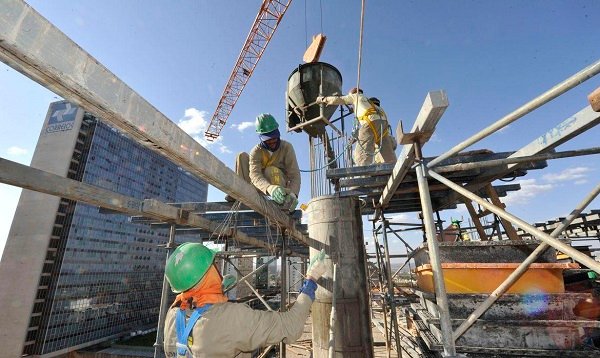
Brazil’s construction industry has entered a pivotal phase in 2026. After years of economic volatility, inflationary pressure and elevated borrowing costs, the sector is no longer driven solely by cyclical recovery.
It is being reshaped by long-term structural investment across transportation infrastructure, affordable housing, renewable energy, logistics, mining and industrial expansion.
As Latin America’s largest economy, Brazil combines a population exceeding 210 million, vast natural resources and rising demand for modern infrastructure — creating substantial opportunities for contractors, engineering firms, equipment manufacturers and institutional investors.
According to the Brazilian Chamber of the Construction Industry (CBIC), the sector continues to expand in 2026, though growth expectations have moderated due to persistently high interest rates and uncertainty around private investment.
Even so, activity remains supported by government infrastructure programmes, housing initiatives and private capital flowing into logistics, mining and energy.
The strongest catalyst is the federal government’s Novo PAC (Growth Acceleration Program), a multi-year programme modernising highways, railways, ports, airports, sanitation, hospitals, schools and energy infrastructure.
Combined with renewed investment in affordable housing through Minha Casa, Minha Vida, it is expected to sustain construction demand through the rest of the decade.
Demand composition is also shifting: traditional residential and commercial development is increasingly complemented by renewable energy, transmission networks, logistics parks, industrial facilities, mining and data centres — attracting both domestic and foreign capital.
For decision-makers, the question is no longer whether Brazil’s construction market is growing, but where growth is concentrated. The evidence points to infrastructure, logistics, industrial construction and clean energy outperforming cyclical residential demand.
Why Brazil Matters to the Global Construction Industry
Brazil’s importance extends well beyond South America. It has become an increasingly strategic destination for international contractors, engineering consultants, equipment manufacturers and infrastructure investors seeking long-term growth.
The country’s vast geography demands continuous investment in transport links connecting agricultural regions, mining operations, industrial centres and export terminals — Brazil is among the world’s largest exporters of soybeans, iron ore, beef, sugar and coffee.
At the same time, Brazil’s clean-energy transition is creating one of the world’s largest pipelines of renewable energy construction, from utility-scale solar and wind to transmission corridors and emerging green hydrogen projects.
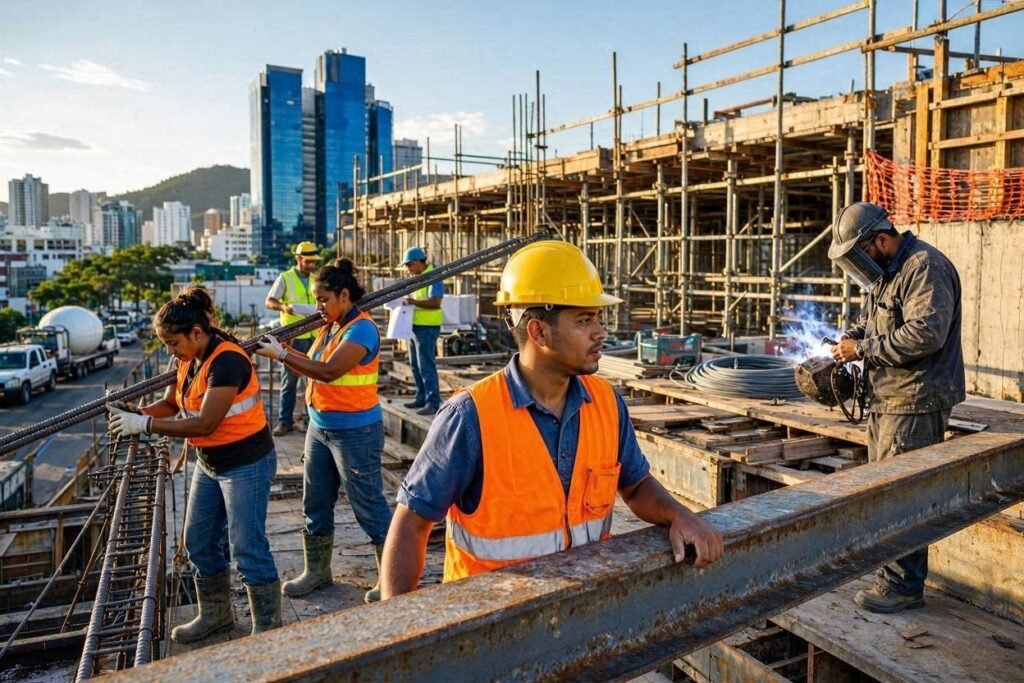
Urbanisation adds a further layer of demand: despite Brazil already being highly urbanised, demographic growth continues to drive residential, public transport, sanitation and mixed-use commercial development.
International investors are taking notice too. Large concession programmes, public-private partnerships (PPPs) and infrastructure auctions are opening roads, airports, ports, water utilities and energy transmission to private capital — diversifying project financing beyond public expenditure and sharpening competition among global engineering and construction firms.
Unlike many emerging markets that depend on a single sector, Brazil’s construction industry is powered by multiple investment engines simultaneously—including infrastructure, agribusiness, mining, manufacturing, renewable energy and urban development.
This diversified investment base makes the industry more resilient to sector-specific downturns while positioning Brazil as one of the world’s most strategically important construction markets over the coming decade. For contractors, equipment manufacturers and investors, the breadth of opportunities reduces reliance on any single market segment and supports long-term business growth.
Related News
Five Forces Reshaping Brazil’s Construction Industry in 2026
1. Government Infrastructure Spending Is Creating a Multi-Year Pipeline
Novo PAC has become Brazil’s flagship investment initiative, bringing together thousands of projects across transport, logistics, energy, education, healthcare, sanitation and urban development, backed by roughly R$1.7 trillion in planned investment, much of it scheduled before end-2026.
Unlike earlier cycles focused mainly on roads, Novo PAC spans highway upgrades, railway expansion, port and airport modernisation, urban mobility, water and sanitation, schools, hospitals, energy transmission and digital connectivity.
This diversified pipeline helps contractors reduce dependence on any single segment while opening opportunities across civil, structural, electrical and specialised infrastructure work.
Its greatest value isn’t just the announced spend — it’s the visibility, letting companies plan fleet expansion, hiring and capital allocation over multiple years rather than reacting to short-term cycles.
2. Housing Remains the Foundation of Construction Activity
Residential construction still accounts for a substantial share of building activity, and government-backed programmes — chiefly Minha Casa, Minha Vida — remain critical for developers and material suppliers despite elevated borrowing costs.
The programme supports employment across the value chain, stimulates demand for cement, steel and finishing materials, and helps stabilise residential construction when higher-end and commercial development slows.
Affordable housing has effectively become one of Brazil’s most important economic stabilisers rather than purely a social policy.
3. Logistics Infrastructure Is Becoming a National Priority
Brazil’s position as a top exporter of agricultural commodities and minerals puts sustained pressure on its logistics network.
Soybeans from Mato Grosso, iron ore from Minas Gerais and Pará, and manufactured export goods all depend on efficient corridors, driving investment in highway duplication, freight rail, inland terminals, port expansion, intermodal facilities and airport cargo infrastructure.
Railway expansion is especially significant — new freight corridors under Novo PAC are expected to cut road dependence, lower freight costs and better connect agricultural and mining regions to ports.
Logistics projects are also a major driver of heavy equipment demand, benefiting both global manufacturers and local rental companies.
4. Renewable Energy Is Expanding the Scope of Civil Construction
Large-scale renewable investment now extends well beyond panels and turbines.
Every utility-scale project requires extensive civil works — site preparation, earthmoving, foundations, internal roads, drainage, substations, transmission infrastructure and worker accommodation — while national grid expansion demands thousands of kilometres of new transmission lines.
Renewable energy should no longer be viewed as part of the power sector alone; it has become a major, direct source of construction demand, particularly for contractors specialising in heavy earthworks, concrete foundations and transmission infrastructure.
5. Industrial Expansion Is Changing Construction Demand
Mining, food processing, automotive manufacturing, steel production and logistics operators continue investing in new capacity to improve productivity and support exports.
Contractors are increasingly delivering manufacturing plants, distribution centres, cold storage, processing plants, mining infrastructure, warehouses and industrial parks rather than office and retail developments — reflecting a national push toward industrial competitiveness, export capacity and supply chain resilience.
Several forecasts expect infrastructure and industrial construction to outpace traditional building segments through the rest of the decade.
Together, these five structural forces point to a fundamental transformation of Brazil’s construction industry. While residential construction continues to provide market stability, the strongest growth opportunities are increasingly concentrated in infrastructure, logistics, renewable energy and industrial development.
This diversified investment pipeline reduces reliance on any single source of demand, creating a more resilient market for contractors, equipment manufacturers and investors. For international companies, long-term success will depend on aligning with Brazil’s strategic investment priorities rather than pursuing isolated projects, positioning themselves in sectors expected to drive the country’s next phase of economic growth.
Infrastructure: The Mega Projects Driving the Boom
Novo PAC spans more than 20 sectors — transport, energy, urban mobility, housing, sanitation, education and healthcare — with roughly R$1.7 trillion envisaged from public and private sources.
Its significance lies not just in scale but in diversity: a broad pipeline of transport, logistics, energy and public infrastructure projects capable of sustaining demand across multiple construction disciplines.
Transport infrastructure is central to reducing Brazil’s high logistics costs. Road rehabilitation continues in agricultural regions to speed exports of soybeans, corn, sugar and beef, while freight railway projects aim to shift cargo from road to rail. Port capacity upgrades target larger cargo volumes and faster turnaround, and airport investment supports rising passenger and cargo traffic.
Railways have become a strategic priority given Brazil’s historical over-reliance on road freight.
Projects such as the West-East Integration Railway (FIOL) aim to strengthen links between mining regions, agricultural areas and export ports — particularly important for iron ore and agribusiness — creating demand for stations, bridges, tunnels, depots and signalling systems.
Ports and logistics investment includes terminal expansions, dredging, container facilities and intermodal connections, increasingly funded through concessions and PPPs that ease pressure on public finances, and involving complex marine engineering, piling and heavy lifting.
Urban infrastructure extends beyond transport to water supply, wastewater treatment, drainage, urban mobility, schools and hospitals. Sanitation is a particularly large long-term opportunity, with millions of Brazilians still lacking adequate water and sewerage access, and regulatory reform drawing growing private investment into water utilities.
Infrastructure projects are among the largest consumers of heavy construction equipment, and Brazil’s expanding project pipeline gives contractors greater confidence to plan capital expenditure, workforce development and fleet expansion.
Related Reading: For a detailed analysis of manufacturers, fleet trends, rental growth and machinery demand, read our companion feature:
Heavy Equipment Market in Brazil.
Residential Construction: Affordable Housing Anchors the Market
Residential construction remains the backbone of the industry, supporting millions of jobs and providing stable demand for contractors, suppliers and equipment manufacturers.
In 2026, demand for new homes stays fundamentally strong, driven by urbanisation, demographic growth and a persistent housing deficit — though elevated interest rates have raised borrowing costs and slowed parts of the private market.
CBIC notes housing remains one of the industry’s strongest pillars where government support offsets financing challenges, while the National Confederation of Industry (CNI) flags credit access and capital costs as the sector’s principal constraints.
The market is increasingly split between affordable housing, sustained by subsidised financing, and higher-value residential projects more exposed to interest rate swings.
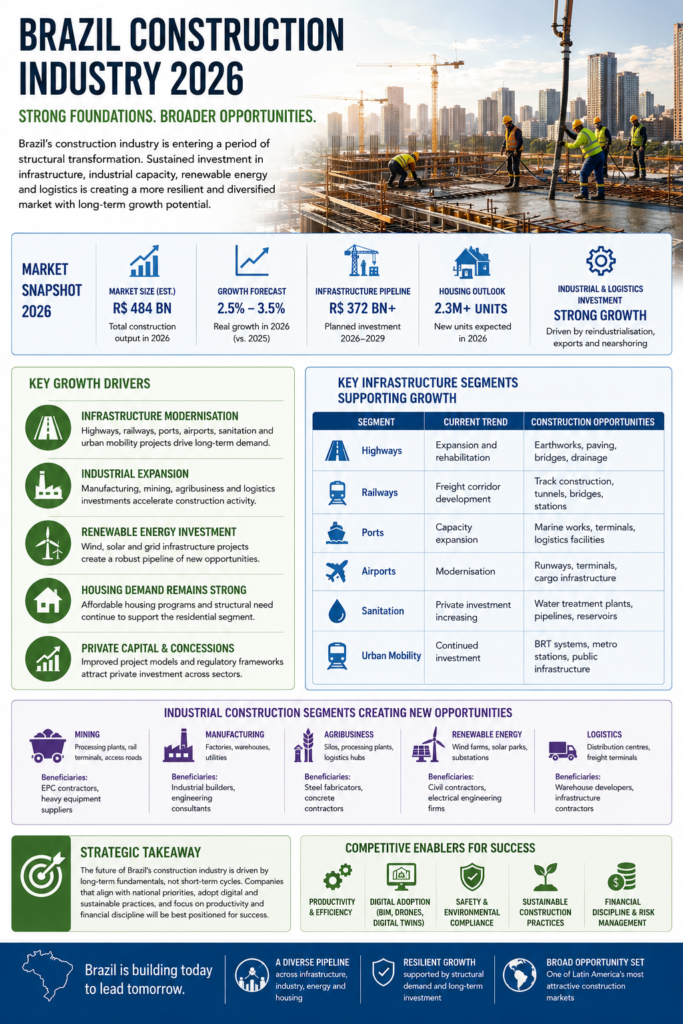 Minha Casa, Minha Vida remains the single most influential force in residential construction, expanding access to home ownership through subsidised financing and creating a predictable development pipeline nationwide.
Its multiplier effect reaches cement, steel, roofing, glass, aluminium, electrical and plumbing systems, and site preparation — supporting employment across manufacturing, logistics, engineering and construction services.
Functioning as a counter-cyclical mechanism, the programme helps sustain project pipelines and stabilise material demand even when commercial or luxury development slows.
Urbanisation continues to shape housing priorities, as population growth and migration toward metropolitan areas drive demand for apartments, mixed-use communities and developments integrating residential units with transport and commercial infrastructure.
Listed developers offer a useful read on market health. Companies including MRV Engenharia, Cyrela, Direcional Engenharia, Even Construtora, Cury Construtora and Tenda report continued demand in affordable segments while emphasising disciplined cost management, operational efficiency and selective land acquisition over rapid expansion — reflecting a more cautious industry posture after previous downturns.
Sustainability is also gaining ground as a competitive differentiator, with developers adopting energy-efficient designs, solar PV, rainwater harvesting, sustainable materials and green certifications — features increasingly valued for cutting homeowner operating costs and meeting ESG expectations.
Brazil’s housing market should not be evaluated solely through the lens of interest rates. While higher borrowing costs continue to influence private-sector investment, the country’s long-term housing demand remains fundamentally strong, supported by urbanisation, demographic trends and a persistent housing deficit.
Continued government commitment to affordable housing programmes provides an important buffer against economic volatility, helping sustain construction activity even during periods of tighter financial conditions. Companies that align with this structural demand while embracing modern construction methods, sustainability and operational efficiency are likely to be best positioned for long-term growth.
Mining, Industrial and Energy Construction: The New Growth Engine
Brazil’s next wave of growth is increasingly industrial. Mining, manufacturing, agribusiness and renewable energy are generating technically complex projects — processing plants, logistics hubs, manufacturing facilities and industrial infrastructure — demanding specialised engineering expertise and long-term capital.
Mining remains one of Brazil’s most equipment- and capital-intensive sectors.
As a leading global producer of iron ore and a growing source of critical minerals such as lithium and nickel, Brazil requires sustained investment in ore processing plants, tailings management, rail loading terminals, access roads and power distribution, alongside modernisation aimed at automation and environmental performance.
Projects typically span several years, generating recurring demand for equipment maintenance and technical support that makes the sector attractive for long-term contractor relationships.
Manufacturing investment is strengthening industrial construction across food processing, automotive, chemicals, steel and consumer goods, with companies modernising existing plants around automation and energy efficiency.
These projects typically require multidisciplinary engineering — structural steel, process piping, electrical installation and specialised concrete work — generating higher-value contracts than conventional commercial builds.
Agribusiness drives construction well beyond the farm gate, with rising investment in grain storage, silos, feed mills, fertiliser terminals, cold storage and export terminals that strengthen Brazil’s agricultural value chain and create steady demand for concrete, steel structures and bulk handling equipment.
Renewable energy projects combine traditional civil engineering — site preparation, foundations, roads, drainage — with advanced electrical infrastructure such as substations and transmission lines, alongside emerging investment in battery storage and green hydrogen.
Industrial clients are increasingly selecting contractors based on engineering expertise, digital project management, safety performance, environmental compliance and lifecycle cost—not price alone.
Technologies such as Building Information Modelling (BIM), drone surveying, digital twins and predictive maintenance are rapidly becoming standard on major industrial projects, helping improve productivity, reduce project risk and deliver better long-term asset performance.
Brazil’s construction market is increasingly defined not by how many projects are being built, but why they are being built. Investments linked to exports, energy security, industrial productivity and supply chain resilience are attracting sustained public and private capital because they strengthen the country’s long-term economic competitiveness.
For contractors, engineering firms, equipment manufacturers and investors evaluating Brazil, these strategically important sectors are likely to offer the most resilient long-term opportunities. Companies that align their capabilities with these national investment priorities will be better positioned to benefit from Brazil’s next phase of infrastructure and industrial growth.
Industry Challenges and the Outlook to 2030
Despite positive fundamentals, several structural challenges could shape the pace of growth.
Financing costs remain the most immediate concern — borrowing costs continue to influence commercial real estate and private residential investment, delaying launches and encouraging more cautious phasing.
Labour availability is tightening as infrastructure and industrial projects expand simultaneously, intensifying competition for engineers, project managers, equipment operators and skilled trades.
Environmental licensing remains a bottleneck for large infrastructure and mining projects despite efforts to improve regulatory efficiency, and material cost volatility in cement, steel, fuel and imported machinery continues to complicate budgeting.
Opportunities and Challenges Shaping the Industry
| Growth Drivers | Industry Challenges |
|---|---|
| Novo PAC infrastructure investments | High interest rates and financing costs |
| Affordable housing programmes | Skilled labour shortages |
| Mining expansion | Environmental licensing procedures |
| Renewable energy projects | Material price volatility |
| Logistics and export infrastructure | Regional infrastructure bottlenecks |
| Manufacturing investment | Productivity pressures and rising project complexity |
Brazil’s construction industry is supported by a diverse mix of firms.
In residential development, MRV Engenharia, Cyrela, Direcional Engenharia, Even Construtora, Cury Construtora and Tenda lead the market; in infrastructure and heavy civil engineering, Andrade Gutierrez, Novonor (formerly Odebrecht Engenharia & Construção) and Construcap remain active alongside numerous regional contractors, with growing investment industry-wide in BIM, sustainability and digital project management.
The medium-term outlook remains positive. Continued Novo PAC implementation, expanding renewable generation and transmission, logistics corridors supporting agribusiness and mining exports, industrial and mineral-processing growth, sustained affordable housing demand, and increasing private participation through concessions and PPPs are all expected to sustain activity through the decade — reinforced by Brazil’s natural resources, large domestic market and strategic position in Latin America.
Brazil’s construction industry in 2026 is characterised by structural transformation rather than cyclical recovery. While residential housing remains a critical pillar of activity, the market’s long-term trajectory is increasingly being shaped by infrastructure modernisation, industrial expansion, renewable energy and logistics development, creating a more diversified and resilient construction ecosystem.
For contractors, future competitiveness will depend on improving productivity, embracing digital construction technologies and maintaining financial discipline in a higher-interest-rate environment. Companies capable of delivering projects more efficiently while meeting increasingly stringent environmental and engineering standards are likely to gain a competitive advantage.
For investors, Brazil offers one of the broadest construction opportunity sets in Latin America, underpinned by long-term infrastructure programmes, expanding industrial capacity, renewable energy investment and continued demand for modern logistics networks. These structural growth drivers position the country as one of the region’s most attractive construction markets over the remainder of the decade.
Key Takeaways for Decision Makers
- Infrastructure remains the primary catalyst for long-term construction growth, supported by Novo PAC.
- Affordable housing continues to underpin market stability, providing consistent demand for contractors and suppliers.
- Mining, logistics and renewable energy are creating the fastest-growing engineering opportunities.
- Digital construction, automation and sustainability are becoming competitive differentiators, not optional investments.
- Brazil’s diversified project pipeline positions it as one of Latin America’s most attractive construction markets for contractors, equipment manufacturers, engineering consultants and long-term infrastructure investors.
Also Read
- US Construction Industry in 2026: Market Size, Spending, Equipment Trends and Major Projects
- Top Construction Machinery Dealers in South Africa: The Companies Powering Africa’s Largest Construction Market
- 0 Benefits of Smart Buildings: How Intelligent Buildings Are Transforming Commercial Real Estate

- Africa’s Water Reuse Opportunity: Building the Infrastructure for a Water-Secure Future - September 28, 2026
- Why Water Reuse Is Becoming a Business Imperative for African Industry - September 28, 2026
- Africa’s Water Reuse Opportunity: Why Treatment Plants Must Be Designed as Complete Systems - September 22, 2026