

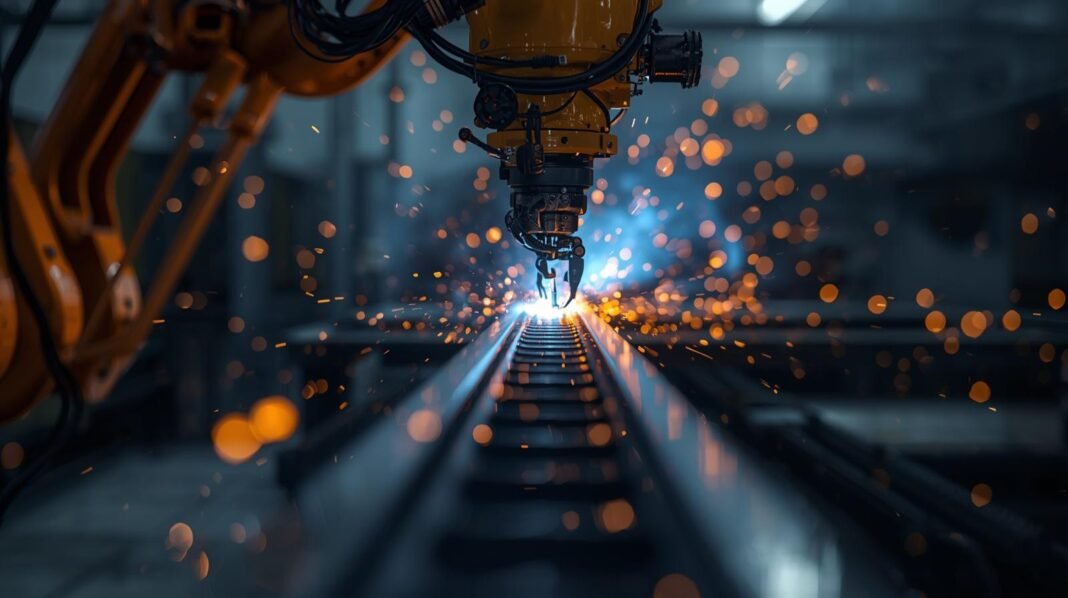
Walk into a modern structural steel fabrication shop today and you may be struck by what you do not see: rows of welders bent over I-beams in showers of orange sparks.
What you are more likely to find are robotic arms — multi-axis, sensor-rich, AI-guided — moving with unhurried precision along weld seams that once took a skilled tradesperson a full shift to complete.
This is not a distant vision. It is the reality of steel fabrication in 2026.
The transformation is being driven by a convergence of forces that, individually, would be significant, but together are proving irresistible: a deepening shortage of qualified welders, falling robot hardware costs, maturing artificial intelligence, and surging global demand for structural steel in infrastructure, renewable energy, and construction.
The result is an industry at an inflection point, where automation has shifted from a competitive advantage to a competitive necessity.
The Labour Crisis That Sparked the Revolution
No single factor has done more to accelerate robotic welding adoption than the collapse of the skilled welding workforce.
According to the American Welding Society’s October 2025 Workforce Digest, the United States faces a shortage of approximately 400,000 welders — an extraordinary structural deficit that is getting worse, not better.
More than 157,000 experienced welders are approaching retirement age, against an average welder age of around 55, compared with 42 for the broader U.S. workforce.
The industry will need to onboard 320,500 new welding professionals by 2029 just to cover attrition, demanding 80,000 new entrants annually.
ROBOTIC WELDING INDUSTRY SNAPSHOT
Key market figures shaping industrial welding automation in 2026
The consequence for steel fabricators has been severe: rising wages, mandatory overtime, declined contracts, and constrained output.
As one industry analyst noted, the question for fabricators has decisively shifted — it is no longer ‘Will automation pay back?’ but ‘Can we hire the operators we need next year?’
Cobots — collaborative robots that can work safely alongside humans without full safety caging — have emerged as a particular lifeline for small and medium-sized fabrication shops that cannot justify a full robotic cell.
Modern cobot welding systems can deploy and begin production on the same day they arrive, a dramatic improvement over the months-long installation timelines of traditional industrial robots.
One marine fabricator in New Jersey, DeAngelo Marine Exhaust, reported a tenfold increase in weld speed — from 2 inches per minute with TIG welding to 20 inches per minute with a cobot welder — on a Coast Guard order, paying off the entire system with a single contract.
The Technology Making It Possible
The robotic welding systems of 2026 bear little resemblance to the fixed, single-task automation of a decade ago. Four technology pillars are defining what is now possible.
1. AI-Powered Seam Tracking and Adaptive Control
Perhaps the most transformative development is the integration of deep-learning vision systems into welding robots.
Traditional robotic welding required extremely precise fixturing because the robot followed a pre-programmed path with no ability to adapt.
Today’s AI-guided systems use vision sensors with sub-millimetre accuracy to track weld seams in real time, automatically compensating for part-to-part variation, thermal distortion, and joint gaps.
Machine learning algorithms continuously refine welding parameters — voltage, wire feed speed, travel speed, arc gap — based on what the system observes during the weld itself.
The result is closed-loop quality control that was previously achievable only with highly experienced human welders.
Machine learning algorithms continuously refine welding parameters — voltage, wire feed speed, travel speed, arc gap — based on what the system observes during the weld itself. The result is closed-loop quality control that was previously achievable only with highly experienced human welders.
According to Universal Robots Vice President Anders Billesø Beck, AI-driven vision-guided seam tracking and machine learning-assisted parameter optimisation are already the defining technological shift in industrial welding, with the next frontier being complex, dexterous assembly tasks that have historically resisted automation.
2. Six-Axis Robotic Cells for Structural Steel
Modern structural steel applications demand robots capable of processing all four faces of a beam — including copes, notches, stiffener slots, and connection plates — in a single continuous workflow.
Six-axis robotic welding cells, now purpose-built for structural steel rather than adapted from automotive applications, can deliver deposition rates three to five times faster than a skilled manual welder, while maintaining weld defect rates below 1 percent on properly qualified procedures.
This matters enormously for fabricators producing bridge girders, high-rise steel frames, wind tower bases, and offshore structural modules — applications where every weld must meet rigorous codes such as AWS D1.1 (Structural Welding Code) and EN 1090.
A structural steel fabricator may produce 40 different beam cross-sections in a single week, each with unique connection plate and stiffener configurations. New-generation robotic cells handle this variety through offline programming and, increasingly, AI-assisted auto-path generation that scans component geometry and calculates weld paths without manual teaching.
3. Digital Twins and Virtual Commissioning
Before a single arc is struck, fabricators can now fully validate a new robotic welding cell inside a virtual environment.
Digital twin platforms — including Siemens Tecnomatix, Emulate3D, and NVIDIA’s Isaac Sim — enable robot trajectory simulation, tooling validation, PLC logic testing, and cycle time optimisation before physical build-out begins.
The business case for digital twins is strongest in high-utilisation cells, where unplanned downtime carries a steep cost.
Virtual commissioning also significantly compresses time-to-production for new product families.
According to industry automation specialists at Pemamek, pairing digital twin environments with offline simulation allows integrators to de-risk cell designs, reduce ramp-up time, and deliver measurable ROI improvements that would have been impossible with physical-only commissioning.
4. Intelligent Quality Monitoring and Data-Driven Fabrication
Welding accounts for approximately 23% of all industrial robot installations globally, according to the IFR World Robotics 2025 Report, and the share of new welding cells incorporating inline quality monitoring and AI vision inspection has grown substantially as affordable edge computing hardware has become available.
Fabricators supplying infrastructure and construction projects increasingly face contractual requirements for digital quality assurance logs — a demand that manual welding simply cannot meet at scale.
AI weld inspection systems now perform real-time analysis against ISO 5817 quality levels, flagging porosity, undercut, incomplete fusion, and geometric defects as the weld is deposited rather than after inspection downstream.
Payback on vision inspection hardware typically runs 12 to 18 months in medium-to-high volume production, driven by reduced scrap, lower rework costs, and reduced downstream non-destructive testing frequency.
Where the Transformation Is Happening
The adoption of robotic welding is not uniform across steel fabrication. Three sectors are experiencing the most dramatic transformation.
Infrastructure and Structural Steel
Bridges, highway overpasses, and rail infrastructure represent the most demanding structural welding environment — long seam runs, high-strength steel grades, strict code compliance, and zero tolerance for defects.
Robotic systems equipped with submerged arc welding (SAW) heads are increasingly the default for bridge girder fabrication, where consistent multi-pass weld quality over seam lengths of tens of metres is essential.
Vision-guided MAG systems manage long seam configurations while real-time feedback loops minimise weld discontinuities.
Renewable Energy Structures
Wind tower manufacturing has become one of the fastest-growing application areas for heavy-duty robotic welding.
A single onshore wind tower requires kilometres of weld seams on high-strength, rolled plate sections — precisely the kind of long, repetitive, high-quality welding that robotic systems execute with greater consistency than manual welders.
As governments worldwide accelerate wind energy deployment under net-zero commitments, wind tower fabricators are investing heavily in automated welding lines to meet contract volumes their existing workforces cannot deliver.
High-Rise and Commercial Construction
The construction sector’s demand for fabricated structural steel — columns, beams, moment frames, and connection assemblies — is both high-volume and high-stakes.
Column and beam production lines now frequently incorporate robotic welding cells that process standard profiles continuously, with programmable changeovers for different sizes.
Fabricators report that robotic cells on beam lines reduce labour costs per tonne of fabricated steel while simultaneously improving throughput consistency and reducing the rework that arises from welder fatigue on long shifts.
The Business Case: ROI That Fabricators Can Measure
The financial argument for robotic welding has become compelling across a broader range of shop sizes than ever before.
Hardware costs for industrial welding robots have fallen substantially over the past decade, while cobot welding systems now enter the market at price points accessible to fabricators of all sizes.
Typical robotic welding systems deliver 30 to 50 percent higher throughput than manual welding, with sub-1 percent defect rates.
Combined with the elimination of overtime premiums, reduced rework, lower consumable waste, and the ability to run lights-out or extended shifts, many fabricators achieve full payback within 12 to 24 months.
Vision inspection hardware adds a further 12 to 18 months to payback but delivers ongoing savings in scrap reduction and downstream NDT costs.
Importantly, automation does not eliminate welding jobs — it changes them. Experienced welders are transitioning into roles as robot operators, automation supervisors, and welding process engineers.
The AWS notes that workforce upskilling from welder to robot operator is a central workforce strategy across the industry, with vendors investing in operator-focused interfaces, digital training platforms, and certification programmes designed to meet welders where they are rather than demanding they become programmers.
Challenges and What Comes Next
Despite the remarkable momentum, adoption is not without friction. Structural steel fabrication is inherently high-mix: a shop producing custom building frames or bespoke bridge components may encounter dozens of unique weld joint configurations every week, challenging the repeatability that makes robots most efficient.
Early AI teach-free systems — which use 3D scanning to auto-generate weld paths — are addressing this barrier, but they remain an emerging technology requiring careful integration.
Workforce transition is also a genuine challenge. Automation requires a different skill set from the shop floor, and training programmes have not yet scaled to meet demand.
Fabricators that invest in structured operator training and digital learning platforms are reporting significantly faster ramp-up times and better sustained productivity from their robotic systems.
Looking ahead, the convergence of technologies gathering pace in 2026 — AI adaptive welding, digital twins, sensor-guided quality control, and collaborative robots — is widely expected to extend robotic welding into smaller-batch and higher-mix applications that were previously considered unsuitable for automation.
The market’s projected growth from $1.7 billion in 2026 to $2.62 billion by 2030 reflects not just continued adoption in existing applications, but the expansion of robotic welding into previously inaccessible territory.
Conclusion: Not a Question of If, but When
The transformation of steel fabrication by robotic welding is not a future event. It is happening now, at scale, across infrastructure projects, renewable energy installations, and commercial construction supply chains on every continent.
The combination of an acute skilled labour shortage, falling automation costs, and rapidly maturing AI technology has created conditions in which standing still is the riskier choice.
For fabricators that have not yet made a meaningful investment in welding automation, 2026 represents a critical inflection point.
Those who move early will build the operational knowledge, the workforce capability, and the customer confidence that will define competitive positioning for the decade ahead.
The arc of change in steel fabrication is bending unmistakably toward automation — and the welding robot is at the centre of it.
Also Read
Top Welding Certifications Required for Construction Projects in 2026
Best Permanent Jewelry Welder Machines for Small Jewelry Businesses in 2026

- Africa’s Water Reuse Opportunity: Why Treatment Plants Must Be Designed as Complete Systems - September 22, 2026
- From Operator to Algorithm: Bedrock Puts Autonomous Excavators to Work on Live Construction Sites - September 7, 2026
- Built For The Rough Stuff: Inside Titan’s new ForestEDGE™ Tyre Line - September 4, 2026
