

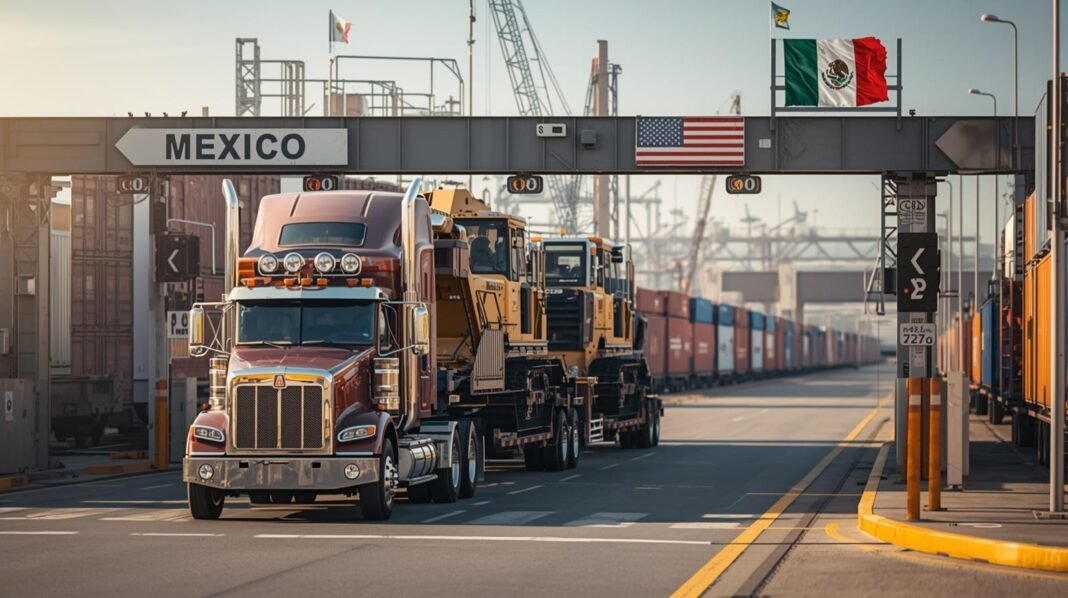
Two United States senators have called on the Commerce Department to open a national security investigation into the import of heavy construction equipment manufactured in Mexico by some of the industry’s biggest names, a development that could trigger sweeping tariffs and reshape procurement costs across the North American construction sector.
A Bipartisan Push Against Industry Giants
Senator Tammy Baldwin, a Democrat from Wisconsin, and Senator Bernie Moreno, a Republican from Ohio, sent a letter to Commerce Secretary Howard Lutnick on March 26, 2026, demanding a probe under Section 232 of the Trade Expansion Act of 1962.
The same legal instrument has already been used by the Trump administration to impose tariffs on steel, aluminum, automobiles, auto parts, timber, furniture, and trucks.
The senators specifically named Caterpillar, CNH Industrial, and John Deere as companies they believe have offshored American manufacturing jobs to Mexico while continuing to ship finished products back into the U.S. market under duty-free terms provided by the United States-Mexico-Canada Agreement (USMCA).
“We are outraged that John Deere, Case New Holland, Caterpillar, and other major manufacturers have turned their backs on the American workers, families, and towns that built them by sending production of heavy construction and agricultural equipment to Mexico,” the senators wrote in their letter.
What the Probe Would Cover
Baldwin and Moreno urged the probe to cover a broad range of product categories including construction and mining equipment, agricultural implements, forestry equipment, heavy machinery, parts, and derivatives.
For contractors, fleet operators, and equipment dealers, this scope means the investigation touches virtually every category of capital equipment used on job sites across the country.
If the Commerce Department launches the investigation and ultimately recommends tariffs, the cost implications for the construction sector could be significant.
Equipment manufactured in Mexico by Caterpillar and CNH would face new duties, potentially driving up purchase prices for excavators, motor graders, crawler dozers, skid steers, and a wide range of other machinery that forms the backbone of U.S. infrastructure and building projects.
Job Losses Cited as Evidence
The senators pointed to concrete examples of job displacement to support their case. CNH laid off 222 workers at its Racine, Wisconsin facility in 2024 while simultaneously relocating production to Mexico.
Baldwin and Moreno argued this pattern is emblematic of a broader industry trend in which manufacturers have eliminated American jobs, offered workers in Mexico wages far below U.S. standards, and then exported the finished machines back into the U.S. market without paying any import duties.
The senators stated that in recent years these large equipment manufacturers have offshored operations and laid off thousands of American workers while distributing billions of dollars in stock buybacks and shareholder dividends, a combination they characterized as unacceptable.
The USMCA Loophole Argument
A central argument in the senators’ letter is that the current USMCA framework contains a significant gap when it comes to heavy equipment.
Under the agreement, imports of heavy equipment can enter the United States from Mexico duty-free and without any rule-of-origin requirement.
The senators argue this has created a direct financial incentive for manufacturers to locate production in Mexico rather than in domestic facilities.
With the Trump administration scheduled to conduct a formal review of the USMCA in July 2026, Baldwin and Moreno are calling on the administration to use that window to close what they describe as a loophole.
They warned that any Section 232 tariffs imposed without corresponding USMCA reform would be weakened by the trade agreement’s existing provisions, leaving manufacturers with a viable route to continue importing from Mexico at low or zero cost.
Bipartisan Signal in a Divided Trade Landscape
The cross-aisle nature of this initiative is notable. Baldwin has been publicly critical of the Trump administration’s broad, sweeping tariff approach but has expressed support for more targeted interventions that address specific instances of industrial displacement.
Moreno, representing Ohio, a state with a deep manufacturing heritage, has aligned with her on the grounds that the heavy equipment sector has not responded to previous warnings despite the inclusion of some equipment components under existing steel and aluminum tariffs.
The timing of their letter was also deliberate. It was sent one day before President Trump was scheduled to host the CEOs of John Deere and CNH at the White House for National Agriculture Day, placing the issue squarely in front of both the executive branch and the targeted companies at a politically charged moment.
Industry Response and What Comes Next
At the time of reporting, CNH, Deere, Caterpillar, and the Commerce Department had not issued public responses to the senators’ letter.
Whether the Commerce Department opens a formal Section 232 investigation remains to be seen, but the bipartisan character of the demand and its alignment with the administration’s broader trade posture means the request carries real political weight.
For the construction industry, the trajectory of this probe deserves close attention. Equipment dealers and fleet managers would face potentially higher acquisition costs if tariffs are imposed, while domestic equipment manufacturers in states like Ohio, Illinois, and Wisconsin could benefit from restored production incentives.
The USMCA review in July will serve as the next major milestone in determining whether the senators’ demand translates into policy action.
Also Read
Can the Cat 707 Wide Body Truck Reduce Cost Per Ton in African Mining?
How Komatsu Is Building the Future of Autonomous Mining in Africa in 2026

- From Operator to Algorithm: Bedrock Puts Autonomous Excavators to Work on Live Construction Sites - September 7, 2026
- Built For The Rough Stuff: Inside Titan’s new ForestEDGE™ Tyre Line - September 4, 2026
- South Africa Has R395 Billion in Infrastructure Projects — But Can the Industry Deliver Them? - August 26, 2026
