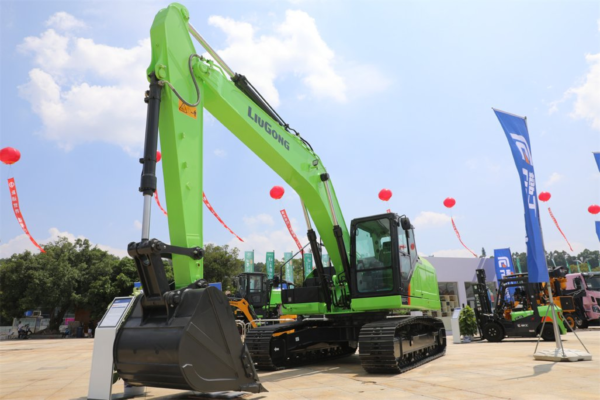
LiuGong is taking battery-electric excavators into a heavier class in North America with the launch of its 924FE, a roughly 27-ton electric excavator designed to bring zero-tailpipe-emission operation to applications traditionally dominated by diesel machines.
The move is significant because electric construction equipment has largely gained traction first in compact excavators, loaders and other smaller machines.
The 924FE pushes that technology into a machine size commonly associated with demanding earthmoving, infrastructure and heavy construction work.
LiuGong North America announced the commercial launch of the 924FE on August 11, 2026, adding the excavator to its growing battery-electric equipment lineup in the region.
The bigger question, however, is not whether LiuGong can build a large electric excavator.
It is whether a battery-powered machine of this size can compete with diesel excavators on the factors contractors care about most: productivity, uptime, operating cost, charging and flexibility.
The LiuGong 924FE at a glance
The 924FE is a heavy electric crawler excavator with an operating weight of about
28,100 kg (61,950 lb) in the standard specification. LiuGong’s published
specifications list a 165 kW rated electric motor, a 423 kWh LFP battery and a
1.0-cubic-metre standard bucket.
| Specification | LiuGong 924FE |
|---|---|
| Machine type | Battery-electric crawler excavator |
| Operating weight | 28,100 kg |
| Battery | LFP |
| Battery capacity | 423 kWh |
| Rated power | 165 kW |
| Standard bucket | 1.0 m³ |
| Bucket digging force | 153 kN |
| Arm digging force | 105 kN |
| Maximum digging reach | 9,890 mm |
| Maximum dumping height | 7,020 mm |
| Charging | DC fast charging |
| Claimed charging time | About 1–1.5 hours |
| Claimed runtime | 8–10 hours in North American launch material |
Specifications can vary by configuration and market. LiuGong’s global product information
lists 423/528 kWh battery options and 5–8 hours of runtime, while LiuGong North America’s
launch material cites an 8–10-hour runtime for the North American machine.
Why a 27-ton electric excavator matters
The significance of the 924FE goes beyond LiuGong.
A 27-ton-class excavator is not a niche piece of equipment. Machines in this category are used for major earthmoving and infrastructure work where contractors need substantial digging force, reach and sustained productivity.
That makes electrification considerably more difficult than it is with a compact excavator.
A small electric excavator can potentially return to a charger frequently or operate in applications where its battery capacity is easier to manage. A machine weighing nearly 28 tonnes has much greater energy requirements.
That is why the 924FE represents an important test of how far battery-electric construction equipment can move into mainstream heavy equipment.
LiuGong itself describes the machine as suitable for demanding applications, including tunnel work, where the absence of tailpipe emissions can be particularly valuable.
For contractors working in enclosed or emissions-sensitive environments, this could be one of the strongest arguments for electric power.
Related Articles
Battery power replaces the diesel engine
At the heart of the 924FE is a lithium iron phosphate, or LFP, battery system.
LiuGong lists a 423 kWh battery for the 924FE, while its global specifications also identify a 528 kWh option.
The machine uses a permanent-magnet synchronous motor and DC fast charging. LiuGong says the battery can be fully charged in approximately 1 to 1.5 hours under its specified fast-charging system.
That changes the operating model of the excavator.
Instead of bringing diesel fuel to the machine, contractors need to plan around electricity.
This creates both an opportunity and a challenge.
The opportunity is that electric equipment can eliminate diesel fuel consumption at the machine and remove tailpipe emissions during operation.
The challenge is ensuring that enough electrical capacity is available at the jobsite and that charging can be incorporated into the contractor’s working schedule.
Can the 924FE work a full shift?
This is arguably the most important question surrounding the machine.
LiuGong North America’s launch information says the 924FE has an 8–10-hour runtime, while LiuGong’s broader product specification gives a more conservative 5–8-hour operating range for the 423/528 kWh configuration.
Those figures should not be interpreted as a guaranteed eight or ten hours of continuous heavy digging.
Actual battery endurance can depend on the duty cycle, digging conditions, attachment, operator behaviour, ambient temperature, travel requirements and workload.
That distinction matters.
An excavator digging continuously in hard material can place very different demands on its battery compared with a machine performing lighter work or spending more time idling and repositioning.
For fleet managers, the question therefore becomes less about a single advertised runtime and more about how the 924FE fits into a complete shift cycle.
If a machine can work through the main portion of a shift and recharge during scheduled breaks, shift changes or other periods of downtime, electric power becomes considerably more practical.
The charging challenge
Charging infrastructure could ultimately be as important as the excavator itself.
A diesel excavator can be refuelled relatively quickly almost anywhere a suitable fuel supply is available. An electric excavator needs access to sufficient electrical capacity and an appropriate charging system.
For the 924FE, LiuGong specifies DC fast charging with a claimed full-charge time of roughly 1–1.5 hours.
That is potentially compatible with multi-shift operations where charging can be planned around production.
But contractors will have to consider more than the charging time.
They also need to consider:
- Available grid capacity
- Charger installation
- Temporary power requirements
- Electricity prices
- Site access
- Charging schedules
- Backup equipment
- Battery management
This means the transition from diesel to electric is not simply a matter of replacing one excavator with another.
It can require a change in the way an entire jobsite is planned.
Where the 924FE could have an advantage
The strongest applications for the 924FE may not necessarily be every conventional excavation project.
Instead, electric power could be particularly attractive in projects where emissions, noise and operating environment are major considerations.
Urban construction
Construction sites increasingly operate close to residential buildings, offices and other occupied areas.
Lower operating noise could make electric excavators attractive where contractors face restrictions or complaints related to noise.
Tunnelling and enclosed work
The absence of diesel exhaust is potentially even more important underground.
LiuGong specifically highlights tunnel applications for the 924FE.
Reducing exhaust emissions in enclosed environments can reduce the burden associated with ventilation and improve the working environment.
Infrastructure projects
Large infrastructure projects can provide a more controlled environment for charging infrastructure.
Where contractors operate fleets from a fixed location for extended periods, installing charging equipment may be easier to justify.
Emissions-sensitive projects
Some projects increasingly include environmental requirements in procurement and tendering.
An electric excavator could help contractors meet site-level emissions targets without sacrificing the digging capability associated with a much larger machine.
But diesel still has an important advantage
The arrival of the 924FE does not mean diesel excavators are suddenly obsolete.
Diesel remains deeply embedded in construction because the fuel infrastructure already exists and contractors understand how to operate and maintain diesel fleets.
A conventional excavator can also remain productive for long periods with relatively short refuelling stops.
That flexibility is particularly important for remote projects.
An excavator working several kilometres away from reliable electrical infrastructure faces a very different operating environment from one working on a major urban development with a high-capacity electrical connection.
This is where the 924FE’s commercial success will ultimately be tested.
The machine has to offer enough productivity and operating efficiency to compensate for the additional planning required around charging.
The economics could change the equation
One of the biggest reasons contractors are interested in electric construction equipment is operating economics.
Electric machines remove the need to purchase diesel for the machine itself and can potentially reduce some maintenance requirements associated with conventional internal-combustion powertrains.
However, it would be premature to assume that every electric excavator automatically costs less to operate.
The economic equation depends on:
Electricity price + charging infrastructure + machine acquisition cost + battery considerations + maintenance + utilisation
compared with:
Diesel price + fuel consumption + maintenance + machine acquisition cost + utilisation
The result can vary dramatically between projects.
A contractor with inexpensive electricity and a high machine utilisation rate may have a very different business case from a contractor operating in a remote location with expensive temporary power.
That is why the 924FE should be viewed as part of an evolving equipment ecosystem rather than simply a diesel replacement.
LiuGong is building an electric equipment portfolio
The 924FE is also significant because LiuGong is not approaching electrification with a single machine.
The company has been expanding its battery-electric portfolio across several equipment categories, including wheel loaders and material-handling equipment.
Its North American strategy therefore appears to be broader than introducing one electric excavator.
The company had already established a presence in North American electric equipment before the 924FE launch, and the new excavator expands the range into a substantially heavier machine category.
That could become important for contractors looking to electrify more than one machine type.
A fleet might eventually combine electric excavators, loaders and material-handling equipment around a common charging strategy.
The bigger competition is not just LiuGong versus diesel
The 924FE also arrives as global construction-equipment manufacturers increase their investment in electrification.
The competition will increasingly be between different approaches to powering construction equipment.
Diesel manufacturers still have decades of experience, mature dealer networks and established refuelling infrastructure.
Electric-equipment manufacturers, meanwhile, are betting that battery technology, charging infrastructure and lower-emission construction will become increasingly important purchasing factors.
Chinese manufacturers such as LiuGong, SANY and XCMG are also becoming increasingly visible in global construction-equipment markets, adding another layer to the competition.
For North American contractors, the eventual decision may therefore come down to more than brand preference.
It could be a choice between established diesel economics and a new electric operating model.
What could determine the 924FE’s success?
The machine’s specifications are important, but several other factors could ultimately determine whether contractors adopt it at scale.
1. Real-world productivity
Contractors will want to know whether the 924FE can maintain digging performance throughout demanding work cycles.
2. Battery endurance
Advertised runtime is useful, but fleet owners will pay closer attention to actual jobsite performance.
3. Charging availability
A powerful electric excavator is only as useful as the charging infrastructure supporting it.
4. Total cost of ownership
Purchase price, electricity, maintenance, battery life and residual value will all influence the business case.
5. Dealer and service support
Heavy equipment buyers need confidence that parts, technicians and technical support will be available when a machine is down.
6. Resale value
As electric construction equipment becomes more established, the secondary market will become an increasingly important factor.
Verdict: Can the LiuGong 924FE challenge diesel?
The LiuGong 924FE does not need to replace every diesel excavator to be considered a success.
Its bigger significance is that battery-electric technology is moving into a class of excavator where contractors perform serious, high-demand work.
At around 28 tonnes, with a 165 kW electric motor, 423 kWh battery and a 1.0 m³ standard bucket, the 924FE is clearly positioned as a serious working machine rather than a compact electric demonstrator.
Its North American launch also comes with a practical operating proposition: fast DC charging and a claimed runtime that LiuGong North America puts at 8–10 hours.
But the machine’s real challenge is not digging force.
It is uptime.
If contractors can charge the excavator reliably, integrate charging into their shifts and achieve competitive total operating costs, the 924FE could make electric power much more credible in the heavy excavator market.
If charging infrastructure proves too difficult or real-world battery endurance falls short on demanding applications, diesel will retain its advantage in many parts of the market.
Either way, LiuGong has raised the stakes.
The arrival of the 924FE in North America suggests that the electric excavator market is moving beyond compact machines and into the territory where construction fleets make some of their biggest equipment investments.
The question is no longer whether electric excavators can become heavy machines. The 924FE has already done that. The next question is whether contractors will decide they are ready to run them.
Also Read
- Where Hyundai Is Winning the Excavator Race: The Markets Driving Its Global Growth
- Caterpillar Posts Record Quarter as Construction Equipment Sales Surge 35%
- Wacker Neuson Expands South African Dealer Network to Strengthen Compact Construction Equipment Support
- Steinexpo 2026 Set to Roar as 21 Heavy Machines Take Center Stage in Europe’s Biggest Live Quarry Showcase

- SODECA Highlights Industrial Ventilation Technology at Mega Clima Expo Kenya 2026 - October 14, 2026
- How They Were Built: Inside the Engineering of the Lesotho Highlands Water Project - October 11, 2026
- Africa’s Water Reuse Opportunity: Building the Infrastructure for a Water-Secure Future - September 28, 2026