

Africa’s affordable housing programmes have never lacked ambition. Kenya wants to deliver 200,000 to 250,000 units a year.
Nigeria’s Renewed Hope Cities and Estates programme is targeting 100,000 homes across the country’s six geopolitical zones.
Rwanda is trying to add tens of thousands of units in Kigali alone as the city’s population is projected to more than double by 2050.
What every one of these programmes shares is a delivery problem: the traditional, brick-and-mortar construction model that built Africa’s cities over the last century is too slow, too labour-intensive and too exposed to material cost inflation to close housing deficits measured in the tens of millions of units.
That gap is why modular housing keeps resurfacing in policy documents, investor pitches and ministry press briefings from Nairobi to Lagos.
The question worth asking is not what modular housing is — most people in the built environment already have a rough idea — but whether it can genuinely move the needle on a housing crisis of Africa’s scale, or whether it remains a niche solution for pilot projects and worker camps.
This piece looks at the case for modular housing in Africa, the real projects already testing it, and the structural barriers that will decide whether it scales.
Africa’s Housing Challenge, By The Numbers
The scale of the shortfall is the starting point for any conversation about construction methods.
Industry estimates put Africa’s housing deficit at more than 50 million homes, driven by an urban population that is growing faster than almost anywhere else in the world.
Kenya alone faces an annual housing demand of around 250,000 units against a formal supply of roughly 50,000 units a year, leaving a deficit that is overwhelmingly concentrated in the low-income segment.
Nigeria’s housing deficit is estimated at around 17 million units.
In Rwanda, Kigali’s population is projected to grow from about 1.6 million today to 3.8 million by 2050, a trajectory that requires tens of thousands of new units every year just to keep pace.
Governments have responded with flagship programmes: Kenya’s Affordable Housing Programme under the Bottom-Up Economic Transformation Agenda, Nigeria’s Renewed Hope Cities and Estates, South Africa’s long-running RDP and social housing schemes, Egypt’s large-scale desert-city housing developments, and Rwanda’s Green City Kigali project.
Nearly all of these programmes carry annual delivery targets that traditional site-built construction has struggled to meet — not because the political will is absent, but because conventional construction is constrained by three things at once: skilled labour shortages, rising material costs, and construction timelines that stretch from months into years on large multi-block developments.
Kenya’s own Affordable Housing Programme illustrates the gap between ambition and delivery: an annual target of 200,000-250,000 units against roughly 112,000 units completed or under development since the programme’s launch.
This is the backdrop against which modular and offsite construction methods are being evaluated — not as a novelty, but as a possible way to compress delivery timelines and stretch limited housing budgets further.
What Is Modular Housing?
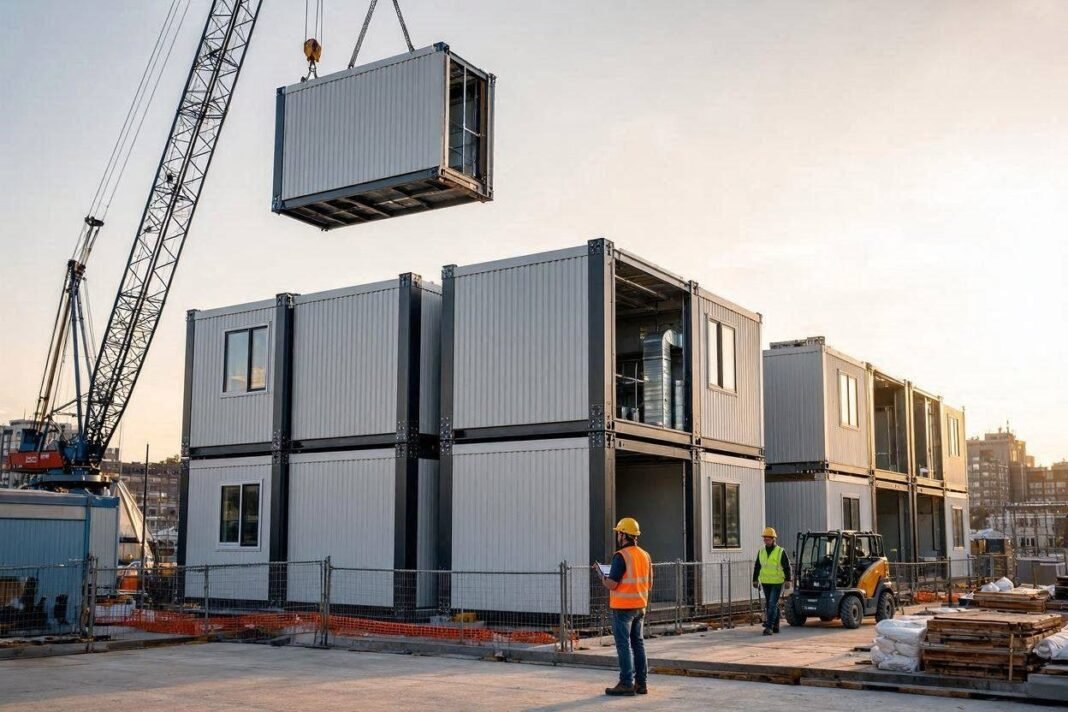
Modular housing refers to homes built as complete, three-dimensional sections — modules — inside a factory, then transported to site and craned into place, stacked, and connected to services.
It sits within a broader family of offsite construction methods that also includes panelised (or “panel and frame”) systems, where flat wall, floor and roof panels are factory-made but assembled on site, and prefabricated components, where individual elements such as bathroom pods, staircases or precast concrete slabs are manufactured off-site and integrated into an otherwise conventional build.
The distinction matters for procurement and regulation. Full volumetric modular construction shifts the largest share of labour and value into the factory, which is where most of its time and cost advantages come from.
Panelised and component-based prefabrication offer a lighter-touch entry point that is easier to introduce alongside existing local trades and supply chains — often a more realistic starting point in markets where a factory-based modular industry does not yet exist.
Conventional construction, by contrast, keeps essentially all fabrication and assembly on site, sequentially, exposed to weather, logistics and labour availability.
Why Modular Housing Is Gaining Attention
The case for modular construction rests on a set of operational advantages that compound on large housing programmes rather than single buildings.
Speed
- Factory modules can be produced in parallel with site preparation and foundation works, rather than in the strict sequence conventional construction requires.
- Assembly on site is measured in weeks rather than the months typically needed for equivalent site-built blocks.
Cost and waste
- Industry figures from African prefabricated housing suppliers put factory-built homes at up to 30% cheaper than conventional construction, largely through standardised designs and bulk-optimised material use.
- Controlled-environment cutting and assembly reduces offcuts and material wastage compared with open-site building.
Quality and safety
- Factory conditions allow tighter tolerances, more consistent workmanship and easier quality inspection than an open construction site.
- Less on-site work at height and in variable conditions reduces exposure to the accidents that drive site injury rates.
Weather and programme certainty
- Factory production is largely insulated from the rain delays that disrupt site-based construction during Africa’s wet seasons.
Scale and carbon
- Repeatable module designs are easier to scale across large developments of hundreds or thousands of units than bespoke site-built designs.
- Lower material waste and fewer site deliveries translate into a smaller carbon footprint per unit over the construction phase.
How Modular Housing Can Support Africa’s Affordable Housing Drive
The operational case for modular construction lines up closely with the constraints African housing programmes are actually running into: annual unit targets that outstrip site-based construction capacity, skilled-trade shortages, and budgets that need to stretch across hundreds of thousands of units rather than dozens.
| Country / Programme | Target or Scale | Where Modular Methods Could Help |
| Kenya — Affordable Housing Programme | 200,000-250,000 units/year target; ~112,000 completed or in development to date | Compressing delivery timelines on standardised bedsitter, one- and two-bedroom typologies used across county projects |
| Nigeria — Renewed Hope Cities & Estates | 100,000-unit target; 15,000+ units under construction nationwide | Repeatable estate layouts (250-1,000 units per site) suited to factory-produced, repeatable module designs |
| Rwanda — Green City Kigali / Kigali housing | 20,700 units/year needed; Kigali population to reach 3.8m by 2050 | Factory-built, green-certified units already piloted at multi-unit estates in Kigali |
| South Africa — social & RDP-style housing | Persistent multi-decade backlog across metros | Offsite panel and volumetric systems already used by local manufacturers for social and worker housing |
| Egypt — new desert cities | Large-scale, multi-hundred-thousand-unit developments | Standardised mass housing typologies suited to factory production at scale |
In each case, the appeal is less about any single technology and more about matching a manufacturing mindset to programmes that are, in effect, industrial-scale procurement exercises.
Where governments are already committing to standardised unit typologies — as Kenya has done with its bedsitter, one- and two-bedroom rent-to-own model — those designs are natural candidates for factory production, because the repeatability that makes a design easy to approve and finance is the same repeatability that makes it efficient to manufacture.
Real Projects Already Testing Modular Construction In Africa
Modular and offsite construction is not a hypothetical for African housing — it is already being deployed, in most cases through local or regional manufacturers rather than large state-run factories.
South Africa
South African manufacturers such as Afripanel and Zhauns are producing panelised and modular housing aimed squarely at the affordable segment, marketing factory-built units at costs the companies put at up to 30% below conventional construction, with delivery timelines measured in weeks.
These products range from single-unit homes to components for larger social housing developments, and increasingly include designs that let owners convert part of a unit into small business space.
Kenya
Kenya’s Affordable Housing Programme remains dominated by conventional multi-storey construction, but the programme’s reliance on standardised typologies across dozens of county-level projects — from Mukuru in Nairobi to Kiambu, Kisumu and beyond — creates an opening for offsite and panelised methods to be introduced within existing procurement frameworks, particularly for lower-rise blocks and worker accommodation on the larger sites.
Rwanda
Rwanda has the continent’s most visible modular housing case study to date: a multi-phase estate in Kigali built using patented, factory-made modular parts designed for “plug-and-play” assembly, ultimately delivering more than 2,000 affordable, green-certified units.
Separately, the Rwanda Green Fund has backed pilot work on low-carbon prefabrication systems, including a demonstration multi-storey building using alternative structural elements, in partnership with regional research institutions.
Ghana and Nigeria
In Nigeria, the scale of the Renewed Hope Cities and Estates programme — with more than 15,000 units under construction nationwide and a 100,000-unit target — has already attracted proposals from developers seeking to deploy industrialised and prefabricated construction technology under engineering-procurement-construction-and-financing arrangements, explicitly framed around cutting delivery timelines and reducing dependence on imported materials.
Ghana’s affordable housing pipeline has seen similar interest from panelised and prefab suppliers targeting government and private mass-housing tenders.
International Reference Points
Africa is not the first region to test whether industrialised construction can solve a housing shortage at national scale.
Sweden built its housing industry around factory production over half a century, and today roughly four in five detached Swedish homes contain prefabricated elements — a figure most other advanced economies have not come close to matching.
Singapore has taken the opposite entry point, mandating prefabricated bathroom units on all government housing projects since 2014 and pushing Prefabricated Prefinished Volumetric Construction into high-rise public housing, including what is billed as the world’s tallest modular residential tower.
Both cases point to the same lesson for African policymakers: modular construction scales fastest when it is backed by consistent government demand and standardised design codes, not left to prove itself project by project.
Challenges That Remain
A fair assessment of modular housing’s prospects in Africa has to weigh the barriers as seriously as the benefits.
- High upfront capital: setting up a modular factory requires significant investment before a single unit is sold, a hurdle in markets where construction financing is already expensive and scarce.
- Transport and logistics: moving large, heavy modules from factory to site is difficult on Africa’s road networks, and can erase much of modular construction’s cost advantage on remote or poorly connected sites.
- Regulatory gaps: building codes in many African countries were written for conventional masonry and concrete construction and do not yet have clear approval pathways for modular or volumetric systems.
- Financing and mortgage products: banks and mortgage lenders are often unfamiliar with modular construction, which can complicate valuations and end-user financing even where the units themselves are cheaper.
- Public perception: modular and prefabricated housing is still associated in many markets with temporary camps and site offices rather than permanent, high-quality homes, a perception gap manufacturers have to actively work against.
- Local manufacturing capacity: much of the modular housing marketed into Africa today is produced by manufacturers based outside the continent, which limits the local job creation and skills transfer that governments want their housing programmes to deliver.
None of these barriers is unique to Africa — they mirror the same regulatory and capital constraints that slowed modular adoption in the UK, the US and Australia.
But they are compounded on the continent by construction finance that is already scarce and by supply chains for structural steel, insulated panels and factory equipment that often have to be imported.
The Outlook
Africa’s urban population is not going to stop growing, and the political pressure on governments to show visible progress on housing delivery is not going to ease.
That combination favours construction methods that can be scaled quickly and repeated across many sites — which is precisely modular housing’s strongest argument.
The direction of travel elsewhere in the industry reinforces the case: digital manufacturing, building information modelling, and early moves toward robotics and automation in factory production are steadily lowering the capital cost of setting up modular plants, which should over time make local African manufacturing more viable than importing finished modules.
Modular construction is also likely to become one more tool inside a broader shift toward smarter, greener urban development across the continent — sitting alongside green building certification, smart city infrastructure planning, and early-stage experiments with 3D-printed housing, several of which are already running as pilot projects in Kenya and Malawi.
The realistic conclusion is not that modular housing will replace conventional construction across Africa.
Site-built masonry and concrete construction will remain the backbone of the industry for the foreseeable future, supported by an established base of contractors, artisans and material suppliers that no factory rollout will displace overnight.
But as a complement — deployed on the standardised, high-volume housing typologies that dominate government programmes — modular and offsite construction has a genuine role to play in closing the gap between Africa’s housing targets and what traditional construction alone can deliver.
Whether it fulfils that role will depend less on the technology itself than on whether governments write it into building codes, procurement frameworks and financing products with the same seriousness they have written their housing targets.
Also Read
- Construction pipelines set to grow but skills shortages a concern
- Top Robotic Welding Brands Leading Industrial Automation
- Skills shortages escalate construction cost globally-report

With years of experience covering infrastructure projects, equipment, and engineering solutions, Yvonne brings in-depth analysis and practical insights to contractors, engineers, and industry stakeholders.
She is passionate about highlighting sustainable construction practices and the latest advancements that drive efficiency and safety on worksites.
- Why America’s Grid Expansion Is Creating a New Construction Boom - July 31, 2026
- U.S. Housing Starts Surge 19% in June, Signalling Strong Construction Activity Despite Decline in Building Permits - July 23, 2026
- 10 Benefits of Smart Buildings: How Intelligent Buildings Are Transforming Commercial Real Estate - July 21, 2026
