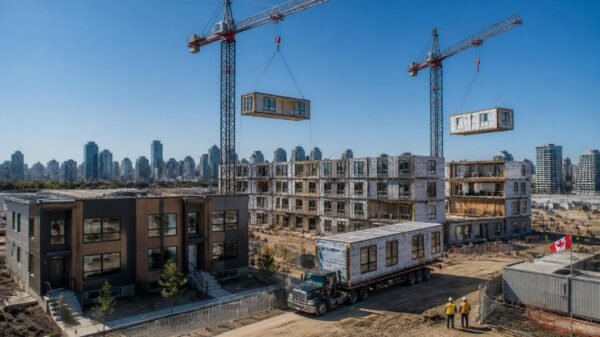
Canada’s modular construction sector has moved from the margins of the housing conversation to the centre of federal policy.
What was once pitched as a niche alternative to stick-built homes is now the delivery method Ottawa is betting on to close a housing gap the government itself has called a national crisis — and the numbers behind that bet are getting bigger by the month.
A Crown corporation is born
On June 19, 2026, Bill C-20, the Build Canada Homes Act, received Royal Assent, establishing Build Canada Homes (BCH) as a federal Crown corporation with a mandate to promote, support and develop the supply of affordable housing in Canada and to advance innovative and efficient building techniques across the sector.
BCH chief executive Ana Bailão called the milestone a step toward full implementation as a Crown corporation, while Housing and Infrastructure Minister Gregor Robertson framed the legislation as giving the agency the tools to scale up results across the country.
The transition isn’t instant. Further steps — orders in council, governance implementation, and leadership appointments — are still required before BCH becomes fully operational as a Crown corporation later this year.
But the direction of travel is unambiguous: modular and prefabricated construction now sits at the centre of a permanent, arm’s-length federal institution, not a temporary pandemic-era program.
BCH was first launched as a special operating agency on September 14, 2025, with an initial $13 billion in capitalization announced in Budget 2025.
In its first months alone, the agency advanced six Direct Build projects — in Toronto, Winnipeg, Edmonton, Ottawa, Dartmouth and Longueuil — and secured partnerships with the City of Ottawa, the provinces of Nova Scotia and Quebec, and a tripartite agreement with Nunavut and Nunavut Tunngavik Incorporated, together representing more than 7,500 new homes.
As a Crown corporation, the agency gains legislated authority to make equity investments and access additional financial tools, along with the power to absorb Canada Lands Company’s land holdings and development expertise to speed up delivery on public land.
Why Ottawa is betting on factory-built homes
The scale of the shortfall explains the urgency. CMHC estimated in 2026 that Canada must add 3.5 million housing units by 2030 just to restore affordability to 2004 levels — a target conventional site-built construction, constrained by permitting timelines and skilled-labour bottlenecks, has no realistic path to hitting on its own.
Factory-built methods offer a way to add capacity without waiting on greenfield investment: modular producers in Canada are currently running at only about one-third of installed capacity, meaning existing plants can absorb a large volume increase before anyone needs to build a new factory.
The productivity case is straightforward. Factory assembly shortens build cycles by 40–50%, a critical advantage in a country where winter weather restricts on-site activity to as little as eight months of the year in many regions.
Because on-site groundwork — foundations, utilities, grading — proceeds in parallel with off-site module fabrication, projects avoid the sequential delays that slow traditional builds, and modules that arrive with finishes and mechanicals largely complete can be craned into place and made weather-tight within days rather than months.
The regulatory bottleneck nobody has fully solved
The single biggest constraint on modular’s growth isn’t factory capacity — it’s approvals.
Municipal permitting processes across Canada were built around the assumption that every project is a unique, one-off design requiring individual review, even when a modular submission consists of repetitive, factory-certified units that have effectively already been engineered and tested.
That mismatch between industrialized production and case-by-case municipal review remains one of the sector’s most persistent drags on speed.
Ottawa has signalled it intends to address this at the code level. In the 2026 Spring Economic Update, the federal government committed to updating the National Model Codes to better support factory-built housing, including accelerating review and approval processes for innovative and prefabricated construction products and expanding the codes to support more flexible building options such as engineered wood.
In February 2026, the government also issued a request for information under the Build Canada Homes initiative seeking turnkey modular supply agreements, prioritizing modular and panelized suppliers under multi-year offtake contracts — effectively guaranteeing a baseline of demand that de-risks new plant investment.
The regional picture
Modular momentum looks different depending on where a contractor or supplier sits in the country.
British Columbia
BC has gone furthest on the regulatory side, enforcing zoning reform that compels every municipality to allow three to six units on formerly single-family lots by June 2026.
The province partnered with Ottawa on a CAD 810 million commitment to deliver 1,100 modular dwellings under the Digitally Accelerated Standardized Housing program, and a separate roughly USD 600 million provincial procurement package earmarks 400 stacked modular units — enough to lift plant utilization in the province from about one-third toward closer to half of installed capacity.
BC manufacturers also point to sustainability credentials — as much as 43% lower carbon emissions and up to 70% less construction waste than comparable site-built projects — as a selling point to environmentally minded municipal governments.
Alberta
Alberta is the volume-growth story, with the sector there projected to expand at roughly an 8% compound annual rate through 2031.
ATCO’s 230,000-square-foot Lethbridge plant anchors western Canadian production, supplying both prairie metros and resource-sector work camps.
Ontario
Ontario has combined federal Direct Build activity in Toronto and Ottawa with province-level support, including a $50 million commitment from the Ontario government specifically for modular housing technology.
The province is also home to one of the sector’s most closely watched equity stories: the Temiskaming Native Women’s Support Group is building a $20 million, Indigenous-women-led modular housing factory in Kirkland Lake, expected to open in July 2026 and intended to serve underserved First Nations communities in northern Ontario.
Atlantic Canada and the territories
These regions see lower absolute volumes but benefit from a different economic logic — single-trip delivery and rapid on-site assembly carry a premium where logistics, not labour, is the binding constraint.
Dartmouth’s Direct Build project and the Nunavut tripartite agreement both fall into this category.
Market size and the manufacturers driving it
Independent market analysis pegs Canada’s manufactured and modular homes market at roughly USD 2.9 billion in 2025, rising to about USD 3.15 billion in 2026 and a projected USD 4.43 billion by 2031 — a compound annual growth rate above 7%.
That growth is being driven as much by private-sector innovation as by public procurement.
Companies such as Stelumar Advanced Manufacturing are applying AI, robotics and automation to push production volumes higher, while steel-frame modular systems from firms like Stack Modular are opening up mid-rise urban infill applications — buildings up to six storeys — where traditional wood-frame modules run into fire-rating limits.
On the manufactured-housing side, publicly listed producer Cavco Industries reported first-quarter fiscal 2026 revenue of USD 476.2 million on 5,176 homes sold, a 6.2% volume gain year over year, evidence that the growth trend extends beyond government-backed projects into the broader factory-built housing market.
What it means for contractors and equipment suppliers
For construction firms and equipment operators, the modular shift changes where value gets captured.
Site crews still handle foundations, utilities and grading, but crane capacity, module transport logistics and factory-floor material handling equipment are becoming as central to project economics as traditional earthmoving fleets.
Firms positioned to service factory production lines — rather than exclusively job sites — stand to benefit as BCH’s offtake contracts convert what was once a fragmented, project-by-project modular market into a pipeline with guaranteed multi-year demand.
Outlook
With Royal Assent secured, the remaining steps toward a fully operational Crown corporation are expected to be completed later in 2026, after which Build Canada Homes will be positioned to deploy its $13 billion capitalization at greater scale.
Combined with provincial procurement commitments in British Columbia and Ontario, National Model Code reforms targeting faster approvals, and a private manufacturing base still operating well below capacity, the structural conditions are in place for modular’s share of Canadian housing starts to keep climbing through 2027 — provided municipal permitting practices catch up with factory-certified construction as quickly as the federal policy framework has.
Also Read
- Canada’s Biggest Infrastructure Projects to Watch in 2026
- How Canada’s Welding and Fabrication Sector Is Fighting Its Labour Shortage

- Hyundai’s New HX210L: Why Earthmoving Contractors Should Pay Attention - August 7, 2026
- Top Construction Machinery Dealers in South Africa: The Companies Powering Africa’s Largest Construction Market - July 27, 2026
- Global Construction Industry on Track to Hit $22 Trillion by 2030 as AI, Energy and Infrastructure Drive New Growth - July 24, 2026