

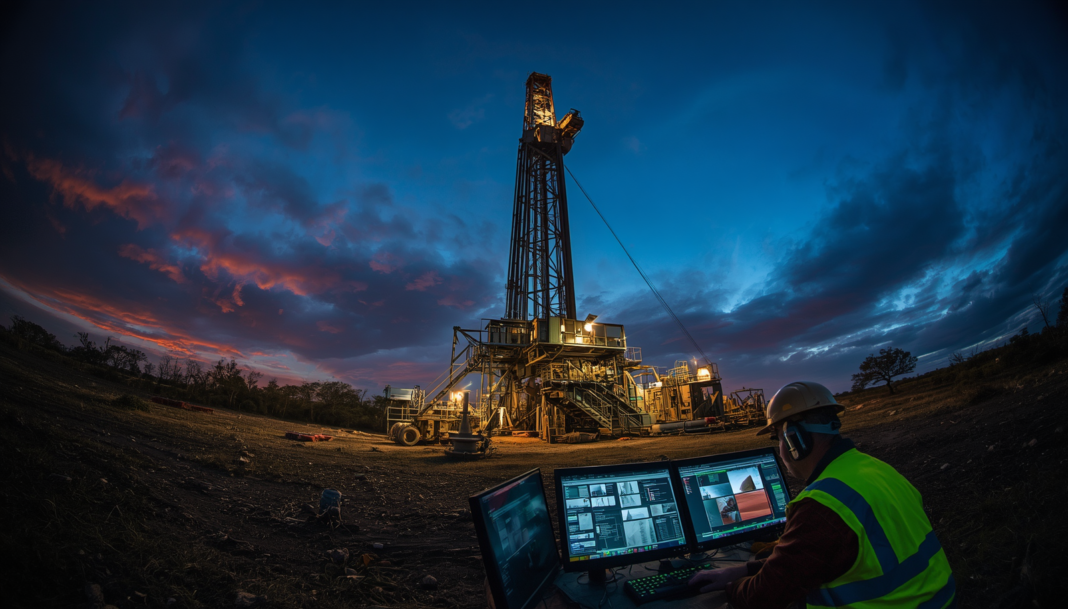
Few machines on Earth inspire awe quite like a mega drilling rig.
Towering derricks that scrape the sky, mud pumps that push fluid at pressures exceeding 10,000 psi, and hook loads capable of suspending more than a million pounds of steel — these are not ordinary machines. They are engineering landmarks.
A drilling rig becomes ‘mega’ when it pushes the boundaries of what is physically and mechanically possible: the deepest boreholes ever attempted, the longest horizontal laterals ever drilled, or the most hostile environments ever conquered.
Whether planted on Texas shale, moored in 12,000 feet of Gulf of Mexico water, or punching through Arctic permafrost, the world’s most powerful drilling rigs represent the absolute pinnacle of heavy machinery engineering.
The global drilling rig market was valued at USD 86.92 billion in 2025 and is projected to reach USD 140.75 billion by 2033 — reflecting surging energy demand, deep offshore exploration, and rapid technological advancement.
Within that market, high-specification rigs command premium day-rates and represent the future direction of the entire industry.
This article profiles the machines, the records, and the companies defining what it means to drill at the limits of possibility.
2. The Machine at a Glance — Key Specifications
Drilling rigs come in two primary categories relevant to mega-machine status: high-specification land rigs (used for deep unconventional wells and extended laterals) and ultra-deepwater offshore drillships (used for ocean-floor hydrocarbon extraction in depths exceeding 10,000 feet).
Both categories share certain characteristics — extreme power, structural mass, and complex systems integration — but differ in how they apply that power.
| Specification | Land Rig (High-Spec) | Ultra-Deepwater Drillship |
| Drawworks Power | Up to 3,000 HP | Up to 75,000 HP (combined) |
| Max Hook Load | Up to 1,000,000 lb | 2,000,000+ lb |
| Max Drilling Depth | 30,000+ ft (land) | 40,000+ ft (offshore total) |
| Mud Pump Pressure | 10,000 psi | 15,000–20,000 psi |
| Mast/Derrick Height | 175 ft+ | 200+ ft above deck |
| Water Depth (offshore) | N/A | 12,000 ft (ultra-deepwater) |
| Lateral Reach | 4+ mile laterals | Extended-reach wells |
| Power Source | Diesel / LNG hybrid | Diesel-electric / hybrid |
The Nabors PACE-X Ultra X33 — deployed in late 2025 and officially designated the most powerful onshore drilling system in the United States — exemplifies the land rig ceiling.
Its one-million-pound mast rating and three 2,000-horsepower mud pumps capable of 10,000 psi reflect a generation of ultra-high-spec rigs built for 4-mile laterals and 14,000-foot vertical depths in technically demanding formations.
3. How It Works — The Technology in Simple Terms
At its core, a drilling rig works by rotating a drill bit at the end of a long steel pipe string, using downward weight and rotational force to cut through rock. But at the mega-rig scale, the simplicity ends there.
Modern high-spec rigs use alternating current (AC) drive systems — similar in principle to industrial electric motors — that replace older mechanical and SCR (silicon-controlled rectifier) technologies.
AC drives offer superior torque control, reduced energy waste, and the ability to fine-tune drilling parameters in real time. The result is faster penetration rates, fewer equipment failures, and better wellbore quality.
The key mechanical systems that define a mega rig include:
- Drawworks: The hoisting engine that raises and lowers the drill string. High-spec drawworks can reach 3,000 HP on land rigs, providing enough torque to handle massive pipe loads.
- Mud Pumps: High-pressure pumps that circulate drilling fluid (mud) down the drill pipe and back up the annulus. Mud cools the bit, carries rock cuttings to surface, and maintains wellbore pressure. Three-pump configurations at 10,000 psi are now standard on ultra-spec land rigs.
- Top Drive: Replaces the old rotary table, allowing the drill string to be rotated from the top rather than the floor. This enables longer pipe stands and faster tripping times.
- Blowout Preventer (BOP): A critical safety system installed at the wellhead to control unexpected pressure surges from the formation — the last line of defence against a blowout.
- Dynamic Positioning (offshore only): Drillships use GPS-linked thruster systems to hold position over a subsea well in deep water without anchoring to the seabed.
| HOW THE TURBODRILLING REVOLUTION CHANGED DEEP DRILLING
The Soviet Union’s record-breaking Kola Superdeep Borehole — which reached 12,262 metres (40,230 ft) in 1989 — used a turbodrill system where only the bit at the very bottom rotated, powered by mud pressure. This solved the problem of rotating an entire 12-km drill string under its own million-pound weight. Modern downhole motor technology used in horizontal shale drilling is a direct descendant of this same principle. |
4. Where It’s Used — Projects and Industries
The world’s most powerful drilling rigs operate across a surprisingly diverse range of sectors, united by one common requirement: the need to reach deep, difficult, or economically critical subsurface resources.
Oil and gas — onshore unconventional: The Permian Basin, Eagle Ford, Haynesville, and Bakken shale plays of North America are the primary arena for ultra-high-spec land rigs.
Wells routinely extend 3 to 4 miles horizontally through thin rock formations, requiring extreme lateral reach and sustained high-pressure mud circulation.
The Nabors PACE-X Ultra X33 is operating in precisely this environment, targeting the Eagle Ford and Austin Chalk in South Texas on behalf of Caturus Energy.
Offshore oil and gas — ultra-deepwater: The Gulf of Mexico, Namibia’s Orange Basin, Guyana’s Stabroek Block, and Brazil’s pre-salt fields are among the world’s most active ultra-deepwater frontiers.
Here, seventh-generation drillships capable of operating in 12,000 feet of water command day-rates exceeding USD 500,000.
The Berkut offshore platform in Russia’s Pacific — the world’s largest oil platform — weighs 200,000 tons and produces up to 4.5 million tons of oil annually.
Mining and minerals exploration: Rotary and diamond core drilling rigs are the backbone of mineral resource assessment in Africa, Australia, and Latin America.
Fleet operators such as Perenti Drilling Services drilled over 2.5 million metres of core in FY2025 alone, using large crawler-mounted rigs to reach gold, copper, lithium, and iron ore deposits at depth.
Geothermal energy: Rigs like Vercana’s 2,500 HP V20 — mobilised in early 2025 for a geothermal and lithium project in Germany — highlight a fast-growing application.
Deep geothermal wells can exceed 5,000 metres and require equipment capable of handling both extreme heat and high-pressure formations.
Scientific drilling: The Japanese drillship Chikyu set a Guinness World Record in September 2024 for the deepest scientific ocean drilling at 7,906 metres of drill pipe deployed.
China launched a project in 2023 targeting a 10,000-metre borehole in the Tarim Basin as part of deep-Earth geological research — and has announced ambitions to surpass the Kola Superdeep Borehole’s 12,262-metre record with a planned 15-kilometre drill programme.
5. Notable Manufacturers — Leading Companies in the Market
The global drilling rig market is dominated by a handful of vertically integrated contractors and original equipment manufacturers (OEMs) who design, build, and often operate their own rigs.
Nabors Industries (NYSE: NBR) — Founded in 1952 and headquartered in Houston, Nabors operates the world’s largest land drilling rig fleet across more than 20 countries.
Its PACE rig series — including the PACE-X Ultra — represents the current pinnacle of onshore drilling technology, integrating AC drives, robotic pipe-handling via its RZR module, and the SmartROS® automated drilling operating system.
In September 2025, Nabors deployed the PACE-X Ultra X33 for Caturus Energy, the most powerful onshore drilling system in the US.
Helmerich and Payne (NYSE: HP) — H&P is the number-one US land driller by footage, recording 16.4 million feet drilled in Q1 2025 across 859 wells.
Following its USD 1.97 billion acquisition of KCA Deutag in January 2025, H&P expanded to 384 land rigs spanning North America, the Middle East, and Latin America. Its FlexRig series is designed for multi-well pad drilling and extended-reach horizontal wells.
National Oilwell Varco (NYSE: NOV) — NOV is the world’s primary OEM for drilling rig equipment, supplying drawworks, top drives, mud pumps, rotary tables, and full rig packages to contractors globally.
Its 2025 census data show the US active rig fleet achieved record production of 13.4 million barrels per day — with a leaner, higher-spec fleet than at any previous point in history.
Transocean (NYSE: RIG) — The world’s largest offshore drilling contractor, Transocean operates a fleet of ultra-deepwater drillships and semisubmersibles.
Its seventh-generation drillships are among the most technically capable offshore drilling vessels ever built, capable of drilling in water depths exceeding 12,000 feet.
Halliburton and SLB (Schlumberger) — While primarily services companies, both are expanding into integrated automated drilling.
In April 2025, Halliburton and Nabors jointly completed the first fully automated surface and subsurface rotary and slide drilling in Oman, using closed-loop digital control systems.
6. Record-Breaking Facts — Biggest, Fastest, Deepest
| DEEPEST HOLE EVER DRILLED
The Kola Superdeep Borehole in Russia reached 12,262 metres (40,230 ft) in 1989 — deeper than the Mariana Trench and taller than Mount Everest. It used a turbodrill system and took nearly 20 years to complete. It remains the deepest human-made point on Earth. |
| LONGEST MEASURED DEPTH BOREHOLE
The Al Shaheen Oil Well in Qatar achieved a measured borehole length of 12,289 metres (40,318 ft) in 2008 — surpassing Kola in total length, though not in true vertical depth. Extended-reach drilling technology enabled this horizontal feat from a single surface location. |
| MOST POWERFUL US LAND RIG (2025)
The Nabors PACE-X Ultra X33 — deployed September 2025 — features a one-million-pound mast rating, three 2,000 HP mud pumps at 10,000 psi, and a racking capacity of 35,000 feet. It is designed for 4-mile laterals and 14,000+ foot vertical depths. |
| WORLD’S LARGEST OIL PLATFORM
The Berkut oil platform off Russia’s Sakhalin Island weighs 200,000 tons, extends 35 metres below sea level, and is designed to withstand subarctic conditions including waves up to 60 feet and temperatures down to -44°C. Its peak production capacity reaches 4.5 million tons of oil per year. |
| TALLEST OIL PLATFORM
The Petronius compliant tower in the Gulf of Mexico stands 1,870 feet tall — taller than most skyscrapers — with more than half its structure submerged. Built between 1997 and 2000, it drills at approximately 1,754 feet of water depth. |
| DEEPEST OFFSHORE PRODUCTION
Shell’s Perdido Spar in the Gulf of Mexico operates in approximately 8,000 feet of water — the world’s deepest oil and gas production hub at the time of its 2010 launch — with a production capacity of 100,000 barrels per day. |
| GREATEST RESERVOIR CONTACT
A Nabors rig drilled a well achieving over 50,000 feet of reservoir contact — the equivalent of nearly 15 kilometres along the productive formation — representing a frontier in extended-reach drilling efficiency. |
| DEEPEST SCIENTIFIC OCEAN DRILLING
Japan’s drillship Chikyu set a Guinness World Record on 21 September 2024 for the deepest scientific ocean drilling at 7,906 metres of drill pipe deployed during IODP Expedition 405. |
7. The Future — Electrification, AI, and the Autonomous Rig
The drilling industry is undergoing the most significant technological transformation in its history. Three converging forces — artificial intelligence, automation, and decarbonisation — are reshaping what a drilling rig is and how it operates.
AI-driven performance: Nabors’ SmartROS® and RigCLOUD® platforms, integrated with Corva’s AI analytics, delivered a 61% increase in rate of penetration (ROP) and a 25% improvement in overall drilling performance in early deployments.
The company’s ROP Optimizer — combining machine learning with closed-loop rig control — achieved a 36% increase in average penetration rate in its first field deployment.
AI tools analyse drilling parameters in real time, predict equipment failures before they occur, and automatically adjust the weight on bit, rotational speed, and mud flow to optimise performance continuously.
Autonomous drilling: In April 2025, Halliburton and Nabors completed the world’s first fully automated surface and subsurface rotary and slide drilling operations in Oman, combining LOGIX and SmartROS to execute closed-loop drilling without manual driller input.
In June 2025, SLB announced a strategic partnership with Cactus Drilling — the largest privately held US land drilling contractor — to scale autonomous drilling solutions across its fleet.
Electrification and fuel transition: The Nabors PACE-X Ultra X33 uses Caterpillar’s Dynamic Gas Blending technology to substitute natural gas for diesel, reducing both fuel costs and carbon emissions without sacrificing power output.
Purpose-built electric rigs — powered by grid electricity or on-site battery storage — are already operational in Canada and northern Europe, eliminating diesel consumption entirely on site.
Robotic pipe handling: Nabors’ RZR robotic module removes crew members from the rig floor during pipe-handling operations — one of the most hazardous tasks in drilling. This technology reduces injury exposure while simultaneously improving pipe-tripping speeds.
Digital twins and predictive maintenance: Virtual replicas of physical rig systems allow operators to simulate drilling strategies, model equipment behaviour under stress, and detect emerging failures before downtime occurs.
Cloud-connected platforms are reducing unplanned downtime by up to 35% in early implementations.
The global drilling automation market — valued at USD 4.43 billion in 2024 — is forecast to reach USD 8.26 billion by 2032, growing at a CAGR of 8.1%.
Meanwhile, the broader drilling rig market is expected to grow from USD 86.92 billion in 2025 to USD 140.75 billion by 2033, signalling sustained global investment in both conventional and unconventional energy extraction.
Perhaps most tellingly, China has announced an ambition to drill a 15-kilometre borehole — breaking the Kola Superdeep Borehole’s 35-year record.
The tools to attempt this challenge will not be the turbodrill rigs of the Soviet era. They will be AI-guided, sensor-rich, materials-science marvels — the next generation of mega machines.
Also Read
Mega Machines: The World’s Most Powerful Drilling Rigs
Mega Machines: The World’s Largest Motor Graders

- South Africa Has R395 Billion in Infrastructure Projects — But Can the Industry Deliver Them? - August 26, 2026
- How Municipal Water Treatment Works: Inside NYEWASCO’s Journey from Raw Water to the Tap - August 17, 2026
- LiuGong Brings a 27-Ton Electric Excavator to North America: Can the 924FE Challenge Diesel? - August 14, 2026
