The 2026 FIFA World Cup will showcase more than world-class football. Hosted across the United States, Mexico, and Canada, the tournament also offers a rare opportunity to examine some of the most advanced stadiums ever built.
From retractable roofs and lightweight ETFE canopies to smart technologies and sustainable engineering, these venues demonstrate how sports architecture continues to evolve.
This ranking evaluates the ten most innovative World Cup stadiums based on architecture, structural engineering, sustainability, technology, adaptability, and long-term legacy rather than football history or commercial success.
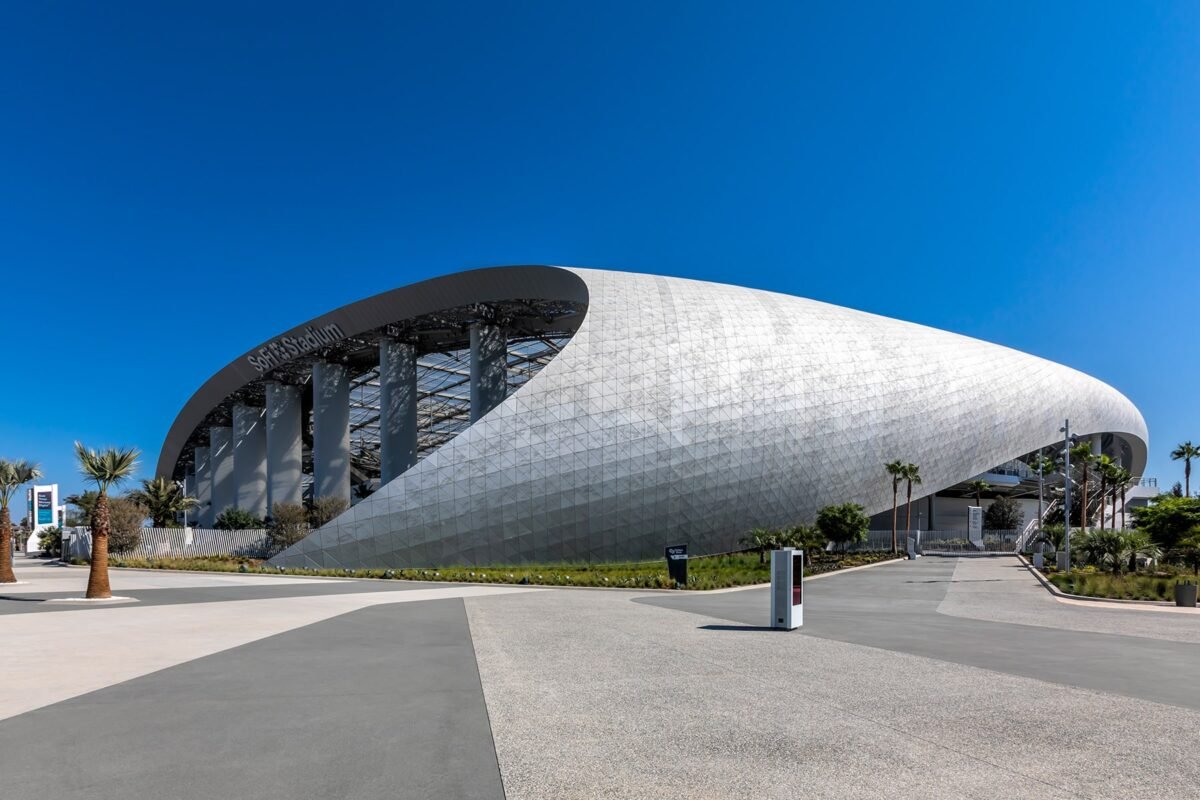
1. SoFi Stadium – Los Angeles, USA
SoFi Stadium stands as the benchmark for modern sports architecture. Its massive ETFE canopy spans both the stadium and surrounding public spaces without internal columns, while the playing field sits below ground level to reduce visual impact and improve structural efficiency.
The venue also features the dual-sided Infinity Screen, advanced digital infrastructure, LEED Gold certification, solar power integration, and water-saving technologies. As host of the 2026 World Cup final, it represents the most complete fusion of engineering, sustainability, and fan experience.
2. Mercedes-Benz Stadium – Atlanta, USA
Atlanta’s Mercedes-Benz Stadium is renowned for its retractable roof inspired by a camera iris. Eight moving steel petals rotate open and closed with remarkable precision, creating one of the world’s most sophisticated roof systems.
Its LEED Platinum certification, extensive solar installations, rainwater harvesting, and iconic 360-degree Halo Board make it one of the greenest and most technologically advanced stadiums in operation.
3. Estadio Azteca – Mexico City, Mexico
Opened in 1966 and extensively modernized for 2026, Estadio Azteca combines historical significance with enduring engineering excellence. Its reinforced concrete cantilever roof remains an impressive achievement, particularly considering it was built in a seismic region decades before modern computational tools.
Recent upgrades have introduced enhanced accessibility, LED lighting, digital infrastructure, and improved spectator amenities while preserving the stadium’s architectural identity.
4. AT&T Stadium – Arlington, USA
AT&T Stadium showcases engineering at monumental scale. Massive steel arch trusses create one of the world’s largest column-free interior spaces while supporting a retractable roof system.
Its enormous suspended video display helped redefine the stadium entertainment experience, and continuous upgrades ensure it remains competitive among newer venues.
5. BC Place – Vancouver, Canada
BC Place earned recognition after replacing its original air-supported dome with an innovative retractable cable-supported roof. The lightweight membrane structure provides weather protection while maintaining structural efficiency.
Its transformation demonstrates how existing stadiums can be successfully modernized instead of replaced, extending operational life while improving performance.
6. MetLife Stadium – New Jersey, USA
As one of the tournament’s largest venues, MetLife Stadium combines structural practicality with advanced facade engineering. Its illuminated ETFE exterior adapts to different events while extensive deep foundations overcome difficult ground conditions in the Meadowlands.
Its flexible design and operational reliability make it well suited for hosting major international events.
7. Estadio BBVA – Monterrey, Mexico
Estadio BBVA is distinguished by its integration with the surrounding Sierra Madre mountains. A sweeping cantilevered roof frames the natural landscape while providing complete spectator coverage without obstructing views.
Sustainable features such as rainwater harvesting and natural ventilation complement its elegant structural design.
8. Lumen Field – Seattle, USA
Lumen Field demonstrates how acoustics can become a defining architectural feature. Its partial roof and carefully engineered geometry amplify crowd noise, making it one of the loudest stadiums in professional sports.
Recent technology upgrades have expanded connectivity, lighting quality, and digital capabilities while preserving its distinctive industrial aesthetic.
9. Hard Rock Stadium – Miami, USA
Rather than demolish an aging venue, engineers transformed Hard Rock Stadium through an ambitious renovation. Cable-supported canopies provide extensive shade while adding minimal load to the existing structure.
The project improved comfort, energy performance, and resilience against Miami’s demanding climate, illustrating the value of adaptive reuse.
10. Estadio Akron – Guadalajara, Mexico
Estadio Akron combines striking architecture with advanced engineering. Its sculpted facade draws inspiration from local volcanic landscapes, while a transparent roof edge introduces natural light into the seating bowl.
Although smaller than many American venues, it proves that innovation depends on design quality rather than scale alone.
Key Trends Across the Top Stadiums
Several themes unite the most innovative World Cup venues:
- Lightweight roof systems: ETFE membranes, retractable canopies, and cable-supported structures reduce weight while increasing flexibility.
- Smart technologies: High-capacity Wi-Fi, digital displays, crowd analytics, and integrated operations platforms improve fan experience and venue management.
- Sustainability: LED lighting, renewable energy, water recycling, and green building certifications have become standard features.
- Multi-purpose functionality: Modern stadiums are designed to host concerts, exhibitions, and community events in addition to football.
- Renovation over replacement: Projects like BC Place and Hard Rock Stadium show how upgrading existing facilities can deliver significant environmental and economic benefits.
Conclusion
The FIFA World Cup 2026 will serve as a global exhibition of architectural and engineering excellence. While cutting-edge venues such as SoFi Stadium and Mercedes-Benz Stadium showcase the latest technologies, historic icons like Estadio Azteca demonstrate that visionary design can remain relevant for generations.
Together, these ten stadiums illustrate how successful sports architecture integrates structure, sustainability, technology, and urban context into a unified vision. Their influence is likely to shape stadium development long after the final whistle of the 2026 tournament.
Also Read
The $2 Billion Stadium Upgrades Behind FIFA World Cup 2026
The Architectural Marvel That Opened Three FIFA World Cups

- SODECA Highlights Industrial Ventilation Technology at Mega Clima Expo Kenya 2026 - October 14, 2026
- How They Were Built: Inside the Engineering of the Lesotho Highlands Water Project - October 11, 2026
- Africa’s Water Reuse Opportunity: Building the Infrastructure for a Water-Secure Future - September 28, 2026