

A Stadium That History Keeps Calling Back
Mexico City, Mexico|June 2026-On 11 June 2026, the world’s eyes converged on a bowl of reinforced concrete in the Coyoacan district of Mexico City.
As the opening whistle of FIFA World Cup 2026 sounded, Estadio Azteca achieved something no other sports venue on earth had managed: hosting its third FIFA World Cup.
That milestone does not belong to the sport alone. It belongs to a structure, to concrete and steel and volcanic rock, to two architects, and to a construction team that, back in the early 1960s, built a stadium ahead of its time.
Football made Estadio Azteca famous. But it is the quality of its architecture, the ingenuity of its structural engineering, and the sheer durability of its construction that made this third World Cup possible.
When Pedro Ramirez Vazquez and Rafael Mijares submitted their design proposal to Mexico City’s Sociedad de Futbol del Distrito Federal in 1960, they were not just sketching a sports venue.
They were defining what a football stadium in the modern era could and should be. Nearly six decades later, that vision endures — upgraded, modernised, and more relevant than ever.
For construction professionals, architects, infrastructure investors, and stadium developers, Estadio Azteca is not merely a cultural landmark.
It is one of the most instructive case studies in the built environment: a masterclass in structural longevity, adaptive reuse, engineering foresight, and the relationship between heritage and innovation.
The Vision Behind Estadio Azteca
Mexico in the early 1960s was a country in transformation. Industry expanded, urban populations surged, and new infrastructure projects were reshaping the national landscape.
In this atmosphere of accelerating development, the ambition to build a world-class stadium took root.
Mexico was pursuing both the 1968 Olympic Games and a FIFA World Cup bid, and civic leaders understood that such events required infrastructure equal to their ambition.
The commission fell to Pedro Ramirez Vazquez, a modernist architect whose work would come to define the face of Mexico City.
Already responsible for the Museo Nacional de Antropologia — which opened in 1964 while the stadium was still under construction — Ramirez Vazquez was a practitioner of expressive concrete and civic-scaled public architecture.
His partner, Rafael Mijares Alcerreca, brought structural experience and a complementary design sensibility. Together, they visited major stadiums across Europe, drawing lessons from Spanish, English, French, and Italian venues before arriving at a distinctly Mexican synthesis.
The brief was demanding: create the largest stadium in the Americas, accommodate over 100,000 spectators, optimise sightlines across every tier, and build on a site with difficult geological conditions.
The result would cost 260 million Mexican pesos — a formidable sum in the 1960s — and require engineering solutions that had no precise precedent in Mexico’s construction industry.
Building a Giant: Construction on Volcanic Ground
Ground was broken in 1961 on a site in the Santa Ursula district of southern Mexico City, then near the expanding outer edge of the city.
The area sat on the lava fields of the Pedregal de San Angel, a volcanic landscape characterised by fractured basalt rock beneath the surface soil.
Engineers quickly identified the challenge: building a stadium foundation on ground where volcanic rock layers lay at unpredictable depths, creating uneven load-bearing conditions across the site.
Large sections of the site required blasting before foundations could be laid.
The team mapped the subsurface geology and designed a foundation strategy that used the volcanic rock as a structural asset wherever it was consistent, while compensating for weaker zones through reinforced concrete pile systems.
This adaptive approach to geotechnical engineering was not common practice in stadium construction of the era and represented a significant technical achievement.
The construction process spanned approximately five years, with the stadium formally opening on 29 May 1966 with an inaugural match between Club America and the Italian club Torino.
The project required coordination of large concrete pours, complex formwork for the upper tier overhangs, and the installation of circulation systems capable of moving massive crowds. With the 1968 Mexico City Olympics on the horizon, the construction timeline was non-negotiable.
MXN$260 million and officially became the
first stadium in FIFA history to host World Cup matches
across three separate tournaments —
1970, 1986, and 2026.
Architecture Ahead of Its Time: The Steep Bowl That Changed Stadium Design
The defining architectural decision behind Estadio Azteca’s enduring functionality was the design of its seating bowl.
Rather than adopting the multi-use oval configuration common in European and American stadiums of the 1960s — layouts designed to accommodate athletics tracks as well as team sports — Ramirez Vazquez and Mijares chose a steep, single-purpose football bowl. This was a philosophical and practical departure of major significance.
The steep angle of the upper deck achieves something that many modern stadiums still struggle to replicate: it places even the back row of the uppermost tier closer to the playing surface than the equivalent position in most contemporary arenas.
The geometry compresses perceived distance between spectator and pitch, creating an intensity of atmosphere that stadium designers continue to study and cite. The noise generated within this bowl has become legendary — and it is a direct function of the enclosure created by the steep, inward-angled terracing.
The stadium’s original capacity exceeded 107,000, making it the largest in the Americas at opening.
The bowl design also incorporated careful attention to sightline geometry across all tiers. Ramirez Vazquez was deliberate in his rejection of the flat-bottomed, track-centred oval, understanding that a football-dedicated bowl could deliver a quality of viewing experience that multipurpose venues could not match.
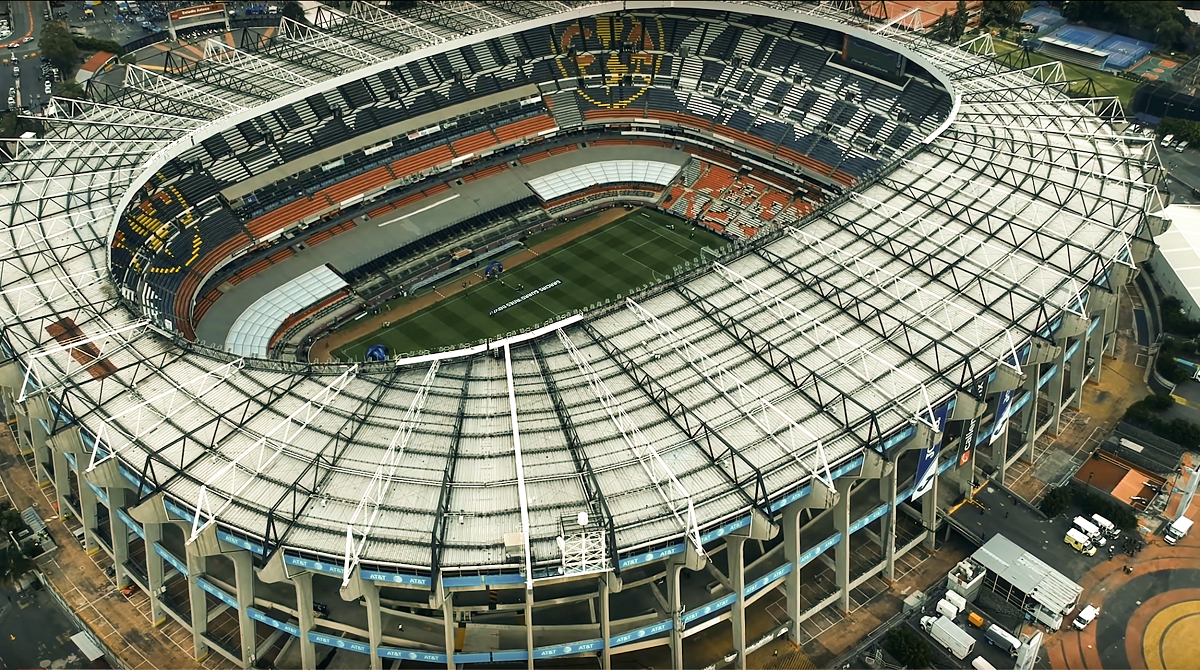
Externally, the stadium presented a distinctive silhouette: a series of characterful concrete columns and cross-beams running around the upper perimeter, creating a visual rhythm that was simultaneously structural and aesthetic.
These columns formed part of the load path for the upper tier and gave the stadium its recognisable outline — an outline that the 2026 renovation programme was specifically instructed to preserve.
Engineering for Scale: Crowd Flow, Access, and Structural Logic
Designing for over 100,000 spectators in a single venue is an exercise in systems engineering as much as structural design.
Estadio Azteca’s circulation strategy was among its most sophisticated contributions to stadium architecture.
Wide ramps and spacious entrance concourses were designed to distribute crowd movement efficiently across all levels, reducing pinch points and managing the flow of tens of thousands of spectators simultaneously entering and exiting the bowl.
The ramp-based vertical circulation system, which replaced the staircase-dominant approaches of older stadiums, allowed for smoother ingress and egress across all tiers and was a direct response to lessons learned from crowd management failures at earlier large-capacity venues.
This approach has since become standard practice in stadium design and represents one of Azteca’s clearest forward-looking contributions to the field.
The structural system combined reinforced concrete frames with cantilevered upper tiers, reducing the need for structural columns in the spectator zones and preserving sightlines.
The cantilevering of the upper deck required precise calculation of load transfer and deflection, particularly given the seismic activity that characterises Mexico City’s geological environment.
Designing a structure of this mass and cantilever depth in a seismically active zone — at an elevation of 2,200 metres above sea level — represented a formidable engineering challenge that the construction team addressed with meticulous precision.
The Volcanic Terrain Challenge: Geology as Design Constraint and Asset
The Pedregal de San Angel lava fields that underpin the stadium’s site presented one of the most complex geotechnical environments in Mexico City.
The volcanic substrate is neither uniform nor predictable: fractured basalt layers alternate with softer volcanic soil, creating conditions where load distribution must be carefully managed across variable bearing capacities.
Typical foundation strategies of the era relied on consistent ground conditions; Estadio Azteca’s team had no such luxury.
Engineers adopted a hybrid approach, using the stronger sections of volcanic rock as natural bearing strata for deep foundations while installing reinforced concrete piles to transfer loads in zones where rock depth or quality was insufficient.
This required comprehensive site investigation — extensive drilling and sampling programmes to map the subsurface before any structural layout could be finalised.
The foundation design was consequently more complex and expensive than a stadium built on sedimentary or alluvial soil, contributing to the project’s elevated cost.
The volcanic landscape also influenced the stadium’s relationship with its immediate environment.
The site’s natural topography was partially incorporated into the design, with ground levels adjusted to reduce the visible height of the structure from surrounding streets while maximising internal bowl depth.
This integration of site contours into stadium geometry is a technique that contemporary sports venue designers now describe as a best practice for reducing the visual and environmental impact of large stadiums on surrounding communities.
Why Estadio Azteca Changed Stadium Architecture
The influence of Estadio Azteca on subsequent stadium design is traceable through several specific innovations that became industry norms.
The steep single-purpose bowl — now a design requirement articulated in contemporary stadium briefs worldwide — traces a direct lineage through Azteca and its contemporaries.
The decision to optimise for one sport rather than compromise for many anticipated the specialisation philosophy that now governs the design of elite football and rugby stadiums globally.
The integration of ramp-based circulation, the use of cantilevered upper tiers to protect sightlines, the management of site geometry to embed the stadium in its landscape, and the structural expression of the concrete frame as an architectural feature — all of these became reference points for the stadium architects who followed.
When Populous, HOK Sport, and other global sports architecture practices began producing their signature stadium designs in the 1990s and 2000s, the foundational logic they employed had been rehearsed at Azteca three decades earlier.
Compared to contemporaries such as Maracana in Brazil, Wembley in England, and the Olympiastadion in Munich, Estadio Azteca was unusual in its singular focus on football as the design driver.
Maracana served athletics; Wembley hosted greyhound racing; Munich’s Olympiastadion served multiple sports.
Azteca’s refusal to compromise was architecturally bold and, over time, proved to be commercially and operationally correct.
Purpose-built venues consistently outperform multipurpose ones on spectator experience metrics, a finding that has shaped stadium policy across every major league in the world.
conceived in the early 1960s — anticipated the defining
stadium design philosophy of the modern era by more than 30 years, prioritizing fan proximity, uninterrupted sightlines, and an immersive match-day atmosphere long before such features became
global architectural standards.
From 1970 to 2026: Sixty Years of Adaptation
Any structure that has been in continuous operation for six decades will have been remade several times over, and Estadio Azteca is no exception.
The stadium’s renovation history is a record of progressive modernisation without structural replacement — a pattern that reflects both the quality of the original construction and the logistical challenges of upgrading a venue of this scale without demolition.
The 1986 renovation, undertaken in preparation for Mexico’s second FIFA World Cup hosting, addressed seating, player facilities, and the expansion of broadcast infrastructure.
The installation of executive boxes and VIP facilities reflected the commercial evolution of professional football during the intervening two decades.
A further renovation in 1999 updated safety systems and concourse infrastructure. The 2013 programme installed modern digital scoreboards and began the transition to LED lighting technology.
In 2016, structural repairs and accessibility upgrades were completed as the stadium approached its 50-year anniversary.
Each of these programmes faced the same fundamental constraint: the original structure’s proportions and layout determined what was possible.
The depth of the bowl, the span of the cantilevers, and the geometry of the circulation routes were fixed by Ramirez Vazquez and Mijares in the early 1960s.
Subsequent architects and engineers could improve what sat within and above that framework, but the structural DNA remained unchanged. This is precisely the testament to the original design’s quality.
The 2026 Renovation Programme: Modernising a Legend
The preparation for FIFA World Cup 2026 triggered the most comprehensive renovation in Estadio Azteca’s history.
Work began in mid-2024 following the conclusion of the Clausura tournament, with architectural firms Populous and KMD Arquitectos leading the project.
The scope encompassed structural reinforcement, complete systems replacement, digital infrastructure deployment, sustainability upgrades, and a comprehensive overhaul of the spectator experience.
The signature intervention of the renovation is the installation of a new metal and glass roof ring, an engineered canopy designed to shield spectators from the elements without altering the stadium’s historic silhouette.
The canopy’s ETFE panels — a lightweight, high-performance material now standard in large-span roof design — were detailed with hexagonal motifs drawn from Mexico’s iconic 1970 World Cup Telstar football, a design gesture that connects engineering material to cultural memory.
The canopy was engineered to meet seismic loading requirements and wind load specifications appropriate to Mexico City’s exposed elevation.
The electrical and mechanical systems were completely replaced. Engineers installed over 40,000 metres of fibre optic cabling and 1,000 Wi-Fi 6 connection points throughout the bowl, supporting both spectator connectivity and the operational infrastructure required for broadcast, security, and stadium management systems.
Smart energy management systems were installed to optimise power consumption across lighting, HVAC, and building services, with photovoltaic panels integrated into the roof structure to reduce grid dependency on matchdays.
The seating bowl was stripped and rebuilt, with capacity adjusted to approximately 87,500 — a reduction from the original 107,000 that reflects current FIFA and UEFA standards for minimum seat dimensions, sightline clearances, and emergency egress requirements.
VIP boxes and hospitality suites were rebuilt to contemporary commercial standards, and the press facilities were relocated to improve broadcast positioning.
New benches and technical areas at pitch level were repositioned to enhance broadcasting angles and spectator views from the lower tier.
The pitch itself was replaced with a GrassMaster hybrid system — a reinforced natural grass surface with synthetic fibres woven into the soil profile to improve durability, drainage, and root stability.
At 2,200 metres above sea level, the pitch’s growing conditions are unusual; the hybrid system addresses the particular challenges of grass maintenance at altitude by improving ventilation and drainage performance below the playing surface.
Over 23,000 square feet of LED screens were installed throughout the venue, transforming the in-stadium visual experience and opening new commercial inventory for broadcasting partners and sponsors.
External LED banners were mounted on the stadium’s distinctive concrete columns, enabling dynamic light displays that reimagine the building’s exterior on matchdays and event nights without compromising the structural character of the original facade.
largest transformation in Estadio Azteca’s nearly 60-year history, featuring a new
ETFE canopy roof, more than
40,000 metres of fibre-optic cabling,
1,000 Wi-Fi 6 access nodes,
23,000 sq ft of LED displays,
complete replacement of core stadium systems, and a
GrassMaster hybrid playing surface designed to meet
FIFA’s next-generation performance standards.
Sustainability and the Future of Stadium Design
The integration of photovoltaic panels into the new roof structure places Estadio Azteca within a broader shift in sports venue design toward active energy generation.
Large-scale stadium roofs present one of the most compelling opportunities for solar deployment in the built environment — high-profile, publicly visible, and typically located in areas with good solar resource.
The Azteca’s photovoltaic installation, while not transforming the venue into a net-zero facility, represents a meaningful contribution to reducing operational carbon and signals a commitment to sustainability performance that operators will be expected to demonstrate in future FIFA and World Cup host evaluations.
Heritage preservation and environmental performance have historically been presented as competing priorities in stadium renovation.
Estadio Azteca’s 2026 programme challenges that framing. By retaining the original concrete structure — the most carbon-intensive phase of any stadium’s lifecycle — and upgrading systems and envelope rather than demolishing and rebuilding, the renovation strategy inherently minimises embodied carbon compared to a new-build replacement.
This is a lesson with broad application: the circular economy principles that the construction industry increasingly applies to commercial and residential building stock are equally valid in sports infrastructure.
Smart building technologies installed during the renovation — real-time energy monitoring, automated lighting management, AI-assisted crowd flow systems — position Estadio Azteca for operational efficiencies that will reduce running costs and environmental impact over the next operational cycle.
As stadium operators globally face pressure from governing bodies, sponsors, and fans to demonstrate sustainability credentials, Azteca’s renovation model provides a viable template for upgrading aging venues without replacement.
Lessons for Today’s Stadium Developers
The longevity and continued relevance of Estadio Azteca offer a concentrated set of lessons for the architects, engineers, contractors, and developers planning the next generation of sports venues.
- Design for the primary sport first. The decision to build a steep, single-purpose football bowl rather than a compromise multipurpose oval is the foundational reason why Estadio Azteca remains fit for elite competition sixty years later. Spectator experience and sightline quality are non-negotiable in venues that will need to generate revenue across a long operational life.
- Invest in geotechnical investigation. The volcanic rock foundation challenges that Azteca’s engineers faced — and solved — illustrate that thorough site investigation before structural design is not a cost overhead but a risk management investment. Foundation systems are the hardest element of any stadium to retrofit; getting them right at the outset determines the building’s operational ceiling for decades.
- Design the circulation system as carefully as the structure. The ramp-based crowd movement system at Azteca has managed crowds of more than 100,000 safely for six decades. Contemporary crowd safety requirements are more demanding than those of the 1960s, but the principle is identical: spectator circulation must be designed with the same rigour as the structural frame.
- Build structures capable of absorbing renovation. The fact that Azteca’s original reinforced concrete frame has accommodated four major renovation cycles without replacement is a direct function of the structural oversizing and quality of concrete work delivered in 1966. Designing for future adaptability — generous structural reserve, accessible services routes, modular internal fit-out — is an investment that compresses long-term lifecycle costs.
- Treat heritage as a structural and commercial asset. Populous and KMD’s brief for the 2026 renovation explicitly required preservation of the stadium’s historic character. This was not sentiment; it was strategy. The stadium’s identity generates global commercial value that a generic new-build replacement could not replicate. Heritage is infrastructure.
Engineering Built to Last
When the FIFA World Cup 2026 opening match kicked off at Estadio Azteca on 11 June 2026, the stadium became the only venue in the history of the sport to have opened three separate World Cup tournaments.
That record will almost certainly never be broken. It is a record that belongs not to any team or player but to a building — and to the architects and engineers who conceived and constructed it across the early 1960s.
Estadio Azteca’s architecture endures because it was designed with clarity of purpose, structural ambition, and careful attention to the human experience of being inside a sports venue.
The volcanic terrain that made its construction difficult also gave it a foundation character that shallow-soil sites could not provide.
The steep bowl that Ramirez Vazquez and Mijares chose over a more conventional oval geometry has produced one of the most atmospherically intense venues in world sport. And the quality of the original concrete work has outlasted buildings designed and constructed decades after it.
For the construction industry, Estadio Azteca is more than a football stadium.
It is a demonstration of what is possible when architecture, engineering, and construction ambition align around a clear design philosophy — and when the resulting structure is maintained with the care that its quality demands.
As the 2026 renovation programme demonstrates, even a 60-year-old building can be modernised, made sustainable, and made relevant again, without abandoning the design DNA that made it worth preserving in the first place.
That is perhaps the deepest lesson Estadio Azteca offers the stadium developers, infrastructure investors, and construction professionals of today: build well enough, and the future will keep finding reasons to come back.
Also Read
The $2 Billion Stadium Upgrades Behind FIFA World Cup 2026
Inside Estadio Azteca: The Architectural Marvel That Opened Three FIFA World Cups

- How They Were Built: Inside the Engineering of the Lesotho Highlands Water Project - October 11, 2026
- Africa’s Water Reuse Opportunity: Building the Infrastructure for a Water-Secure Future - September 28, 2026
- Why Water Reuse Is Becoming a Business Imperative for African Industry - September 28, 2026