

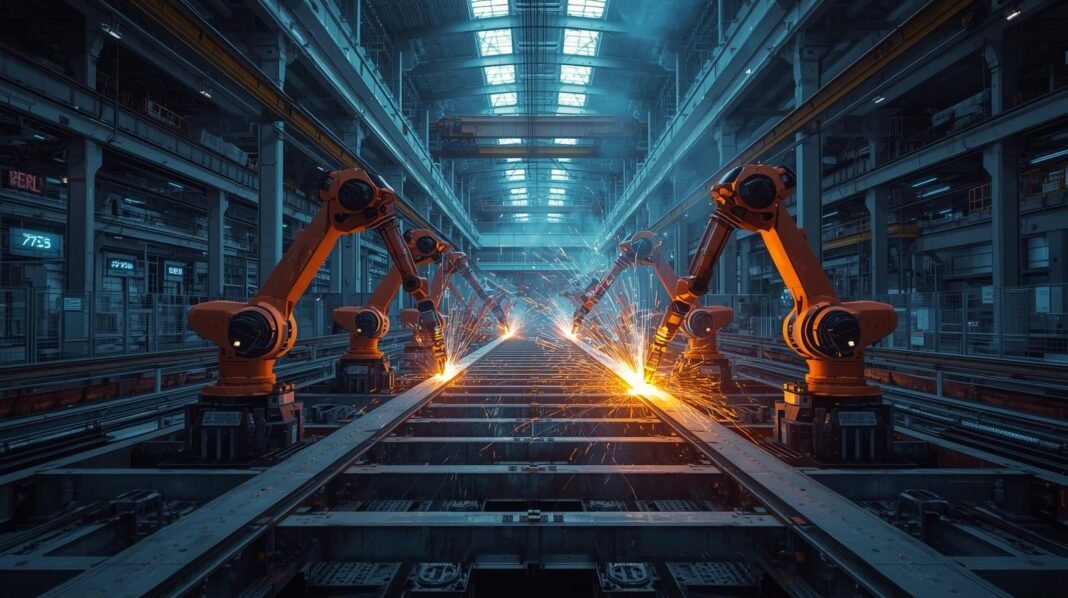
In factories across the world — from automotive assembly plants in Germany to steel fabrication shops in the United States and shipyards in South Korea — robotic welding systems are becoming the backbone of industrial production.
Sparks still fly, but increasingly there are fewer manual welders behind the torches.
Instead, robotic arms guided by machine vision, AI-assisted programming, and real-time sensing systems are executing welds with a level of consistency that human operators struggle to match over long production cycles.
The shift is no longer limited to automotive manufacturing, where robotic welding first gained dominance decades ago.
In 2026, robotic welding has become central to structural steel fabrication, renewable energy infrastructure, aerospace manufacturing, heavy equipment production, shipbuilding, and even small-batch fabrication environments once considered unsuitable for automation.
At the centre of this transformation are a handful of global robotics companies competing aggressively to define the next generation of industrial welding automation.
These brands are not merely selling robotic arms; they are building complete intelligent manufacturing ecosystems that integrate artificial intelligence, digital twins, cloud analytics, adaptive sensing, and collaborative robotics.
As labour shortages intensify and manufacturers face mounting pressure to increase throughput while reducing defects, robotic welding suppliers are emerging as some of the most strategically important technology companies in industrial manufacturing.
Market Overview
The global robotic welding market surpassed $9.3 billion in 2026 and is projected to exceed $14 billion by 2030 as manufacturers accelerate automation investments amid workforce shortages and rising production demands.
Welding applications continue to account for more than one-quarter of all industrial robot installations globally, according to data from the International Federation of Robotics (IFR).
Automotive production remains the largest adopter of robotic welding systems, but growth is increasingly being driven by structural steel fabrication, renewable energy projects, heavy manufacturing, and infrastructure development.
The convergence of AI-guided robotics, lower automation costs, and smarter vision systems is expanding robotic welding adoption beyond large manufacturers into medium-sized and even smaller fabrication shops.
The Brands Defining Robotic Welding in 2026
1. FANUC: The Global Industrial Automation Giant
No company has had a larger impact on industrial robotics than FANUC. The Japanese automation giant remains one of the dominant suppliers of robotic welding systems worldwide, with installations spanning automotive plants, aerospace facilities, metal fabrication workshops, and heavy manufacturing operations.
FANUC’s strength lies in reliability, scale, and ecosystem integration. Its Arc Mate welding robots are widely regarded as industry benchmarks for high-volume welding applications, particularly in automotive manufacturing where uptime and repeatability are critical.
The company has aggressively expanded its AI capabilities in recent years, integrating machine learning-assisted path optimization and predictive maintenance systems into its robotic platforms.
FANUC’s FIELD system enables connected manufacturing environments in which robotic welding cells continuously analyze operational performance and identify inefficiencies before downtime occurs.
One reason FANUC maintains such a dominant market position is its ability to support both highly complex fully automated production lines and more flexible mid-sized fabrication operations.
The company’s extensive global support network also makes it particularly attractive for multinational manufacturers seeking standardized automation systems across multiple facilities.
Key Strengths
- High reliability and uptime
- Extensive global support infrastructure
- Strong automotive sector dominance
- Advanced predictive maintenance capabilities
- Broad range of arc welding robots
2. ABB Robotics: Driving Intelligent Welding Automation
Swiss-Swedish engineering giant ABB has become one of the most influential innovators in robotic welding, particularly through its emphasis on AI-enabled automation and flexible manufacturing systems.
ABB’s robotic welding portfolio is widely used in shipbuilding, automotive manufacturing, heavy steel fabrication, and energy infrastructure projects. Its OmniCore control platform has emerged as a major differentiator, providing significantly faster processing speeds and advanced motion control for complex welding applications.
Perhaps ABB’s most important strategic advantage is its integration of robotics with digital manufacturing software. Through platforms such as RobotStudio, manufacturers can create full digital twins of welding cells before physical deployment, dramatically reducing commissioning time and minimizing costly production interruptions.
ABB has also invested heavily in collaborative robotics. Its YuMi and GoFa collaborative robots are helping smaller manufacturers adopt robotic welding without the infrastructure requirements traditionally associated with industrial robots.
Industry Focus Areas
- Automotive manufacturing
- Structural steel fabrication
- Shipbuilding
- Renewable energy infrastructure
- Smart factory integration
3. Yaskawa Motoman: Precision and Welding Expertise
Yaskawa Motoman has long been recognized as one of the world’s most welding-focused robotics companies. Unlike some competitors that emphasize broad automation portfolios, Motoman has built a reputation around welding specialization.
Its ArcWorld robotic welding cells are widely deployed in fabrication industries where precision and repeatability are essential. The company’s welding expertise is particularly valued in sectors such as agricultural equipment manufacturing, heavy machinery, railcar production, and industrial steel fabrication.
One of Motoman’s defining strengths is ease of programming. In high-mix fabrication environments where product configurations change frequently, simplified robot teaching and offline programming are becoming increasingly important competitive advantages.
The company has also invested significantly in adaptive welding technologies, including seam tracking and real-time arc sensing systems that compensate for part variation during welding operations.
As labour shortages continue affecting fabrication industries worldwide, Motoman’s focus on user-friendly automation is helping manufacturers transition experienced welders into robotic operator roles more efficiently.
Key Advantages
- Strong welding-specific expertise
- User-friendly programming systems
- Excellent arc welding performance
- Adaptive seam tracking technologies
- Flexible robotic cell configurations
4. KUKA: Heavy-Duty Automation Leadership
German robotics manufacturer KUKA remains one of the most recognizable names in industrial automation, particularly in large-scale manufacturing and heavy industrial applications.
KUKA welding robots are extensively used in automotive body production, shipbuilding, structural steel manufacturing, and aerospace fabrication. The company is especially strong in applications requiring large payload capacities and complex multi-axis motion control.
KUKA’s latest robotic welding systems increasingly integrate AI-driven quality monitoring and cloud-connected production analytics. The company has focused heavily on smart manufacturing environments in which robotic welding systems communicate continuously with factory-wide automation platforms.
Its KR QUANTEC series remains a major force in heavy-duty welding applications where large steel components, long weld seams, and high deposition rates are required.
KUKA is also investing aggressively in autonomous mobile robotics and flexible manufacturing systems that allow robotic welding cells to adapt more dynamically to changing production requirements.
Key Market Strengths
- Heavy industrial automation expertise
- Strong European manufacturing presence
- High payload robotic systems
- Advanced smart factory integration
- Complex multi-axis welding capabilities
5. Universal Robots: Expanding Collaborative Welding
While traditional industrial robots continue dominating high-volume production, collaborative robotics specialist Universal Robots is helping redefine welding automation for smaller manufacturers.
The company’s cobot welding systems are particularly attractive to fabrication shops that lack the space, budget, or technical expertise for large robotic cells. Unlike traditional industrial robots that often require extensive safety fencing and complex integration, collaborative robots can operate safely alongside human workers in many environments.
Universal Robots has become especially influential in small-to-medium fabrication businesses where labour shortages are severe but automation budgets remain limited.
Modern cobot welding systems can often be deployed within days rather than months, making automation accessible to businesses previously excluded from robotic manufacturing.
The company’s AI-guided welding applications and simplified programming interfaces are further lowering barriers to adoption.
Why Cobots Matter
- Lower entry costs
- Faster deployment
- Easier programming
- Reduced floor-space requirements
- Ideal for small fabrication shops
The Technologies Separating Market Leaders
AI-Powered Welding Systems
Artificial intelligence has become one of the biggest competitive battlegrounds among robotic welding manufacturers.
Modern systems increasingly use AI for:
- Adaptive weld path generation
- Real-time defect detection
- Seam tracking
- Predictive maintenance
- Parameter optimization
- Production analytics
Machine learning systems continuously refine welding parameters based on live production data, improving weld quality while reducing consumable waste and downtime.
Digital Twins and Offline Programming
Digital twin technology is becoming standard among leading robotic welding suppliers.
Manufacturers can now simulate complete welding cells virtually before physical installation, reducing commissioning risks and accelerating production readiness.
Platforms such as ABB RobotStudio, FANUC ROBOGUIDE, and KUKA.Sim are transforming how welding automation systems are designed and optimized.
Intelligent Quality Inspection
AI-driven inspection systems are rapidly becoming standard features in robotic welding environments.
Vision inspection systems now perform real-time weld analysis against international quality standards, identifying:
- Porosity
- Incomplete fusion
- Undercut
- Cracking
- Geometric inconsistencies
The ability to detect defects during welding rather than after production significantly reduces scrap and rework costs.
Where Robotic Welding Demand Is Growing Fastest
Structural Steel Fabrication
Infrastructure expansion and commercial construction projects are accelerating robotic welding adoption in structural steel fabrication.
Fabricators producing beams, bridge girders, columns, and connection assemblies increasingly rely on robotic welding to maintain throughput amid labour shortages.
Renewable Energy Manufacturing
Wind tower fabrication, solar infrastructure, and energy storage manufacturing represent some of the fastest-growing robotic welding applications globally.
Long repetitive weld seams and strict quality requirements make renewable energy manufacturing particularly well suited to automation.
Shipbuilding and Heavy Industry
Shipyards and offshore fabrication facilities are increasingly adopting robotic welding to improve productivity and reduce reliance on highly specialized manual welders.
Heavy industries dealing with large steel structures are investing heavily in robotic systems capable of operating continuously under demanding production conditions.
The Business Case for Automation
For manufacturers, the economics of robotic welding are becoming increasingly difficult to ignore.
Modern robotic welding systems commonly deliver:
- 30–50% higher throughput
- Reduced defect rates
- Lower consumable waste
- Improved production consistency
- Reduced overtime costs
- Extended production capability through lights-out manufacturing
Many fabrication shops now achieve full ROI within 12 to 24 months, particularly in sectors facing severe skilled labour shortages.
Importantly, robotic welding is not eliminating skilled trades — it is changing them. Experienced welders are increasingly transitioning into roles such as robot operators, automation technicians, welding programmers, and quality control specialists.
Challenges Still Facing the Industry
Despite rapid growth, robotic welding adoption still faces significant barriers.
High-mix fabrication remains difficult to automate efficiently, particularly in custom steel fabrication environments where component variation is substantial.
Integration complexity also remains a challenge. Many smaller manufacturers lack in-house automation expertise, requiring system integrators and specialized training programmes.
Cybersecurity is emerging as another concern as robotic welding systems become increasingly connected to cloud manufacturing environments.
Workforce training also remains critical. The industry now requires technicians capable of combining welding expertise with robotics knowledge, software understanding, and digital manufacturing skills.
The Future of Welding Is Intelligent Automation
The robotic welding market in 2026 is no longer defined simply by robotic arms replacing manual welders. It is increasingly about intelligent manufacturing ecosystems that combine AI, machine vision, digital twins, and adaptive automation into integrated production platforms.
Companies such as FANUC, ABB, Yaskawa Motoman, KUKA, and Universal Robots are not merely competing for equipment sales — they are shaping the future architecture of industrial manufacturing itself.
As labour shortages intensify and global manufacturing becomes more competitive, robotic welding is rapidly evolving from an efficiency upgrade into a strategic necessity.
For manufacturers, steel fabricators, and industrial producers, the question is no longer whether automation will reshape welding operations.
That transformation is already underway. The real question is which companies will adapt quickly enough to remain competitive in the next era of intelligent manufacturing.
Also Read
How Robotic Welding Is Transforming Steel Fabrication in 2026
Top Welding Certifications Required for Construction Projects in 2026

- Africa’s Water Reuse Opportunity: Why Treatment Plants Must Be Designed as Complete Systems - September 22, 2026
- From Operator to Algorithm: Bedrock Puts Autonomous Excavators to Work on Live Construction Sites - September 7, 2026
- Built For The Rough Stuff: Inside Titan’s new ForestEDGE™ Tyre Line - September 4, 2026
