

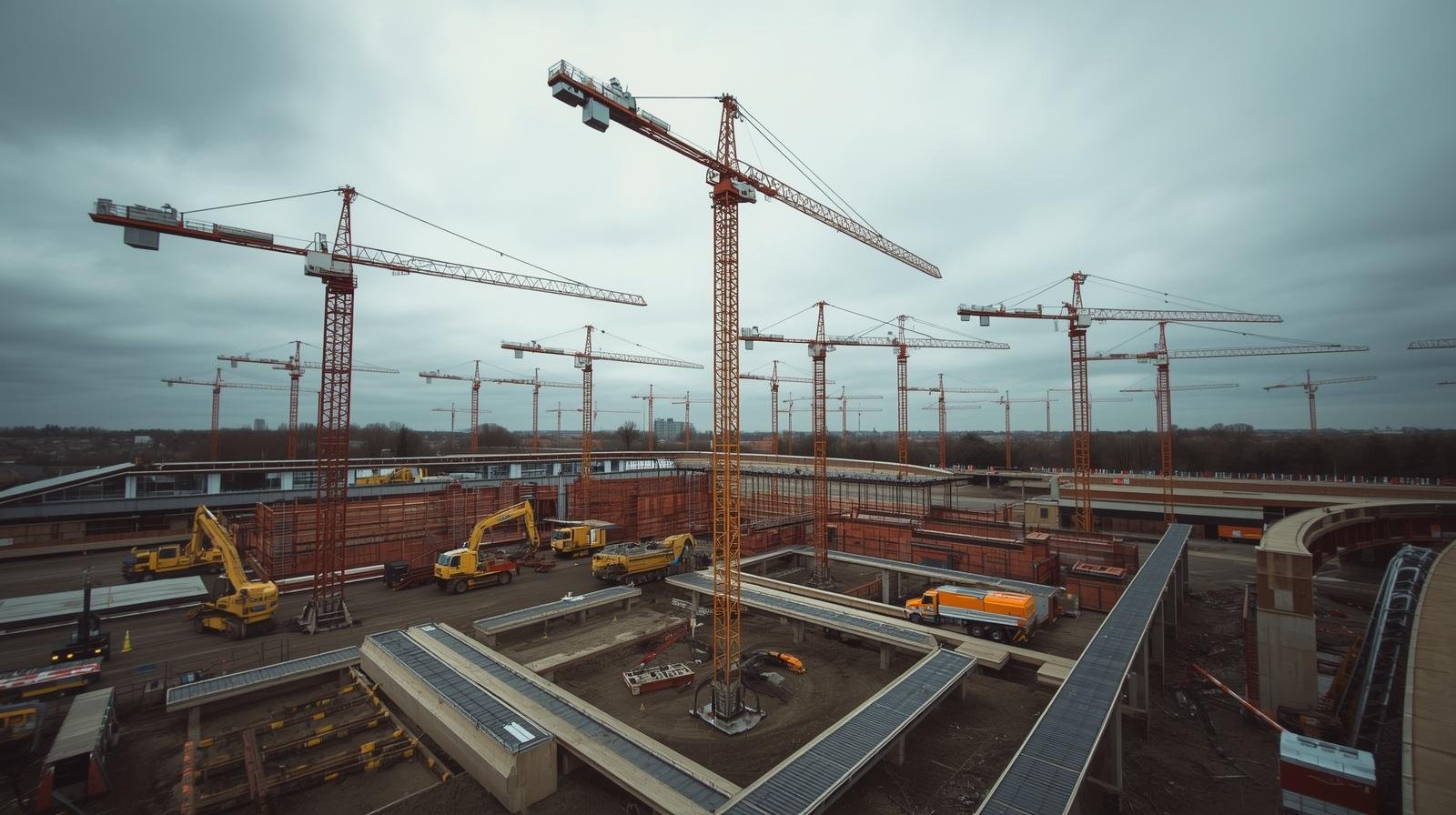
The United Kingdom’s construction industry has been dealt another brutal blow.
The Construction Products Association (CPA), the country’s most authoritative voice on construction market forecasting, has published its Spring 2026 Forecasts — and the numbers are stark.
Overall UK construction output is now expected to contract by 2.5% in 2026, a dramatic reversal from the 1.7% growth the same body forecast just four months ago in January.
The trigger is the Iran war. When the United States and Israel launched military strikes on Iran on 28 February 2026, the ripple effects were felt almost immediately across global energy markets.
Oil prices surged past $100 a barrel.
The Strait of Hormuz — through which roughly a fifth of the world’s oil and liquefied natural gas passes — was disrupted. European gas storage levels, already critically low after a harsh winter, saw Dutch TTF gas benchmarks nearly double.
For energy-intensive industries like construction, the consequences are severe.
“At the start of this year, there was a degree of cautious optimism over the outlook for construction activity in 2026 and 2027 across most sectors,” said Rebecca Larkin, the CPA’s Head of Construction Research.
“This has been replaced by stark concerns over global factors and rising oil and industrial energy costs, leading to a spike in inflation.”
The CPA describes its own downgrade as a “sharp, unprecedented downward revision.” The second half of 2026 is expected to see particularly acute cost increases as the lagged effects of the conflict work through the supply chain.
The CPA’s central assumption models four months of direct disruption, with knock-on impacts extending over the following 12 to 18 months.
What This Means for Construction Equipment in the UK
For equipment manufacturers, dealers, rental companies and fleet operators with exposure to the British market, the implications are direct.
A contracting construction sector means fewer new machine orders, extended equipment life cycles, tighter rental utilisation rates and deferred capital expenditure across the board.
Private housing — the single largest construction sector in the UK and historically a key driver of compact and earthmoving equipment demand — faces a collapse in output.
The CPA now forecasts a 7% fall in private housing output in 2026, followed by flat performance in 2027.
Mini excavators, dumpers, telehandlers and compaction equipment — the workhorses of housebuilding sites — will all feel the demand squeeze.
The situation in private housing repair, maintenance and improvement (RM&I), the second-largest construction sector, is similarly grim.
Activity was already subdued throughout 2025 despite households holding accumulated savings and experiencing real income growth.
The RM&I sector is now forecast to contract by 1.0% in 2026 — a second consecutive year of decline — partly because the government’s ECO energy-efficiency programme ends in March 2026 and the replacement Warm Homes Plan is not expected to drive notable activity in the near term.
“Even if the disruption were to end today, a degree of damage has already been done.” — Rebecca Larkin, CPA Head of Construction Research
Independent analysis from law firm Birketts adds further texture to the supply chain pressures now hitting UK construction.
Brick kilns, cement plants and glass factories — all energy-intensive domestic manufacturers — were among the first to feel the surge in energy costs. But the indirect effects have since spread further.
Because the UK imports significantly from China, and China purchases around 90% of Iran’s oil, Chinese manufacturing costs have risen sharply, affecting the price of electrical components, lighting and other lightweight construction products imported from Asia.
UK projects procuring goods directly from the Middle East are already reporting multi-week delivery delays.
The impact on construction materials has been broad. Aluminium prices rose by 8% in March alone following production disruptions at Emirates Global Aluminium.
Tungsten — critical for drill bits, cutting tools and precision construction equipment — surged over 50% in March 2026 and has more than tripled in price since December 2025.
Steel and specialist alloy surcharges of up to 30% are being passed down supply chains by European manufacturers facing soaring electricity and feedstock costs.
Infrastructure: The One Corner Holding Firm
Against this bleak backdrop, infrastructure remains the sector most likely to sustain meaningful equipment deployment through 2026 and 2027.
The CPA expects infrastructure output to rise by 3.2% in 2026 and 3.4% in 2027, supported by a committed pipeline of government contracts that is more insulated from the confidence-driven dynamics affecting private sectors.
The key drivers are energy generation and water infrastructure. Investment under AMP8 — the regulatory asset management plan guiding water company capital expenditure in England and Wales — is ramping up significantly.
Wind farm construction is also accelerating.
These projects require heavy plant: large excavators, piling rigs, crane hire, specialist groundworks equipment. Contractors and rental fleets positioned in these sub-sectors are best placed to weather the wider market downturn.
HS2, the UK’s high-speed rail megaproject, continues to provide workload, though the CPA has flagged rising concern over the government’s delayed reset of the programme and what it means for the continuity of new contract awards.
Road spending remains another weak point — the next Road Investment Strategy (RIS3) is delayed and funding has been cut in nominal terms, creating a growing gap in the roads construction pipeline that will affect plant-intensive civil engineering work.
The Broader Picture: Confidence Is the Missing Variable
What makes this downturn particularly difficult to call is that it is as much a confidence crisis as a cost crisis.
Survey data published ahead of the CPA’s Spring Forecasts found that nearly seven in ten UK construction companies fear severe impacts from the Iran conflict over the next six months.
Glenigan, the construction intelligence firm, has warned that project starts have “nosedived” and that the macroeconomic effects of the conflict are sending shockwaves through an industry that was already fragile.
The Bank of England had been expected to cut interest rates in 2026, a move that would have helped unlock stalled housing and commercial development.
The Iran war has put that on hold. UK inflation is now forecast to breach 5% in 2026 — the highest projection in Europe — and the ECB has already postponed its own planned rate reductions.
Higher borrowing costs for longer means developers, housebuilders and private sector investors are holding back spending decisions, compounding the demand contraction that the CPA’s numbers are already capturing.
Arcadis, in its own Spring 2026 UK Market View, notes that even under optimistic scenarios — an early reopening of the Strait of Hormuz — the flow of oil, gas and cargo will be disrupted for at least three to six months, and potentially longer.
Construction cost inflation, which had been moderating, now faces renewed upward pressure precisely when demand is weakest, squeezing contractor margins and creating a difficult environment for new project commitments.
Outlook: 2027 Recovery Is Possible — But Fragile
The CPA’s forecast for 2027 is a return to growth of 1.2%, but the organisation is explicit that risks remain heavily weighted to the downside.
Any recovery is contingent on the Iran conflict resolving within the four-month disruption window assumed in the central forecast scenario. A prolonged war, or a wider regional escalation, would push the 2027 numbers into negative territory.
For the equipment sector, the message is clear. The UK market is not a near-term growth story. Fleet investment decisions for housebuilding and commercial applications should be treated with caution.
The opportunity, for now, lies in infrastructure — energy, water, and the public sector building programmes for schools, hospitals and prisons that the government has ringfenced.
Contractors and rental operators who can pivot capacity into these sub-sectors, and who can absorb the cost pressures from rising materials and energy prices, are best positioned to navigate what is shaping up to be another difficult year for British construction.
Also Read
The Hidden Fuel Shock Reshaping US Construction Costs in 2026
U.S. Senators Push for Tariff Probe into Construction Equipment Imports from Mexico

- SODECA Highlights Industrial Ventilation Technology at Mega Clima Expo Kenya 2026 - October 14, 2026
- How They Were Built: Inside the Engineering of the Lesotho Highlands Water Project - October 11, 2026
- Africa’s Water Reuse Opportunity: Building the Infrastructure for a Water-Secure Future - September 28, 2026