

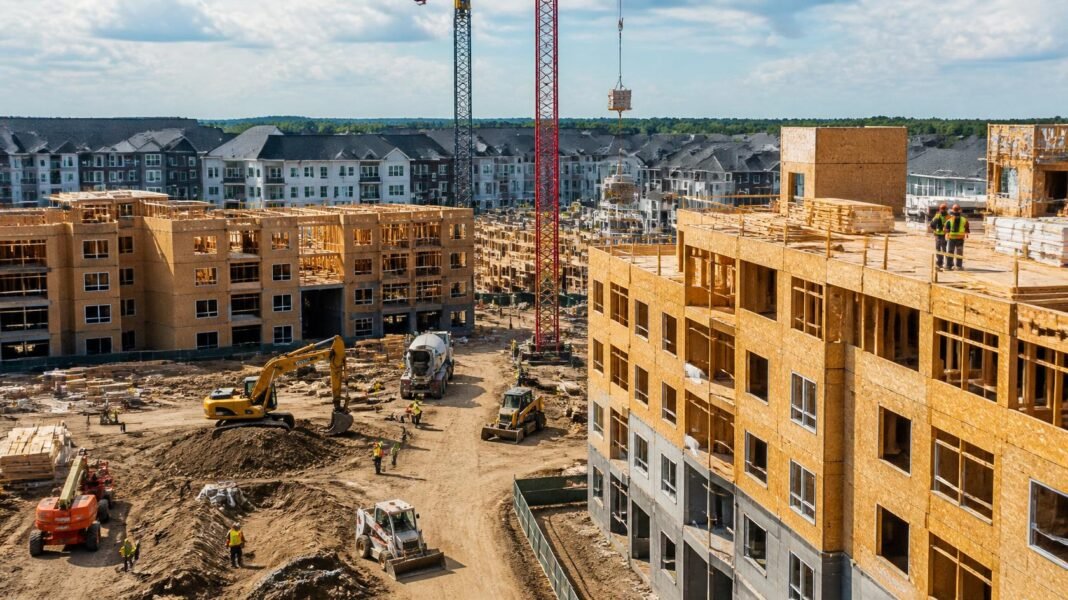
The U.S. residential construction industry posted a strong rebound in June 2026, with housing starts rising sharply from the previous month even as building permits declined, highlighting a market that continues to expand while facing persistent economic uncertainties.
The latest New Residential Construction report, jointly released by the U.S. Census Bureau and the Department of Housing and Urban Development (HUD), shows that privately owned housing starts reached a seasonally adjusted annual rate of 1.427 million units in June, representing a 19.0% increase from the revised May estimate and a 3.5% improvement compared with June 2025.
The figures point to renewed construction activity across the country and provide encouraging signals for contractors, equipment manufacturers, building material suppliers and project developers, particularly following several months of subdued residential building activity.
“Privately-owned housing starts in June were at a seasonally adjusted annual rate of 1,427,000. This is 19.0 percent above the revised May estimate of 1,199,000 and is 3.5 percent above the June 2025 rate,” the report reads in part.
Multifamily Construction Drives the Recovery
Although overall residential construction strengthened considerably, the latest figures show that much of the growth came from multifamily developments rather than single-family homes.
Single-family housing starts were recorded at 895,000 units, a marginal 0.2% decline from May, indicating that homebuilders remain cautious amid elevated mortgage rates and affordability concerns.
In contrast, construction of buildings with five housing units or more recorded a significant increase, reflecting continued demand for rental accommodation and higher-density residential developments.
The divergence between the two segments illustrates how developers are adapting to changing market conditions, with multifamily projects offering greater resilience in an environment where higher borrowing costs continue to weigh on homeownership demand.
Building Permits Signal Caution
Despite the sharp increase in housing starts, the report indicates that developers are taking a more measured approach when planning future residential projects.
Privately owned housing units authorised by building permits declined to a seasonally adjusted annual rate of 1.367 million units, down 3.0% from May and 2.3% lower than the same period last year.
Single-family building permits stood at 871,000 units, while permits for buildings with five units or more reached 445,000.
“Privately-owned housing units authorized by building permits in June were at a seasonally adjusted annual rate of 1,367,000. This is 3.0 percent below the revised May rate,” the report states.
Building permits are widely regarded as one of the construction industry’s leading indicators because they typically precede new project starts by several months.
The latest decline suggests that while contractors remain busy with projects already underway, developers are carefully evaluating future investments in response to financing costs, material prices and broader economic conditions.
Housing Completions Continue to Rise
The report also highlights steady progress in bringing new homes to market.
Housing completions reached a seasonally adjusted annual rate of 1.392 million units during June, representing a 3.3% increase from May and a 1.5% improvement compared with June 2025.
More than one million of those completions were single-family homes, helping expand housing supply in several markets where inventory has remained constrained.
The report further notes that “privately-owned housing completions in June were at a seasonally adjusted annual rate of 1,392,000. This is 3.3 percent above the revised May estimate.”
The increase in completed homes is expected to ease supply pressures and support greater market stability, although affordability challenges continue to influence buyer demand.
Regional Construction Activity Improves
Residential construction activity strengthened across all four major regions of the United States during June, although the pace of growth varied considerably.
The Northeast recorded the strongest monthly increase in housing starts, followed by the Midwest, while the South continued to account for the largest share of new residential construction nationwide.
The West also posted gains, underscoring the broad-based nature of the June recovery.
The widespread improvement suggests that stronger construction activity was not limited to a single market but reflected growing momentum across multiple regions.
What It Means for Construction Equipment Manufacturers
For the construction equipment industry, stronger housing starts generally translate into higher demand for machinery used throughout the residential construction cycle.
Manufacturers including Caterpillar, John Deere, Komatsu, Volvo Construction Equipment, CASE Construction Equipment, JCB and Bobcat are likely to monitor the latest figures closely, as residential building remains an important driver of equipment demand in North America.
Projects entering the construction phase typically require compact excavators, skid steer loaders, compact track loaders, telehandlers, backhoe loaders, concrete equipment and earthmoving machinery for site preparation, foundation work, utility installation and material handling.
Equipment rental providers may also benefit from improved fleet utilisation as contractors mobilise resources for new housing developments initiated during June.
Industry Perspective
While the latest figures paint an encouraging picture for the residential construction sector, they also reveal a market that continues to balance optimism with caution.
The surge in housing starts demonstrates that builders remain committed to advancing projects already in the pipeline. However, the decline in building permits indicates that developers are becoming more selective when committing capital to future projects.
This environment places increasing emphasis on productivity, equipment reliability and cost efficiency.
Contractors are expected to continue investing in technologies that improve jobsite performance, reduce fuel consumption and maximise machine uptime, while equipment manufacturers may place greater focus on financing solutions, fleet support and aftersales services to help customers navigate uncertain market conditions.
What the Industry Should Watch
Although June’s report marks a positive development for the residential construction sector, several economic indicators will determine whether the recovery can be sustained through the remainder of 2026.
Among the key factors are mortgage interest rates, inflation, labour availability, construction material costs and future building permit activity.
Continued improvement in these areas would strengthen confidence among developers and support additional residential investment.
Conversely, prolonged weakness in permit issuance could eventually reduce the pipeline of new housing projects, affecting demand for construction equipment, building materials and related services.
Outlook
The June residential construction report presents a cautiously optimistic outlook for the U.S. construction industry.
Housing starts have rebounded strongly, signalling renewed activity across residential construction sites and creating opportunities for contractors, equipment manufacturers and rental companies.
At the same time, declining building permits serve as a reminder that developers remain mindful of economic risks and financing conditions before launching new projects.
For the construction sector, the months ahead will reveal whether June’s rebound marks the beginning of a sustained recovery or a temporary acceleration in activity.
If permit volumes stabilise and financing conditions improve, residential construction could continue supporting demand for machinery, materials and skilled labour well into 2027.
Source: U.S. Census Bureau and the U.S. Department of Housing and Urban Development, New Residential Construction – June 2026.
Also Read
- Top Autonomous Construction Equipment Trends to Watch in 2026
- State of US Construction 2026: Market Trends, Challenges, and Future Outlook
- US Construction Begins Race to Find 456,000 Workers by 2027

With years of experience covering infrastructure projects, equipment, and engineering solutions, Yvonne brings in-depth analysis and practical insights to contractors, engineers, and industry stakeholders.
She is passionate about highlighting sustainable construction practices and the latest advancements that drive efficiency and safety on worksites.
- Why America’s Grid Expansion Is Creating a New Construction Boom - July 31, 2026
- U.S. Housing Starts Surge 19% in June, Signalling Strong Construction Activity Despite Decline in Building Permits - July 23, 2026
- 10 Benefits of Smart Buildings: How Intelligent Buildings Are Transforming Commercial Real Estate - July 21, 2026
