

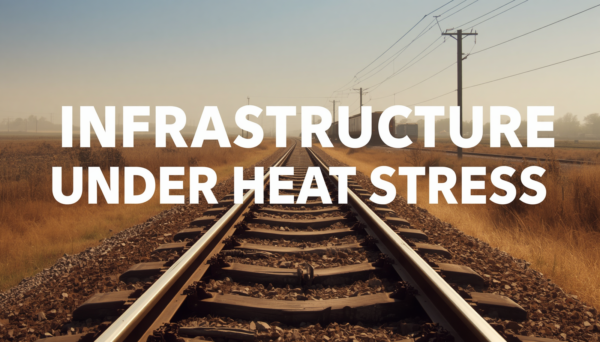
LONDON, 25 June 2026 — Temperatures in parts of England climbed to 36.1°C on 24 June 2026, smashing the UK’s June heat record set nearly 70 years ago. The rail network buckled — literally.
Across Sussex, Surrey, the West Midlands, and the South East, train services were suspended, speed-restricted, or drastically cut as steel rails expanded beyond safe operating limits and overhead power lines sagged under the sustained heat.
The images of empty platforms and stranded commuters dominated the headlines.
But for engineers, contractors, and infrastructure professionals, the story behind those images is far more sobering: the UK’s rail, road, and civil infrastructure estate was largely designed for a climate that no longer exists.
“UK infrastructure, logistics systems and live construction environments were never originally designed around repeated Mediterranean-style heat stress.” — London Construction Magazine, May 2026
When Steel Becomes the Enemy
Rail steel expands predictably under heat. Network Rail uses continuous welded rail on most main lines, pre-tensioned to be stress-free at a track temperature of 27°C.
Air temperatures, however, are routinely 15°C lower than track surface temperatures — meaning that when the Met Office records 36°C air temperatures, rails can reach 50°C or beyond in direct sunlight.
At those temperatures, the risk of buckling becomes acute. Train operators responded by imposing severe speed restrictions — slower trains exert lower lateral forces on the track, reducing the chance of deformation.
You May Also Like:
Best Portable Air Conditioners in the UK for 2026: Top Picks for Staying Cool This Summer
But slower trains mean fewer trains, and fewer trains meant that hundreds of thousands of commuters, freight consignments, and airport-bound passengers had no viable rail option for two days.
The Gatwick Express was suspended entirely from early afternoon on both 24 and 25 June. Services between Brighton, Haywards Heath, Lewes, Eastbourne and Seaford were halted at the peak of the heat on 24 June.
Emergency bus acceptance was activated, though this provided minimal relief on congested summer roads.
The Real Cost: Beyond Cancelled Trains
The economic damage from this single heatwave event extends well beyond refunded rail tickets.
Construction and civil engineering sites across southern England operated under heat-health restrictions throughout the week, with the Health and Safety Executive having already warned employers that strenuous physical work should be confined to before 10am and after 4pm during peak heat.
Concrete pours scheduled for midday windows were postponed. Steelwork gangs working on exposed structural frames faced mandatory rest rotations.
Asphalt laying — a temperature-sensitive operation at the best of times — was disrupted on road projects across the South East where surface temperatures made compaction unreliable.
One safety adviser quoted in industry press put it plainly: telling workers to drink water is not a heat policy.
A compliant heat management approach requires documented rest rotation schedules with frequency increasing as temperatures rise. That standard is not yet universal across UK construction sites.
“If we continue to experience hotter summers this could have a big impact on the workforce of this country, affecting everything from the health of workers to productivity on construction sites.” — John Rowe, Deputy Director, Health and Safety Executive
A Structural Problem, Not a Seasonal Inconvenience
What the June 2026 heatwave has demonstrated is that this is not a weather anomaly. The UK has now experienced record-breaking spring and summer heat events in 2022, 2025, and twice in 2026 already.
The Met Office has issued only its second-ever Red Extreme Heat Warning — and Wales received its first.
Parliament’s own research service has acknowledged what engineers have known for years: heatwaves pose structural risks to infrastructure that were never factored into original design standards. Rail tracks buckle.
Overhead catenary lines sag and arc. Water mains fail under thermal expansion. Power cuts become more frequent, cascading across energy, IT, and water systems simultaneously.
For the civil engineering sector, the design question is no longer hypothetical.
Also Read:
The Biggest Mistakes People Make When Buying a Portable Air Conditioner
Rolling stock, track geometry standards, overhead line specifications, and bridge expansion bearing tolerances were calibrated for historical temperature distributions. Those distributions have shifted, and they are unlikely to shift back.
What Climate-Resilient Infrastructure Looks Like
Network Rail has already introduced some adaptation measures: white-painted rail sections that can run 5–10°C cooler than unpainted steel, temperature probes providing early warnings on high-risk sections, and adjusted overhead line tensioning for summer operation.
But these are incremental mitigations on a network designed for a different era.
Genuine climate adaptation in civil infrastructure means rethinking design temperature envelopes for bridges and rail geometry, specifying heat-resilient materials for road surfaces, engineering drainage systems for more intense precipitation events that follow heat spells, and building cooling provisions into workers’ welfare facilities on construction sites as a default, not an afterthought.
The construction industry — which builds and maintains the very infrastructure now failing under heat stress — has a professional and commercial stake in this conversation that goes beyond the immediate.
Contractors facing programme compression when heatwaves halt site activity, designers specifying materials without accounting for a 40°C design day, and asset managers watching maintenance costs escalate as heat cycles degrade infrastructure faster than expected are all confronting the same underlying reality.
Looking Ahead
National Rail has advised passengers that disruption is expected to continue through at least 27 June, with amber warnings in place across large parts of England and Wales.
The rail industry is keeping 26 June under review.
When normal operations resume, the trains will run again. The deeper engineering reckoning, however, is only just beginning.
The UK cannot continue to treat infrastructure heat failures as exceptional events requiring emergency responses.
They are becoming routine — and the construction sector is better placed than any other to help design the way out.
Also Read
ExxonMobil Plans 35-Well Exploration Program to Expand Guyana’s Stabroek Block
From 5 Million to 6 Million in Just Two Years: What’s Driving America’s Solar Boom?

- PV Guangzhou 2027 to Highlight Solar and Energy Storage Technologies - October 22, 2026
- Accurate and Reliable Measurement and Monitoring of Industrial Plant Water Treatment - October 21, 2026
- SODECA Highlights Industrial Ventilation Technology at Mega Clima Expo Kenya 2026 - October 14, 2026