

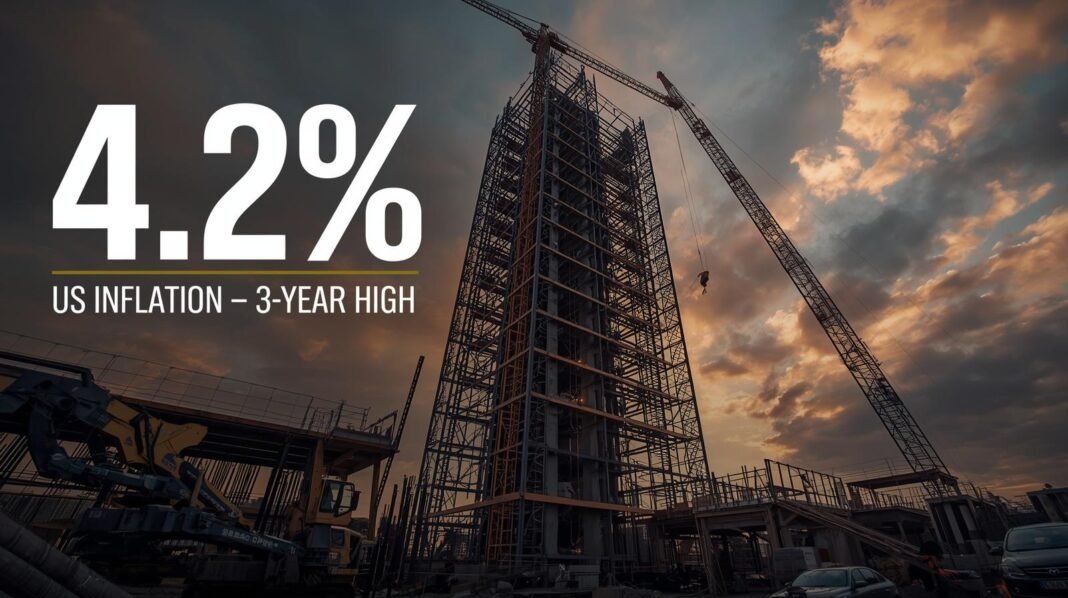
| Indicator | Figure | Key Insight |
|---|---|---|
| US CPI Annual Rate | 4.2% | Highest level since April 2023 |
| Gasoline Prices (YoY) | +40.5% | Diesel costs are also rising sharply |
| Construction PPI (YoY) | +6.0% | All-time high index reading of 354.9 |
The Report: What the Data Shows
Washington, DC, June 10, 2026 — The United States Bureau of Labor Statistics released its May 2026 Consumer Price Index data on Wednesday morning, confirming what energy markets had been telegraphing for months: America’s inflation problem has surged back with force.
The headline CPI rose 4.2% year-on-year in May — the fastest pace recorded since April 2023 — up from 3.8% in April and representing the third consecutive month of acceleration.
On a monthly basis, prices climbed 0.5%, the latest in a string of outsized month-on-month increases.
The driver is unmistakable. Energy costs jumped 23.5% on an annual basis, with gasoline prices rocketing 40.5% year-on-year. Fuel oil surged 58.9%. Energy alone accounted for more than 60% of the monthly price gain.
Electricity costs rose 0.6% in May and are up 5.9% over the past year. The proximate cause is geopolitical: Iran’s closure of the Strait of Hormuz earlier this year choked off roughly a fifth of the world’s oil supply, sending shock waves through energy markets that are now registering clearly in consumer data.
Petrol at US pumps has risen to an average of USD 4.15 per gallon, up from USD 2.98 at the outbreak of the conflict.
Beyond energy, the breadth of price pressures is widening. Food inflation accelerated to 3.1% in May from 2.3% in April. Shelter costs ticked up to 3.4%. Clothing is 4.8% more expensive than a year ago.
Airline fares — pulled higher by costlier jet fuel — have surged nearly 27% year-on-year, with a 2.7% jump in May alone.
The core inflation rate, which strips out food and energy, climbed to 2.9% — a new high since September 2025.
The policy implications are immediate. The Federal Reserve, which had signalled at the start of the year that two rate cuts were likely in 2026, now faces a rapidly closing window for easing.
Multiple Fed officials have shifted to openly discussing a rate hike rather than a cut as their next move.
Markets currently place the probability of any cut before December at less than 50%, while JPMorgan has forecast zero cuts this year and a potential hike in Q3 2027.
Construction in the Crosshairs
For the construction industry, today’s inflation reading lands on terrain that was already under significant pressure.
Even before the latest CPI print, construction-specific costs had been running well above the general economy’s inflation rate, driven by a combination of post-pandemic structural shifts, Trump-era tariffs on steel and aluminium, tightening labour markets, and persistent supply chain fragility.
The May data amplifies every one of those pressures simultaneously.
| “We are well on track to post the highest rate of materials cost inflation since 2022.” — Ed Zarenski, Construction Analytics, May 2026 |
- Fuel and Diesel: The Foundational Cost Shock
No input cost cuts across construction operations as broadly and as immediately as diesel. Every piece of mobile heavy equipment — excavators, bulldozers, haul trucks, cranes — runs on it.
Every supply chain movement from quarry to ready-mix plant to job site depends on it. And diesel has not merely risen; it has been transformed into a structural liability.
Construction Analytics data shows that diesel PPI has risen 83% comparing April 2026 against December 2025 — a figure that defies routine cost-model adjustments and demands a wholesale rethink of fuel exposure management.
More expensive diesel fuel has also cascaded into logistics: UPS and FedEx have both added fuel surcharges, pushing up freight costs for building materials being delivered to site.
The implications for Africa’s construction sector — where fuel is imported, and supply chains are longer and more fragile — are magnified considerably.
- Steel, Copper, Aluminium: A Multi-Front Materials War
Metal-intensive construction is facing a convergence of pressures that has no recent parallel.
The Producer Price Index for construction materials reached 354.9 in March 2026 — an all-time record, up 6.0% year-on-year. But within that index, the standout categories are alarming. Steel mill products have risen 10% since December 2025.
Aluminium is up 14%. Copper — critical for electrical systems, MEP installations, and data centre infrastructure — now trades near USD 5.76 per pound on COMEX, up roughly 32% year-on-year.
The copper surge is compounded by structural demand from AI data centres, EV infrastructure build-out, and grid modernisation programmes running simultaneously with constrained smelter output.
Looking at the longer-term picture, fabricated structural metal products have risen more than 63% since the onset of the pandemic in 2020. Since early 2020, overall construction input prices have risen more than 43% in total, according to BLS data — a cumulative shift that rewrites the economics of virtually every project financed in the pre-pandemic era.
- Financing: The Fed’s Shadow Over Every Project
Of all the channels through which today’s inflation data will damage the construction sector, borrowing costs may prove the most durable.
The Federal Reserve kept rates at 3.50%–3.75% at its most recent meeting, and the new May CPI data significantly reduces the likelihood of any near-term easing.
For construction, this matters because project financing timelines are long, margin pressure from materials costs is already severe, and higher interest rates extend the carrying cost on every dollar of interim construction debt.
Q2 2026 data from construction cost analysts shows that baseline construction cost escalation is now projected at 4% to 6% for the year, with potential for higher increases in tariff-sensitive or labour-intensive trades.
Extended project durations — themselves a product of labour and material sourcing delays — compound the interest burden further, eroding returns that were already thin.
The Q2 2026 construction cost outlook summarises the situation bluntly: for owners, lenders, and contractors, the central issue is no longer whether costs will rise, but how unevenly and unpredictably those increases will appear across markets, trades, and material categories.
- Labour: The Wage Spiral Intensifies
Inflation at 4.2% creates direct wage pressure. Workers in skilled construction trades — electrical, carpentry, civil engineering, crane operations — benchmark pay expectations against living costs.
With petrol, groceries, utilities, and housing all rising simultaneously, real wage demands will not soften.
US construction was already facing acute labour shortages heading into 2026, with workforce gaps in skilled trades contributing to project delays and extended schedules that themselves raise costs.
Workforce shortages are actively extending timelines and increasing carrying costs. Structural steel and custom components now carry longer lead times factored months in advance.
For contractors pricing work in a 4.2% inflation environment with no sight of rate relief, every week of schedule extension is a compounding cost event.
The African Dimension: Why This Is Not an American Story Alone
It is tempting to read today’s US inflation data as a domestic American problem. It is not. For African construction markets — particularly in Kenya, South Africa, Uganda, Nigeria, and the growing infrastructure corridors of East and West Africa — the transmission mechanisms are direct, multiple, and fast-moving.
- Imported plant and equipment priced in US dollars — excavators, concrete batching plants, tower cranes, compaction equipment — all become more expensive as dollar inflation erodes purchasing power and raises replacement costs.
- Steel and structural aluminium sourced from global commodity markets track the same PPI indices driving US construction cost inflation. Local fabricators absorb the same metal price surges.
- Diesel in most African markets is imported, refined, and sold in dollar-linked pricing. A US fuel inflation reading of 83% PPI growth does not stay on American shores.
- Infrastructure projects financed through international development banks, bilateral facilities, or commercial dollar-denominated debt face repricing risk if US interest rates rise further.
- African contractors competing for World Bank, AfDB, or bilateral-funded infrastructure tenders that denominate bids in US dollars face margin compression as their input costs inflate in line with global benchmarks.
South Africa, where the construction sector is heavily tied to rand-dollar commodity price dynamics, is particularly exposed.
The rand’s sensitivity to global risk sentiment means that any Fed rate hike would add currency depreciation pressure on top of the materials cost inflation already running through the sector.
In Kenya, the ongoing cost of imported fuel — which directly affects the operation of heavy equipment on infrastructure projects — maps almost exactly onto the US diesel inflation figures released today.
Key Indicators Construction Leaders Should Watch in 2026
These economic signals could shape construction costs, project financing, and contractor profitability over the coming months.
| Indicator | Why It Matters for Construction |
|---|---|
| Fed FOMC Meeting (June 2026) | The Federal Reserve’s rate decision will influence borrowing costs for developers, contractors, and infrastructure investors, shaping project financing conditions through Q3 and Q4 2026. |
| Strait of Hormuz Status | A reopening could quickly ease diesel and fuel-oil costs. Continued disruption would maintain upward pressure on transportation, equipment operation, and material delivery expenses. |
| US June CPI Release | Investors and builders will watch closely to determine whether May’s inflation surge marks a peak or signals a broader inflationary trend affecting construction budgets. |
| BLS Construction PPI (Monthly) | One of the most important indicators for contractors, tracking price changes in steel, copper, aluminium, diesel, and other key construction inputs before they reach project budgets. |
| ABC Confidence Index (Q3 2026) | Provides a real-world snapshot of contractor sentiment, hiring expectations, backlog strength, and project outlook across the construction industry. |
| Rand & Kenyan Shilling vs USD | Currency fluctuations directly impact the cost of imported machinery, equipment, fuel, and construction materials purchased in US dollars, particularly across African markets. |
Bottom Line
Today’s CPI data is not a statistical anomaly. It is the confirmed output of an energy shock triggered by geopolitical conflict, layered onto pre-existing structural cost inflation in the construction sector, in an interest rate environment that is either on hold or heading higher.
The combination of 4.2% headline CPI, a 6.0% construction PPI, 40.5% gasoline inflation, copper at multi-year highs, and a Federal Reserve that is more likely to hike than cut — all arriving simultaneously — constitutes one of the most challenging cost environments for project delivery since 2022.
For contractors, developers, lenders, and public infrastructure clients across Africa and globally, the appropriate response is not to wait for conditions to normalise.
The Q2 2026 data is increasingly clear: the industry must plan for sustained pressure, not relief.
That means proactive materials procurement, aggressive diesel hedging where available, front-loaded project scheduling to reduce schedule-driven cost drift, and revised bid structures that build in escalation clauses for energy and metals.
| The 2026 construction cost environment is not a temporary disruption. It is the new operating baseline — and the firms that understand this earliest will absorb the least damage. |
Also Read
CBK Holds Lending Rate at 8.75% as Iran War Fuels Cost Pressures Across Kenya’s Construction Sector
The Rise of AI Data Centers and What It Means for the Construction Industry

- Africa’s Water Reuse Opportunity: Why Treatment Plants Must Be Designed as Complete Systems - September 22, 2026
- From Operator to Algorithm: Bedrock Puts Autonomous Excavators to Work on Live Construction Sites - September 7, 2026
- Built For The Rough Stuff: Inside Titan’s new ForestEDGE™ Tyre Line - September 4, 2026
