

The way steel is designed, cut, welded, and assembled is changing faster than at any point since the post-war industrialisation boom.
In 2026, a confluence of forces — labour shortages, digital technologies, sustainability mandates, tariff realignments, and a global infrastructure spending surge — is reshaping steel fabrication from a trade craft into a precision-engineered, data-driven discipline.
For construction professionals across Africa and the world, understanding these trends is no longer optional.
Projects that leverage advanced fabrication techniques are delivering faster timelines, tighter tolerances, and stronger environmental credentials.
Those that do not risk falling behind on cost, quality, and compliance — particularly as green building requirements tighten on major infrastructure contracts.
This report examines eight key trends defining steel fabrication in 2026, drawing on the latest industry data, market research, and technological developments shaping projects from Nairobi to Newcastle.
2026 Steel Fabrication At a Glance
| Indicator | Data / Projection |
| Global prefab construction market (2026) | USD 180.3 billion, growing to USD 307.2B by 2035 at 6.1% CAGR |
| MEA modular construction market | USD 4.54 billion in 2025; projected CAGR of 7.5% through 2033 |
| US welder shortage | ~400,000 workers; 157,000+ heading to retirement; 320,500 new welders needed by 2029 |
| High-performance alloys market growth | Projected CAGR of 8.35% from 2026 to 2033 in the US alone |
| Steel industry CO2 emissions | ~3.7 billion tonnes annually — nearly 9% of global emissions |
| Digital fabrication waste reduction | Up to 80% reduction in material waste via BIM-driven automated cutting |
| CNC precision gains (MEA) | On-site rework reduced by over 20% using thermomechanically rolled steel components |
| EAF green steel carbon cuts | Up to 85% reduction in carbon emissions using renewable-powered electric arc furnaces |
1. Robotic Welding and Automation: From Luxury to Necessity
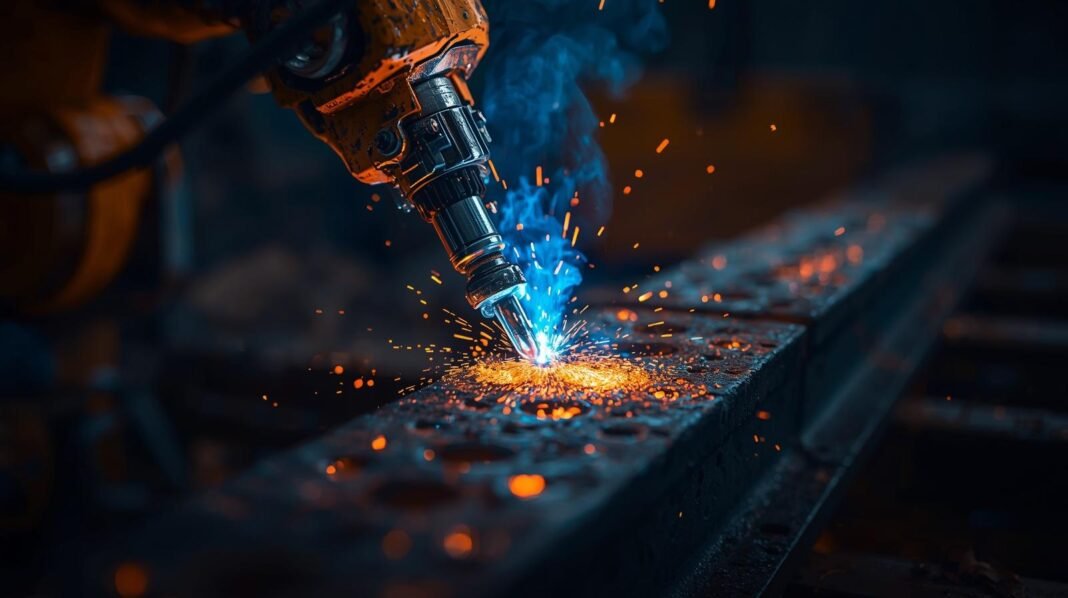
For decades, robotic welding was the exclusive preserve of large automotive and aerospace manufacturers running high-volume production lines.
In 2026, that boundary has dissolved. The conversation in fabrication shops around the world has shifted fundamentally — from ‘Can we justify automation?’ to ‘Can we survive without it?’
The American Welding Society’s October 2025 workforce analysis quantified the scale of the labour crisis underpinning this shift.
The US welder shortage now stands at roughly 400,000 workers, with more than 157,000 welders approaching retirement age and 320,500 new welders needed by 2029 just to cover attrition.
The average welder is now around 55 years old, against 42 for the broader US workforce. Similar dynamics are playing out across Europe and, increasingly, in Africa’s more mature fabrication markets.
Modern robotic welding systems have risen to meet this challenge with capabilities that earlier generations of automation simply could not match. Six-axis robotic cells can now process all four sides of a structural beam — including copes, notches, and stiffener slots — in one continuous flow.
Systems like Path Robotics’ newly launched ‘Rove’ platform take this further still, pairing physical AI with quadruped mobility to bring welding automation to large-scale assemblies and environments where moving the workpiece is not an option.
Collaborative robots (cobots) are changing the economics of smaller fabrication shops too.
Unlike traditional industrial robots that require safety caging and extensive re-programming for different jobs, cobots work alongside human operators on hybrid shop floors, handling repetitive or ergonomically hazardous tasks while skilled welders focus on complex work requiring judgement and experience.
“Automation is no longer an all-or-nothing leap. Even smaller teams can put robotics to work and see meaningful gains — without losing the craftsmanship that makes their work valuable.” — American Welding Society, 2026
AI-enhanced adaptive welding represents the cutting edge of the field. Sensor-fused machine learning now adjusts welding current, voltage, and travel speed in real time based on seam geometry and joint conditions, cutting rework on parts with fit-up variance and shortening new-part ramp-up cycles.
The business case is compelling: automated systems minimise waste, reduce rework, and enable 24/7 production without increasing overhead.
For African fabricators — particularly in South Africa, Kenya, and Nigeria, where skilled welder shortages are a growing constraint on project capacity — the declining cost of entry-level welding automation represents a significant opportunity that forward-thinking shops are beginning to act on.
2. High-Amperage Plasma and Precision Cutting: The ‘Bolt-Ready’ Revolution
On the cutting floor, the most significant technological shift in 2026 is the mainstream adoption of high-amperage plasma systems.
The Hypertherm XPR460 has established a new performance benchmark, capable of piercing up to 64mm (2.5 inches) of mild steel using argon-assist technology.
Service centres can now process heavy structural components that previously required slower, more expensive oxyfuel cutting systems.
Equally significant is the industry-wide push toward what fabricators are calling ‘bolt-ready’ precision.
Using advanced five-axis bevel heads and True Hole technology, fabricators can now produce parts — including precise weld preparations and structural bolt holes that meet strict AISC (American Institute of Steel Construction) standards — straight off the cutting table, with no secondary reaming or grinding required.
The productivity implications are substantial. Work that previously required multiple machines and handling steps can now be completed in a single automated operation, dramatically reducing lead times and the risk of measurement errors accumulating across processing stages.
For large infrastructure projects — bridges, long-span roof structures, industrial facilities — this kind of dimensional accuracy at scale is transformative.
3. BIM Integration and Digital Fabrication: Building Smarter from the Blueprint
Building Information Modelling (BIM) has been talked about in construction for over two decades. In 2026, it has finally matured into the operational backbone of modern steel fabrication workflows — not just a design tool, but an end-to-end digital thread connecting concept to completed structure.
The integration of BIM-driven design with CNC machinery, robotic assembly, and automated cutting systems is what industry analysts are calling ‘sustainable digital fabrication’ (SDF).
The results are striking: digital design tools paired with automated machinery can reduce material waste by up to 80%, according to recent studies.
And because building materials represent a major share of embodied carbon, this precision directly reduces greenhouse gas emissions — meaning BIM is not just an efficiency tool, but a sustainability one.
Digital twins — dynamic, real-time digital replicas of physical structures — are extending BIM’s reach further.
Teams can now simulate design scenarios before a foundation is poured, modelling the carbon impact of different material choices, optimising structural geometry to reduce steel usage without compromising strength, and running path validation against virtual fabrication cells before physical hardware ships.
This virtual commissioning shortens on-site commissioning timelines by weeks.
For steel fabricators, the practical impact of BIM integration is felt in two areas above all: cost estimation and logistics.
BIM-powered cost estimation provides detailed project analyses with financial clarity that traditional methods cannot match.
On the logistics side, BIM-driven scheduling enables smart job routing, tracking material status from mill to shop floor to site, and feeding predictive maintenance alerts to CNC operators before failures occur.
4. Green Steel and Low-Carbon Fabrication: From Voluntary to Mandatory
Perhaps no trend in 2026 carries more long-term consequence than the transition to verified low-carbon steel.
What was, until recently, a voluntary commitment on major prestige projects has shifted rapidly toward commercial requirement status — particularly in Europe and on large public infrastructure contracts in North America and Australasia.
The steel industry accounts for approximately 3.7 billion tonnes of CO2 emissions per year, representing nearly 9% of global greenhouse gas output.
Structural steel typically generates 1.8 to 2.5 tonnes of CO2 per tonne of steel produced, making it a primary target for embodied carbon reduction programmes.
Electric arc furnaces (EAF) — which melt scrap steel or direct-reduced iron using electricity rather than coal — are the key enabling technology.
When powered by renewable energy sources, EAF-produced steel can achieve up to 85% reductions in carbon emissions compared to blast furnace production.
The challenge has been scale: EAF production is now growing globally, but supply remains constrained relative to demand, keeping premiums for verified green steel meaningful.
Fabricators working on major projects are responding by implementing carbon management frameworks — measuring and tracking carbon footprints across all phases from material sourcing to final delivery — and by integrating BIM tools that allow clients to model the embodied carbon of design alternatives before committing to structural choices.
For African construction markets, green steel requirements are beginning to appear on projects financed by multilateral development banks and international private developers, particularly in the commercial and industrial sectors.
South African fabricators are best positioned on the continent to respond, given the relative maturity of the local steel supply chain and the presence of electric arc furnace capacity.
5. Prefabricated and Modular Steel Construction: Reshaping the Site
The shift of steel fabrication away from variable, weather-exposed job sites and into controlled, automated factory environments is accelerating significantly in 2026.
Prefabricated and modular steel construction is no longer a niche alternative — it is becoming a mainstream delivery method for healthcare facilities, commercial buildings, multi-family residential developments, and infrastructure projects across the world.
The global modular and prefabricated construction market was estimated at USD 180.3 billion in 2026, and is projected to reach USD 307.2 billion by 2035 at a compound annual growth rate of 6.1%.
Rapid urbanisation in Africa and Asia is a key driver, as prefabrication offers a fast, scalable, and cost-efficient solution for affordable housing and social infrastructure programmes that traditional on-site methods cannot deliver at the required speed or cost.
In the Middle East and Africa specifically, the modular construction market generated USD 4.54 billion in 2025 and is forecast to grow at a CAGR of 7.5% through 2033.
South Africa holds a significant market share in the region, supported by its established manufacturing and engineering sector and its experience delivering prefabricated steel structures, modular units, and precast concrete components.
The productivity case for prefabricated steel is compelling. Factory-controlled environments deliver superior quality consistency, reduced material waste, shorter construction timelines, and lower exposure to site-based labour shortages.
Ongoing labour shortages across the construction sector are making modular construction an increasingly practical choice for builders facing tight budgets and compressed schedules.
Pre-engineered steel buildings, in particular, are becoming standard for logistics hubs, warehouses, and industrial facilities across Africa — offering speed and scalability that traditional construction methods cannot match.
The use of CNC machinery ensures precision in steel components, with Technavio data indicating on-site rework reductions of over 20% compared to conventionally fabricated structures.
- Healthcare, institutional and multi-family residential sectors are the fastest-growing adopters of prefabricated steel systems.
- Barndominiums, modular data centres, and emergency housing represent emerging non-traditional applications for prefabricated steel.
- Advanced framing solutions in pre-engineered systems are enabling material savings of up to 15% without compromising structural integrity.
6. Advanced Steel Alloys and High-Performance Materials
The materials palette available to structural designers and fabricators in 2026 is broader and more capable than at any point in the industry’s history.
Demand is rising sharply for materials that combine higher strength with improved corrosion resistance and reduced weight — enabling structural systems to do more with less steel.
New steel grades are offering significantly higher strength-to-weight ratios, enabling designers to fine-tune structural systems for specific regional risks — seismic loading, wind exposure, coastal corrosion — while keeping overall steel usage efficient and construction costs controlled.
The US high-performance alloys market is projected to grow at a CAGR of 8.35% from 2026 to 2033, driven by demand from construction, energy infrastructure, and the rapidly expanding electric vehicle supply chain.
Reinforced steel composites are gaining traction on projects exposed to harsh environments.
They provide superior durability and corrosion resistance compared to conventional grades, and new alloy formulations are improving weldability and fabrication ease — reducing the skill level required for joining and streamlining construction processes on complex structures.
For African markets, where infrastructure projects frequently face exposure to tropical climates, coastal salinity, and challenging maintenance environments, the performance advantages of advanced alloys translate directly into lower whole-life costs — an increasingly important consideration as project developers and governments become more sophisticated in their lifecycle cost assessments.
The counterbalance to these benefits is cost. High-performance alloys carry price premiums over standard structural grades, and their processing can require specialised equipment and skilled operators.
The industry is working through this challenge by developing tailor-made steel grades for specific project types — a shift from commodity supply to customised, application-specific material solutions.
7. Domestic Sourcing and Supply Chain Reshoring
Global supply chain disruptions over recent years — compounded in 2025 and 2026 by shifting trade policy frameworks and new tariff regimes — have fundamentally altered how fabricators approach material sourcing.
The era of optimising for the cheapest global source regardless of origin has given way to a more strategic balance between cost, reliability, and supply chain security.
In the United States, tariff adjustments on imported steel have accelerated a trend toward domestic mill sourcing.
This is driving investment in local fabrication capacity and reducing exposure to the kind of port and logistics disruptions that crippled supply chains in earlier years.
The same dynamic is unfolding in Europe, where energy security concerns and reshoring industrial policy are pushing steel production back toward domestic facilities.
For Africa, the implications cut both ways. Countries with domestic steel production — South Africa being the continent’s most significant — have an opportunity to position local supply as a more reliable and increasingly competitive alternative to imported product.
Countries that depend heavily on imported steel, including many East African markets, face continued cost and availability uncertainty that makes domestic fabrication capacity a strategic priority.
The shift toward small-batch, customised production is another supply chain response to uncertainty.
Rather than ordering standard grades in bulk, sophisticated project teams are working with steel producers earlier in the design process to specify tailor-made grades for particular project requirements — reducing waste, improving structural performance, and creating supply relationships that are harder for competitors to replicate.
8. AI-Powered Design Optimisation and Predictive Maintenance
Artificial intelligence is reshaping the steel fabrication value chain at both ends — in design and in production.
On the design side, generative AI tools are enabling structural engineers to explore far larger solution spaces than traditional parametric design methods permit, identifying structural geometries that minimise material usage while meeting loading, serviceability, and aesthetic requirements simultaneously.
The integration of generative AI with BIM environments means that structural optimisation — which once required weeks of specialist engineering analysis — can now be performed iteratively within a design session.
This capability is particularly valuable for reducing the embodied carbon of structural steel by minimising the amount of high-impact material required to achieve a given structural performance.
On the production side, AI is enabling a new generation of smart CNC systems that perform automated tool path corrections based on material variations, track tool wear and surface temperatures using embedded sensors, and provide predictive maintenance alerts before equipment failures occur.
These capabilities deliver measurable improvements in machine uptime, weld quality consistency, and material yield.
For fabrication shops, the transition to AI-enhanced production systems is not straightforward.
The technology itself is increasingly accessible; the harder challenges are data infrastructure, operator training, and integrating AI-generated recommendations into existing workflows.
The shops that are succeeding in 2026 are those that are investing in the data pipelines and human capacity to use AI tools effectively, rather than simply deploying the technology and expecting immediate results.
African Outlook: Challenges and Opportunities
Across Africa, the steel fabrication sector sits at a pivotal juncture. The continent’s infrastructure gap — estimated by the African Development Bank to require USD 130 to 170 billion in annual investment — creates an immense structural demand for steel.
At the same time, the adoption of advanced fabrication technologies is uneven, concentrated in South Africa and a handful of North African markets, with much of sub-Saharan Africa still reliant on relatively conventional methods.
The opportunity is significant for fabricators willing to invest. Pre-engineered steel buildings are gaining ground rapidly for logistics, warehousing, and industrial applications across East and West Africa, driven by the same cost and speed advantages that are making them standard in more mature markets.
Modular and prefabricated steel solutions are increasingly relevant to Africa’s affordable housing challenge, where construction speed and cost certainty are paramount.
Skill development remains the critical constraint. The automation and digital tools driving productivity gains in more mature fabrication markets require operators and engineers with capabilities that are in short supply across much of Africa.
Closing this gap — through apprenticeship programmes, technical partnerships with equipment suppliers, and investment in trade training institutions — is as important as any capital investment in machinery.
Sustainability requirements are beginning to reach African project markets through the requirements of international financiers, development banks, and multinational developers.
Fabricators that build green credentials and carbon tracking capabilities now will be better positioned to access this growing pool of project finance as environmental requirements tighten.
“Increasing population in Africa pertains to a growing demand for infrastructure, which offers promising opportunities in the use of steel for both residential and infrastructural construction purposes.” — Custom Market Insights, 2026
Fabrication as a Competitive Differentiator
Steel fabrication in 2026 is no longer a back-of-house process that happens after the real design decisions have been made.
It is a competitive differentiator — a domain where the right technology, the right talent, and the right supply chain relationships can determine whether a project is delivered on time and on budget, or not.
The eight trends examined in this report — robotic welding, precision plasma cutting, BIM integration, green steel, prefabrication, advanced alloys, domestic sourcing, and AI optimisation — are not independent developments.
They reinforce each other: digital design feeds automated fabrication, which reduces waste, which supports sustainability mandates, which opens access to green project finance. The fabricators that will lead in the years ahead are those building integrated capability across this entire chain.
For Africa’s construction industry, the message is one of significant opportunity with clear-eyed acknowledgement of the work required to seize it.
The infrastructure demand is real, the technology is available, and the financing — both traditional and green — is increasingly accessible.
The imperative now is to invest in the skills, systems, and supply chain relationships that will allow African fabricators to deliver at the quality and pace the continent’s development trajectory demands.
Also Read
Global Steel Prices Surge Across Major Markets as Brazil Leads Gains and China Output Falters
The Rise of CNC Steel Processing in Africa

She brings insightful analysis and in-depth reporting to the sector, highlighting innovations and developments that shape Africa’s built environment.
- Moldtech: Engineering Africa’s Next Generation of Precast Concrete Production - September 23, 2026
- How They Were Built: Inside the Construction of the Grand Ethiopian Renaissance Dam - September 4, 2026
- CNH Construction Sales Rise 12% as North American Demand Offsets Tariff Headwinds - August 3, 2026
