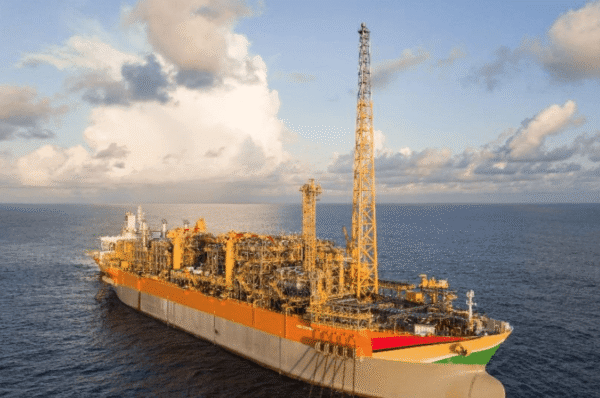
Guyana’s oil output continued its upward trajectory in the first two months of 2026, with government data released Monday confirming average production of 918,000 barrels per day (bpd) in February — a modest but meaningful climb from the 915,000 bpd recorded in January.
Both figures represent a dramatic acceleration from Guyana’s 2025 full-year average of 716,000 bpd, underscoring how rapidly the small South American nation has scaled its offshore operations.
The growth has firmly established Guyana among the top oil producers on the continent — a transformation that has unfolded in just seven years since first oil was achieved at the Stabroek block in 2019.
All Four Stabroek Projects Beating Expectations
The Stabroek block is operated by ExxonMobil Guyana Limited, which holds a 45% working interest alongside Hess Guyana Exploration (30%) and CNOOC Petroleum Guyana (25%).
The block currently hosts four producing developments — Liza Phase 1, Liza Phase 2, Payara, and Yellowtail — all of which are delivering output above their original design targets.
Yellowtail, the most recent of the four projects, came online in August 2025 via the ONE GUYANA floating production, storage and offloading (FPSO) vessel — arriving four months ahead of schedule.
The project was initially designed to produce 250,000 bpd, but has since ramped to approximately 264,000 bpd, already surpassing its nameplate capacity.
“We think it’s feasible that this facility could produce around 290,000 barrels per day — that is sustainable.”
— Alistair Routledge, President, ExxonMobil Guyana
ExxonMobil Seeks Approval to Push Yellowtail to 290,000 bpd
ExxonMobil Guyana President Alistair Routledge confirmed last week that the company has filed an application with the Government of Guyana to increase Yellowtail’s production capacity from the current 263,000 bpd to approximately 290,000 bpd.
The government is currently reviewing the technical details of the proposal.
Routledge noted that the initial Yellowtail Environmental Impact Assessment envisioned production at 250,000 bpd, though the vessel was built with a recognized capacity of 263,000 bpd to account for operational reliability margins.
ExxonMobil has previously conducted debottlenecking programmes across all three other Stabroek FPSOs — Destiny, Unity, and Prosperity — extracting additional barrels at relatively low incremental cost.
At 290,000 bpd, Yellowtail alone would account for roughly one-third of Guyana’s current total national output — a remarkable output density for a single FPSO development.
Uaru and Whiptail Coming: Road to 1.7 Million bpd by 2030
The current production figures are just an intermediate milestone in a much larger expansion.
Construction is underway for the fifth and sixth approved Stabroek developments — Uaru and Whiptail — with Uaru anticipated to begin production in 2026 and Whiptail targeted for 2027 startup. Each is expected to contribute approximately 250,000 bpd.
A seventh project, Hammerhead, has been sanctioned with an estimated cost of US$6.8 billion and is expected to come online in 2029.
It will be developed via an FPSO with approximately 150,000 bpd capacity, bringing total installed capacity across the Stabroek block to 1.5 million bpd.
An eighth development, the Longtail gas and condensate project, is targeting a final investment decision in 2026 with the potential to produce up to 290,000 bpd of condensate alongside major gas volumes.
ExxonMobil’s stated target is to reach 1.7 million barrels of oil equivalent per day across eight Stabroek developments by 2030 — a figure that would place Guyana among the world’s significant mid-tier producers and rival the national output of established OPEC members.
A Transformed Economy — and Growing Scrutiny
Guyana’s oil boom has generated significant macroeconomic transformation. The rapid scaling from first oil in 2019 to nearly one million barrels per day by early 2026 represents one of the fastest upstream production ramp-ups in modern petroleum history.
Revenue flows from the Stabroek block have allowed the government to fund infrastructure, social programmes, and a major local content push, with Guyanese nationals now making up more than 67% of the country’s oil and gas workforce.
However, the pace and scale of development have also drawn scrutiny. Environmental groups and regional observers have raised concerns over the adequacy of EIAs for rapidly debottlenecked projects, the long-term fiscal implications of the production-sharing contract structure, and Guyana’s preparedness to manage sovereign wealth at scale as royalty and profit oil accumulates.
For now, the headline numbers tell an unambiguous story of a nation in the midst of a resource-driven economic acceleration — with production still well short of its projected peak and multiple major projects yet to come online.
Also Read
U.S. Senators Push for Tariff Probe into Construction Equipment Imports from Mexico
Caterpillar Spotlights Skilled Trades with Global Technician and Operator Challenges

With years of experience covering infrastructure projects, equipment, and engineering solutions, Yvonne brings in-depth analysis and practical insights to contractors, engineers, and industry stakeholders.
She is passionate about highlighting sustainable construction practices and the latest advancements that drive efficiency and safety on worksites.
- Why America’s Grid Expansion Is Creating a New Construction Boom - July 31, 2026
- U.S. Housing Starts Surge 19% in June, Signalling Strong Construction Activity Despite Decline in Building Permits - July 23, 2026
- 10 Benefits of Smart Buildings: How Intelligent Buildings Are Transforming Commercial Real Estate - July 21, 2026