

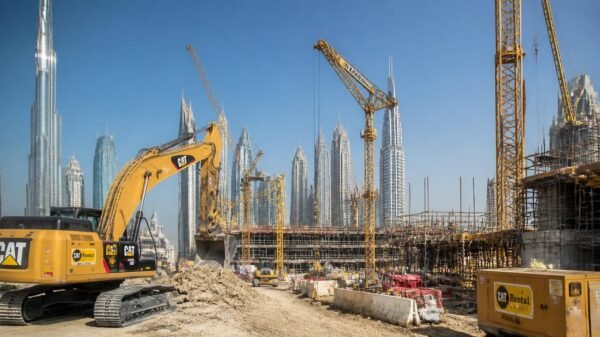
The Middle East and Africa (MEA) construction sector is entering a new phase of expansion as governments continue investing in transport, housing, energy and industrial developments.
From Saudi Arabia’s Vision 2030 to growing infrastructure programmes across Africa, contractors are managing larger and more diverse project portfolios while navigating changing economic conditions.
As project requirements evolve, equipment acquisition strategies change alongside them.
More contractors are incorporating rental fleets into their operations to improve financial flexibility, access newer technologies and scale equipment according to project demand.
Why Rental Models Are Gaining Momentum
The region’s strong project pipeline is creating sustained demand for heavy machinery.
A report from Research and Markets, distributed via GlobeNewswire estimated that the construction equipment market is projected to grow from USD 4.31 billion in 2025 to USD 6.74 billion by 2031, supported by a USD 2 trillion GCC infrastructure pipeline spanning Saudi Arabia, the UAE and Qatar.
At the same time, construction equipment rental trends continue accelerating.
The market report notes that Saudi Arabia’s equipment rental market is experiencing double-digit annual growth as contractors seek greater capital flexibility while supporting large-scale infrastructure programmes.
Equipment ownership has traditionally offered contractors greater fleet control, particularly on long-term projects. Today’s market conditions are shifting that calculation.
BY THE NUMBERS
- $2 trillion — GCC infrastructure pipeline cited in the market forecast
- $4.31 billion — MEA construction equipment market in 2025
- $6.74 billion — projected market size by 2031
- 35.75% — excavators’ reported share of the MEA construction equipment market in 2025
- Saudi Arabia — one of the region’s fastest-growing equipment rental markets
Contractors weighing equipment rental vs purchase construction decisions can also consider a practical rule of thumb — equipment used only once or twice a year often delivers greater value as a rental, while machines needed frequently throughout the year may justify the investment in ownership.
Factoring in expected utilisation, maintenance costs and project duration can help determine which approach offers the strongest long-term value.
This framework aligns with the increasingly flexible fleet strategies emerging across the Middle East and Africa as contractors adapt to changing project demands.
Another useful consideration is the break-even point. According to Peter Chambers of Renovated, buying becomes more cost-effective once ownership costs are offset through long-term use, while renting often suits shorter or less predictable timelines.
The same principle applies to construction equipment, where utilisation determines whether ownership delivers better long-term value.
The decision extends beyond finances. Mega-projects often require specialised machinery for limited phases of construction, making rentals an attractive option for contractors managing changing workloads across multiple sites.
A contractor may require large excavators during earthworks, followed by telehandlers or aerial lifts during structural and finishing work.
Rental fleets allow equipment to scale with each project phase while reducing the risk of underutilised assets between contracts.
Excavators Continue Leading Demand
Earthmoving equipment remains the backbone of GCC infrastructure development, with excavators accounting for 35.75% of the MEA construction equipment market in 2025, according to the Research and Markets GlobeNewswire report.
Their dominance reflects ongoing investment in transport networks, commercial developments, mining operations and large-scale urban expansion across Saudi Arabia, the UAE and Qatar.
Demand also extends into Africa, where road, energy and mining investments continue across South Africa, Kenya, Uganda and several West African markets.
Contractors supporting SANRAL road upgrades, battery mineral projects and renewable energy developments often require flexible access to heavy equipment as project schedules evolve.
RELATED STORIES
Technology Is Influencing Fleet Decisions
Technology upgrades are reshaping how contractors evaluate both owned and rented equipment.
While digital fleet management, telematics and predictive maintenance are becoming standard across modern fleets, diesel-powered machinery continues to dominate demanding construction applications.
Construction accounts for roughly 16% of the global diesel engines market, reflecting the extensive use of diesel engines in excavators, bulldozers, loaders, graders and cranes.
More than 80% of heavy construction equipment worldwide still relies on diesel power because it delivers the high torque and durability needed for continuous earthmoving, mining and infrastructure projects.
Engine technology is also becoming more efficient. Modern fuel management and engine mapping systems can reduce idle fuel consumption by nearly 15%, helping contractors lower operating costs on long-duration infrastructure projects.
For rental providers, these efficiency gains make newer fleets more attractive to customers seeking predictable fuel costs while benefiting from improved machine performance without the capital commitment of purchasing new equipment.
Why African Contractors Should Pay Attention
Although many headline projects are concentrated in the Gulf, the effects extend throughout Africa.
Original equipment manufacturers expanding production, dealer networks and service capabilities for GCC mega-projects frequently strengthen their regional supply chains, improving equipment availability across neighbouring markets.
This matters for contractors delivering transport corridors, mining developments and energy infrastructure throughout southern and eastern Africa.
Greater rental availability can improve access to modern fleets, reduce maintenance burdens and help companies respond more quickly to fluctuating project demand.
Keeping Up With the Shifting Market
As infrastructure spending accelerates across the region, the construction equipment rental market is becoming more than a financing option.
It is emerging as a strategic tool that enables contractors to remain competitive while preserving capital for future opportunities.
The sheer scale of today’s GCC infrastructure projects creates a market where a contractor’s success now hinges on balancing the stability of equipment ownership with the strategic flexibility of rentals.
Also Read
- Where Hyundai Is Winning the Excavator Race: The Markets Driving Its Global Growth
- Hyundai’s New HX210L: Why Earthmoving Contractors Should Pay Attention
- Caterpillar Posts Record Quarter as Construction Equipment Sales Surge 35%

- SODECA Highlights Industrial Ventilation Technology at Mega Clima Expo Kenya 2026 - October 14, 2026
- How They Were Built: Inside the Engineering of the Lesotho Highlands Water Project - October 11, 2026
- Africa’s Water Reuse Opportunity: Building the Infrastructure for a Water-Secure Future - September 28, 2026