

The global construction industry is entering a new phase of expansion, with investment increasingly concentrated in sectors that support artificial intelligence (AI), the energy transition and the modernization of critical infrastructure.
According to the Global Construction Insurance and Surety Market Report 2026, despite ongoing economic uncertainty, inflationary pressures and geopolitical risks, the outlook for the construction sector remains positive.
The report projects global construction output to grow from approximately US$17 trillion in 2026 to nearly US$22 trillion by 2030, creating significant opportunities for contractors, engineers, equipment manufacturers and project developers worldwide.
“As we approach the second half of 2026, there are meaningful opportunities and cause for optimism in the global construction industry—despite operating in an environment of persistent complexity,” the report states.
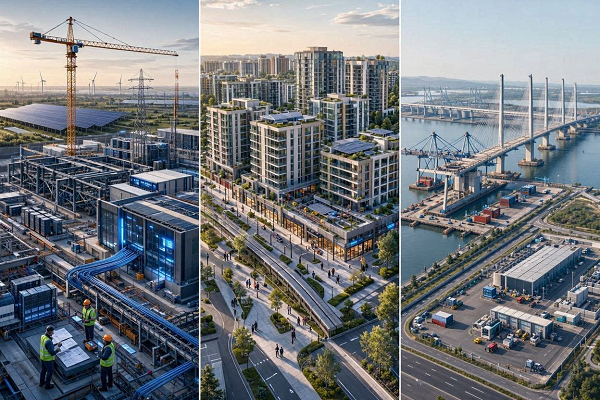
Rather than being driven primarily by commercial buildings or residential developments, the next wave of construction investment is being powered by three rapidly expanding sectors: digital infrastructure, power infrastructure and critical infrastructure.
1. Digital infrastructure: Building the foundation of the AI economy
Digital infrastructure has become one of the fastest-growing segments of the global construction market as artificial intelligence, cloud computing and data-intensive technologies transform economies.
The report identifies digital infrastructure as a primary engine of construction growth, reflecting unprecedented investment in hyperscale data centres, cloud facilities, fibre-optic networks and telecommunications infrastructure.
“Digital infrastructure, power infrastructure and other critical assets are the main engines of construction growth worldwide,” the report notes, highlighting the increasing importance of these sectors in supporting global economic development.
One of the strongest drivers is the rapid expansion of AI, which is dramatically increasing demand for high-performance computing facilities.
As companies deploy more advanced AI systems, they require larger and more sophisticated data centres capable of processing enormous volumes of information.
The report cites research indicating that global spending on data centre construction could reach approximately US$3 trillion by 2030, making it one of the largest construction opportunities of the decade.
For construction companies, this translates into increased demand for specialist civil works, mechanical and electrical installations, cooling systems, structural steel, concrete solutions and advanced project management expertise.
2. Power infrastructure: Meeting the world’s growing energy demand
The expansion of digital infrastructure is placing unprecedented pressure on electricity networks, making power infrastructure another major growth sector.
Countries across the globe are investing heavily in renewable energy generation, electricity transmission, battery energy storage systems and grid modernization to meet rising electricity demand while advancing decarbonization goals.
The report highlights power infrastructure as a key area of sustained investment, driven by the need to support both economic growth and the digital transformation of industries.
Large-scale solar farms, wind energy projects, hydropower developments and transmission upgrades are creating extensive opportunities for engineering and construction firms.
At the same time, many hyperscale data centre developments are being planned alongside dedicated power-generation facilities to ensure reliable electricity supply.
The convergence of AI, electrification and clean energy is expected to keep investment in power infrastructure strong throughout the remainder of the decade.
3. Critical infrastructure: Governments continue to modernize essential assets
Beyond digital and energy projects, governments continue to prioritize investment in critical infrastructure that supports economic growth and public services.
This includes transportation networks such as roads, bridges, railways, airports and ports, as well as water systems, healthcare facilities, educational institutions and other essential public infrastructure.
The report suggests that climate resilience is becoming an increasingly important factor in infrastructure planning, with governments investing in projects designed to withstand floods, storms, wildfires and other extreme weather events.
“Rising demand for resilient infrastructure will increase investment in the global construction industry,” the report states, reflecting the growing emphasis on sustainability and long-term asset resilience.
For contractors, this means a growing pipeline of infrastructure projects that not only replace aging assets but also improve resilience against future climate risks.
Technology is reshaping construction delivery
Technology is also changing how projects are designed, managed and insured.
Building Information Modelling (BIM), digital twins, remote monitoring systems and advanced data analytics are becoming standard tools on many major projects, enabling better planning, improved collaboration and more accurate risk assessment.
“Advanced technologies continue to reshape risk assessment and mitigation,” the report says, noting that these innovations are helping insurers better understand project risks while supporting improved loss prevention and underwriting decisions.
Construction companies that embrace digital technologies are expected to gain a competitive advantage through greater efficiency, improved project visibility and enhanced decision-making.
Challenges continue to test the industry
Despite the positive outlook, contractors continue to face several significant challenges.
Persistent inflation, volatile material prices, labour shortages, supply chain disruptions and geopolitical uncertainty continue to influence project costs and delivery schedules.
“Inflationary pressures on material and labor costs continue to intensify, compressing project margins while enlarging and complicating budgets,” the report warns.
It adds that shortages of skilled labour and increasingly complex regulatory requirements remain key concerns for project owners and contractors alike.
Cybersecurity has also emerged as an increasingly important issue as construction projects become more digitally connected through cloud-based management systems, connected equipment and smart infrastructure technologies.
Strong outlook despite global uncertainty
Although economic headwinds remain, the report concludes that construction market fundamentals remain robust.
Construction continues to account for approximately 13% of global GDP and supports around 220 million jobs worldwide, underlining its critical role in economic development.
Insurers also report improving market conditions across many regions, with increased competition and strong capital availability supporting well-managed projects.
“Insurers and regions remain well-capitalized and growth oriented, and market conditions, while varying by region and risk class, remain favorable for well-managed risks,” the report concludes.
As governments and private investors continue expanding digital infrastructure, strengthening power networks and modernizing essential public assets, these three sectors are expected to remain the primary drivers of global construction growth.
While contractors must continue navigating inflation, labour shortages and evolving risk landscapes, the industry’s long-term outlook remains positive.
The growing demand for AI infrastructure, clean energy and resilient public works is reshaping construction priorities and creating opportunities across the global value chain, positioning digital infrastructure, power infrastructure and critical infrastructure at the centre of the industry’s next growth cycle.
Also Read
- Global Construction Industry on Track to Hit $22 Trillion by 2030 as AI
- British Steel Nationalisation Raises Questions for Africa’s Infrastructure Partnerships

- Africa’s Water Reuse Opportunity: Why Treatment Plants Must Be Designed as Complete Systems - September 22, 2026
- From Operator to Algorithm: Bedrock Puts Autonomous Excavators to Work on Live Construction Sites - September 7, 2026
- Built For The Rough Stuff: Inside Titan’s new ForestEDGE™ Tyre Line - September 4, 2026
