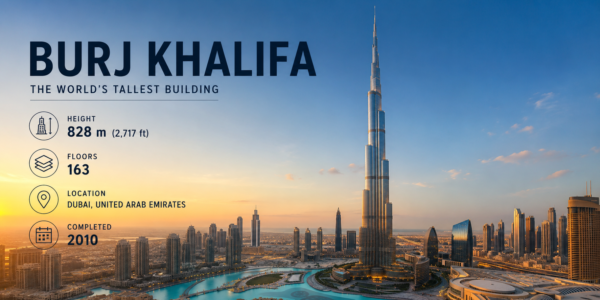
At 828 metres, the Burj Khalifa is not merely the world’s tallest building — it is the tallest structure humanity has ever erected.
When it opened its doors on 4 January 2010 in Dubai, United Arab Emirates, it shattered every skyscraper record that had come before it, standing more than 300 metres taller than its nearest rival at the time, Taipei 101.
It is visible on a clear day from over 95 kilometres away. From the top of its spire, you can see the curvature of the earth.
But the Burj Khalifa is more than superlatives. It is the story of a desert city’s relentless ambition, a flower-shaped structural system invented specifically to tame wind at height, concrete cooled with ice and pumped higher than any pump had gone before, and a global construction team of over 12,000 workers who, at peak, were adding one new floor every three days.
This is the story of how they built it.
From Vision to Blueprint: The Making of an Icon
The genesis of the Burj Khalifa lies in the strategic ambitions of Sheikh Mohammed bin Rashid Al Maktoum, Ruler of Dubai.
In the early 2000s, recognising that oil would not remain the emirate’s economic engine indefinitely, Dubai set out to reposition itself as a global hub for tourism, commerce, and finance. An iconic centrepiece was deemed essential.
The instruction was simple and audacious: build the tallest building the world had ever seen.
The design mandate was awarded to the prestigious American architectural firm Skidmore, Owings & Merrill (SOM) of Chicago — the same firm behind the Sears Tower and One World Trade Center.
Lead architect Adrian Smith and chief structural engineer Bill Baker were assigned to the project.
According to accounts of the design process, Smith found his inspiration not in other skyscrapers but in Lake Point Tower in Chicago, whose three-winged curved form he observed from his office window.
The conceptual design, however, drew its deepest inspiration from an unlikely botanical source: the Hymenocallis, also known as the spider lily — a rare flower cultivated in Dubai and India.
The spider lily’s spiralling, layered petals, radiating symmetrically outward from a central column, provided the exact geometric template that Smith and Baker needed to solve the tower’s most fundamental engineering problem: how to keep an 828-metre structure stable in high desert winds.
The structural system that Baker developed became known as the buttressed core system. At its heart is a central hexagonal reinforced concrete core, with three Y-shaped wings radiating outward at 120-degree intervals.
Each wing buttresses the others, creating mutual structural support that allows the building to resist lateral wind loads without the need for a tuned mass damper — the heavy pendulum system used in Taipei 101 and other supertall towers.
The tower’s wings also step back as they rise, progressively reducing the floor plate at each setback. This tapering and twisting reduces wind load by an estimated 30 to 40 percent, because the wind never encounters the same building geometry twice as it climbs.
Originally designed to peak at around 560 metres — which would have made it the tallest building in the Middle East — the project’s ambitions were radically revised upward as competing projects emerged globally.
The final height of 828 metres was kept confidential until 2007, more than two years into construction.
Laying the Foundation: Engineering the Desert Floor
Before a single floor could be built, engineers faced an immediate and profound challenge: the ground beneath Dubai is not the solid, stable substrate on which conventional skyscrapers are typically erected.
The desert subsoil is a complex mix of loose sand, weak rock, and chemically aggressive groundwater laden with sulphates and chlorides that would rapidly corrode ordinary concrete and steel.
The foundation design that emerged was both massive and innovative.
A reinforced concrete raft foundation — a single, continuous concrete mat — was specified at 3.7 metres thick and 50 metres by 50 metres across, poured in four separate pours totalling 12,500 cubic metres of concrete.
Beneath this raft, 192 bored reinforced concrete piles, each 1.5 metres in diameter and 43 to 50 metres long, were driven into the ground to reach competent bearing strata.
The concrete used throughout the foundation — and indeed the entire structure — was not ordinary.
Sulphate-resistant Portland cement, blast-furnace slag, and silica fume were blended to produce a high-density, low-permeability concrete capable of withstanding the chemical assault of the local groundwater.
An underground cathodic protection system was installed to further shield the steel reinforcement from corrosion over the building’s design life.
Geotechnical studies for the foundation were led by Hyder Consulting, the UK-based engineering firm that served as supervising engineer for the entire project.
Excavation work began in January 2004 and the foundation took approximately a year to complete — before the superstructure could climb even a single floor above grade.
Rising Floors: The Construction Machine
With the foundations set, the construction consortium swung into operation.
The joint venture was led by Samsung C&T of South Korea — whose track record on the Petronas Twin Towers and Taipei 101 had demonstrated mastery of supertall construction — with a 55 percent share in the contract.
Samsung was partnered with Belgium’s BESIX Group at 30 percent and the UAE’s Arabtec at 15 percent. Turner Construction International, the American firm, served as overall construction manager, reporting to developer Emaar Properties.
At peak construction, over 12,000 workers were on site simultaneously, working day and night in rotating shifts to maintain an around-the-clock construction rhythm.
The workforce was drawn predominantly from South Asia. The project recorded 22 million total man-hours worked across its full duration.
“At the fastest point during construction, the team was completing
one new floor every three days.”
A key structural innovation was the use of a jump-form formwork system — a hydraulically self-climbing framework that anchored to the already-poured concrete walls and used them as the support from which to pour the next level.
This system allowed the core walls to be built ahead of the floor slabs, creating a continuous upward momentum.
The central hexagonal core walls and the three wing walls were constructed first, giving the structure its lateral stiffness before the floors were added.
The wall concrete mix varied in strength from C80 to C60 cube compressive strength, with Portland cement and fly ash used throughout.
The stronger mixes were used in the lower sections where loads are greatest, stepping down to lighter specifications in the upper floors.
The Concrete Challenge: Ice, Pumps, and a World Record
If there is one engineering story within the Burj Khalifa story that captures the imagination of structural engineers worldwide, it is the concrete. Pumping concrete to the heights required for this building was, quite simply, something no one had ever done before.
Ordinary concrete would not work. In Dubai’s extreme summer heat — temperatures routinely exceed 45 degrees Celsius — standard concrete cures too rapidly, losing workability before it can be pumped and cast at altitude.
At the same time, the immense pressure required to push concrete vertically through kilometres of pipeline risked causing the water to separate from the aggregates in a process called segregation, producing weak, unusable concrete at the pour point.
Engineers developed a bespoke High-Performance Concrete (HPC) mix with a compressive strength of up to 100 MPa.
But mix design alone was insufficient. To retard the curing process in desert heat, ice was added to the concrete at the batching plant, chilling the mix before it entered the pump.
Concrete was also typically poured at night, when temperatures were lower, further slowing premature curing.
Above 606 metres, the structure transitions from reinforced concrete to a lighter structural steel framework.
This hybrid approach — concrete for the massive lower structure where wind and gravity loads are most critical, steel for the spire and upper sections — reduced the weight of the upper tower while maintaining the required structural performance.
The total concrete used across the project was 330,000 cubic metres; total steel rebar used was 55,000 tonnes.
Burj Khalifa: Key Construction Statistics
Taming the Wind: 40 Tests and a Twisting Tower
At 828 metres, wind is not merely an inconvenience — it is the dominant structural force governing every design decision.
Engineers at SOM, in collaboration with wind engineering consultants at RWDI, conducted more than 40 separate wind tunnel tests on the Burj Khalifa across the entire design and construction period.
These ranged from preliminary tests to establish Dubai’s wind climate, to full structural analysis model tests, to facade pressure testing, to microclimate studies around the base and terraces, to tests of tower crane positioning during the construction phase itself.
The results of these tests informed one of the tower’s most critical — and cleverly understated — design moves: the progressive stepping and twisting of the building’s profile as it rises.
At each setback, the building presents a different cross-section to the wind, breaking up and disrupting the formation of organised vortex shedding — the rhythmic swirling that causes structures to sway dangerously in high winds.
Because the wind constantly encounters a new geometry as it ascends the tower, vortices never have the opportunity to organise into a synchronised oscillation.
The system is elegant precisely because it requires no active mechanical damping.
A secondary wind phenomenon studied in detail was the stack effect: the pressure and temperature differential between ground level and the building’s upper floors, which in a supertall structure can create significant airflow through elevator shafts, stairwells, and mechanical risers.
A dedicated study was conducted to quantify this effect and design appropriate mechanical countermeasures.
The Facade: 26,000 Panels Against the Desert Sun
The Burj Khalifa’s exterior skin is one of the most sophisticated building envelope systems ever constructed.
The curtain wall system covers more than 174,000 square metres and consists of over 26,000 reflective glass panels, aluminium spandrel panels, and textured stainless steel vertical fins.
Each standard panel measures approximately 1.4 metres wide by 3.3 metres tall and weighs around 360 kilograms.
The glass was specially engineered to address Dubai’s extreme solar conditions.
High-performance reflective coatings dramatically reduce solar heat gain and UV transmission, reducing the building’s cooling load and protecting interiors and occupants.
The facade also integrates thermal performance values calibrated to handle the temperature differential between Dubai’s ground-level extremes — which can exceed 48 degrees Celsius in summer — and the estimated 6 degrees Celsius cooler conditions at the spire.
Installation of the curtain wall system was itself a logistical undertaking of significant complexity, with specialised climbers and access systems required to work at extreme altitude. The exterior was completed on 1 October 2009.
Moving People in a Vertical City
The Burj Khalifa is, in practical terms, a city stacked vertically. It houses a 304-room Armani Hotel across 15 floors, 900 private residential apartments on floors 19 to 108, corporate offices, the At.
mosphere restaurant on the 122nd floor (one of the highest restaurants in the world), and the world-famous observation decks — At the Top on the 124th floor and At the Top SKY on the 148th floor.
Moving people efficiently through this vertical city required an entirely new approach to lift engineering.
The building is served by 57 elevators and 8 escalators. Among them are the world’s fastest double-deck elevators, which travel at up to 10 metres per second (36 km/h), climbing from the ground to the sky lobbies on floors 43 and 76 in under a minute.
The elevator systems were designed and installed by Otis, working through a complex interfloor zoning strategy to manage peak demand without requiring a lift on every floor for every destination.
Refuge floors — pressurised, fire-resistant floors with independent air supplies — are located at 25 to 30 floor intervals throughout the tower, providing safe haven in emergency evacuations.
These floors were designed in accordance with UAE Fire and Life Safety Code requirements and both British Standards and American Codes, with the reinforced concrete structure providing significantly greater fire resistance than equivalent steel-frame alternatives.
The Opening: A Name Revealed
The Burj Khalifa was called Burj Dubai throughout its entire construction period. On 17 January 2009, the last section of the spire was raised into position and the tower reached its full height of 828 metres.
The remainder of 2009 was devoted to interior fit-out, mechanical commissioning, facade completion, and preparation of the hotel, restaurants, and observation facilities.
The official opening ceremony took place on 4 January 2010, with a spectacular fireworks display launched from the building itself and a laser and light show visible across Dubai.
It was at the ceremony that the name change was announced: the tower would henceforth be called Burj Khalifa, in honour of Sheikh Khalifa bin Zayed Al Nahyan, President of the UAE.
Sheikh Khalifa had organised critical federal financial support for developer Emaar Properties during the stress of the 2008 global financial crisis, and the naming was both a tribute and an acknowledgement.
Legacy and Lessons for the Construction Industry
The Burj Khalifa permanently shifted the parameters of what the global construction industry believes is possible.
It proved that reinforced concrete — long considered the domain of mid-rise and high-rise structures, not supertalls — could be engineered to heights previously thought to belong exclusively to steel.
Its buttressed core system, invented by Bill Baker for this specific project, has since become an accepted structural solution for the next generation of supertall towers.
Its concrete pumping record — 606 metres in a single lift — established new performance baselines for pump manufacturers and concrete technologists globally.
The ice-chilling technique for managing concrete workability in extreme heat has been adopted on desert construction projects from Saudi Arabia to Qatar.
The wind tunnel testing protocols developed for the Burj Khalifa, incorporating the full range of tests from preliminary wind climate mapping through construction-phase crane testing, are now considered best practice for any supertall project.
The building’s aerodynamic stepping and twisting — the technique of confusing the wind through geometry rather than mechanical damping — is studied in structural engineering programmes worldwide.
The Burj Khalifa also became the benchmark against which every subsequent height ambition is measured.
Adrian Smith, who left SOM after the project’s completion to found his own firm, went directly into the design of what is intended to be its successor: the Jeddah Tower in Saudi Arabia, planned to exceed 1,000 metres. The race it ignited has not ended.
Also Read
How They Were Built: Engineering Christ the Redeemer
Inside Nairobi’s Le’Mac Tower Auction: Which Properties Are Being Sold and Why?

- PV Guangzhou 2027 to Highlight Solar and Energy Storage Technologies - October 22, 2026
- Accurate and Reliable Measurement and Monitoring of Industrial Plant Water Treatment - October 21, 2026
- SODECA Highlights Industrial Ventilation Technology at Mega Clima Expo Kenya 2026 - October 14, 2026