

The Rule Every Coating Inspector Knows
Ask any NACE-certified coating inspector what single factor most determines the longevity of an industrial coating system, and the answer comes back almost without pause: surface preparation. Not the coating product.
Not the applicator’s skill. Not the primer formulation or the topcoat chemistry. The substrate condition before the first drop of paint ever lands on it.
This is not a matter of opinion. It is codified in every major international standard — ISO 8501, SSPC, NACE, and AS/NZS 1627 — and backed by decades of field failure analysis.
The oft-cited ‘80 percent rule’ in industrial coatings is a practical distillation of what the data consistently shows: the overwhelming majority of premature coating failures are attributable not to defective products or poor application technique, but to inadequate or improperly executed surface preparation.
For asset owners, project managers, and procurement teams operating in Africa’s construction, infrastructure, and heavy equipment sectors — where assets may be exposed to coastal chloride environments, high UV flux, mining dust, or aggressive chemical contact — understanding this principle is not academic.
It is the difference between a coating that protects a structure for its design life and one that begins delaminating within eighteen months.
The Science: Why the Substrate Decides Everything
Adhesion Is a Surface Phenomenon
Industrial coatings adhere to substrates through a combination of mechanical interlocking and chemical bonding. Mechanical adhesion depends on the surface having sufficient anchor profile — the microscopic peaks and valleys that allow the coating to ‘key in’ as it cures.
Chemical adhesion requires a substrate that is free of contaminants which would prevent molecular-level bonding between the coating binder and the metal surface.
Both mechanisms fail when the surface is improperly prepared.
Mill scale — the hard, brittle iron oxide layer formed during steel fabrication — has essentially no adhesion to the base steel and will delaminate under thermal cycling and moisture ingress, taking any overlying coating with it.
Soluble salt contamination (chlorides, sulfates, nitrates) creates osmotic cells beneath the coating film, driving blistering and cathodic delamination even when the coating appears intact on the surface.
The Corrosion Cell Under the Coating
Chloride ions in particular are the most damaging contaminant in coastal and marine environments.
They are highly soluble, they penetrate coating films over time, and they act as electrolyte catalysts in the electrochemical corrosion process.
The SSPC-SP 5 / NACE No. 1 standard (White Metal Blast Cleaning) specifically requires the removal of all soluble salts to a level below 2 μg/cm² (measured as sodium chloride equivalent) for immersion and marine service precisely because even trace contamination below a coating film will initiate corrosion.
Structures along the East African coast — from Mombasa to Dar es Salaam — and in South Africa’s coastal industrial zones face airborne chloride deposition rates that can exceed 100 mg/m²/day in the most exposed locations.
In these environments, the margin for error on surface cleanliness is essentially zero.
The Standards Framework: ISO 8501 and Beyond
The internationally recognised benchmark for surface cleanliness of steel is ISO 8501-1, which defines four preparation grades (Sa 1 through Sa 3 for blast cleaning, and St 2 / St 3 for hand and power tool cleaning).
Each grade has a corresponding photographic reference standard. The following table summarises the grades, their typical applications, and their performance implications.
Surface Preparation Standards at a Glance
| Standard / Grade | Method | Description | Typical Application |
|---|---|---|---|
| ISO Sa 1 / SSPC-SP 6 | Abrasive Blast | Light blast; removes loose mill scale, rust and paint. | Temporary protection and non-critical service. |
| ISO Sa 2 / SSPC-SP 10 | Abrasive Blast | Near-white blast; removes about 95% of contaminants. | Infrastructure, pipelines and industrial coatings. |
| ISO Sa 2½ / SSPC-SP 10 | Abrasive Blast | Industry standard for severe-environment coatings. | Offshore, coastal and mining structures. |
| ISO Sa 3 / SSPC-SP 5 | White Metal Blast | 100% free of visible contaminants and coatings. | Immersion service and water tanks. |
| ISO St 2 | Hand / Power Tool | Thorough cleaning with light metallic lustre. | Maintenance overcoating. |
| ISO St 3 | Power Tool | Very thorough cleaning with clear metallic lustre. | Spot repairs and maintenance. |
| SSPC-SP 1 | Solvent Cleaning | Removes oil, grease and soluble contaminants. | First step before mechanical cleaning. |
It is important to note that ISO Sa 2½ is the de facto minimum requirement specified by most premium coating manufacturers for high-performance epoxy and polyurethane systems.
Applying a specification-grade coating over an inadequately prepared surface does not merely reduce performance proportionally — it can render the entire system ineffective, as the failure mechanism is initiated from the substrate up.
Anchor Profile: The Invisible Architecture of Adhesion
Beyond cleanliness, surface preparation must also achieve an adequate anchor profile (or surface roughness), quantified in micrometres and specified by coating manufacturers in their product data sheets.
The anchor profile provides the mechanical interlocking surface that dramatically increases the effective contact area between substrate and primer.
Profile depth is typically specified as a range, not a target. Most industrial epoxy primers specify a profile of 40–75 μm (Rz), measured per ISO 8503-2 using comparator discs or profilometry.
Going below this range reduces adhesion; exceeding it can cause pinholes at the high points of the profile (‘peaks’ that protrude through thin film coatings) and increases coating consumption.
The abrasive media selected for blast cleaning directly determines the profile achievable. Steel grit produces an angular profile ideal for epoxy systems; steel shot produces a rounded, peened profile better suited to certain anti-corrosion primers.
Copper slag and garnet produce intermediate profiles and are widely used in African project markets. The choice of abrasive should be specified in the coating procedure, not left to the subcontractor’s preference.
✔ Critical Inspection Points Before Coating Application
| ✓ | Surface cleanliness grade confirmed against ISO 8501-1 photographic standards |
| ✓ | Anchor profile measured and within specified range (ISO 8503-2) |
| ✓ | Soluble salt contamination tested (Bresle patch or equivalent) and results recorded |
| ✓ | Surface temperature minimum 3°C above dew point |
| ✓ | Relative humidity below coating manufacturer’s specified maximum (typically ≤85%) |
| ✓ | No surface condensation visible; substrate dry to touch |
| ✓ | Blast profile re-cleaned if surface left overnight or flash rusting is observed |
| ✓ | Inspection results signed off and logged before primer application commences |
Contamination: The Hidden Failure Mechanism
Soluble Salts
Soluble salt contamination is arguably the most insidious surface preparation problem because it is invisible to the naked eye.
Chloride, sulfate, and nitrate ions from marine aerosols, industrial fallout, or handling contamination embed in corroded steel and are not removed by abrasive blasting alone.
They must be measured and, if above the project threshold, mitigated through high-pressure fresh water washing prior to blasting or through a secondary decontamination step after blasting.
The Bresle patch test (ISO 8502-6 / ISO 8502-9) is the standard field method for measuring soluble salt levels.
Many premium coating specifications now require measurements to be documented on a hold point in the inspection and test plan (ITP), meaning application cannot proceed until acceptable results are achieved and signed off.
Oil and Grease
Hydrocarbon contamination from metalworking fluids, hydraulic oil, or handling is the most common cause of adhesion failure in fabrication shop environments.
The critical rule: SSPC-SP 1 (solvent cleaning) must always be performed before any mechanical preparation.
Blasting over an oily surface simply drives the contamination into the newly created anchor profile, where it will prevent primer penetration and create an internal release layer.
Flash Rusting
In high-humidity environments — common in East Africa’s coastal regions, particularly during the long and short rain seasons — freshly blasted steel can begin flash rusting within minutes of exposure.
Coating manufacturers distinguish between light flash rusting (acceptable for some primers) and moderate-to-heavy flash rusting (which requires re-blasting).
The practical implication is that blasting and coating application must be coordinated within tight timeframes, typically two to four hours, and the ambient conditions must be monitored continuously.
The Cost of Getting It Wrong: A Business Case for Premium Preparation
For asset owners and procurement managers evaluating the cost of thorough surface preparation, the arithmetic is straightforward. The table below illustrates the lifecycle cost differential between three preparation scenarios for a hypothetical 10,000 m² industrial structure in a C4 (high corrosivity) environment.
Why Surface Preparation Determines Long-Term Coating Economics
| Preparation Strategy | Upfront Cost | Service Life | Recoat Cycles (20 Years) |
Total 20-Year Cost |
|---|---|---|---|---|
| Minimal Preparation Hand Tool Cleaning (St 2) |
Low | 3–5 Years | 4× | Very High |
| Intermediate Preparation Abrasive Blast (Sa 2) |
Moderate | 8–12 Years | 2× | Moderate |
| Best-Practice Preparation Sa 2½ + Salt Testing |
Higher | 18–25 Years | 0–1× | Lowest |
Scenario C consistently produces the lowest total lifecycle cost despite the highest initial preparation cost.
This is because recoating is not simply a matter of applying paint: it involves shutting down operations, erecting access scaffolding, disposing of deteriorated coating material (which may now carry regulatory requirements), and managing the significant risk of structural section loss from corrosion if recoating is deferred.
In mining, port, and process plant environments, operational downtime alone can dwarf the cost of the coating system itself.
What Best-Practice Surface Preparation Looks Like in the Field
Step 1: Pre-Blast Degreasing (SSPC-SP 1)
All surfaces must be degreased with a suitable solvent or detergent solution before any mechanical preparation. This step is non-negotiable and frequently skipped on price-driven projects — invariably with expensive consequences.
Step 2: Initial Salt Surveys
In coastal, offshore, or contaminated environments, baseline soluble salt surveys should be conducted on representative areas of the substrate before blasting commences. This establishes whether decontamination washing will be required and informs the project hold point requirements.
Step 3: Abrasive Blast Cleaning
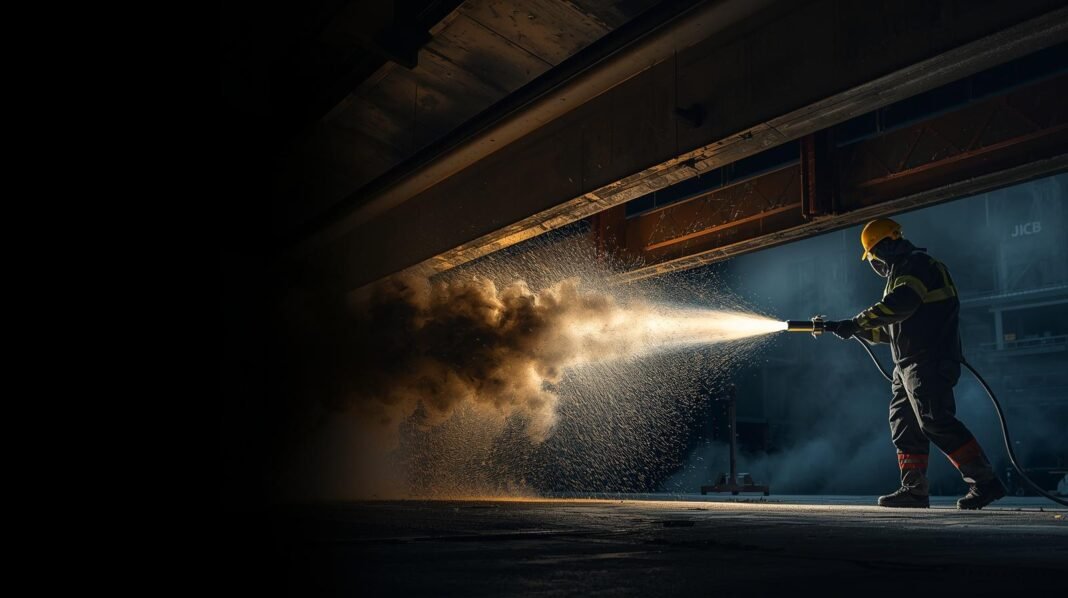
Blasting should be performed to the specified cleanliness grade and anchor profile using approved abrasive media. The blast operator’s qualifications, abrasive type, compressor output (minimum 690 kPa / 100 psi at the nozzle), nozzle condition, and standoff distance should all be defined in the surface preparation procedure. Wet blasting or vacuum-enclosed blasting are increasingly specified for maintenance work where environmental containment is required.
Step 4: Post-Blast Inspection and Salt Testing
Immediately after blasting and before any primer is applied: cleanliness grade is confirmed visually against ISO 8501-1 photographic standards; anchor profile is measured; and soluble salt levels are tested. All results are recorded on the ITP. Any area failing to meet specification must be re-prepared before proceeding.
Step 5: Ambient Condition Verification
Surface temperature and relative humidity must be measured and recorded at the point of application, not just at the start of the shift. The surface must be at least 3°C above the dew point. These measurements should be repeated every two hours in variable conditions.
Step 6: Application Window Management
From final blast to primer application, the window must be controlled. In C4–C5 environments, two hours is the typical maximum. If this window is exceeded or if visible flash rusting develops beyond the ‘light’ category, the surface must be re-blasted. There are no shortcuts here.
For Specifiers and Procurement Teams: Asking the Right Questions
When evaluating coating contractors and surface preparation proposals, premium asset owners should be asking the following questions before any work commences:
- What surface preparation standard is specified, and is it matched to the coating system and the exposure environment?
- How will soluble salt contamination be measured and documented, and what are the project acceptance limits?
- What abrasive media will be used, and does it achieve the manufacturer’s specified anchor profile range?
- What are the hold points in the ITP, and who has sign-off authority before each subsequent step?
- How will ambient conditions (temperature, humidity, dew point) be monitored and recorded during application?
- What is the contractor’s plan for flash rust management in high-humidity conditions?
- Are blast operators and coating inspectors certified to the relevant standard (NACE, FROSIO, or equivalent)?
The answers to these questions will reveal more about the likely performance of a coating system than any product data sheet. A contractor who cannot answer them with specificity is not ready to execute to industrial coatings standards.
The Margin Is in the Preparation
Industrial coating technology has advanced significantly over the past two decades. High-build epoxies, moisture-tolerant primers, zinc-rich formulations, and ceramic-reinforced topcoats offer genuinely exceptional corrosion protection under the right conditions.
But all of these technologies share a common prerequisite: a properly prepared substrate.
The 80% rule is not a critique of coating products. It is a statement about where investment, attention, and quality control must be concentrated if a coating system is to deliver its design-life performance.
For the structures, plant, and equipment that keep Africa’s infrastructure, mining operations, and construction projects operational, that investment is not a cost — it is the asset protection strategy.
Surface preparation done right is invisible. You see only the finished, protected structure. Surface preparation done wrong is eventually unmistakeable — in blistering paint, rust runs, structural section loss, and the cost of doing it all again.
Standards & Further Reference
- ISO 8501-1:2007 — Preparation of steel substrates before application of paints and related products: Visual assessment of surface cleanliness
- ISO 8502-6 / ISO 8502-9 — Tests for assessment of surface cleanliness: Extraction of soluble contaminants (Bresle method)
- ISO 8503-2 — Surface roughness characteristics of blast-cleaned steel substrates
- SSPC-SP 1 through SP 10 / NACE equivalent standards — Surface Preparation Specifications
- AMPP (formerly NACE) TM0174 — Laboratory Methods for Evaluation of Protective Coatings on Metal Substrates
- ISO 12944 — Paints and varnishes: Corrosion protection of steel structures by protective paint systems
Also Read
Battling the Elements: Choosing the Right Protective Primers for Coastal Steel Structures
The Low-VOC Shift: How Commercial Coatings Are Meeting Stricter Green Building Standards

- Africa’s Water Reuse Challenge: Why Scaling Matters More Than Technology - September 22, 2026
- UK Construction Sector Contracts Again as Housing Weakness Weighs on Industry - July 16, 2026
- What Indian Solar Firms Need to Know Before Entering Africa’s Market - July 15, 2026
