

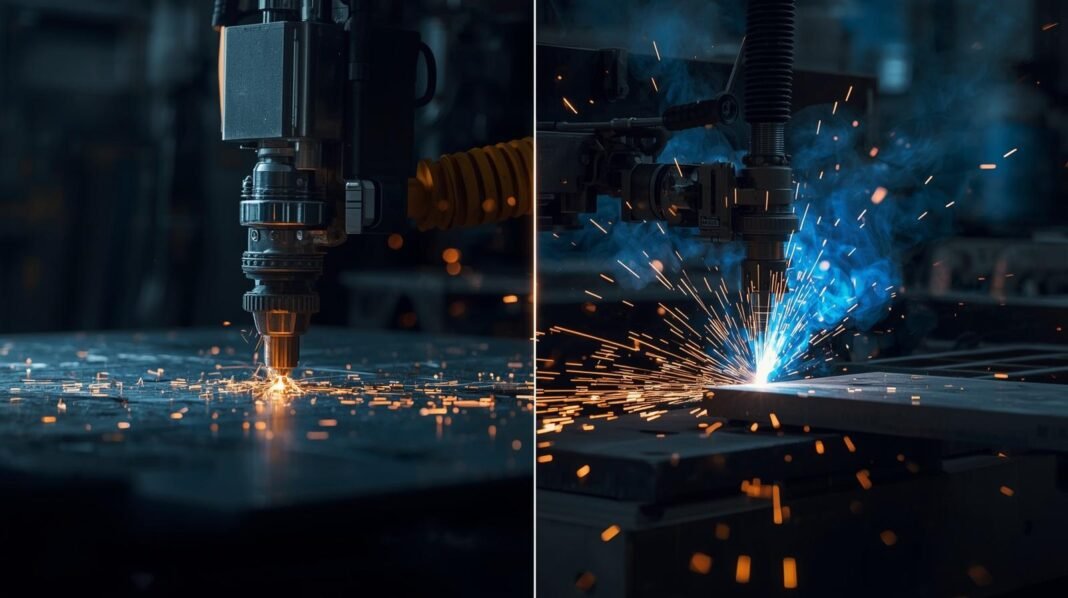
When it comes to cutting steel, two technologies dominate the modern fabrication shop floor: laser cutting and plasma cutting.
Both rely on intense heat to slice through metal, both are commonly driven by computer numerical control (CNC) systems, and both can produce impressive results — yet they are fundamentally different in how they work, what they cost, and where they excel.
Choosing the wrong method for a project can mean wasted material, blown budgets, and hours of grinding away rough edges. Choosing the right one can be a genuine competitive advantage.
This guide breaks down everything you need to know about laser cutting vs plasma cutting in steel fabrication, from the underlying physics to real-world cost figures, so you can make an informed decision for your next project.
How Each Technology Works
Laser Cutting
Laser cutting uses a highly concentrated beam of light — LASER stands for Light Amplification by Stimulated Emission of Radiation — to melt, burn, or vaporize steel along a precisely programmed path.
A stream of assist gas (typically oxygen or nitrogen) blows the molten material away, leaving a clean kerf. The process is non-contact, meaning the cutting head never touches the workpiece, which eliminates mechanical stress and tool wear.
Today’s industrial laser cutters are predominantly fiber lasers, which have largely displaced older CO₂ technology due to their higher efficiency, faster speeds, and lower maintenance requirements.
Modern systems routinely operate at power levels between 6 kW and 20 kW, with cutting-edge machines reaching 30 kW and beyond — a dramatic leap from the 500 W to 2 kW systems that were standard a decade ago.
Plasma Cutting
Plasma cutting takes a very different approach. An electrical arc superheats a conductive gas — typically compressed air, nitrogen, or argon — to temperatures that can reach up to 40,000°F (22,000°C), transforming it into the fourth state of matter: plasma.
This intensely hot, ionized gas stream is directed through a constricted torch opening onto the workpiece, melting the steel and blowing the molten metal away.
Because plasma relies on electrical conductivity to generate the arc, it can only cut conductive metals — steel, aluminum, stainless steel, and copper among them.
However, it imposes no restrictions on surface condition; it will cut through painted, rusted, or scaled steel that would first need surface preparation for laser cutting.
Precision and Cut Quality
This is where the two technologies diverge most sharply.
Laser cutting has earned a well-deserved reputation for exceptional accuracy. Tolerances as tight as ±0.002 inches (0.05 mm) are achievable, and the cut surfaces are smooth, burr-free, and sharp-edged — often requiring little to no post-processing.
This makes laser cutting ideal for intricate profiles, fine notching, decorative metalwork, and parts that must fit together with minimal adjustment.
Plasma cutting produces a wider kerf and is known for somewhat poorer perpendicularity, meaning the cut edge can have a slight bevel rather than a perfectly square face.
Slag and burrs on the cut edge are common, typically requiring grinding, bead blasting, or other secondary finishing operations before the part is ready for use.
For structural components where ultra-fine detail is not critical, this is an acceptable trade-off — but for precision assemblies or decorative work, it is a meaningful limitation.
Material Thickness: Where Each Method Wins
Thickness is arguably the most important variable when choosing between these two technologies, and both have clearly defined sweet spots.
Laser cutting excels on thin to medium-gauge steel. Modern high-power fiber lasers can cut up to 25 mm (roughly 1 inch) of mild steel, 19 mm of stainless steel, and 12.7 mm of aluminum with excellent quality. Below 1.25 mm, laser is nearly twice as fast as plasma. In the thin sheet range, nothing else comes close for speed and precision combined.
Plasma cutting comes into its own on thicker materials. Industrial plasma systems can cut steel plates exceeding 50 mm (2 inches) in thickness — territory where most laser systems struggle to penetrate at all.
For structural steel fabrication, heavy equipment manufacturing, shipbuilding, and construction, where plate thicknesses routinely exceed 25 mm, plasma remains the dominant choice for raw cutting power.
The crossover point has been shifting, though. High-power fiber lasers at 20 kW and above are now capable of cutting 25–30 mm mild steel at competitive speeds, encroaching on what was traditionally plasma’s exclusive domain.
A 12 kW fiber laser can cut 12 mm mild steel three to five times faster than plasma — a performance gap that would have seemed impossible just a few years ago.
Speed and Productivity
Cutting speed is rarely a simple comparison because it varies with material type, thickness, power level, and system configuration. A useful rule of thumb:
- Thin steel (under 3 mm): Laser is dramatically faster — often two to three times the speed of plasma.
- Medium steel (3–12 mm): Laser maintains a speed advantage, particularly with high-power fiber systems.
- Thick steel (over 25 mm): Plasma typically wins on speed and cost-efficiency. The plasma cost of cutting 25 mm carbon steel can be 44% lower per metre than laser at that thickness.
Beyond raw cutting speed, laser systems offer near-zero setup time for job changeovers, and their CNC integration allows for rapid switching between complex profiles without tooling changes — a significant productivity advantage in job shops handling varied work.
Cost Comparison: Equipment and Operations
Cost is where plasma cutting’s case is most compelling — at least on the surface.
Capital investment for plasma cutting is substantially lower. Entry-level CNC plasma tables start around $10,000–$20,000, while industrial-grade systems run $20,000–$100,000.
Laser cutting systems are a much more significant commitment: industrial fiber lasers typically range from $50,000 to $500,000, with the most powerful high-definition systems exceeding $1 million.
Operating costs tell a more nuanced story. Laser cutters average around $20 per hour to operate, compared to roughly $15 per hour for plasma.
However, laser systems carry lower consumable costs over time — the primary ongoing expenses are the laser source itself (which lasts many years) and occasional lens replacements.
Plasma systems, by contrast, require frequent replacement of electrodes, nozzles, and torch components due to the extreme heat and wear of the process.
The hidden cost advantage of laser cutting lies in post-processing. Because laser-cut edges are clean and burr-free, parts often go directly to the next fabrication stage without grinding or finishing.
Plasma-cut parts frequently require additional labor before they are ready — a cost that is easy to overlook when comparing machine rates alone.
A complete, honest cost comparison must account for:
- Equipment purchase or lease cost
- Operating rate (energy, gas, consumables)
- Post-processing labor
- Material yield (laser’s narrower kerf wastes less material)
- Maintenance frequency and downtime
When all these factors are considered, laser cutting often delivers a lower cost per finished part for thin-gauge, high-precision work, while plasma maintains a clear advantage in high-volume, thick-plate cutting where finish quality is secondary.
Industry Applications
Laser cutting is the technology of choice in:
- Aerospace and defense components
- Automotive body panels and precision parts
- Medical device manufacturing
- Electronics enclosures
- Custom architectural metalwork and signage
- HVAC ductwork and light-gauge fabrication
Plasma cutting is preferred for:
- Structural steel fabrication and construction
- Shipbuilding and offshore platforms
- Heavy equipment and agricultural machinery manufacturing
- Pipeline and pressure vessel fabrication
- Demolition and salvage cutting in the field
Many fabrication shops invest in both technologies to cover the full spectrum of work — plasma for heavy structural cutting, laser for detail work and thin-gauge production.
Environmental and Safety Considerations
Both processes produce fumes and particulate matter that require proper ventilation and extraction.
Plasma cutting, however, generates considerably more smoke, slag, and noise than laser cutting, and plasma torches emit radiation that requires workers to use appropriate eye protection.
Stricter environmental regulations in manufacturing are creating additional pressure on plasma cutting operations, particularly in markets with high regulatory standards.
Fiber laser systems, by comparison, produce a smaller environmental footprint — a consideration that is increasingly factored into equipment decisions as sustainability targets become embedded in manufacturing strategy.
Laser cutting does introduce its own safety requirements: the high-powered beams used in industrial cutting are invisible to the naked eye and can cause serious injury. Enclosed cutting systems with appropriate interlocks are standard in professional installations.
The Shifting Landscape: Fiber Laser’s Growing Dominance
The competitive balance between these two technologies has changed significantly in recent years, and the trend is unmistakable.
The global fiber laser cutting machine market, valued at approximately $2.06 billion in 2024, is projected to reach $3.19 billion by 2033.
The broader laser cutting machines market is forecast to grow from $6.85 billion in 2025 to $14.14 billion by 2032.
As fiber laser prices have come down and power levels have climbed into the 20–30 kW range, the traditional “plasma domain” of thick plate cutting is shrinking.
A 20 kW laser can now cut material thicknesses that previously required plasma, with better edge quality and no post-processing.
For shops that once needed two plasma tables, a single high-power fiber laser can often consolidate the work.
Plasma is not disappearing — it remains unmatched for very thick plate cutting (over 40–50 mm) and for situations where budget constraints make laser investment impractical.
But for most thin-to-medium steel fabrication, fiber laser has become the standard that modern shops aspire to.
Making the Right Choice
Neither technology is universally superior. The right choice depends on your specific production requirements, material thickness, precision demands, and budget. Here is a practical framework:
Choose laser cutting when:
- Working with steel under 25 mm thick
- Part precision and edge quality are critical
- Intricate profiles or fine detail work is required
- Post-processing time and labor need to be minimized
- You are running high-volume production of varied profiles
Choose plasma cutting when:
- Cutting steel plate over 25 mm (up to 50+ mm)
- Budget constraints make laser investment prohibitive
- Working in field or construction environments
- Surface condition of the material (rust, paint, scale) is variable
- Speed on thick plate outweighs precision requirements
Laser cutting and plasma cutting both have legitimate and important roles in modern steel fabrication.
Plasma brings raw power, affordability, and unmatched capability on thick plate; laser brings precision, clean edges, speed on thin material, and an increasingly competitive case even at higher thicknesses as fiber laser technology advances.
The fabricator who understands both technologies — their strengths, their limits, and the cost dynamics of each — is better positioned to make smart equipment decisions, quote jobs accurately, and deliver parts that meet specification the first time.
In an industry where margins are tight and competition is fierce, that knowledge is worth more than any single piece of equipment.
This article was last updated in May 2026. Technology specifications and pricing figures are representative of current industrial systems and may vary by manufacturer, region, and configuration.
Also Read
Metal Fabrication in Construction: How Steel Structures Are Built
What Is Deep Reactive Ion Etching (DRIE)? A Complete Beginner’s Guide

- Africa’s Water Reuse Opportunity: Why Treatment Plants Must Be Designed as Complete Systems - September 22, 2026
- From Operator to Algorithm: Bedrock Puts Autonomous Excavators to Work on Live Construction Sites - September 7, 2026
- Built For The Rough Stuff: Inside Titan’s new ForestEDGE™ Tyre Line - September 4, 2026
