

The American industrial sector is experiencing its most significant transformation in decades.
Across the country, massive industrial parks are rising from the ground, representing billions in construction investment and signaling a fundamental shift in how America manufactures, distributes, and innovates.
These aren’t your grandfather’s factory complexes—they’re cutting-edge facilities designed for electric vehicles, advanced logistics, and next-generation manufacturing.
For construction professionals, these projects represent both opportunity and evolution. The scale, complexity, and technological requirements of these developments are pushing the industry to new heights.
Let’s explore ten of the most significant industrial park projects currently reshaping America’s construction landscape.
1. Hyundai Metaplant: Georgia’s Electric Vehicle Colossus
Location: Savannah, Georgia
Scale: 17 million square feet
Status: Limited production began October 2024
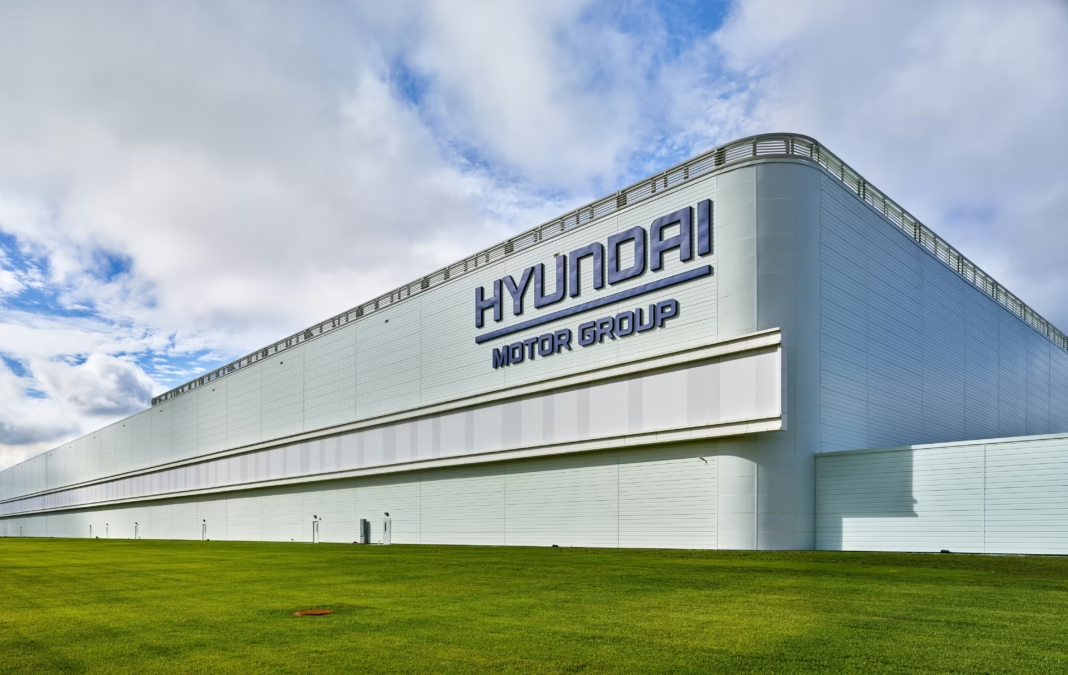
The numbers alone tell a compelling story. Hyundai’s Metaplant isn’t just large—it’s monumental. With capacity to produce 300,000 electric vehicles annually, this facility represents the single largest industrial construction project underway in 2025.
What makes this project particularly interesting from a construction standpoint is its integrated approach.
Rather than separate facilities for different production stages, the Metaplant consolidates battery manufacturing, component assembly, and final vehicle production under one massive roof.
This required construction teams to coordinate multiple specialized systems simultaneously—from clean rooms for battery production to heavy-duty assembly line infrastructure.
The construction timeline has been aggressive, with crews working around the clock to meet production targets. For contractors involved, this project has provided invaluable experience in building next-generation manufacturing facilities that will define industry standards for years to come.
2. BlueOval City: Ford’s Tennessee Transformation
Location: Memphis, Tennessee
Scale: 10 million square feet across 4,000+ acres
Status: Production expected late 2025
Ford’s BlueOval City represents more than just a manufacturing plant—it’s an entire industrial ecosystem.
The 4,000-acre site includes the main manufacturing facility, a dedicated supplier park, and SK Innovation’s battery production complex, creating an integrated supply chain within a single development.
From a construction perspective, BlueOval City has required unprecedented coordination. Multiple contractors are building different sections simultaneously, each with unique requirements but all needing to integrate seamlessly.
The supplier park concept means that dozens of smaller facilities must align with the main plant’s timeline and specifications.
The project has created thousands of construction jobs and established new benchmarks for large-scale industrial development.
The lessons learned here about coordinating multiple contractors, managing complex logistics, and building at this scale will influence industrial construction for decades.
3. Central 9 Logistics Park: New Jersey’s Distribution Hub
Location: Old Bridge, New Jersey
Scale: 4.2 million square feet across nine buildings
Status: Multiple phases complete, ongoing development
The New York-New Jersey metro area has long needed modern logistics infrastructure, and Central 9 delivers.
This nine-building complex along Route 9 showcases how logistics facilities have evolved beyond simple warehouses into sophisticated distribution centers with advanced automation capabilities.
Each building in the complex presents unique construction challenges. Modern logistics facilities require specific ceiling heights (typically 32-40 feet), heavy-duty floor loading capacity, and extensive power infrastructure for automation systems.
Recent tenants like JD Logistics have leased significant space, validating the market demand and encouraging continued development.
Construction crews have had to maintain operations at completed buildings while continuing work on adjacent structures—a juggling act that requires meticulous planning and coordination.
4. Gateway Crossing: Dallas-Fort Worth’s Logistics Expansion
Location: Forney, Texas
Scale: 1.76 million square feet across three buildings
Status: Under development
The Dallas-Fort Worth metroplex continues its explosive growth, and Gateway Crossing positions itself at the heart of this expansion.
The three-building development takes advantage of Forney’s strategic location with access to multiple interstate highways and proximity to major distribution networks.
What’s noteworthy about this project is its focus on flexibility. The buildings are designed with adaptable floor plans that can accommodate various tenant needs, from e-commerce fulfillment to manufacturing distribution.
This requires construction teams to build in future flexibility—reinforced floors that can handle various equipment configurations, electrical systems with excess capacity, and layouts that facilitate easy reconfiguration.
5. AllianceTexas: The Mixed-Use Industrial Pioneer
Location: Fort Worth, Texas
Scale: Master-planned development with ongoing expansion
Status: Continuous development
AllianceTexas has been developing for years, but its ongoing expansion represents a unique approach to industrial development: the master-planned industrial community. Unlike single-purpose industrial parks, AllianceTexas integrates industrial, commercial, and even residential components.
For construction firms, this creates interesting challenges and opportunities. Projects range from massive logistics centers to advanced manufacturing facilities to supporting commercial infrastructure.
The diversity of construction types within a single development has attracted a wide range of specialized contractors and created a hub for construction innovation.
The development’s proximity to Fort Worth Alliance Airport—one of the world’s busiest cargo airports—adds another layer of complexity and opportunity. Facilities here often require specialized design considerations for rapid cargo handling and just-in-time logistics.
6. Merrill Commerce Center: Inland Empire’s Logistics Giant
Location: Ontario, California
Scale: Nearly 8 million square feet (Buildings 4, 5, and 7)
Status: Recent completion in 2024
The Inland Empire has become America’s logistics capital, and Merrill Commerce Center exemplifies why. Developed by Prologis, the completion of Buildings 4, 5, and 7 in 2024 added almost 8 million square feet of industrial space to an already massive complex.
California’s stringent building codes make construction here particularly challenging. Seismic requirements, energy efficiency standards, and environmental regulations mean that every aspect of construction requires additional engineering and specialized techniques.
The buildings incorporate advanced sustainability features, including solar installations, water reclamation systems, and energy-efficient climate control—all of which add complexity to the construction process.
The scale of material delivery alone presented logistical challenges. Concrete, steel, and other materials arrived in constant streams, requiring sophisticated on-site logistics to prevent construction delays.
For contractors, this project demonstrated the importance of supply chain management in modern industrial construction.
7. Camp Hall Commerce Park: South Carolina’s Manufacturing Hub
Location: Ridgeville, South Carolina
Scale: Master-planned industrial development
Status: Ongoing development
South Carolina has aggressively pursued advanced manufacturing, and Camp Hall Commerce Park is central to that strategy. Designed specifically to support automotive production and advanced manufacturing, the park features infrastructure built to exacting specifications.
The construction approach here emphasizes preparedness. Rather than building facilities for specific tenants, developers are creating ready-to-customize industrial shells with robust foundations, heavy power infrastructure, and adaptable layouts.
This “build ready” approach allows manufacturers to move in quickly while still customizing interiors to their specific needs.
For construction teams, this means building to higher standards upfront—stronger foundations, more electrical capacity, better climate control systems—creating facilities that can adapt to various manufacturing needs without major structural modifications.
8. Aldea Exchange: Phoenix’s Future Logistics Hub
Location: Phoenix, Arizona
Scale: 471,439 square feet across three buildings
Status: Construction starting Q3 2026, completion May 2027
While smaller than some mega-projects, Aldea Exchange represents the next wave of industrial development: strategically located, mid-sized facilities serving growing markets. Phoenix’s Southwest Valley submarket offers proximity to major distribution routes while providing room for expansion.
Provident Industrial’s development timeline gives us insight into modern construction planning.
The gap between land acquisition and construction start reflects the extensive planning required for modern industrial facilities—from environmental assessments to infrastructure coordination to tenant engagement.
Desert construction presents unique challenges: extreme heat affects concrete curing and worker safety, while Arizona’s monsoonal weather patterns require careful scheduling.
Experienced desert contractors have developed specialized techniques for these conditions, making Phoenix an interesting case study in climate-specific construction approaches.
9. SouthPoint Industrial Park: Jacksonville’s E-Commerce Gateway
Location: Jacksonville, Florida
Scale: Large-scale logistics development
Status: Ongoing development
Jacksonville’s strategic position—with a major port, multiple interstate highways, and rail connections—makes it ideal for logistics operations. SouthPoint Industrial Park capitalizes on these advantages, focusing specifically on e-commerce and rapid distribution facilities.
Modern e-commerce fulfillment centers require specialized construction approaches. High-density storage systems need stronger floors, automation systems require extensive electrical infrastructure, and rapid throughput demands efficient layouts.
Construction teams must work closely with e-commerce operators to understand their specific workflow requirements and translate them into physical spaces.
The park’s focus on state-of-the-art facilities means incorporating the latest in industrial construction technology: advanced climate control systems for temperature-sensitive products, sophisticated fire suppression systems for high-density storage, and layouts optimized for both human workers and automated systems.
10. Tahoe Reno Industrial Center: Nevada’s Tech and Manufacturing Expansion
Location: Northern Nevada
Scale: Ongoing expansion of existing mega-site
Status: Continuous development
TRIC has already made headlines as home to major tech and manufacturing operations, but its ongoing expansion demonstrates the site’s continued relevance.
The latest developments focus on attracting advanced manufacturing and technology companies, requiring specialized construction capabilities.
What makes TRIC particularly interesting is its evolution. Early buildings served primarily as distribution centers, but newer construction increasingly supports high-tech manufacturing and data operations.
This shift requires different construction approaches—clean rooms, advanced power systems, sophisticated climate control, and specialized security infrastructure.
Nevada’s construction environment offers advantages: favorable labor laws, lower regulatory burden compared to California, and proximity to both West Coast markets and mountain states.
For contractors, TRIC represents a proving ground for advanced industrial construction techniques without some of the constraints found in more regulated states.
What These Projects Mean for Construction
These ten industrial parks represent more than just building projects—they signal fundamental shifts in American construction:
Scale and Speed: Projects are larger and timelines more aggressive than ever. The Hyundai Metaplant went from groundbreaking to limited production in under three years—a remarkable achievement for a 17-million-square-foot facility.
Specialization: Each project requires specific expertise. EV manufacturing facilities need different construction approaches than logistics centers. Contractors are increasingly specializing in industrial niches.
Technology Integration: Modern industrial facilities aren’t just buildings—they’re complex systems. Construction must account for automation, advanced power systems, and future technology integration.
Sustainability: Green building isn’t optional anymore. Solar installations, water reclamation, energy-efficient systems, and sustainable materials are standard expectations.
Supply Chain Complexity: Managing material delivery for these massive projects requires sophisticated logistics. The construction industry is learning from the very logistics operations it’s building facilities for.
The Road Ahead
These projects represent billions in construction investment and tens of thousands of jobs. For construction professionals, they offer opportunities to work on cutting-edge projects that will define American industry for decades.
But they also present challenges: labor shortages, material cost volatility, aggressive timelines, and increasing technical requirements.
Success requires not just construction expertise but also project management sophistication, technology integration capabilities, and the ability to coordinate with multiple stakeholders.
As America continues its industrial renaissance, construction firms that can master the complexities of these large-scale industrial projects will find themselves at the forefront of the industry.
The lessons learned building today’s industrial parks will shape how we construct the factories, logistics centers, and manufacturing facilities of tomorrow.
The future of American industry is being built right now—one massive project at a time.
Also Read
7 Major Construction Projects Launching Across America in 2026
Africa’s Biggest PPP Projects to Watch in 2026

- Africa’s Water Reuse Opportunity: Why Treatment Plants Must Be Designed as Complete Systems - September 22, 2026
- From Operator to Algorithm: Bedrock Puts Autonomous Excavators to Work on Live Construction Sites - September 7, 2026
- Built For The Rough Stuff: Inside Titan’s new ForestEDGE™ Tyre Line - September 4, 2026
