
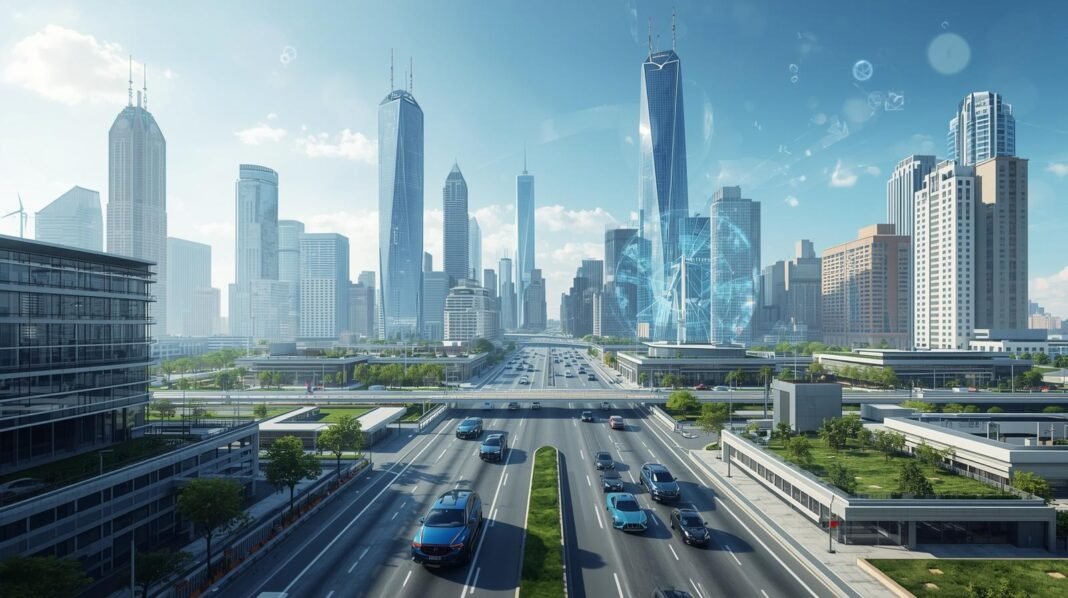
As 2026 approaches, American cities are undergoing unprecedented digital transformations that promise to reshape urban living.
With major global events on the horizon—including the 2026 FIFA World Cup, preparations for the 2028 Los Angeles Olympics, and billions in infrastructure investments—municipalities across the nation are racing to deploy cutting-edge smart city technologies.
These initiatives represent more than just technological upgrades; they’re comprehensive reimaginations of how cities can serve their residents more efficiently, sustainably, and equitably.
Los Angeles: Olympic Ambitions Drive Smart City Revolution
Los Angeles stands at the forefront of America’s smart city transformation, with its SmartLA 2028 initiative serving as perhaps the most ambitious municipal technology overhaul in the nation’s history.
The city’s strategic plan, developed by the Information Technology Agency in collaboration with 24 departments and elected officials, envisions a fully connected metropolis ready to showcase American innovation during the 2028 Summer Olympics.
The timeline is aggressive but achievable. By 2026, Los Angeles plans to establish public-private partnerships for an open-source IoT integration platform, creating the backbone for citywide smart infrastructure.
The initiative includes developing strategic plans for street lighting that incorporate shared IoT sensor devices and remote monitoring capabilities, all while maintaining city ownership and intellectual property rights.
What sets LA’s approach apart is its emphasis on equity and accessibility. The plan calls for a unified digital payment platform that seamlessly integrates Metro rail, buses, bikes, and shuttles—eliminating the friction that often prevents residents from using public transportation.
The city is also deploying ubiquitous 5G connectivity and smart wayfinding kiosks in multiple languages, ensuring that both residents and Olympic visitors can navigate the sprawling metropolis with ease.
Perhaps most innovative is LA’s focus on “ethical proactive technology” that can identify fire, violence, or other risks to public health and safety even before a 911 call is placed. This AI-powered approach to emergency response could fundamentally change how cities protect their residents.
While specific smart city components lack a dedicated price tag, the overall 2028 Games are estimated to cost approximately $7 billion, with smart infrastructure representing a significant portion of this investment.
New York City: Layering Innovation on America’s Largest Infrastructure
New York City faces a unique challenge in its smart city journey: retrofitting some of the world’s largest infrastructure systems—including the most extensive subway network globally with over 470 stations—with 21st-century technology.
The city’s approach combines ambitious pilot programs with practical, scalable solutions that address the needs of over 8.5 million residents.
Through the NYC Smart City Testbed Program, launched in 2023, the city is experimenting with emerging technologies before full-scale deployment.
Recent pilots focus on street and infrastructure safety, including pedestrian traffic monitoring using sensors that collect anonymized Wi-Fi data across six public spaces. This data helps city officials make informed decisions about staffing, design, and resource allocation in heavily trafficked areas.
Another groundbreaking pilot uses augmented reality to help communities visualize proposed construction projects.
Residents can scan QR codes at development sites to view 3D renderings that adapt based on their perspective, giving them a detailed understanding of how projects will impact their neighborhoods before ground is broken.
New York’s commitment to smart infrastructure extends beyond pilot programs. The city has retrofitted over 650 government buildings with LED lighting through its Accelerated Conservation and Efficiency program, preventing more than 900 metric tons of greenhouse gas emissions annually while saving over $800,000 per year.
The Department of Environmental Protection has deployed automated meter reading systems to over 800,000 properties, giving residents daily water consumption data instead of just monthly bills—a shift that encourages conservation and helps detect leaks before they become costly problems.
The city’s sanitation department, the world’s largest, collects more than 10,500 tons of trash daily using “BigBelly” smart bins.
These solar-powered receptacles are equipped with sensors that detect when bins are full, allowing for optimized collection routes. The bins’ built-in compactors hold five times more waste than conventional cans, improving collection efficiency by 50-80% while reducing emissions from garbage trucks.
Miami: Transit Transformation and Smart Living
Miami is leveraging its position as a rapidly growing tech hub to implement comprehensive smart city solutions focused on transportation and sustainable urban development.
The Strategic Miami Area Rapid Transit (SMART) Program is transforming public transportation across five major corridors, with the South-Dade Transitway upgrading to a top-tier Bus Rapid Transit system through 2025-2026.
The SMART upgrades go beyond simply adding buses. The system includes modern stations with real-time tracking, air-conditioned waiting areas, and integration with other transit modes—creating a more attractive alternative to personal vehicle use in a notoriously car-dependent metropolitan area.
Miami’s autonomous vehicle integration is particularly noteworthy. Waymo announced plans to expand its robotaxi services in the city in early 2025, with deployment on Miami streets throughout 2025 and public service anticipated by 2026 via the Waymo One app.
This positions Miami as a leader in autonomous vehicle integration, offering residents AI-driven commuting options while reducing carbon emissions.
Perhaps Miami’s most transformative project is the Little River District, a $3 billion, 63-acre mixed-use smart city development recently approved by the Miami-Dade County Commission.
Set to break ground in 2026, this project will create over 5,700 affordable and workforce housing units integrated with SKYX’s plug-and-play smart home platform technology.
Every residence will feature Wi-Fi, voice and app controls, emergency calling features, smart speakers, room-to-room intercom systems, emergency lighting, smoke and carbon monoxide detectors, and smart thermostats—making it one of the most comprehensive smart living developments in American history.
The development includes 370,000 square feet of retail space, 1.5 million square feet of green walkways and parks, and a new $35 million Tri-Rail station—demonstrating how smart city principles extend beyond technology to encompass sustainable urban design and transit-oriented development.
Developers are providing free internet access for all community apartments, addressing the digital divide while creating a connected ecosystem of over 500,000 smart home devices.
Denver: Innovation Districts and Connected Infrastructure
Denver’s smart city evolution centers on Peña Station NEXT, a “transit-oriented, mixed-use development” expected to be completed in 2026.
This partnership with Panasonic creates a testing ground for emerging technologies including Wi-Fi-enabled smart lighting, electric vehicle charging infrastructure, and renewable energy systems.
The 385-acre site near Denver International Airport aims to become an energy self-sufficient community that serves as a model for sustainable urban development.
The development includes office, retail, dining, outdoor, and residential space, all integrated with smart infrastructure that allows for real-time monitoring and optimization.
An autonomous shuttle service provides shared mobility within the community, demonstrating how transportation can evolve in purpose-built smart districts.
Beyond Peña Station, Denver continues implementing projects from its Department of Transportation Smart City Challenge participation, including connected vehicle networks and pedestrian detection systems at intersections.
The city received $6 million to fund these initiatives and is matching this grant with city funds to purchase as many as 1,500 connected electric city vehicles—a significant step toward electrifying municipal fleets while creating a network of vehicles that can communicate with infrastructure and each other.
Austin: Academic Excellence Meets Urban Innovation
Austin’s smart city transformation benefits from its unique partnership with the University of Texas at Austin, particularly through the Texas Smart Cities Project and the Good Systems initiative.
These programs combine academic research with practical municipal applications, creating a model for how universities can drive urban innovation.
The Good Systems project focuses on developing AI systems that link fragmented city datasets, enabling better decision-making within complex and dynamic environments.
The initiative has started with fire and smoke mitigation in Austin’s wildland-urban interface, using digital twin technology and real-time data to monitor critical infrastructure and visualize different scenarios.
Austin’s Smart Mobility Office actively pilots emerging transportation technologies, including connected vehicle pedestrian warning systems and LiDAR-based traffic analysis that works in any weather or lighting conditions.
These pilots test technologies before wider deployment, ensuring they meet Austin’s needs while providing valuable data for other cities considering similar implementations.
With an overall smart city preparedness score of 75.4 out of 100, Austin ranks as the best-prepared city in America for a smart city future, scoring particularly high on technology infrastructure (88/100) and green infrastructure (92/100).
This comprehensive foundation positions Austin to rapidly deploy new technologies as they mature.
Buffalo: Smart Streets Pilot Redefines Urban Corridors
Buffalo’s Smart Streets Design Plan represents a different approach to smart city development—focusing intensively on transforming specific corridors rather than attempting citywide implementation all at once.
The pilot project on Washington Street, expected to be completed in 2026, will serve as a model for smart streets throughout the city’s core and beyond.
The 2,000-foot corridor will prioritize all types of transportation enhancements, including bicycle and scooter lanes, heated sidewalks, curb extensions, and parking sensors.
The project also emphasizes fundamental improvements often overlooked in smart city plans: well-designed, accessible sidewalks; clearly visible crosswalks; code-compliant ramps; and pedestrian buttons that actually work.
This attention to detail alongside advanced technology demonstrates an important principle: smart cities aren’t just about deploying sensors and software—they’re about using technology to enhance basic urban services that residents depend on daily.
Buffalo’s approach of testing on a pilot street, monitoring results, and then scaling citywide offers a pragmatic model for cities without massive budgets.
The Broader Smart City Landscape
These major projects represent just the visible tip of a much larger transformation. Smart city investment in North America is projected to reach $750 billion by 2026, up from $3 trillion in 2017. This massive influx of capital is driving innovation across multiple sectors:
Digital Governance: Cities are deploying AI-powered 311 platforms and digital service portals that make it easier for residents to access government services, report issues, and engage with their local governments.
Energy Management: Smart grids and renewable energy integration are becoming standard, with cities deploying solar roadways, intelligent street lighting that adjusts based on need, and building management systems that optimize energy consumption.
Public Safety: Advanced sensor networks, predictive analytics, and computer vision technologies are enhancing emergency response while raising important questions about privacy and data governance that cities must address thoughtfully.
Climate Resilience: Smart technologies are essential for addressing climate change impacts, from flood monitoring systems and air quality sensors to platforms that help cities track and reduce greenhouse gas emissions.
Challenges and Considerations
Despite their promise, smart city projects face significant challenges. Data privacy concerns are paramount—as cities collect vast amounts of information about residents’ movements, behaviors, and needs, robust protections and transparent policies become essential.
Cybersecurity is another critical issue, as interconnected systems create potential vulnerabilities that could disrupt critical city functions.
Equity remains a persistent challenge. Without intentional design and inclusive implementation, smart city technologies risk exacerbating existing disparities rather than reducing them.
Cities must ensure that investments in technology don’t leave behind neighborhoods that need them most, and that digital services remain accessible to residents without smartphones or reliable internet access.
Looking Ahead
As 2026 approaches, American cities are at an inflection point. The projects launching and completing over the next year will demonstrate whether smart city technologies can deliver on their promises of improved efficiency, sustainability, and quality of life.
The upcoming major events—particularly the FIFA World Cup matches and preparations for the Los Angeles Olympics—provide both deadline and motivation for cities to showcase American innovation on the global stage.
What’s clear is that smart cities are no longer a futuristic concept but a present reality. The question isn’t whether American cities will become smarter, but how quickly they can implement these technologies in ways that benefit all residents.
The projects launching in 2026 will provide crucial lessons for cities across the nation and around the world, offering blueprints for urban transformation in an increasingly connected and urbanized world.
The success of these initiatives will ultimately be measured not by the sophistication of their technology, but by their impact on residents’ daily lives—whether they make cities safer, more accessible, more sustainable, and more livable for everyone who calls them home.
Also Read
10 Cutting-Edge Industrial Parks Underway Across America
7 Major Construction Projects Launching Across America in 2026

