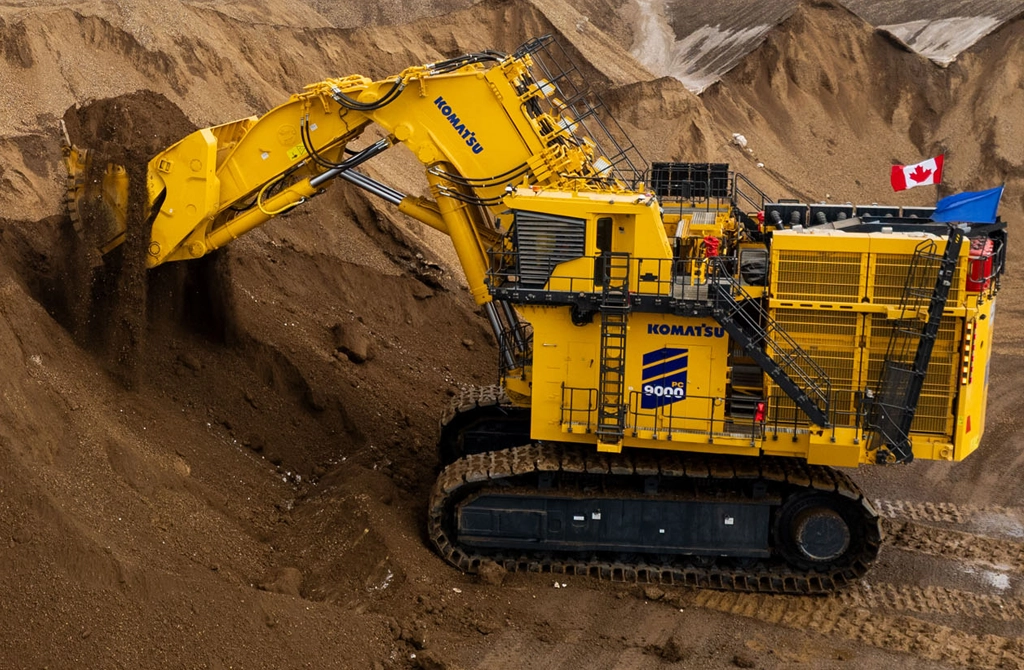
The Komatsu PC9000-12 hydraulic mining excavator belongs firmly in the second category.
Weighing in at nearly 896 tonnes — close to two million pounds — this colossal piece of equipment is not simply the largest hydraulic mining excavator Komatsu has ever built.
It represents a fundamental rethinking of what is possible when raw power, intelligent technology, and relentless efficiency converge in a single machine designed to reshape mountains.
Officially launched globally in April 2026 by Komatsu Germany Mining Division (KGM), the PC9000-12 marks a new chapter in the century-long story of a company that has never stopped pushing the boundaries of surface mining.
For mine operators facing mounting pressure to move more material faster, at lower cost per tonne, and with a smaller environmental footprint, the PC9000 arrives at precisely the right moment.
From Concept to Canada: The Birth of a Giant
The PC9000’s journey from engineering concept to working mine site was itself an extraordinary logistical feat.
The machine was first publicly revealed in 2024, developed by KGM with deep input from Komatsu’s global customer base — a deliberate, collaborative engineering process that shaped every major design decision.
The inaugural unit was delivered in May 2025 to Suncor’s Fort Hills oilsands operation in Alberta, Canada — a mine site that has long served as a crucible for innovation in heavy equipment.
The machine travelled 8,700 miles across oceans, rivers, and roads, arriving in 31 separate sections before a six-week assembly process at the mine transformed the freight into one of the world’s most powerful excavators.
The handover ceremony on May 1, 2025 was more than a commercial transaction.
It was the culmination of decades of partnership between KGM, Canadian distributor SMS Equipment, and Suncor — the same trio that previously introduced Canada’s first Autonomous Haulage System, the 980E haul truck, and the PC7000 front shovel to the country’s oil sands.
“The PC9000 is set to transform the future of mining,” declared Ansgar Thole, President and Managing Director of Komatsu Germany GmbH at the event. “This new class of hydraulic mining excavator raises the bar for productivity, efficiency and performance, while enhancing operator comfort and safety.”
Suncor was so convinced by the machine’s potential that a second PC9000 arrived by mid-2025, with further units scheduled into 2026.
Engineering at the Extreme Edge
Size and Weight
The PC9000-12 operates in a class of its own within Komatsu’s lineup. Measuring over ten metres in both width and height, it dwarfs its predecessor, the PC8000, in every critical dimension.
Its operating weight of up to 896 tonnes means the ground beneath it feels the force of roughly 180 adult African elephants standing together.
Bucket Capacity: Moving Mountains, One Scoop at a Time
The machine is available in two configurations. As a front shovel, it carries a 46 m³ bucket — roughly the volume of a large swimming pool. In backhoe configuration, the bucket grows to an even more formidable 49 m³.
Each pass lifts a payload of more than 80 tonnes of raw material — rock, ore, oil sands, or overburden — in a single bite.
These numbers translate directly into the metric that matters most on a mine site: cycle time.
The PC9000 can load a Komatsu 980E 400-short-ton haul truck in just five passes and complete the entire loading sequence in under 150 seconds — less time than it takes to brew a pot of coffee.
Under optimal conditions, this delivers a staggering production rate of approximately 8,000 tonnes per hour.
Reach and Digging Force
Beyond raw bucket size, the PC9000 brings longer reach and higher digging forces than any previous model in the PC series. Extended reach is not merely a performance statistic — it is an operational enabler.
Greater reach means the excavator can load trucks positioned further away, making it fully compatible with the wider spotting requirements of autonomous haulage systems and enabling the highly efficient double-sided loading that dramatically compresses truck cycle times.
Power Options: Diesel or Electric, Your Choice
One of the most significant engineering decisions embedded in the PC9000’s design is its powertrain flexibility. The machine can be configured with three distinct power options:
- Diesel Tier 4 — for operations in regions with strict emissions regulations
- Diesel Unregulated — for remote sites where Tier 4 fuel infrastructure is unavailable
- Full Electric Drive — powered by two electric motors, each delivering 1,700 kW, for a combined output of 3,400 kW
This is not a token gesture toward electrification. The electric drive configuration gives mining companies operating in jurisdictions with tightening emissions legislation — or those committed to net-zero roadmaps — a genuine path to decarbonising their largest, most energy-intensive pieces of equipment.
As Peter Buhles, Vice President of Sales & Service at KGM, stated at the global launch: “The PC9000-12 delivers the power, performance and reliability our customers expect, while supporting higher productivity, lower emissions per ton and seamless integration with autonomous haulage systems.”
The Intelligence Inside the Iron
Brute force alone does not define the PC9000. Komatsu has engineered an advanced digital nervous system into the machine, transforming it from a passive tool into an active participant in mine-site optimisation.
KOMTRAX Plus Telematics
The PC9000 features the latest generation of KOMTRAX Plus, Komatsu’s intelligent telematics platform.
From the operator’s cabin, all critical machine data is available in real time — and that data is simultaneously transmitted off-site, where it can be accessed through cloud-based analytics tools.
Fleet managers sitting thousands of kilometres away can monitor equipment health, track utilisation rates, and respond to emerging issues before they become costly failures.
MineCare Maintenance Management
Integrated with KOMTRAX Plus, the MineCare Maintenance Management System brings real-time remote health monitoring and advanced predictive analytics to the PC9000.
The system is designed to detect potential issues before they manifest as breakdowns, reducing unplanned maintenance events, maximising uptime, and cutting the total cost of ownership over the machine’s operational life.
ProVision Machine Guidance
For precision digging operations, the ProVision Machine Guidance System uses high-precision global navigation satellite system (HP-GNSS) positioning, capable of achieving up to 1 cm accuracy.
This guides operators to the exact material they should be excavating, maintains designed bench grades, respects dig limits, and helps truck operators spot precisely at the loading point.
In an industry where every unnecessary tonne of waste material moved costs money, centimetre-level precision is a competitive advantage.
KomVision 360° Safety Monitoring
The KomVision system equips the PC9000 with an array of high-definition cameras providing operators with a real-time bird’s-eye view of the machine’s entire working area.
In an environment where visibility is limited by the machine’s own massive structure, this all-around monitoring capability is a critical safety feature — protecting ground crew, spotters, and autonomous trucks operating in proximity.
DISPATCH Fleet Management System Integration
The PC9000 integrates natively with Komatsu’s DISPATCH Fleet Management System (FMS), which optimises load-and-haul cycle efficiency across the entire fleet.
By coordinating excavator loading patterns with truck dispatch timing, DISPATCH minimises both queue times (trucks waiting to be loaded) and hang times (excavators waiting for trucks), keeping the entire haulage system operating at peak throughput.
Built for Autonomous Mining
Perhaps the most forward-looking aspect of the PC9000’s design is its deep integration with Komatsu’s FrontRunner Autonomous Haulage System (AHS).
Surface mining is moving steadily toward autonomous operations, with self-driving haul trucks reducing labour costs, improving safety, and enabling around-the-clock operation without fatigue-related performance degradation.
Autonomous trucks impose stricter demands on excavators than human-driven fleets. Payloads must be placed with precision.
Cycle times must be consistent and predictable. Communication between excavator and truck fleet management systems must be seamless and reliable.
The PC9000 has been engineered from the ground up to meet these demands — its extended reach facilitating the precise truck spotting positions that autonomous vehicles require, and its digital systems fully capable of communicating with FrontRunner’s orchestration algorithms.
The PC9000 also supports efficient double-sided loading, meaning trucks can approach and be loaded from either side of the excavator.
This flexibility reduces dead travel time for the truck fleet and allows mine planners to design more efficient loading geometries — a critical advantage as operations scale up.
Reliability Built to Last
In ultra-class mining equipment, downtime is not merely inconvenient — it is catastrophically expensive.
A machine capable of moving 8,000 tonnes per hour sitting idle for maintenance represents an opportunity cost that can run into hundreds of thousands of dollars per shift.
Komatsu has addressed this reality with an engineering focus on longevity and maintenance efficiency throughout the PC9000’s design.
Key reliability features include:
- A slew ring with a 60,000-hour design lifespan — among the longest in the industry for a component of this type, providing decades of service on a well-maintained machine
- Hydraulic filters rated for 2,000-hour service intervals, dramatically reducing the frequency and cost of routine maintenance interventions
- A newly designed Hensley tooth system that delivers lower wear rates on ground-engaging tools, extending the intervals between bucket tooth changes and reducing consumable costs
- Fast and flexible sprocket exchange capability for longer trackpad lifetime, minimising the disruption of undercarriage maintenance
- A larger fuel tank enabling up to 25 hours of continuous operation before refuelling — meaning the machine can run through multiple shifts without a fuel stop on most sites
- Redesigned hydraulics and advanced cooling delivering cycle times of under 30 seconds per pass
- Variable swing motors that provide higher swing torque and faster swing speeds while maintaining fuel economy — a rare combination that directly reduces cycle time without increasing operating costs
Also Read
JCB Brings Its Heaviest Excavator to Kenya and Uganda as Infrastructure Demand Intensifies
Best Off Road Tyres for Heavy-Duty Construction and Mining Applications

- SODECA Highlights Industrial Ventilation Technology at Mega Clima Expo Kenya 2026 - October 14, 2026
- How They Were Built: Inside the Engineering of the Lesotho Highlands Water Project - October 11, 2026
- Africa’s Water Reuse Opportunity: Building the Infrastructure for a Water-Secure Future - September 28, 2026