
Corrosion Quick Fact
Corrosion costs the global economy more than $2.5 trillion annually—around
3.4% of world GDP. In coastal environments, steel structures located within
1 km of the shoreline can deteriorate up to 5× faster than inland assets.
Why Coastal Corrosion Is a Different Beast
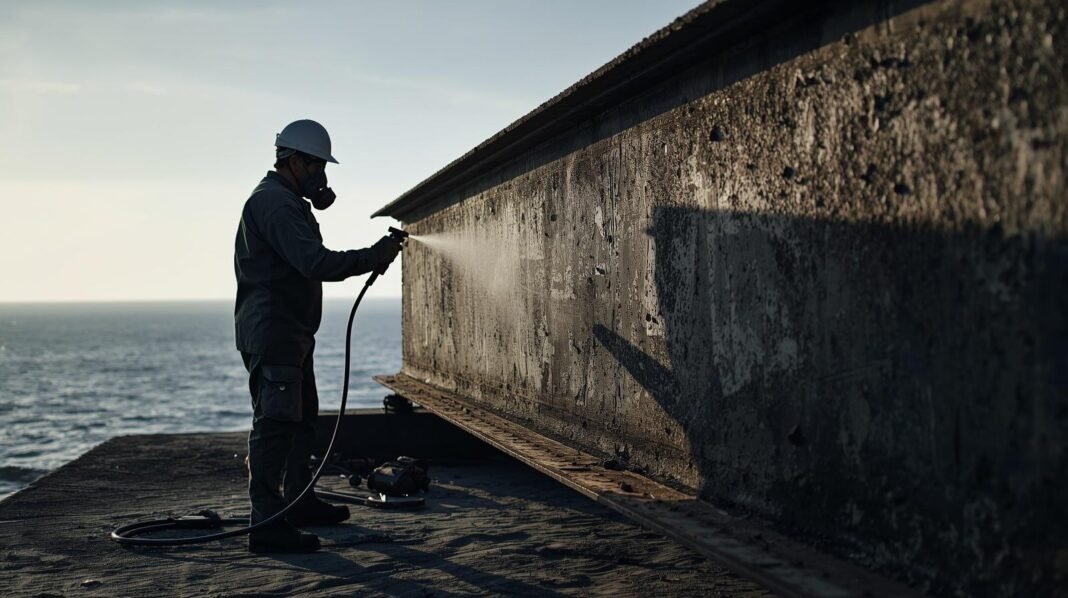
It would be tempting to treat a coastal structure as simply a “wet” application of standard protective coating principles.
But the electrochemical environment at the coast creates conditions that are fundamentally more aggressive than ordinary atmospheric exposure.
Chloride ions — abundant in sea spray and coastal fog — are small enough to penetrate most coating systems and catalyse anodic dissolution of steel at a rate that conventional inland specifications cannot adequately address.
This is compounded by the thermal cycling of tidal zones, UV degradation at splash zones, and biofouling in submerged sections. The result is a multi-threat corrosion environment that demands a multi-layer coating strategy built on the right primer foundation.
“In coastal corrosion control, the primer does more than adhere — it actively sacrifices, seals, or passivates. Choose the wrong chemistry for the exposure zone, and every topcoat layer above it is a false promise.”
Mapping Exposure Zones: The First Specification Decision
Before a single primer specification is written, the structure must be assessed against its precise exposure profile.
ISO 12944 classifies corrosivity into categories C1 through C5, with CX reserved for offshore environments. For coastal structures, engineers typically operate within C4 (high), C5 (very high), and CX (offshore/submerged) — each demanding meaningfully different primer chemistry.
The Four Dominant Coastal Primer Chemistries
Not all primers are created equal. In coastal environments, the chemistry behind a primer largely determines its long-term corrosion resistance, durability, and maintenance requirements. Each technology protects steel through a different mechanism and is suited to specific exposure conditions.
Zinc-Rich Epoxy
Provides sacrificial galvanic protection by allowing zinc particles to corrode before the steel substrate.
High-Build Epoxy Barrier
Creates a dense barrier that blocks moisture and chloride penetration, especially in severe marine environments.
Zinc Phosphate Epoxy
Uses passivating pigments to protect steel while delivering strong adhesion and cost efficiency.
Surface-Tolerant Epoxy
Designed for maintenance projects where ideal surface preparation is difficult or impossible.
System Design: The Primer Is Not Enough Alone
Specifiers who focus solely on primer selection without considering system compatibility risk undermining even the most technically sound choice. A coastal coating system is a precisely engineered stack, and each layer must be chemically and mechanically compatible with those above and below.
Zinc-rich primers, for example, require an intermediate epoxy mist coat when topcoated with polyurethanes to prevent solvent-induced “mud cracking” of the zinc layer. High-build glass flake epoxy intermediates can dramatically extend the effective life of a zinc primer in splash zones, converting a 10-year system into a 25-year one at a fraction of the long-term asset lifecycle cost.
- Surface preparation grade: ISO Sa 2.5 is the minimum for zinc-rich primers; ISO Sa 3 is required for inorganic zinc silicates. No primer overcomes inadequate prep.
- Zinc content verification: ISO 3549 specifies that “zinc-rich” organic primers must contain ≥80% zinc by weight in the dry film. Sub-specification products are widespread — verify independently.
- DFT monitoring: Dry film thickness tolerances are tighter in coastal systems; under-application of primer is the leading cause of premature system failure in inspection data.
- Application window compliance: Inorganic zinc primers have narrow humidity and temperature windows. Schedule applications carefully to avoid recoat contamination or inadequate cure.
- Cathodic protection compatibility: In Im2/Im3 submerged zones with impressed current cathodic protection, primer selection must account for cathodic disbondment resistance. Not all epoxies perform equally here.
What the Market Is Telling Specifiers
The protective coatings sector is responding to coastal infrastructure demand with a wave of product innovation that specifiers should monitor actively. Several trends are reshaping the primer landscape.
Ultra-High-Solids and Solvent-Free Formulations
Environmental compliance is driving rapid adoption of high-solids and solvent-free epoxy primers that dramatically reduce VOC emissions without sacrificing film-build performance.
The latest generation of these products achieves zinc-rich protection levels at application efficiencies previously impossible, making them increasingly competitive on both environmental and lifecycle cost grounds.
Waterborne Zinc-Rich Primers
Once considered a compromise technology, advanced waterborne zinc-rich primers have closed the performance gap considerably. For enclosed coastal structures — bridges with restricted ventilation, confined spaces in port infrastructure — they represent a genuinely viable alternative that eliminates solvent exposure risk for applicators.
Self-Stratifying and Duplex Systems
Among the most exciting innovations, self-stratifying primers separate into distinct functional layers during cure, delivering both sacrificial and barrier protection in a single-coat application.
While not yet mainstream for severe CX exposure, they offer compelling economics for C4–C5 coastal structures where application time directly drives project cost.
Smart Primers with Corrosion Inhibitor Release
Micro-encapsulated corrosion inhibitors embedded within primer matrices represent a frontier technology that is beginning to reach commercial specification.
When localised coating damage occurs, the microcapsules rupture and release inhibitors that temporarily arrest active corrosion — significantly extending the repair interval on large, difficult-to-access structures such as cable-stay bridge towers and offshore platforms.
Key Takeaways for Specifiers and Procurement Teams
Choosing the right protective primer for a coastal steel structure is not a catalogue exercise — it is a systems engineering decision informed by exposure classification, substrate condition, application method, system compatibility, and lifecycle economics. The following principles should anchor every specification process:
- Classify the corrosivity zone accurately before specifying — overspecifying has cost implications; underspecifying has far greater lifecycle ones.
- Treat the primer as a system component, not a standalone product — compatibility with intermediate and topcoat layers is non-negotiable.
- Verify zinc content independently for zinc-rich claims — regulatory and performance claims require substantiation on live projects.
- Interrogate manufacturer long-term performance data, not just accelerated test results — coastal exposure performance diverges significantly from salt spray chamber outcomes.
- Engage manufacturers at the design stage — specification-level influence creates better project outcomes and more sustainable supplier relationships than tender-stage competition alone.
Also Read
How Commercial Coatings Are Meeting Stricter Green Building Standards
Choosing the Right Spray Equipment for Mega-Projects

- Africa’s Water Reuse Opportunity: Why Treatment Plants Must Be Designed as Complete Systems - September 22, 2026
- From Operator to Algorithm: Bedrock Puts Autonomous Excavators to Work on Live Construction Sites - September 7, 2026
- Built For The Rough Stuff: Inside Titan’s new ForestEDGE™ Tyre Line - September 4, 2026
