

June 2026
Robotics & Welding Automation: Key Market Signals (2026)
Walk the floor of a mid-sized fabrication shop in 2026 and the old image of industrial automation — the thunderous, caged robot arm that only a Fortune 500 company could afford or operate — is giving way to something altogether different.
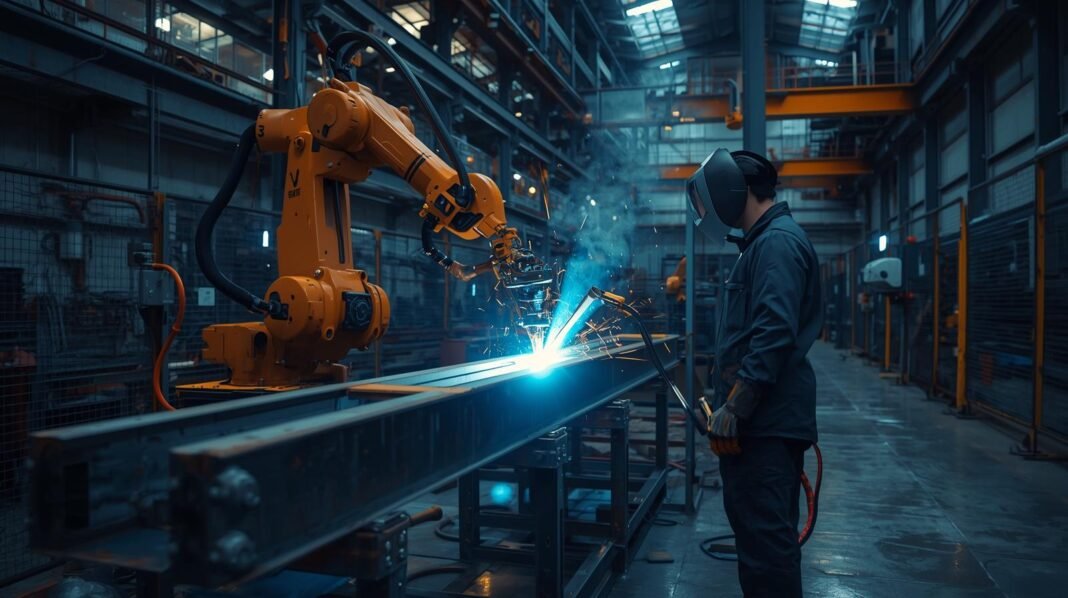
Compact, sensor-laden collaborative robots, known as cobots, are working shoulder-to-shoulder with human welders and fitters.
They ask for no safety cage, no dedicated robotics engineer, and no seven-figure capital commitment.
They ask, instead, for a decent parts programme, a trained operator, and a bottleneck worth solving.
That shift is not incidental. It reflects a structural transformation in the economics and technology of automation — one that is turning mid-tier fabrication shops from observers of the robotics revolution into active participants in it.
The Scale of the Change
The numbers underline the speed of the shift. The global collaborative robots market reached USD 3.06 billion in 2025 and is on track to hit USD 3.74 billion in 2026, growing at a compound annual rate of 22 percent through 2035, according to market analysis.
Crucially, small and medium-sized businesses now account for more than 42 percent of new cobot deployments, a statistic that would have been difficult to imagine even five years ago.
Within manufacturing, metal fabrication sits alongside automotive components and electronics as one of the highest-growth application sectors.
Cobot welding alone grew over 40 percent in 2025 and is projected to sustain strong momentum well into the decade, according to Robotomated’s 2026 cobot adoption report.
Installations of collaborative robot arms have increased year-over-year as unit prices declined and programming became more accessible — a virtuous cycle that is compressing adoption timelines for shops that once sat on the sidelines.
“Automation is no longer an all-or-nothing leap. Even smaller teams can put robotics to work and see meaningful gains — without losing the craftsmanship that makes their work valuable.” — American Welding Society, 2026
Why the Middle Market Is Moving Now
The question worth asking is not why fabrication shops are adopting cobots, but why they are doing so now, at this pace, and in this market segment specifically.
Part of the answer is a labour crisis that shows no signs of abating. The American Welding Society projects a shortfall of 400,000 welders in the United States by 2029.
More than 157,000 welders are approaching retirement age, and the industry needs 320,500 new entrants simply to cover attrition.
The average welder is now around 55 years old, versus 42 for the broader US workforce. Similar demographic pressures are playing out across European fabrication markets and, increasingly, in the more mature manufacturing hubs of Africa and Asia-Pacific.
For a mid-sized shop running two or three shifts, these numbers are existential. The traditional response — raise wages and hope to attract the dwindling supply of qualified trade workers — is delivering diminishing returns.
Cobots offer a different logic: augment the skilled workers you already have rather than competing for workers you cannot find.
The economics are now genuinely compelling at the mid-market level. An entry-tier cobot welding setup runs from USD 35,000 to 65,000 — compared to USD 80,000 to 150,000 for a conventional industrial welding cell once safety caging, dedicated mounting, facility modifications, and integrator fees are factored in.
A USD 40,000 to 50,000 cobot system replacing one full-time welder on a two-shift operation can achieve payback in as little as eight to ten months at current labour rates, according to manufacturer data.
Most shops see ROI within 18 to 36 months, with high-volume repetitive applications frequently coming in under 12 months.
What Cobots Can — and Cannot — Do on the Shop Floor
Cobots are not a universal solution, and fabricators who approach them with clear-eyed expectations consistently outperform those who over-automate.
The technology has well-understood strengths and real limitations that determine where it earns its place.
On the strengths side, cobots excel in high-mix, lower-volume production environments — precisely the conditions that define most mid-sized fabrication shops.
Programming a new part takes two to eight hours of teach-through rather than the two to five days of offline programming a conventional cell requires.
Their force-limiting and collision-detection safety features mean they can operate without safety fencing, sharing floor space with operators without extensive facility modifications.
And they can be redeployed: a cobot handling fillet welds on structural brackets in the morning can be reprogrammed for CNC machine tending the same afternoon.
The limitations are equally real. Cobots run at one to two metres per second in collaborative mode, well below the six metres per second of conventional industrial robots.
Arc-on time tops out at 50 to 65 percent for a typical cobot welding cell, compared to 70 to 85 percent for an industrial cell.
For continuous, high-throughput body-shop welding or very heavy fabrications, traditional caged systems remain the more effective investment.
The trade-off — some speed and throughput in exchange for flexibility, ease of programming, and shared floor space — suits fabrication job shops far better than it suits automotive volume producers.
Applications where cobots are delivering the strongest results in fabrication shops include:
- MIG and TIG welding of repetitive seams, straight lines, and simple curves
- CNC machine tending — loading and unloading parts without dedicated staffing
- Material handling and pick-and-place between fabrication stages
- Visual quality inspection using camera-equipped arms
- Grinding and finishing on consistent part geometries
The Software Edge: Where ROI Is Actually Made
Industry analysts are increasingly clear that the cobot hardware itself is becoming commoditised.
Universal Robots, FANUC’s CRX line, ABB GoFa, Doosan, and Techman all produce capable arms.
The differentiator in 2026 — the factor that determines whether a deployment generates exceptional returns or merely adequate ones — is the software stack sitting above the hardware.
AI integration is advancing rapidly across all major platforms. Enhanced machine vision now allows cobots to handle varied part presentations and packaging with less manual programming.
Cloud connectivity enables remote monitoring and predictive maintenance. Sensor-fused adaptive welding uses machine learning to adjust current, voltage, and travel speed in real time based on seam geometry and joint conditions, cutting rework on parts with fit-up variance and shortening ramp-up cycles for new part families.
Turnkey packages from providers like Vectis Automation, Hirebotics, and Cobot Systems have become particularly important for the mid-market.
These pre-integrated bundles reduce integration risk and can be deployed by shops without in-house robotics expertise.
Hirebotics’ Beacon platform, for instance, allows operators to control cobot welders through a smartphone or tablet interface — a deliberate design choice aimed at shops where no one holds a robotics engineering qualification.
Real Shops, Real Results
The most persuasive evidence for the mid-market cobot case comes from the shops that have made the leap.
Ohio-based metal fabricator Raymath deployed Universal Robots cobots for complex TIG welding, MIG welding, and CNC machine tending applications.
The company moved from three operators on a single shift to running three shifts per day with just one operator per shift — quadrupling production capacity. ROI came in under 12 months.
DeAngelo Marine, a shipyard fabricator in Gloucester, Massachusetts, deployed a cobot welder for a Coast Guard order requiring 200 inches of weld per unit. Manually, each unit took 100 minutes. With the cobot: 10 minutes.
A single order paid for the entire system. The math was not complicated, even if the seams were.
These are not outliers. The pattern is consistent: a shop with a well-defined bottleneck, a part mix that includes at least some repetitive geometry, and an operator willing to invest two to three days in programming training is a strong candidate for a successful deployment.
The Skilled Worker Equation
One of the most important cultural shifts accompanying cobot adoption is the reframing of what automation does to skilled workers.
The industry narrative has evolved considerably. The early anxiety — that cobots would simply displace qualified tradespeople — has given way, in the shops that are running this equipment daily, to a more nuanced reality.
Cobots handle monotonous, physically demanding, and ergonomically hazardous repetitive work: the long straight seams, the high-volume fillet runs, the CNC load cycles that grind away at a welder’s joints across a ten-hour shift.
OSHA data suggests welding causes 500,000 injuries annually in the United States — injuries that are disproportionately concentrated in exactly the repetitive tasks a cobot handles well.
Skilled welders, freed from that grind, can be redeployed to complex, high-value work that requires human judgment: multi-pass structural welds with challenging geometries, quality inspection, fixture setting, and the kind of adaptive problem-solving that no cobot can replicate.
The result, in well-managed deployments, is not headcount reduction but capacity expansion: the same team producing more, at higher quality, with lower injury risk.
What Fabricators Should Measure Before They Buy
The technology is mature enough that the deciding factor in most mid-market cobot investments is not the robot — it is the quality of the business case preceding it.
The fabricators generating the strongest returns are those who begin with clear measurement of the problem they are solving.
A sound evaluation should capture: the shop’s primary bottleneck and whether it involves consistent part geometry; baseline scrap rate, cycle time, and changeover minutes; current labour pressure and the realistic cost of recruiting and retaining welders; and the realistic payback timeline based on two-shift operation.
Starting with a pilot on one process — a single weld cell or one CNC — and proving ROI within 60 to 90 days before scaling has become the recommended deployment sequence across most of the industry.
The trajectory from here is clear. Cobots are projected to represent 25 to 30 percent of all industrial robot installations by 2030, up from 14 percent today.
AI-enabled systems that learn tasks from demonstration rather than programming are beginning to reach fabrication shop price points. The gap between large-scale industrial automation and the mid-market shop floor is narrowing with every software release cycle.
For fabricators still weighing the decision, the relevant question in 2026 is no longer whether collaborative robotics will reshape the mid-market shop floor. It already is.
The question is whether your shop is measuring the bottlenecks clearly enough to know where to put the first cobot — and how quickly you can prove that it works.
Also Read
Building the Future: Automation in Modern Fabrication Shops
Is Robotic Welding Ready for Dynamic Construction Sites?

- From Operator to Algorithm: Bedrock Puts Autonomous Excavators to Work on Live Construction Sites - September 7, 2026
- Built For The Rough Stuff: Inside Titan’s new ForestEDGE™ Tyre Line - September 4, 2026
- South Africa Has R395 Billion in Infrastructure Projects — But Can the Industry Deliver Them? - August 26, 2026
