

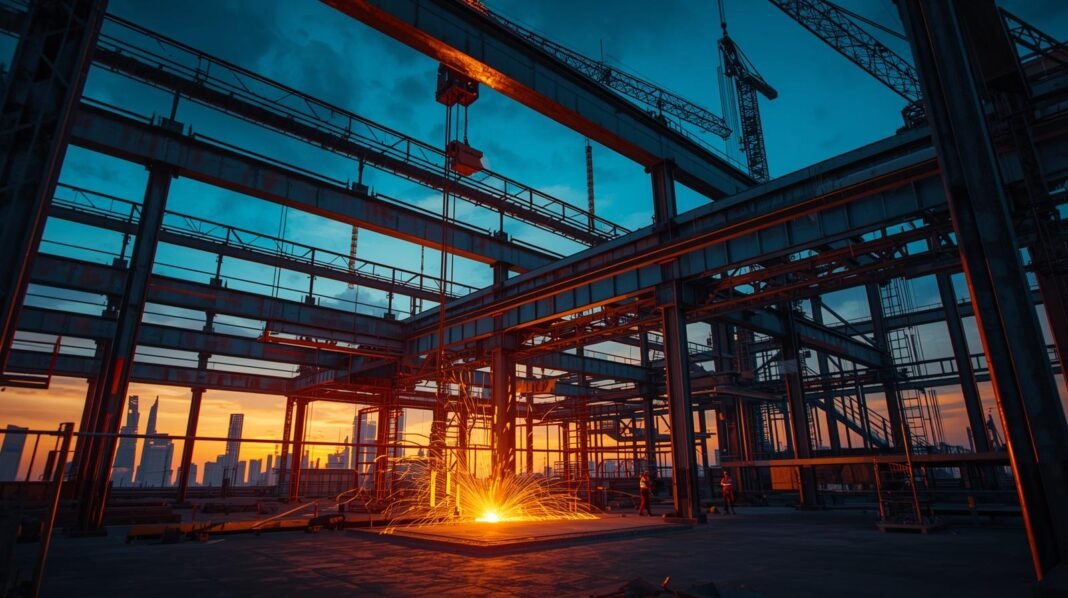
Steel is the skeleton of modern civilisation. It carries the weight of skyscrapers, spans the gaps of bridges, and frames the floors of warehouses, hospitals, stadiums and industrial plants.
Yet behind every finished structure lies a complex, precision-driven process known as metal fabrication — the transformation of raw steel into engineered structural components that must perform flawlessly for decades under immense load, seismic stress, and extreme weather.
This feature takes an in-depth look at the entire lifecycle of structural steel fabrication: from the properties and grades of steel selected for construction, through cutting, drilling, bending, welding and surface treatment in the fabrication shop, all the way to erection on site.
We also examine quality assurance, the role of digital technology and automation, and the sustainability credentials that are making steel an increasingly important choice in green construction.
1. Understanding Structural Steel
Structural steel refers to steel that has been formed into specific cross-sectional profiles — beams, columns, channels, angles, hollow sections and plates — manufactured to defined chemical compositions and mechanical properties, and engineered to carry loads within a building or infrastructure project.
Unlike reinforcement bar (rebar) that works in tension inside concrete, structural steel members work independently: carrying bending forces in beams, compression in columns, axial tension in bracing, and combinations of all three in trusses and frames.
Key Grades of Steel Used in Construction
Not all steel is created equal. Construction projects select grades based on yield strength, weldability, ductility, and environmental exposure:
- ASTM A36 (Carbon Steel): The most common general-purpose structural grade. Yield strength of 36,000 psi (248 MPa). Good weldability and formability. Used extensively in frames, beams and connections across residential, commercial and industrial buildings.
- ASTM A572 Grade 50 (HSLA): A high-strength low-alloy steel offering a yield strength of 50,000 psi — a 39% improvement over A36 while maintaining excellent weldability. Widely used in bridges, large structural frameworks and high-rise buildings.
- ASTM A588 / Weathering Steel (Corten): A high-strength low-alloy steel that forms a stable rust-like protective patina on exposure to weather, eliminating the need for paint in many applications. Originally developed by US Steel in the 1930s, it achieves a 120-year design life with minimal maintenance and is commonly used in bridges and exposed facades.
- Stainless Steel: Preferred where corrosion resistance and aesthetics are both priorities — cladding, handrails, and architectural components in coastal or chemically aggressive environments.
- High-Alloy / Quenched & Tempered Steels: Used in specialised heavy-load applications such as heavy equipment, mining structures and naval construction.
| Steel Grade | Yield Strength (psi) | Key Application | Notable Property |
| ASTM A36 | 36,000 | General structures, beams | Low cost, excellent weldability |
| ASTM A572 Gr.50 | 50,000 | Bridges, high-rise frames | 39% stronger than A36 |
| ASTM A588 / Corten | 50,000+ | Bridges, facades | Self-protecting patina |
| Stainless Steel | Varies | Architectural, coastal | Superior corrosion resistance |
| Q&T High Alloy | 80,000+ | Heavy industry, mining | Extreme strength & toughness |
2. The Fabrication Process: Step by Step
Structural steel fabrication is a systematic, multi-stage manufacturing process carried out in a fabrication shop before components are transported to site.
Each stage demands precision, skilled labour, and increasingly, advanced automation.
Step 1: Design Preparation and Detailing
Every fabrication project begins with design. Structural engineers and architects produce general arrangement drawings and specifications.
These are then handed to steel detailers — specialists who transform engineering drawings into detailed shop drawings for every individual member: beams, columns, trusses, braces, stairs and handrails.
Shop drawings specify exact dimensions, hole locations, bolt grades, connection types and erection sequences. They also generate the Bill of Materials (BOM) and Bill of Operations (BOO) needed for procurement and production planning.
Today, most detailing is done using 3D Building Information Modelling (BIM) software such as Tekla Structures, Advance Steel or SDS/2, enabling clash detection and virtual assembly before a single piece of steel is cut.
Step 2: Material Procurement and Verification
Once drawings are approved, the procurement team sources the required steel sections — I-beams, universal columns, hollow sections, plates and more — from steel mills.
Upon delivery to the fabrication shop, every consignment is verified against the BOM for grade, dimensions and certification (mill test certificates confirming chemical composition and mechanical properties).
Any material that does not conform to specifications is rejected before production begins. Steel sections may also need straightening if they have been distorted during transport.
Step 3: Cutting and Profiling
Raw steel sections must be cut to the precise lengths and profiles specified in shop drawings. Modern fabrication shops employ several high-precision cutting technologies:
- Plasma Cutting: Uses a high-temperature plasma arc to cut through steel plate and sections at high speed. Effective for complex profiles and thicker materials.
- Oxy-Fuel (Flame) Cutting: The traditional method, still widely used for thicker plate cutting. A fuel gas flame heats the steel to ignition temperature, and a jet of oxygen causes rapid oxidation, cutting through the material.
- Laser Cutting: Offers the highest precision and is increasingly used for thin-to-medium gauge steel. Computer Numerical Control (CNC) laser cutting machines follow shop drawing data directly, ensuring exact dimensions while minimising waste.
- Sawing: Band saws and circular saws produce clean, square cuts on structural sections for standard length cuts.
- Shearing: Used for straight cuts on steel plate, producing clean edges without heat-affected zones.
CNC equipment is now standard in most fabrication shops, following digital drawing data directly to produce components that fit together precisely on site without rework.
Step 4: Drilling, Punching and Hole Making
Most structural steel connections — both bolted and welded — require precisely located holes.
Fabricators use CNC drills, magnetic drilling machines and punch presses to create bolt holes at specified locations.
Accuracy in this step is critical: even small positional errors can cause major misalignment during erection.
CNC drilling lines can process entire sections in a single pass, drilling all required holes simultaneously across multiple axes.
Step 5: Bending and Forming
Some structural members and architectural steel elements require bending or forming into curved, angled or custom profiles. This is achieved through:
- Press Braking: A press brake machine applies controlled bending force to steel plate or sheet along a defined fold line. Used for purlins, cleats, brackets and secondary structural elements.
- Plate Rolling: Steel plate is passed between rollers to produce curved sections — used for circular columns, tanks, pipes and curved facades.
- Section Rolling: Structural sections such as beams and channels can be curved or cambered using section-rolling equipment — important for arch structures, roof beams with built-in camber, and curved architectural elements.
Step 6: Assembly and Fit-Up
Individual cut and drilled components are assembled into complete structural members on fabrication platforms using jigs and fixtures to ensure accurate positioning and alignment.
Temporary fasteners — tack welds, bolts or clamps — hold parts in position before final welding. Jigs are custom-made for each project to maintain dimensional accuracy across multiple identical members.
This stage requires experienced fitters who understand structural drawings and can work to tight tolerances. Any dimensional errors in fit-up will be amplified during welding as heat distortion occurs.
Step 7: Welding
Welding is the most technically demanding stage of fabrication. It permanently joins steel components using the application of heat and, typically, filler material. Key welding processes used in structural fabrication include:
- Shielded Metal Arc Welding (SMAW / Stick Welding): A versatile manual process. Used for site welding and repair work.
- Flux-Cored Arc Welding (FCAW): High-deposition semi-automatic process, widely used in fabrication shops for structural welds. The flux core provides shielding and improves weld quality.
- Submerged Arc Welding (SAW): An automated process that submerges the arc under a blanket of flux, producing high-quality, high-deposition welds with excellent mechanical properties. Used for long, straight welds on heavy plate.
- Gas Metal Arc Welding (GMAW / MIG): Uses a continuously fed wire electrode and shielding gas. Fast and suitable for semi-automatic or robotic welding.
- Friction Stir Welding (FSW) & Laser Beam Welding: Emerging techniques offering superior precision and strength, increasingly adopted in high-specification and aerospace-grade structural applications.
All welding must be performed by qualified welders following approved Welding Procedure Specifications (WPS) that define parameters such as preheat temperature, electrode type, current and interpass temperatures.
Heat input must be controlled carefully to manage distortion and avoid metallurgical damage to the steel.
| Industry Insight
Robotic welding systems are now standard in high-volume fabrication shops. Robotic welders ensure consistent weld quality, higher deposition rates, and reduced exposure of workers to fumes and arc radiation — while processing repetitive weld joints around the clock with zero fatigue. |
Step 8: Identification and Marking
Every fabricated member receives a unique identification mark — typically stamped, stencilled or laser-engraved — corresponding to the erection drawing reference.
This mark allows site erectors to locate each piece within the overall structure, even when hundreds or thousands of individual members are delivered to a complex project.
Step 9: Surface Treatment and Protective Coating
Unprotected steel will corrode when exposed to moisture and oxygen. Protective treatment is therefore applied in the fabrication shop before delivery, and may include:
- Shot Blasting: Abrasive steel shot is propelled at high velocity against the steel surface to remove mill scale, rust, and contaminants. This is essential surface preparation before painting or galvanising, ensuring coating adhesion. The standard of blasting is measured by Swedish standard grades (Sa 2.5 is commonly specified for structural steelwork).
- Primer Painting: One or two coats of primer — typically zinc-rich epoxy — are applied immediately after blasting. This provides temporary corrosion protection during transport and erection, and forms the base for topcoats applied after erection.
- Full Paint Systems: Multi-coat paint systems are specified for environmental protection. The system design (primer, intermediate and topcoat) is driven by the corrosivity category of the environment (C1 to C5 per ISO 12944). Coastal, offshore or industrial environments require more robust systems.
- Hot-Dip Galvanising: Components are immersed in molten zinc at approximately 450°C, producing a metallurgically bonded zinc coating that provides exceptional corrosion protection. Widely used for secondary steelwork, purlins, gratings and components in aggressive environments.
- Intumescent Coating (Fire Protection): A passive fire protection paint that expands dramatically when exposed to heat, forming an insulating char that protects the steel section from reaching critical temperatures. Applied in the fabrication shop to a specified dry film thickness.
3. Quality Control and Inspection
The structural integrity of a building depends entirely on the quality of the fabricated steel components. A comprehensive quality control (QC) system is not optional — it is fundamental, governing every stage of fabrication from incoming material to final delivery.
Key QC Inspection Points
- Material Verification: Mill test certificates are checked against specifications before any material enters production. Grade, heat number, dimensions and condition are all verified.
- Dimensional Inspection: Fabricated members are measured against shop drawings throughout production, with particular attention to overall lengths, hole positions and bolt gauge lines.
- Weld Visual Inspection: Every weld is visually inspected by a Certified Welding Inspector (CWI) for surface defects including cracks, porosity, undercut, incomplete fusion and overlap.
- Non-Destructive Testing (NDT): For critical welds and high-specification projects, NDT methods allow inspectors to detect internal and surface defects without damaging the component.
- Coating Inspection: Surface preparation standard, paint dry film thickness (DFT) and adhesion are all measured and documented. Galvanising thickness is checked by magnetic gauge.
- Final Inspection and Documentation: All completed members are dimensionally rechecked, welds and coating reviewed, marking confirmed, and a complete documentation package prepared for the client.
NDT Methods in Steel Fabrication
| NDT Method | What It Detects | Application |
| Radiographic Testing (RT) | Internal weld defects (voids, inclusions) | Full penetration welds — pressure vessels, bridges |
| Ultrasonic Testing (UT) | Subsurface flaws, laminations | Heavy plate, critical structural welds |
| Magnetic Particle Testing (MT) | Surface and near-surface cracks | Welds, heat-affected zones |
| Dye Penetrant Testing (PT) | Surface-breaking defects | Non-magnetic materials, complex geometry |
| Visual Inspection (VT) | Surface weld quality | All welds — mandatory first inspection |
Complete documentation — including welding procedure specifications, NDT reports, coating inspection records, and deviation logs — provides traceability, supports regulatory approval, and simplifies future maintenance and audits.
4. Transportation and Site Erection
Fabricated steel members are typically transported to site by road on flatbed trucks, with larger or longer members requiring specialist low-loaders and route planning. Components are secured and protected against damage and corrosion during transit.
Steel Erection on Site
On-site erection transforms individual fabricated members into a complete structural framework. The process typically follows this sequence:
- Foundation and Anchor Bolt Installation: Column base plates are set on prepared concrete foundations and aligned to survey control points. Anchor bolts are cast into foundations in advance, following templates from the fabricator.
- Column Erection: Columns are the first primary members to be erected. Each is lifted by crane, set on its base plate, and plumbed (made perfectly vertical) using adjusting bolts and survey instruments.
- Beam and Bracing Installation: Primary beams (spanning between columns) are lifted into position and connected — initially using temporary erection bolts — before floor beams and bracing members follow.
- Alignment and Plumbing: As each section of the frame progresses, surveyors check alignment, level and plumb. Temporary bracing ensures stability during construction.
- Final Bolting and Site Welding: Once alignment is confirmed, high-strength bolts are tightened to specified torques (using calibrated torque wrenches or DTI washers). Where full structural continuity is required, site welds are made by qualified welders.
- Decking and Secondary Steelwork: Metal decking, purlins, rails, stairs and platforms follow the primary frame.
The erection sequence is planned in the fabrication drawings and must be followed carefully to manage stability at every stage of construction. Temporary bracing and guy wires are used to stabilise the frame until it becomes self-supporting.
5. Applications of Steel Structures in Construction
Steel’s unique combination of strength, versatility, speed of construction, and recyclability makes it the material of choice across a vast range of construction types:
High-Rise Buildings and Skyscrapers
Steel’s high strength-to-weight ratio allows structural engineers to design tall, slender buildings with large, column-free floor plates — ideal for offices, hotels and residential towers. A steel-framed building can be erected faster than a concrete-framed equivalent, reducing programme durations and financing costs. Steel also performs well under seismic loading, absorbing energy through controlled ductile deformation rather than brittle failure.
Bridges and Infrastructure
From cable-stayed bridges and box girder highway structures to railway viaducts and pedestrian footbridges, steel is a dominant material in infrastructure. Weathering steel grades allow long-span bridges to achieve design lives of 120 years with minimal maintenance. The Forth Rail Bridge in Scotland — arguably the most recognisable steel structure in the world — has been in service for over 130 years.
Industrial Facilities and Warehouses
Steel portal frames are the preferred structural system for industrial buildings, distribution warehouses, manufacturing plants and cold-storage facilities across Africa and globally. A portal frame can be designed, fabricated, transported and erected within weeks — providing clear-span, adaptable internal space suitable for heavy cranes, conveyor systems, and large process equipment.
Mining and Heavy Industry
Ore processing plants, crusher frames, conveyor gantries, headframes and materials handling structures in the mining sector are almost exclusively fabricated from structural steel, typically in thicker plates and sections designed to withstand continuous vibration, impact loading, and highly corrosive conditions.
Sports Stadia and Public Buildings
Long-span roof structures covering football stadia, arenas, airports and convention centres use steel trusses, space frames and cable-supported systems to achieve spans that are simply unachievable in other materials. The structural steel used in stadiums must be designed for dynamic crowd loads — a unique loading condition that steel handles well through its natural damping properties.
6. Technology Transforming Steel Fabrication
The metal fabrication industry is undergoing a significant technological transformation, driven by digital tools, automation, and data-driven manufacturing.
Building Information Modelling (BIM)
BIM is now central to modern steel fabrication. 3D digital models integrate architecture, structure, and services, enabling automatic generation of shop drawings, clash detection in virtual space, and coordination between the design team, fabricator, and erector.
BIM models are also used to simulate erection sequences, check stability at each stage, and produce precise material take-offs.
CNC Automation and Robotic Fabrication
Computer Numerical Control (CNC) equipment — cutting lines, drilling machines and bending presses — now operates directly from digital model data, eliminating manual setting and reducing errors.
Robotic welding systems deliver consistent, high-quality welds at speeds that manual welders cannot match, and are increasingly used for standard structural connection details.
At the 2025 NASCC Steel Conference, researchers demonstrated quadruped robots capable of walking autonomously across fabrication yards to monitor steel inventory, enabling AI-driven coordination between purchasing and production planning in real time.
Artificial Intelligence and Predictive Manufacturing
AI-paired automation is revolutionising fabrication workflows by improving precision, reducing production times, and minimising errors.
AI systems can monitor welding parameters in real time, predict equipment maintenance needs before failure, optimise cutting sequences to minimise material waste, and flag dimensional deviations during production for immediate correction.
Advanced Welding Technologies
Friction Stir Welding and Laser Beam Welding are increasingly available, offering precision, strength, and reduced heat input compared to conventional arc welding processes.
These techniques are particularly valuable for connections in high-spec projects where traditional welding risks distortion or heat-affected zone degradation.
| Digital Future
The TyBOT robot, developed for bridge construction, automatically ties steel rebar intersections at a rate of over 1,100 ties per hour — demonstrating how BIM-driven robotics are closing the gap between digital design and physical construction at scale. |
7. Steel Fabrication and Sustainability
Steel’s sustainability credentials are increasingly important as the construction industry works to reduce embodied carbon and meet green building certification requirements.
Recyclability and Circular Economy
Steel is 100% recyclable.
Modern steel mills produce steel containing an average of 90% recycled content, and at the end of a building’s life, the current recovery rate for structural steel is 98%. Recycled steel production saves approximately 75% of the energy required to produce virgin steel from ore — a transformative reduction in embodied carbon.
The global metal fabrication market reflects this sustainability drive: valued at USD 26.85 billion in 2024, it is projected to reach USD 41.48 billion by 2033, growing at a CAGR of 4.85%. The North American structural steel fabrication market alone reached USD 19.2 billion in 2025, driven partly by green construction demand.
Green Building Certifications
Steel structures can achieve LEED, BREEAM and other green building certifications through recycled content, efficient framing (reducing total material use), dimensional stability (minimising site waste), and disassembly potential at end of life. The Bank of America Tower in New York uses recycled steel in its structural framework specifically to reduce embodied carbon.
Low-Carbon Steel Production
Steel manufacturing is undergoing a green transformation through hydrogen-based production methods that replace carbon-intensive blast furnace ironmaking.
Several major producers are already piloting hydrogen-reduced steel production, targeting near-zero carbon emission pathways that will fundamentally change the embodied carbon profile of structural steel over the next decade.
Hybrid Structures
Hybrid structures combining structural steel with mass timber (Cross-Laminated Timber or Glulam) are gaining popularity globally.
These structures offer the strength and speed of steel for primary framing, combined with the carbon-storage and aesthetic properties of timber for floors, walls and secondary structure — delivering high-performance buildings with significantly reduced net carbon footprints.
8. The African Context: Structural Steel in Construction
Across Africa, structural steel is playing an increasingly central role in industrial development, infrastructure delivery, and commercial construction.
The continent’s pipeline of mining, energy, ports, logistics, manufacturing, and urban development projects is creating significant demand for locally fabricated structural steel.
South African fabricators serve not only the domestic market but export to sub-Saharan Africa, while Kenyan and East African fabricators are growing capacity to serve regional infrastructure programmes.
Challenges remain around steel pricing (heavily influenced by global scrap markets and import tariffs), skills availability, and NDT capability — but investment in CNC equipment and welding automation is accelerating.
For Africa’s construction sector, metal fabrication offers a compelling value proposition: faster project delivery than in-situ concrete, adaptability to remote and challenging terrain, and the ability to relocate or repurpose structures as project needs evolve — particularly relevant in mining and temporary infrastructure contexts.
Conclusion
Metal fabrication in construction is far more than cutting and welding steel.
It is a precision manufacturing discipline — a carefully orchestrated sequence of digital design, material science, advanced manufacturing, quality assurance, and skilled assembly that transforms raw steel into the structures that define our built environment.
As technology continues to evolve — with BIM-driven automation, robotic welding, AI-powered quality control, and low-carbon steel production reshaping the industry — structural steel’s position as the backbone of construction is only growing stronger.
For Africa’s construction and infrastructure sector, mastering the full steel fabrication value chain is not just a technical challenge: it is a strategic opportunity.
Industry at a Glance
Also Read
What Is Deep Reactive Ion Etching (DRIE)? A Complete Beginner’s Guide
Steel Fabrication Trends Transforming Modern Construction Projects in 2026

- From Operator to Algorithm: Bedrock Puts Autonomous Excavators to Work on Live Construction Sites - September 7, 2026
- Built For The Rough Stuff: Inside Titan’s new ForestEDGE™ Tyre Line - September 4, 2026
- South Africa Has R395 Billion in Infrastructure Projects — But Can the Industry Deliver Them? - August 26, 2026
