

The financial logic is compelling. Chinese OEMs are offering 60-100 tonne wide body trucks at price points 70-81% below comparable imported models from Western manufacturers.
In Africa, where capital expenditure budgets at junior and mid-tier miners are tightly constrained, that price differential frequently determines the purchase decision.
Caterpillar’s traditional 73-series and 77-series rigid truck lineup — with its premium pricing and premium specifications — was not designed to compete in this segment.
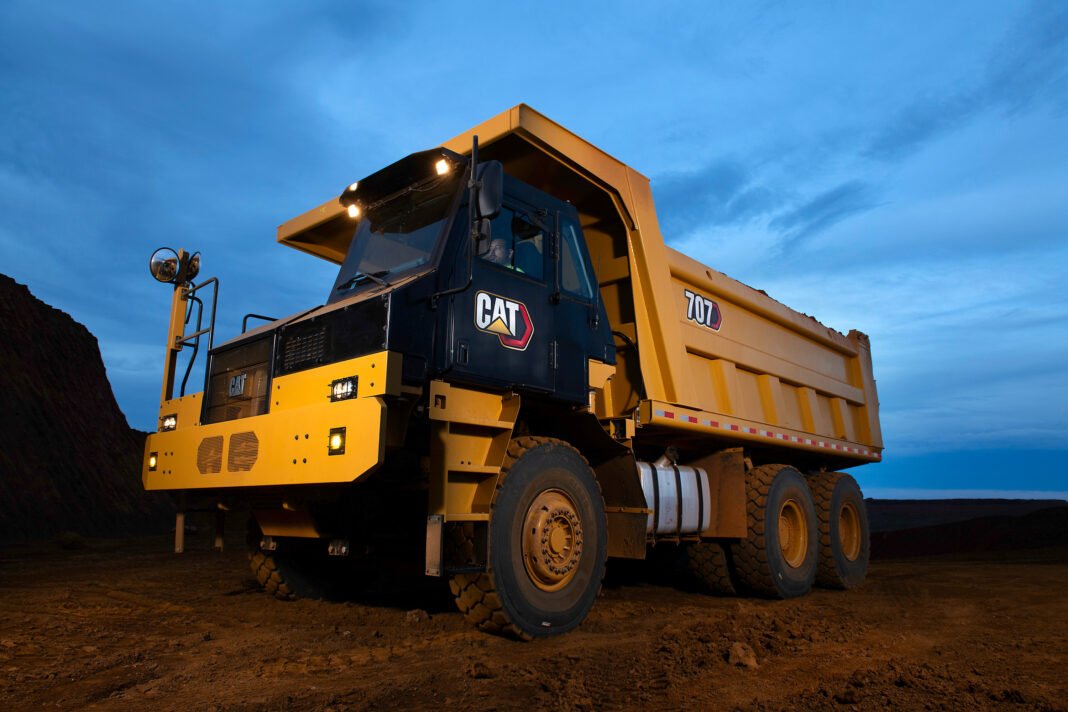
Caterpillar’s response has been the 707: the first truck in an entirely new wide body product family, built at Caterpillar’s Qingzhou facility (CQL) in China — the same plant that produces SEM-branded machinery for the domestic Chinese market — but engineered to Cat specifications, warranted under the Cat brand, and supported through Caterpillar’s global dealer network.
It was previewed at MINExpo 2024 and began its formal phase-in to developing markets including Africa in mid-2025.
2. Technical Specifications: What the 707 Delivers
At its core, the Cat 707 is a 66-tonne (approximately 70 short ton) rated payload wide body rear-dump truck.
This payload class slots below the Cat 773 (55-tonne class rigid) and the Cat 777 (90-tonne class rigid), but in a fundamentally different body architecture — wider, lower-slung, and better optimised for the shorter haul cycles, shallower pits, and loader types common in mid-tier African operations.
Two body configurations are available: a standard body for general mining and a heavy-duty body for more abrasive or high-density materials.
The choice of 40 or 42 cubic metre body size allows operators to match the truck to their material density profile — a critical consideration in African operations that may haul anything from low-density tailings to dense copper or iron ore.
2.1 The Fully Integrated Cat Powertrain: Why It Matters
The 707’s powertrain integration is one of its defining differentiators from Chinese competitors.
The C13 engine, CX31RT transmission, proprietary Cat axles, and Cat wiring harnesses are all Caterpillar-designed components, connected through Cat-integrated powertrain controllers.
This end-to-end integration eliminates the component mismatch risk that plagues some lower-cost Chinese wide body trucks — where sourced diesel engines, third-party transmissions, and after-market electrical systems from different suppliers can create diagnostic complexity and maintenance headaches in remote environments.
For African operations where technical support infrastructure can be thin and where identifying the source of an intermittent fault across a multi-supplier drivetrain is genuinely costly, the single-supplier powertrain accountability of the Cat 707 is a practical advantage that does not always appear in purchase price comparisons.
2.2 Three-Level Braking: Designed for African Haul Profiles
African open-pit mines frequently feature significant elevation changes — particularly in the DRC’s Copperbelt, the steep haul grades of some West African gold pits, and the topography of Zambia’s copper mines.
The 707’s three-level braking and retardation system is specifically designed to handle these profiles: the standard engine brake (high-rating), the optional integrated hydraulic retarder, and conventional parking and service brakes provide layered control on long downhill loaded cycles.
Caterpillar specifically cites the 707’s superior downhill loaded cycle performance as a key differentiator — and field data from the EKAPA Minerals trial bears this out.
2.3 The 20-Second Hoist: Productivity in the Dump Cycle
In high-cycle operations — particularly tailings reprocessing and short-haul pit-to-crusher movements common in African operations — dump cycle time is a meaningful component of overall productivity.
The 707’s 20-second raise-and-lower hoist cycle time is designed to minimise the time spent at the tipping point and maximise the proportion of the truck’s shift time spent actually moving material. Over a 10-hour shift with dozens of dump cycles, a fast hoist cycle compounds into measurable productivity improvement.
3. The EKAPA Minerals Field Trial: Africa’s Own Data
The most important evidence base for assessing the Cat 707’s performance in African conditions is not a factory test or a modelling exercise — it is a real-world field deployment at a real South African mine.
EKAPA Minerals, a diamond mining company near Kimberley in the Northern Cape, was the site of the Cat 706 Early Learner and 707 Field Follow truck deployments throughout 2024.
EKAPA’s operation is an instructive African case study. The company specialises in reprocessing diamond mining tailings — ripping and dozing material from old tailings dumps into stockpiles, loading with front-end loaders and excavators, and hauling to a combined treatment plant for diamond recovery.
It is a high-cycle, shorter-haul operation that places a premium on reliability, payload consistency, and fuel efficiency per tonne moved — precisely the metrics the 707 was designed to optimise.
The comparison with the LGMG CMT96 is significant: LGMG is one of China’s most commercially successful wide body truck exporters, with a growing installed base across Africa. The CMT96 is a credible, competitively priced 90-tonne class wide body truck.
That the 707 demonstrated double-digit advantages at full payload against this benchmark — in an actual African mining environment, not a controlled test — provides meaningful validation of the truck’s productivity claims.
The important qualifier from Caterpillar’s own reporting is equally noteworthy: at underloaded conditions (80% of target payload), the 707 performed at equivalent levels to the LGMG.
This tells a clear story about where the 707’s advantage lies: it is maximised when loader-truck matching is optimised and payload targets are consistently achieved.
In operations where loading equipment is poorly matched, or where payload discipline is inconsistent — conditions that are common in some African operations — the productivity edge narrows significantly.
This finding has direct implications for how African operators should deploy the 707: its cost-per-ton advantage is not passive or automatic.
It is earned through disciplined fleet management, proper loader matching (the 707 is specifically designed for pass compatibility with Cat 986, 988 and 988 XE wheel loaders, and Cat 350, 374 and 395 excavators), and consistent payload targeting.
4. The ‘Built to Be Rebuilt’ Philosophy: Lifecycle Cost Economics
The most strategically distinctive aspect of the Cat 707 is its design philosophy, which Caterpillar’s global product specialist Angel Gonzalez has articulated directly: “We have engineered our new wide body truck with a unique philosophy — it’s built to be rebuilt, offering consistent mechanical availability and longevity through a second lifecycle, which can help lower operating costs.”
This philosophy is a deliberate and pointed response to the dominant model in the Chinese wide body truck market, where many competitors offer what the industry describes as ‘one life’ trucks: lower capital cost machines engineered for a single service life, after which the economics of rebuilding are unfavourable and replacement is the expected outcome.
4.1 What ‘Built to Be Rebuilt’ Means Economically
The economic logic of rebuildability is powerful, particularly for African mining operations that face high capital import costs, long equipment lead times, and foreign exchange constraints. Consider two scenarios over a 20-year mine life:
Under a ‘one life’ truck model, an operation might purchase a fleet of wide body trucks at lower initial capital cost, operate them through one service life (typically 30,000-50,000 hours), then replace the fleet — incurring a second round of capital expenditure, import duties, and fleet changeover costs.
Under the ‘built to be rebuilt’ model, the same operation purchases the 707 at a higher initial capital cost, operates through a first life, then rebuilds the powertrain and structural components for a second life — at a fraction of the new-truck cost, using Cat-supported rebuild kits and the existing dealer network. The total capital cost over two service lives is substantially lower than two sequential new-truck purchases.
For African mine operators — particularly those in countries with volatile currencies, high import duties on new equipment, and challenging access to capital — this lifecycle economics model has particular appeal. Zambia, for instance, applies significant import duties on new mining equipment not covered by specific statutory instruments.
South Africa’s persistent rand weakness amplifies the dollar cost of new equipment replacement. A truck designed to run two lives within the same capital base fundamentally changes the long-term cost-per-ton equation.
4.2 Parts Commonality: The Hidden Cost Advantage
The 707’s powertrain components are shared with other Cat machines in the lineup. The C13 engine is used across multiple Cat products.
The CX31RT transmission and the common cab are shared components. This parts commonality means that dealers across Africa already carry significant Cat C13 inventory — reducing the risk of extended parts wait times that are one of the most significant cost drivers for remote African mining operations.
In Zambia’s Copperbelt, in West Africa’s gold belt, and in Mozambique’s growing coal and mineral sands sector, the ability to source a critical engine component from existing dealer stock — rather than waiting weeks for a specialist import — is not a minor convenience. It can be the difference between a two-day repair and a three-week standstill.
5. The Competitive Landscape: What the 707 Is Up Against
To assess whether the 707 can reduce cost per ton in African mining, it must be evaluated against the realistic alternatives available to African operators.
The competitive landscape in the 60-100 tonne wide body class in Africa in 2025 is more dynamic and more competitive than it has ever been.
5.1 Chinese OEMs: The Primary Competitive Pressure
The most direct competitive threat to the 707 comes not from Komatsu or Hitachi but from a cohort of Chinese wide body truck manufacturers that have built substantial African presence over the past five years.
LGMG, XCMG, SANY, Tonly, and Yutong are among the most active, with growing dealer networks and increasingly competitive after-sales support models.
Chinese 60-100 tonne wide body trucks typically enter the African market at acquisition prices that are 70-81% below Western equivalents.
On a pure capital cost basis, this is an overwhelming advantage that no Cat product can overcome at the purchase order stage.
The 707’s proposition must therefore be framed not around purchase price but around lifecycle cost — and specifically the argument that higher initial investment delivers lower total cost of ownership over a ten-year or twenty-year mine life.
Critically, the Chinese manufacturers are not standing still. In 2024, battery-electric and hybrid wide body trucks from Chinese OEMs accounted for a growing proportion of deliveries.
By January-April 2025, battery-electric vehicles represented approximately 52% of Tonly’s sales revenue — a figure that illustrates the pace of electrification in this segment.
Chinese OEMs are also integrating OEM-agnostic autonomy systems from providers like EACON into their trucks as factory-fitted options, giving them an autonomous capability that currently runs ahead of what the 707 can offer at launch.
By 2025, China had more than 3,000 autonomous wide body trucks running in its domestic mines alone.
5.2 The 707 vs. Cat’s Own Rigid Truck Lineup
The 707 also sits in a nuanced relationship with Caterpillar’s own rigid truck lineup. The Cat 773 (55-tonne class) and Cat 775 (65-tonne class) are established mid-tier rigid trucks with deep African installed bases and mature dealer support.
In some applications — particularly those with longer haul distances, more complex haul road profiles, or higher dump heights — the rigid truck’s ground clearance, suspension travel, and payload management systems may offer advantages over the lower-slung wide body.
Caterpillar appears to be managing this internal competition deliberately: the 707 is targeted at shorter haul cycles, shallower pits, and applications where the wide body truck’s lower centre of gravity, higher volume body, and lower purchase price relative to a rigid truck make it the logical choice.
International Mining has noted that if wide body trucks continue to eat into the rigid truck market — as they have done comprehensively in China — it is better for Caterpillar to have a branded offering in this space rather than cede the territory entirely to Chinese manufacturers.
6. African Market Context: Where the 707 Fits and Where It Doesn’t
6.1 South Africa: A Challenging but Strategic Entry Market
South Africa is where Caterpillar first deployed the 707 field follow trucks and where the EKAPA Minerals trial was conducted.
It is the continent’s most sophisticated mining market — with the deepest dealer network, most developed haul road standards, and strongest Cat parts infrastructure. It is also a market under significant structural stress.
South Africa’s mining sector has been severely impacted by Transnet’s logistical failures, power supply instability through load shedding, and labour relations complexity.
Mining operations in Mpumalanga, the Northern Cape, and the North West are facing rising costs across all input categories.
In this environment, any technology that credibly reduces haulage cost per ton — particularly if it avoids the capital burden of importing a premium-class truck — is commercially relevant.
The wide body truck format is also particularly well-suited to South Africa’s tailings reprocessing operations — of which EKAPA is a prime example.
These operations typically involve short haul cycles, consistent material density, and high cycle counts, all of which play to the 707’s design strengths.
As South Africa’s historic mine waste reprocessing industry grows — driven by demand for critical minerals like vanadium, cobalt, and platinum group metals embedded in legacy tailings — the 707’s application space in-country could expand significantly.
6.2 Zambia and the DRC: Copper and Cobalt Country
Zambia’s Copperbelt and the DRC’s Haut-Katanga and Lualaba provinces represent the most dynamic growth frontier for mining haulage equipment in sub-Saharan Africa.
Demand for copper and cobalt — driven by battery supply chains for electric vehicles and grid storage — is driving sustained expansion in pit scale, truck fleet size, and production volumes.
In this environment, the economics of the haulage fleet are under intense scrutiny. Operators in the DRC in particular face some of Africa’s most challenging logistics costs: remoteness, border complexity, import duty regimes, and limited OEM dealer infrastructure outside the main copper belt corridor.
The 707’s parts commonality with existing Cat equipment already deployed in the region, and Caterpillar’s established Mantrac dealer presence, provide a meaningful infrastructure advantage over newer Chinese entrants that may offer lower purchase prices but thinner after-sales support.
Mining applications grow at the fastest rate of any segment of Africa’s heavy truck market — a 7.75% CAGR through to 2030, according to Mordor Intelligence — with the critical mineral mining boom in Zambia advancing particularly strongly. The 707’s launch timing is aligned with this growth wave.
6.3 West Africa: Gold and Bauxite Operations
West Africa’s gold mining sector — spanning Ghana, Mali, Burkina Faso, Senegal, and Côte d’Ivoire — and its growing bauxite sector in Guinea are important potential markets for the 707.
Operations here are typically characterised by 1-5 km haul cycles, shallow to moderate pit depths, and material handling profiles that match the 707’s design envelope.
Ghana’s mining contractor and owner-operator E&P announced in early 2026 plans to invest US$1.2 billion at Tarkwa and Damang — two of West Africa’s most significant gold operations.
Haulage fleet upgrades are a core component of major expansion investments of this scale, and the 707 is positioned to compete for this business against both Chinese alternatives and Cat’s own rigid truck lineup.
6.4 Mozambique: Coal and Mineral Sands
Mozambique’s coal sector in the Tete province and its growing mineral sands operations represent a different application profile: lower-grade ore requiring high-volume movement, longer haul distances in some cases, and often more challenging haul road conditions.
The 707’s 40 or 42 cubic metre body options — allowing operators to configure for volume rather than density — make it adaptable to the mineral sands context, though its shorter cycle optimisation means coal haul applications with extended distances will need careful analysis before committing.
7. The Cost-Per-Ton Equation: Building the Case
Cost per ton is the ultimate operational metric in haulage — total cost of the haul cycle divided by tonnes of material moved. To assess the 707’s potential, it is useful to structure the cost-per-ton analysis across the four principal cost drivers: fuel, maintenance, tyres, and capital/labour.
7.1 Fuel: The Dominant Variable
Fuel typically represents 30-35% of total haul truck operating costs. In Africa, where diesel frequently trades at a premium of 15-25% above global benchmarks due to inland logistics costs, the fuel efficiency of haulage equipment is even more significant.
The 707’s C13 engine, integrated powertrain controllers, and six-speed automatic transmission with optional hydraulic retarder are designed to optimise fuel consumption across the full haul cycle — particularly on loaded downhill cycles where the retarder recovers energy that would otherwise be dissipated as heat in service brakes.
The EKAPA trial’s headline result — double-digit tonnes per litre advantage over the LGMG CMT96 at full payload — suggests that the 707’s integrated powertrain delivers meaningful fuel efficiency gains in real African conditions.
A 10-15% reduction in fuel burn per tonne moved, sustained across a fleet of 8-12 trucks over a ten-year mine life, compounds into tens of millions of dollars of recovered value.
7.2 Maintenance: Where Rebuildability Changes the Calculation
Maintenance costs for haul trucks in remote African environments are notoriously difficult to benchmark accurately, because they embed not just component costs but also labour, logistics, and downtime.
The 707’s grouped service points, ground-level engine shut-off switch, LED lighting (longer life, more vibration-resistant than conventional bulbs), and integrated diagnostic systems are designed to reduce both the frequency and duration of maintenance interventions.
The rebuildability factor changes the long-run maintenance calculation profoundly. A truck designed with a second lifecycle in mind is manufactured with component tolerances, frame stiffness, and structural integrity targets that go beyond first-life requirements.
This typically manifests as lower structural failure rates in the first life, and lower rebuild costs at end of first life, compared to ‘one life’ competitors.
7.3 Tyres: An Underappreciated Cost Driver
Tyre costs can represent 15-20% of total haul truck operating costs in Africa, driven by poor haul road surfaces, overloading events, and heat generation on long downhill cycles.
The 707’s three-level braking system — and in particular the optional hydraulic retarder — reduces the thermal stress on tyres during long downhill loaded cycles, extending tyre life compared to trucks that rely primarily on service brakes for descent control.
Payload consistency — maintained through proper loader matching and operator discipline — also directly reduces tyre stress.
Consistent loading within the rated payload envelope produces more predictable tyre wear patterns and extends tread life.
The 707’s optimised pass matching with Cat 986/988 loaders and Cat 350/374/395 excavators is designed precisely to support this consistency.
7.4 Indicative Cost-Per-Ton Modelling
These figures are indicative estimates, drawing on the EKAPA field trial data, Caterpillar’s published specifications, and industry benchmarking for mid-tier African open-pit operations with 2-4 km average haul cycles. Results will vary materially based on haul road quality, altitude, payload consistency, loader match quality, fleet management discipline, and dealer support responsiveness.
8. The Autonomy Gap: A Near-Term Limitation and Long-Term Opportunity
One area where the 707’s 2025 launch specification lags behind some Chinese competitors is autonomous haulage readiness.
In China’s domestic mining market, autonomous wide body trucks are no longer experimental: by mid-2025, GlobalData’s Mining Intelligence Center was tracking over 3,800 autonomous haul trucks globally, with China alone accounting for more than 2,000 — the majority of which are wide body trucks from Tonly, LGMG, XCMG, and others, many fitted with OEM-agnostic autonomy systems as factory options.
Chinese OEMs like Tonly have partnered with autonomous technology providers including EACON to offer cabless, fully autonomous wide body trucks.
In January-April 2025, battery-electric vehicles already accounted for roughly 52% of Tonly’s sales revenue — a figure that illustrates the pace of technology evolution in this segment.
The Cat 707 at launch does not have a confirmed autonomous haulage integration pathway.
Cat MineStar Command for hauling has been successfully proven on the Cat 777 (with over two million tonnes hauled autonomously at Luck Stone’s Bull Run quarry by mid-2025), and Caterpillar has signalled ambitions to scale autonomous haulage to over 2,000 trucks by 2030. However, the 707’s position on this autonomy roadmap is not yet publicly defined.
For African mining operations, near-term autonomous deployment of wide body trucks is constrained by the same factors that limit autonomy adoption elsewhere on the continent: haul road standardisation requirements, network connectivity in remote areas, regulatory frameworks for unmanned heavy vehicle operation, and the capital cost of control room infrastructure.
These barriers mean that the autonomy gap between the 707 and some Chinese competitors is less commercially significant in Africa in 2025 than it appears on paper.
Over a five to ten year horizon, however, autonomy will become increasingly relevant even for mid-tier African operations.
Skilled haul truck operator availability is a growing constraint in countries like Zambia, Ghana, and Mozambique, where competition for experienced mining equipment operators is intensifying as production scales.
An autonomous or semi-autonomous 707 — if and when Cat’s MineStar Command roadmap encompasses the wide body class — would be a compelling proposition for these markets.
9. Critical Success Factors for African Operators
Based on the technical analysis, competitive context, and field evidence reviewed in this article, the following conditions are required for African operators to realise the 707’s cost-per-ton potential:
9.1 Invest in Haul Road Maintenance
Research consistently demonstrates that haul road condition is the single most powerful variable in haul truck fuel consumption — with poorly maintained roads adding up to 20% to fuel burn compared to well-graded alternatives.
The 707’s powertrain efficiency and downhill braking performance can only be fully realised on roads that are graded, drained, and dust-suppressed to appropriate standards. Operations that underinvest in road maintenance will see the 707’s efficiency claims systematically eroded.
9.2 Match the Loader to the Truck
The 707’s design has been explicitly optimised for pass matching with Cat 986, 988 and 988 XE wheel loaders and Cat 350, 374 and 395 excavators.
Using these pairings — calibrated to target payload in a defined number of passes — is the foundation of consistent payload achievement. Mismatched loader-truck combinations are among the most common causes of under-loading, which the EKAPA data confirms nullifies the 707’s productivity advantage.
9.3 Plan for the Second Life from Day One
The 707’s lifecycle cost advantage is fully realised only when operators plan for the rebuild from the initial fleet commissioning.
This means establishing component condition monitoring from the start, maintaining rebuild fund provisions, engaging the local Cat dealer on rebuild programme terms, and ensuring that operational practices (payload discipline, haul road standards, service schedule adherence) protect the structural integrity of the truck for its second service life.
9.4 Negotiate a Comprehensive Support Agreement
In Africa’s remote mining environments, machine downtime is among the most costly operational risks.
Operators should negotiate Cat dealer agreements that include guaranteed parts availability response times, on-site technician visit schedules, and proactive component exchange programmes — turning the dealer relationship from transactional to strategic.
The 707’s shared parts with the C13 engine family means that dealers already carrying Cat C13 stock — which is the majority of Cat mining equipment dealers in Africa — can service the 707 without dedicated new inventory build-up.
9.5 Monitor Payload Discipline Actively
Given that the 707’s double-digit productivity advantage disappears at 80% payload utilisation, payload monitoring must be treated as a front-line operational metric rather than a back-office data point.
Operations should implement systematic shift-by-shift payload reporting, with clear accountability for loader operators when average payload falls below 90% of target.
10. Conclusion: A Calculated Bet on Lifecycle Value
The Cat 707 wide body truck is Caterpillar’s most direct response yet to the profound market shift driven by Chinese OEMs in Africa’s mining haulage sector.
It is not a truck designed to win on purchase price — it cannot, and Caterpillar is not positioning it to do so.
It is a truck designed to win on lifecycle cost: to outperform Chinese alternatives not at the point of sale, but across 20,000, 40,000, and 60,000 hours of accumulated service life.
Also Read
How Komatsu Is Building the Future of Autonomous Mining in Africa in 2026
Cost of Excavators in 2026: New vs Used

She brings insightful analysis and in-depth reporting to the sector, highlighting innovations and developments that shape Africa’s built environment.
- Moldtech: Engineering Africa’s Next Generation of Precast Concrete Production - September 23, 2026
- How They Were Built: Inside the Construction of the Grand Ethiopian Renaissance Dam - September 4, 2026
- CNH Construction Sales Rise 12% as North American Demand Offsets Tariff Headwinds - August 3, 2026
