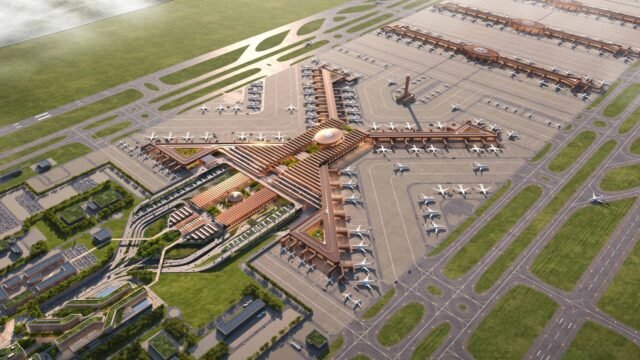
On January 10, 2026, Ethiopian Prime Minister Abiy Ahmed Ali laid the cornerstone for what will become Africa’s largest aviation infrastructure project.
The Bishoftu International Airport, rising approximately 40 kilometers south of Addis Ababa, represents far more than concrete and steel—it embodies a continental vision carved from the very earth that inspired its design.
A Geological Blueprint
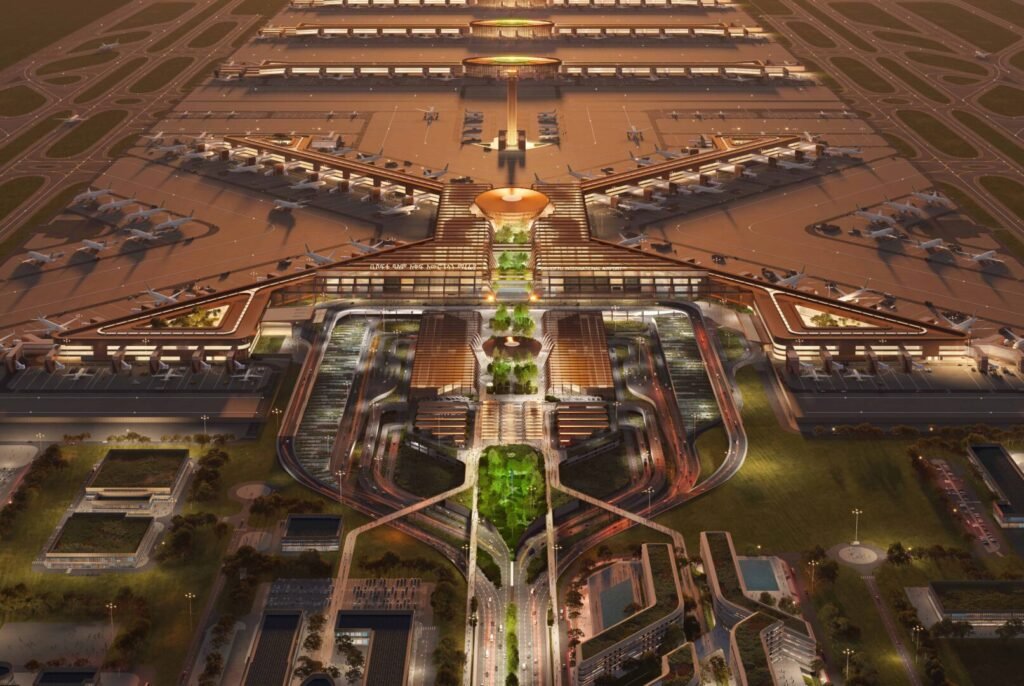
The Great Rift Valley, which passes near Bishoftu, inspired a central circulation spine connecting the terminal’s facilities and aircraft piers.
This isn’t architectural metaphor for its own sake. Zaha Hadid Architects, the visionary studio behind the project, has translated Ethiopia’s most dramatic geological feature into a functional organizing principle that will serve up to 110 million passengers annually once fully operational.
The central spine concept does more than evoke natural wonder. It optimises circulation while minimising transfer distances, a critical consideration given that 80 percent of passengers are expected to transit through the airport without leaving its boundaries.
In an era where connection time can make or break an aviation hub, this geological inspiration serves profound operational purpose.
Cultural Cartography in Architecture
Beyond the grand gesture of the central spine lies a more intimate architectural narrative. Each pier radiating from this central axis tells a different regional story.
The piers feature distinct interior material palettes and colors, referencing the country’s varied regions.
This isn’t mere decoration—it’s wayfinding through cultural identity, transforming the anxiety of navigation into an experiential journey through Ethiopia’s diversity.
Imagine transitioning between connections: from the warm earth tones evoking the Danakil Depression to cooler palettes suggesting the Simien highlands.
The architecture becomes a passive guide, reducing stress while celebrating national heritage.
For the millions of African passengers who will pass through these halls, it’s a subtle assertion that world-class infrastructure can speak in local dialects.
Also Read: The Top 5 Infrastructure Marvels Making Headlines in 2025
Engineering Elevation
The site selection itself reveals sophisticated thinking about aviation physics. Located almost 400m lower than Addis Ababa’s existing Bole Airport, with longer runways, the location enhances aircraft performance, enabling Ethiopian Airlines to optimize maximum take-off weight.
This translates directly into operational advantages: aircraft can carry more passengers and cargo on longer non-stop routes while consuming less fuel.
The first phase, scheduled for completion in 2030, will feature a 660,000-square-meter terminal serving 60 million passengers annually, supported by two parallel runways.
Subsequent phases will expand capacity to 110 million passengers with four runways and parking for 270 aircraft—more than quadruple the capacity of the current main airport, which will reach its limits on existing traffic in the next two to three years.
Sustainability Woven into Structure
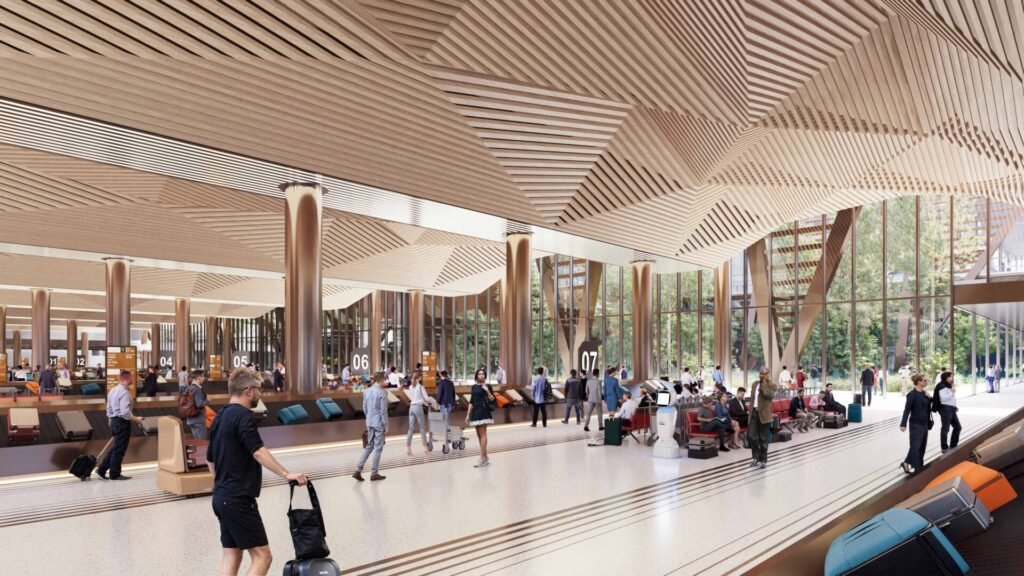
Environmental performance isn’t an afterthought at Bishoftu—it’s foundational architecture. The terminal is designed to achieve LEED Gold certification, featuring natural ventilation with effective solar shading.
In Ethiopia’s temperate subtropical highland climate, this approach transforms regional weather patterns into a design asset rather than a challenge to overcome.
Also Read:Who Are Zaha Hadid Architects? The Visionary Firm Designing Ethiopia’s Bishoftu Mega Airport
The sustainability framework extends beyond the terminal envelope. Water management systems redirect stormwater from runways and rooftops into wetlands and bioswales, supporting biodiversity while enabling water reuse.
Photovoltaic arrays will generate on-site energy, and construction prioritizes locally produced or recycled materials—concrete, aggregates, and steel from Bishoftu itself.
This commitment to local procurement serves dual purposes: reducing the carbon footprint of materials transport while stimulating regional manufacturing capacity. It’s infrastructure that builds industries in its wake.
Also Read: Zambia Launches Construction of $80 Million Siavonga Solar Power Plant
The Transit Hub Reimagined
Bishoftu’s design responds to a fundamental shift in aviation patterns. With transfer passengers comprising the vast majority of traffic, the airport incorporates what Zaha Hadid Architects calls “extensive amenities for transiting passengers.”
This includes a 350-room airside hotel—a recognition that modern hubs must function as destinations themselves, not merely waypoints.
The architecture embraces this reality through semi-enclosed spaces and outdoor courtyards landscaped with native plants, allowing passengers to experience Ethiopia’s climate during extended layovers.
The building incorporates dining and entertainment facilities, as well as outdoor gardens, transforming the traditionally sterile transit experience into something approaching urban leisure.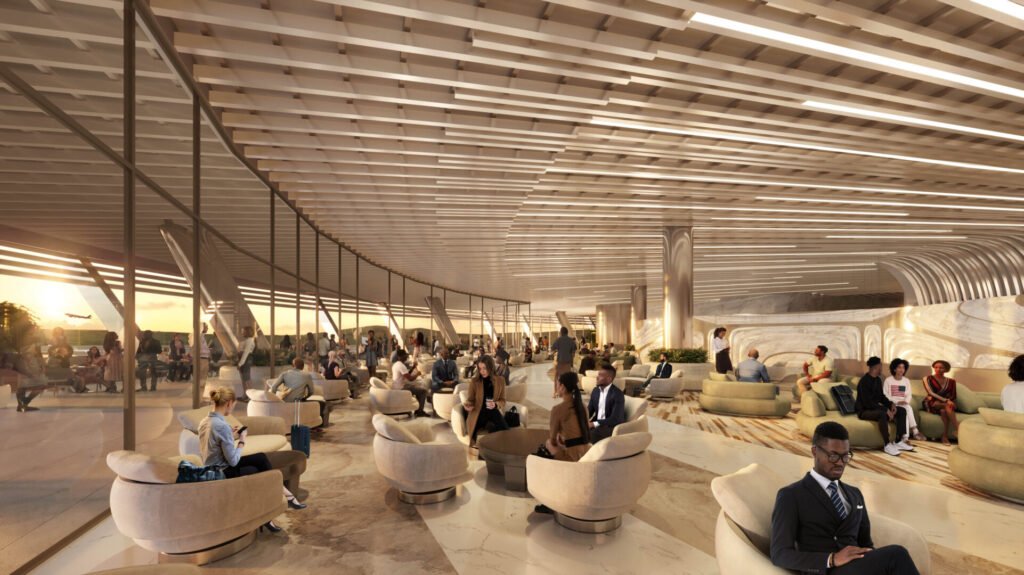
Modular Ambition
The construction methodology reflects both pragmatism and vision. Modular fabrication and assembly methods allow flexibility and efficiency, enabling the airport to evolve with changing demand forecasts and technological innovations.
This isn’t a monument frozen in time but a living infrastructure designed to adapt.
The phased approach acknowledges economic realities while maintaining architectural cohesion.
The initial $12.5 billion investment—financed through a combination of Ethiopian Airlines’ equity (30 percent) and institutional lending led by the African Development Bank—positions the project as financially viable rather than purely aspirational.
Continental Connectivity
The airport exists within a broader transportation ecosystem. A planned high-speed rail link will connect Bishoftu with central Addis Ababa and the existing Bole International Airport, creating an integrated network rather than isolated infrastructure.
This rail connection anticipates the airport’s role as catalyst for an adjacent Airport City—mixed-use development designed to house approximately 80,000 people and generate employment in hospitality, logistics, and retail.
The vision extends beyond aviation to economic geography. By positioning Ethiopia at the intersection of Africa, Asia, and the Middle East, Bishoftu aims to capture the exponential growth projected for East African aviation.
Also Read: The Biggest Public Transit Projects Transforming American Cities in 2026
IATA forecasts suggest passenger numbers in the region will multiply significantly over the coming decade, driven by population growth, rising incomes, and expanding trade networks.
Architecture as Continental Statement
Perhaps the most remarkable aspect of Bishoftu International Airport isn’t its physical scale but its symbolic weight. In a continent long relegated to the periphery of global aviation networks, this project asserts African agency in shaping its own connectivity future.
The design consortium includes Zaha Hadid Architects and Pascall+Watson, but the vision belongs to Ethiopian Airlines and the Federal Government of Ethiopia.
As Cristiano Ceccato de Sabata, Zaha Hadid Architects’ Director of Aviation, observes: “Bishoftu International Airport is a visionary project for Ethiopia and Africa as a whole. Airports bring people together and bridge national divides.”
When the first passengers walk through those Great Rift Valley-inspired halls in 2030, they’ll experience more than efficient architecture.
They’ll witness a continent writing its own future in steel, glass, and stone—one thoughtfully designed pier at a time.
From the careful calibration of runway elevation to the culturally specific color palettes of terminal piers, every architectural decision reflects a deeper ambition: positioning Africa not as destination but as the crossroads of global movement.
The runways may be the infrastructure that enables flight, but it’s the lounges, courtyards, and transit spaces where Bishoftu’s true architectural vision reveals itself—creating human experiences worthy of the continent’s aspirations.
Also Read
R1.35 Billion Marriott Edition Hotel: Cape Town’s Ultra-Luxury Construction Milestone
The Hidden Construction Gold Rush: How AI’s Power Hunger Is Fueling Caterpillar’s $40B Backlog

- SODECA Highlights Industrial Ventilation Technology at Mega Clima Expo Kenya 2026 - October 14, 2026
- How They Were Built: Inside the Engineering of the Lesotho Highlands Water Project - October 11, 2026
- Africa’s Water Reuse Opportunity: Building the Infrastructure for a Water-Secure Future - September 28, 2026