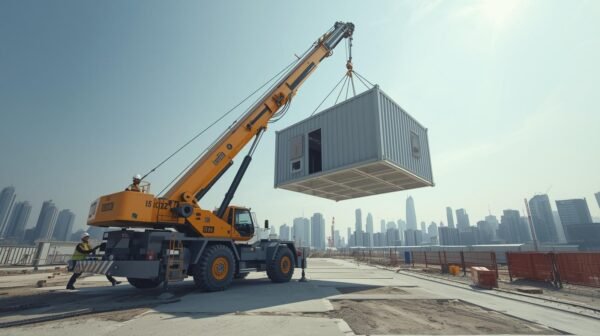
Mobile cranes represent one of the most versatile and essential pieces of lifting equipment on modern construction sites.
Unlike their tower crane counterparts that require extensive installation and dismantling, mobile cranes arrive ready to work, equipped with telescopic or lattice booms that can be configured for diverse lifting tasks.
Their ability to move between job sites and adapt to changing project demands has made them indispensable across residential, commercial, industrial, and infrastructure construction.
2026 marks a pivotal year for mobile crane innovation as the construction industry confronts unprecedented challenges: tighter project schedules, larger prefabricated components requiring heavy lifts, skilled labor shortages, and increasingly complex urban environments.
These pressures have accelerated the evolution of construction crane technology, pushing manufacturers to develop machines that can lift more weight, set up faster, and operate with greater precision than ever before.
The convergence of digital controls, advanced materials, and changing construction methodologies has transformed mobile cranes from simple lifting tools into sophisticated machinery central to project delivery strategies.
Why Mobile Cranes Are in High Demand in 2026
Larger Prefabricated Components
The construction industry’s ongoing shift toward off-site fabrication has fundamentally changed lifting requirements.
Where crews once assembled structures piece by piece, projects now routinely incorporate fully finished modular units, precast concrete sections weighing 40 tons or more, and integrated mechanical systems that arrive ready for installation.
These components reduce on-site labor and construction time but require lifting equipment trends that favor higher capacities and more precise placement capabilities.
Infrastructure and High-Rise Expansion
Global infrastructure investment continues to accelerate in 2026, with governments prioritizing transportation networks, energy facilities, and utility upgrades.
Simultaneously, urban densification drives high-rise construction in cities where horizontal expansion is no longer feasible.
Both sectors demand cranes capable of handling exceptionally heavy loads, from bridge girders exceeding 100 tons to precast facade panels for residential towers.
Mobile cranes offer the flexibility to work across multiple phases of these projects without the fixed footprint constraints of tower cranes.
Time-Sensitive Projects and Labor Constraints
Construction schedules have compressed dramatically as owners seek faster returns on investment and developers race to meet market demands. Projects that once spanned three years now target 18-month completion windows.
This acceleration coincides with persistent skilled labor shortages affecting every developed market.
High-capacity mobile cranes address both challenges by reducing the number of lifts required, minimizing crew sizes needed for assembly operations, and enabling work sequences that would be impractical with smaller equipment or manual methods.
Shift Toward Flexible, Multi-Site Equipment
Construction companies increasingly view equipment as fleet assets that must generate revenue across multiple projects rather than dedicated resources for single sites. This economic reality favors mobile cranes that can transition quickly between jobs, adapt to diverse lifting scenarios, and maximize utilization rates.
Rental companies report that contractors now prioritize crane mobility and setup efficiency over raw capacity alone, seeking machines that balance lifting power with operational flexibility.
Key Mobile Crane Trends Shaping 2026
Higher Lifting Capacities in Compact Footprints
Mobile crane trends 2026 highlight a remarkable achievement in engineering: cranes delivering 500-ton class lifting capacities while maintaining dimensions suitable for urban construction sites.
Advanced high-strength steel alloys and optimized structural designs enable boom sections that combine exceptional load-bearing capabilities with reduced weight. These machines can navigate standard roadways and position in tight spaces that previously required smaller, less capable cranes or extensive site modifications.
The practical impact is significant. Contractors can now handle lifts that traditionally required crawler cranes or heavy-duty tower cranes using mobile equipment that arrives ready to work within hours. This capability proves especially valuable in urban environments where site access limits equipment choices and where every day of crane rental directly impacts project economics.
Faster Setup and Dismantling Times
Setup efficiency has become a critical performance metric in construction machinery trends 2026. Modern mobile cranes incorporate automated outrigger systems, self-configuring counterweights, and intelligent boom extension sequences that reduce setup time from hours to 30 minutes or less for many configurations.
Hydraulic pin connections replace manual coupling operations, and computerized systems guide operators through configuration procedures with minimal guesswork.
This speed advantage compounds throughout project lifecycles. A crane that sets up in 30 minutes versus two hours saves 1.5 hours per mobilization, translating to three additional productive hours daily when the crane relocates between morning and afternoon lifts. Over a six-month project with frequent repositioning, this efficiency gain can eliminate days of non-productive time.
Improved Mobility for Urban and Remote Sites
Enhanced all-terrain capabilities and refined steering systems allow 2026-era mobile cranes to access construction sites that previously challenged conventional equipment.
Variable wheelbase configurations adapt to narrow streets and confined job sites, while advanced suspension systems maintain stability across uneven terrain common on infrastructure projects.
Some models now feature asymmetric outrigger positions, enabling setup against building faces or property lines where traditional symmetric configurations would be impossible.
Remote site performance has improved equally. Cranes designed for rough-terrain work incorporate flotation tires, reinforced undercarriages, and sealed hydraulic systems that withstand harsh environmental conditions while maintaining the precision controls expected in urban settings.
Integration with Modular and Prefabricated Construction
Mobile cranes have evolved alongside modular construction methodologies, with manufacturers optimizing load charts and control systems specifically for prefab lifting scenarios.
Fine-tuning controls allow millimeter-precise positioning of modular units weighing 30 to 80 tons, while enhanced load sensing prevents damage to finished components during placement.
Dedicated rigging attachments designed for modular lifting distribute loads evenly across factory-built units, protecting architectural finishes and integrated building systems.
Technology Advancements in Mobile Cranes
Load Moment Indicators and Intelligent Lift Planning
Modern load moment indicators (LMIs) have evolved into comprehensive lift management systems that do far more than prevent overloads.
These systems integrate real-time wind speed monitoring, boom deflection calculations, and ground bearing pressure analysis to provide operators with complete situational awareness.
Advanced versions incorporate 3D site models, allowing pre-planning of complex lifts with virtual simulation of every movement before the hook ever engages a load.
Lift planning software now connects directly to crane control systems, uploading pre-approved lift sequences that guide operators through complex multi-crane operations or lifts requiring precise coordination with other site activities. This integration reduces human error and ensures consistent execution of engineered lift plans.
Telematics, Fleet Monitoring, and Predictive Maintenance
Telematics systems embedded in high-capacity mobile cranes provide real-time data on machine health, operational performance, and utilization patterns.
Fleet managers monitor hydraulic pressures, engine parameters, and structural stress indicators remotely, identifying maintenance needs before failures occur.
Predictive algorithms analyze operating patterns to forecast component wear, enabling proactive replacement of parts during scheduled downtime rather than emergency repairs that halt projects.
For rental companies and contractors managing multiple machines, this visibility transforms maintenance from reactive to strategic, reducing unexpected downtime by significant margins while extending equipment service life.
Remote Operation and Smart Control Systems
While fully autonomous crane operation remains limited to controlled industrial settings, remote operation capabilities have advanced substantially.
Operators can now control certain lift functions from ground level using wireless interfaces, improving visibility for critical pick and placement operations.
Smart control systems incorporate anti-collision algorithms, automatic load swing dampening, and path optimization that reduce cycle times while enhancing safety.
These systems prove particularly valuable during complex lifts where operator visibility from the cab is compromised. Ground-level control with direct sightlines to the load improves positioning accuracy and reduces the need for signal persons, streamlining crew requirements.
Safety Automation and Operator-Assist Technologies
Safety features that once required optional upgrades now come standard on most high-capacity mobile cranes.
Automatic outrigger load monitoring prevents tipping by continuously calculating stability margins across all operating quadrants. Proximity sensors detect obstacles in the crane’s swing radius, alerting operators to potential collisions with structures, power lines, or other equipment.
Some systems can automatically halt dangerous movements, serving as a last line of defense against operator error or distraction.
Operator-assist technologies reduce fatigue during repetitive lifting operations by automating routine movements.
Programmable lift sequences handle recurring tasks like setting trusses or placing repetitive precast elements, allowing operators to focus on critical decision-making rather than constant joystick manipulation.
Powertrain & Sustainability Trends
Hybrid and Low-Emission Crane Engines
Environmental regulations and corporate sustainability commitments are driving significant changes in crane powertrains.
Hybrid systems that combine diesel engines with electric motors or battery packs are increasingly common in 2026, particularly on cranes operating in urban areas with strict emission requirements.
These systems reduce fuel consumption during idle periods and low-power operations while maintaining full diesel capability for heavy lifts requiring maximum hydraulic output.
Stage V emission-compliant engines with advanced after-treatment systems have become standard across developed markets, dramatically reducing particulate matter and nitrogen oxide emissions compared to equipment manufactured just five years earlier.
Fuel Efficiency Improvements
Beyond emission reductions, fuel efficiency directly impacts operating costs. Modern mobile cranes incorporate variable-displacement hydraulic pumps that match power delivery precisely to instantaneous demands, eliminating the constant high-power operation characteristic of older fixed-displacement systems.
Intelligent engine management systems adjust RPM based on load requirements, reducing fuel consumption during positioning moves and light lifts that don’t require full engine output.
These efficiency gains translate to measurable cost savings. Contractors report fuel consumption reductions of 20 to 30 percent on comparable lifting tasks when operating newer equipment versus machines manufactured before 2020.
Noise Reduction for Urban Construction
Noise pollution concerns in urban environments have prompted acoustic engineering improvements across construction machinery trends 2026.
Enclosed engine compartments with advanced sound insulation, quieter hydraulic systems, and vibration-dampening mounts reduce operational noise levels significantly. Some jurisdictions now enforce strict construction noise limits, making quieter equipment essential for securing project permits and maintaining community relations.
Compliance with Evolving Environmental Regulations
Regional regulatory variations create complex compliance challenges for equipment manufacturers and international contractors.
Mobile cranes in 2026 increasingly feature modular powertrain designs that allow configuration to meet specific market requirements, from California’s stringent air quality standards to European Union Stage V regulations.
This adaptability helps maintain equipment value across different regulatory environments and extends useful service life as standards continue to evolve.
High-Capacity Lifting: What’s Changed by 2026
How Modern Mobile Cranes Handle Heavier Loads
The capability of mobile cranes to routinely handle lifts exceeding 200 tons represents a fundamental shift in construction sequencing possibilities.
Projects that previously required crawler cranes with extensive assembly time and site preparation can now proceed with mobile equipment that arrives and departs in single days.
This flexibility compresses project schedules and reduces the site disruption associated with heavy lifting operations.
High-capacity mobile cranes achieve these capabilities through integrated design approaches that optimize every structural component for strength-to-weight performance. Computer modeling and finite element analysis during development ensure that booms, outriggers, and counterweight systems work together efficiently, maximizing lifting capacity without unnecessary material or weight.
Improved Boom Design and Materials
Boom technology has advanced considerably through application of high-strength low-alloy steels, optimized cross-sectional profiles, and manufacturing techniques that achieve tighter tolerances and more consistent material properties.
Multi-section telescopic booms extend to working heights exceeding 100 meters while maintaining sufficient structural rigidity for precise load control. Lattice boom sections utilize advanced welding processes and connection systems that reduce assembly time while ensuring structural integrity under maximum-rated loads.
These improvements allow longer reaches and greater tip capacities than previous generation equipment of similar base weight, expanding the operational envelope for contractors and reducing the need to position cranes dangerously close to excavations or other site hazards.
Enhanced Stability and Counterweight Systems
Stability systems have evolved beyond simple hydraulic outriggers to incorporate active monitoring and adjustment capabilities.
Load-sensing outriggers continuously measure ground bearing pressures and adjust extension to maintain optimal stability across uneven terrain. Modular counterweight systems allow field configuration tailored to specific lift requirements, eliminating excess weight that reduces mobility while ensuring adequate stability for maximum-capacity operations.
Some advanced systems incorporate computer-controlled counterweight positioning that automatically adjusts weight distribution as boom position and load change throughout lift cycles, maintaining optimal stability margins without operator intervention.
Impact on Faster Assembly and Reduced Crane Downtime
The cumulative effect of these technological improvements translates directly to project acceleration. Cranes that set up faster, operate more efficiently, and require less maintenance deliver more productive hours over project durations.
Contractors report schedule compression of 15 to 25 percent on projects where heavy lifting represents the critical path, simply through deploying modern high-capacity mobile cranes instead of older equipment or alternative lifting methods.
Reduced downtime extends beyond faster setup to encompass improved reliability. Telematics-enabled predictive maintenance schedules service during non-critical periods, while enhanced component design extends service intervals and reduces frequency of major repairs.
Use Cases Across Construction Sectors
Modular and Prefabricated Building Projects
Modular construction depends absolutely on lifting equipment trends that support rapid placement of large, heavy building sections. High-capacity mobile cranes enable construction sequences where multi-story modular units arrive on trucks and install within hours, transforming vacant lots into functional buildings in days rather than months.
This approach dominates hospitality, multi-family residential, and student housing sectors where speed to occupancy directly determines project viability.
The precision controls of modern mobile cranes prove essential for protecting factory finishes on modular units during lifting and placement operations, preventing damage that would require costly field repairs and compromise the efficiency advantages of modular construction.
Infrastructure and Bridge Construction
Infrastructure projects present some of the most demanding applications for mobile crane trends 2026. Bridge construction requires positioning precast concrete girders weighing 80 to 120 tons with millimeter precision across spans where access for lifting equipment is severely constrained.
Modern mobile cranes handle these challenges through extended boom configurations, precise load control systems, and stability capabilities that allow setup in locations where older equipment could not achieve adequate capacity.
Road and highway projects benefit similarly from crane mobility that allows rapid relocation as work fronts advance, eliminating the delays associated with moving and reconfiguring tower cranes or crawler equipment.
Energy, Industrial, and Port Projects
Power plant construction, whether conventional generation or renewable energy facilities, involves extremely heavy components including turbine assemblies, generator stators, and transformer units that can exceed 300 tons.
Port and maritime facilities require similar heavy-lift capabilities for positioning dock cranes, container handling equipment, and structural elements. High-capacity mobile cranes serve these sectors by providing flexible lifting solutions that adapt to project phases from initial civil construction through final equipment installation.
Industrial facility construction and maintenance increasingly relies on mobile cranes that can navigate within operating plants, position between existing structures, and perform lifts in locations where permanent crane installation is impractical.
Remote and Fast-Track Construction Sites
Mining, energy extraction, and other resource-sector projects often occur in remote locations with limited infrastructure and aggressive construction timelines.
Mobile cranes designed for rough-terrain operation and rapid deployment enable construction in these challenging environments, supporting fast-track schedules essential for projects where weather windows are limited or where operational start dates drive significant revenue implications.
The self-sufficiency of modern mobile cranes, with onboard diagnostic systems and reduced maintenance requirements, proves particularly valuable in remote settings where equipment failures can cause extended delays due to parts availability and technician travel requirements.
Operational Benefits for Contractors
Reduced Project Timelines
The most significant operational advantage of modern high-capacity mobile cranes lies in schedule compression.
Projects complete faster when heavy lifting operations proceed efficiently, when cranes spend minimal time in setup and teardown, and when the same equipment handles diverse lifting requirements without multiple mobilizations.
Contractors routinely report one to three month reductions in overall project duration when deploying latest-generation mobile cranes on projects where heavy lifting represents critical path activities.
This time savings directly impacts project economics through earlier revenue recognition for owners, reduced financing costs, and earlier release of contractor resources for subsequent projects.
Lower Labor Requirements
While skilled crane operators remain essential, modern construction crane technology reduces the size of crews required for heavy lifting operations.
Automated setup systems eliminate the need for dedicated rigging crews during crane configuration. Improved visibility systems and operator-assist technologies reduce requirements for signal persons. Telematics and remote monitoring reduce field supervisor time spent on equipment management.
These labor efficiencies prove particularly valuable in the current construction environment where qualified workers remain scarce and wage pressures continue across all trades.
Improved Site Flexibility
The ability to reposition mobile cranes quickly as construction sequences evolve provides enormous operational flexibility.
Contractors can adapt to weather delays, material delivery changes, or revised construction sequences without the extensive planning and downtime associated with moving less mobile equipment.
This flexibility reduces schedule risk and allows more aggressive planning around optimal construction sequences rather than accommodating fixed equipment positions.
Better ROI for Crane Owners and Rental Fleets
For equipment owners and rental companies, modern mobile cranes deliver improved return on investment through higher utilization rates, reduced maintenance costs, and command of premium rental rates.
Cranes that can work across more project types and that contractors actively request for their efficiency advantages maintain stronger residual values and generate more consistent revenue streams.
Telematics data provides rental companies with detailed utilization metrics that support more accurate pricing and help identify underperforming assets requiring repositioning or disposal decisions.
Challenges and Limitations
Higher Upfront Equipment Costs
Advanced technology, enhanced capabilities, and premium materials translate to higher acquisition costs for latest-generation mobile cranes.
Units capable of 500-ton lifts can represent investments exceeding several million dollars, creating significant capital requirements for contractors seeking to own rather than rent equipment. This cost reality pushes more contractors toward rental strategies or forces difficult decisions about equipment replacement cycles.
For smaller contractors or those in markets with limited large-project activity, the economics of owning high-capacity mobile cranes may not justify the investment, potentially limiting competitive positioning on projects requiring this equipment.
Operator Training Requirements
The sophistication of modern construction crane technology demands more extensive operator training than previous generation equipment.
While automated systems assist operators, the complexity of lift planning software, telematics interfaces, and advanced control systems requires operators with broader technical skills beyond traditional crane operation expertise.
This training requirement creates challenges in markets already facing operator shortages and adds costs for contractors committed to maintaining properly qualified personnel.
Certification requirements continue evolving alongside equipment capabilities, with some jurisdictions implementing more stringent testing and recertification standards that impose ongoing training obligations.
Transport and Logistics Constraints
Despite improved mobility, high-capacity mobile cranes still present significant transport challenges. Counterweight requirements, boom sections, and the carrier unit itself often require multiple truck loads, creating mobilization costs that can reach tens of thousands of dollars for single projects.
Road weight restrictions, bridge clearances, and permit requirements vary across jurisdictions, complicating logistics planning and sometimes limiting equipment choices based on transport practicality rather than lifting capability.
Urban projects with restricted site access may find that the largest mobile cranes physically cannot navigate to job sites, forcing contractors to consider alternative equipment or expensive road closures for crane delivery.
Regulatory and Permitting Considerations
Heavy mobile cranes attract regulatory scrutiny regarding transportation permits, lift permits, and operational safety requirements. Permit acquisition timelines can extend weeks in some jurisdictions, requiring advance planning that conflicts with the rapid deployment advantages mobile cranes otherwise offer. Varying regulatory frameworks across regions create complexity for contractors working in multiple markets, as equipment configurations and operational procedures may require modification to meet local requirements.
Insurance considerations also escalate with crane capacity, as higher liability exposures associated with heavy lifting operations translate to increased premiums that impact overall project costs.
Outlook Beyond 2026
Expected Future Innovations
The trajectory of mobile crane development points toward continued integration of automation, artificial intelligence, and electrification.
Full electric powertrains suitable for high-capacity lifting operations remain constrained by battery technology and charging infrastructure, but hybrid systems will continue gaining market share as battery performance improves.
Autonomous functions will expand from current operator-assist features toward semi-autonomous operation for routine lifting tasks, though fully unmanned operation faces both technical and regulatory barriers that will take years to resolve.
Materials science advances may enable further weight reductions in structural components, allowing higher capacities from existing chassis configurations or more compact machines for urban applications.
Digital twin technology will mature, enabling virtual commissioning of complex lifts and real-time comparison of actual versus predicted crane performance during operations.
Role of Automation and AI in Crane Operation
Artificial intelligence applications in crane operation will likely focus initially on optimizing lift paths, automatically adjusting for wind conditions, and predicting component wear patterns with greater accuracy than current analytics.
Machine learning algorithms analyzing thousands of lift cycles could identify efficiency improvements invisible to human operators, suggesting adjustments to swing speeds, boom configurations, or load positioning sequences that reduce cycle times while maintaining safety margins.
Long-term, AI may enable adaptive control systems that adjust operation based on operator skill level, providing more assistance to less experienced personnel while allowing seasoned operators full manual authority when preferred.
Long-term Impact on Traditional Lifting Methods
As mobile crane capabilities continue expanding, traditional distinctions between mobile and crawler cranes may blur.
If mobile cranes achieve capacities and reach currently exclusive to crawler equipment while maintaining superior mobilization advantages, crawler crane applications may contract to only the most extreme heavy-lift scenarios.
Tower crane usage may similarly decline on projects where modular construction and high-capacity mobile cranes enable construction sequences that eliminate the extended tower crane presence traditionally required.
This evolution would fundamentally reshape construction equipment fleets and the economics of equipment ownership versus rental strategies.
Conclusion
Mobile cranes have evolved from versatile but limited lifting tools into strategic assets that fundamentally enable the construction methods dominating 2026.
The convergence of higher capacities, faster setup, advanced technology, and improved sustainability aligns perfectly with industry demands for faster project delivery, accommodation of prefabricated and modular construction components, and operational flexibility across diverse project types.
Construction crane technology advances reflected in modern mobile equipment directly address the core challenges confronting contractors: compressed schedules, labor constraints, increasingly complex lifting requirements, and economic pressures demanding maximum equipment utilization.
The operational benefits extend across all construction sectors, from urban high-rises to remote infrastructure projects, making high-capacity mobile cranes essential rather than optional for competitive contractors.
While challenges around equipment costs, operator training, and logistics complexity persist, the trajectory is clear. Mobile crane trends 2026 demonstrate that these machines will continue gaining capabilities and market share, enabling construction methods and project schedules that would be impossible with previous-generation equipment.
For contractors, equipment owners, and project planners, understanding and embracing these trends represents not just an operational decision but a strategic imperative for remaining competitive in an industry where speed, capacity, and flexibility increasingly determine project success.
Frequently Asked Questions (FAQs)
What are the trends in the crane industry in 2026?
The crane industry in 2026 is being shaped by several key trends, including higher lifting capacities in more compact designs, increased use of smart technologies such as telematics and load monitoring, and a growing shift toward low-emission and hybrid-powered cranes.
Safety automation, faster setup times, and cranes optimized for modular and prefabricated construction are also driving industry innovation.
What is the highest-paid crane operator?
In 2026, the highest-paid crane operators are typically those certified to operate large mobile cranes, tower cranes, and specialized heavy-lift cranes used in infrastructure, energy, and industrial projects.
Operators working on high-risk or complex lifts, remote projects, or major infrastructure developments tend to earn the highest salaries due to skill requirements and safety responsibilities.
What is the crane market forecast?
The global crane market is expected to experience steady growth through 2026, driven by infrastructure expansion, urban development, renewable energy projects, and the rising adoption of modular construction methods.
Demand for mobile cranes is forecast to grow faster than traditional fixed cranes due to their flexibility, faster mobilization, and suitability for time-sensitive projects.
Who is the biggest crane manufacturer in the world?
As of 2026, Liebherr is widely regarded as the world’s largest crane manufacturer, offering one of the most extensive portfolios of mobile cranes, crawler cranes, and tower cranes globally.
Other major global players include XCMG, Tadano, Manitowoc, and Zoomlion, each with strong market presence across different crane segments.
Also Read
Top Concrete Mixer Pump Brands in Africa and Their Price Ranges
Inside a Modern Asphalt Plant: Where Science Meets Infrastructure

- PV Guangzhou 2027 to Highlight Solar and Energy Storage Technologies - October 22, 2026
- Accurate and Reliable Measurement and Monitoring of Industrial Plant Water Treatment - October 21, 2026
- SODECA Highlights Industrial Ventilation Technology at Mega Clima Expo Kenya 2026 - October 14, 2026