
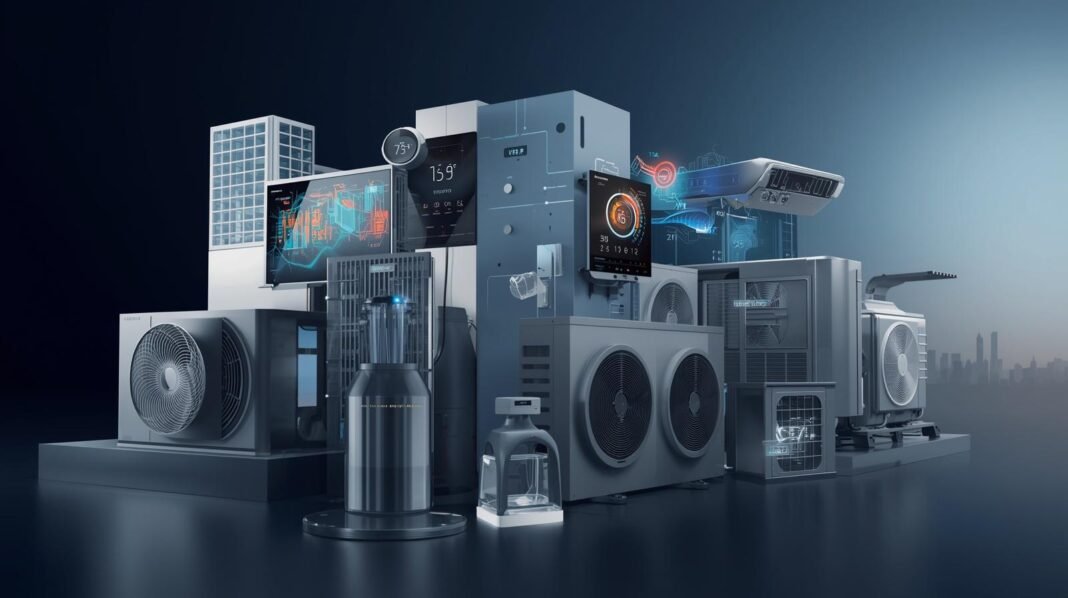
The U.S. HVAC sector has proven remarkably resilient. While 2025 was a challenging year — marked by refrigerant transition disruptions, a residential cooling market decline, and supply chain headwinds — 2026 is emerging as a stabilization and innovation year.
Several macro forces are driving both urgency and opportunity:
$333 billion by late 2026,
growing at a CAGR of
7.4%.
$74.80 billion by 2029.
Electrification Momentum: Over 48% of U.S. households have now transitioned to electrical heating systems, spurred by federal tax credits and state-level rebates. Heat pumps outsold gas furnaces by 32% in 2024 and the trend is continuing into 2026.
Refrigerant Transition: All new HVAC installations must now use low-GWP refrigerants such as R-454B or R-32 as of January 2026. This has forced manufacturers to retool product lines and prompted technicians to pursue A2L certification.
AI and Smart Systems: Early adopters of AI-driven predictive maintenance are reporting up to 50% less downtime and 25-40% lower maintenance costs.
The smart thermostat market alone is estimated at $3.8 billion between 2026 and 2029.
Data Center Cooling: With the explosion of AI infrastructure, data center cooling has emerged as a $54 billion opportunity within commercial HVAC — a segment most residential contractors are not yet positioned to serve.
Workforce Crisis: The industry faces over 110,000 unfilled positions with a 5:2 retirement-to-replacement ratio. Companies investing in training, AI dispatch, and automation are gaining a decisive competitive edge.
Top HVAC Companies in the U.S. to Watch in 2026
1. Carrier Global Corporation
Specialty: Residential & Commercial HVAC, Refrigeration, Building Automation
Carrier Global is, by any measure, the foundational name in American HVAC. The company traces its roots to Willis Carrier, whose 1902 invention of modern air conditioning transformed the built environment worldwide.
In 2026, Carrier continues to hold the largest market share in the U.S. HVAC sector and is actively navigating the twin challenges of refrigerant transition and residential market normalization.
CEO Dave Gitlin has been candid about near-term pressures: the U.S. residential market exited 2025 well below normal replacement pace, and Carrier is not projecting a single-year snap back.
Instead, the company is investing in long-cycle growth — launching field trials for next-generation heat pump technology, expanding its connected building platforms, and positioning itself at the intersection of HVAC and building automation.
extreme cold climates — a key competitive frontier as
electrification expands northward.
2. Trane Technologies
(U.S. Operations: Davidson, NC)
Specialty: Premium Residential & Commercial HVAC, Decarbonization Services
decarbonization services
and high-margin commercial projects sets it apart from peers in a softening residential market.
Trane Technologies, which owns both the Trane and American Standard HVAC brands, holds a 10% market share in the U.S. and is widely regarded as the premium standard for system durability.
American Standard units are manufactured in the same U.S. factories as Trane equipment, offering contractors a mid-market option without sacrificing engineering quality.
In 2026, Trane is navigating a difficult first half — the company expects the residential market to remain soft as one-time disruptions from the refrigerant transition fade.
However, its commercial segment and decarbonization services pipeline remain strong. Trane’s high-margin focus on commercial HVAC and its growing portfolio of energy-as-a-service offerings make it a compelling long-term watch.
On the product innovation front, Trane’s Climatuff compressor technology and Spine Fin coil design continue to set benchmarks for longevity, while the XV20i variable-speed system remains a leading choice for high-performance residential installations.
3. Lennox International
Specialty: High-Efficiency Residential & Light Commercial HVAC, Smart Controls
high-margin, tech-forward climate solutions leader.
Its cold-climate heat pump and Samsung VRF partnership make it the most dynamic established player in 2026.
Lennox International is arguably the most interesting story in U.S. HVAC heading into 2026.
With a century of heritage in home heating, the company has been actively repositioning itself as a technology-forward climate solutions leader — and the strategy is yielding results.
Two developments are particularly notable. First, the SL22KLV cold-climate heat pump, part of the Dave Lennox Signature Collection, can operate efficiently at temperatures as low as -22 degrees Fahrenheit.
This effectively dismantles the long-standing objection that heat pumps are unsuitable for Northern climates — a major commercial and policy significance.
Second, in 2024, Lennox entered a joint venture with Samsung to expand into ductless and Variable Refrigerant Flow (VRF) systems, a fast-growing segment where it previously had limited presence.
and Ultimate Comfort System
use AI-driven diagnostics to
predict equipment failure before it occurs —
transforming routine maintenance into a
premium, subscription-style service.
Wall Street currently rates Lennox a cautious buy, reflecting both its ambitious transformation trajectory and the broader market pressures affecting the residential segment. For those watching the HVAC space for innovation leadership, Lennox is the name to follow in 2026.
4. Daikin Industries (U.S. Operations)
Specialty: VRF Systems, Ductless Mini-Splits, Inverter Technology, Heat Pumps
unmatched inverter technology
and energy efficiency
to the U.S. market, while its Goodman and Amana brands continue to
dominate the value segment.
Daikin Industries is the global HVAC giant — the world’s largest HVAC manufacturer by market capitalization — and its U.S. presence continues to grow.
The company’s American footprint spans premium VRF and ductless systems under the Daikin brand, mid-market residential under Amana, and the widely popular budget-friendly Goodman brand, which dominates contractor volume sales.
In 2026, Daikin’s competitive advantage is threefold. Its inverter-driven technology delivers energy savings of up to 30% compared to conventional systems.
Its Goodman line — featuring models like the GSXC18 — provides affordable, high-performance options for contractors who need to compete on price.
And its ductless systems are increasingly being specified in new construction projects seeking electrification compliance.
Daikin’s Wichita, Kansas manufacturing facility underscores its commitment to domestic production, a factor gaining increasing importance with contractors and commercial clients alike as supply chain resilience becomes a procurement priority.
5. Johnson Controls International (York, Coleman, Luxaire)
(U.S. HQ: Milwaukee, Wisconsin)
Specialty: Commercial Building Automation, HVAC Integration, Smart Controls
digital building controls
and integrated building solutions —
positioning it as the
dominant force in commercial and enterprise-scale HVAC for 2026.
Johnson Controls International occupies a unique position in the HVAC industry: it is as much a building technology company as it is an equipment manufacturer.
Its portfolio — spanning York, Coleman, and Luxaire HVAC brands — serves the residential and commercial market, but its true competitive moat is its OpenBlue digital platform, which integrates HVAC, fire safety, security, and energy management at the building or campus level.
In an era where building owners are demanding condition-based maintenance, real-time energy optimization, and net-zero compliance tracking, Johnson Controls is uniquely positioned to offer the full stack.
For large commercial buildings, healthcare campuses, universities, and data centers, JCI’s integrated approach reduces total cost of ownership and simplifies vendor management.
The York Affinity Series remains a contractor favorite for its compact design and quiet operation, while the LX Series provides reliable performance for smaller commercial applications.
As the commercial HVAC sector anticipates modest 5% growth in 2026, Johnson Controls’ deep integration capabilities give it a meaningful advantage over pure-play equipment manufacturers.
6. Rheem Manufacturing Company
Specialty: Residential & Light Commercial HVAC, Heat Pumps, Water Heating
one-stop solution for residential contractors.
Its Prestige Series and growing heat pump lineup keep it highly competitive.
Rheem Manufacturing is one of the most contractor-trusted names in the U.S. HVAC market.
Its dual-brand strategy — Rheem for direct sales and Ruud distributed through separate dealer networks — allows the company to serve multiple price points and distribution channels simultaneously without brand cannibalization.
The Rheem Prestige Series remains a top-tier residential offering, known for reliable performance and strong warranty protection.
Rheem’s adjacent strength in water heating — including tankless water heaters — makes it particularly attractive to contractors who want a single supplier relationship for both HVAC and hot water systems.
In 2026, Rheem is expanding its heat pump portfolio to capitalize on both the IRA incentive landscape (while it remains in effect) and growing state-level electrification mandates.
Its manufacturing footprint across multiple U.S. states also insulates it from some of the supply chain volatility that has affected competitors.
7. Mitsubishi Electric Trane HVAC US (METUS)
Specialty: Ductless Mini-Splits, VRF Systems, Hyper-Heating Technology
Hyper-Heating INVERTER technology
makes it the gold standard for cold-climate electrification.
Mitsubishi Electric’s joint venture with Trane Technologies — operating as METUS — has emerged as the definitive market leader in ductless and VRF HVAC solutions across the United States.
As the electrification movement accelerates and new construction increasingly avoids ductwork in favor of flexible zoning, METUS finds itself at the center of the most dynamic growth segment in residential and light commercial HVAC.
The company’s Hyper-Heating INVERTER (H2i) technology enables efficient operation in temperatures as low as -13 degrees Fahrenheit — a critical capability as heat pumps push into cold-climate markets in the Midwest and Northeast.
The recent installation of Mitsubishi Electric VRF systems at the Westin Atlanta Gwinnett exemplifies its growing footprint in large-scale commercial hospitality projects.
ductless mini-split
and Variable Refrigerant Flow (VRF) systems.
Its partnership with Trane provides access to the
largest commercial HVAC distribution network in North America.
8. LG Electronics USA — LG Air Conditioning Technologies
Specialty: Multi-V VRF Systems, Commercial Air Handlers, Heat Pump Water Heaters
commercial VRF and
heat pump water heaters positions it as the
most globally-informed competitor in the U.S. HVAC market.
LG Electronics brings the scale and R&D firepower of a $60 billion global technology company to the U.S. HVAC market.
Its LG Air Conditioning Technologies division, based in Alpharetta, Georgia, offers a comprehensive range of heating and cooling solutions — from individual ductless units to large-scale industrial systems — all underpinned by LG’s signature inverter technology and smart connectivity.
The LG Multi-V VRF system is widely specified for commercial applications requiring flexible zoning, high efficiency, and integration with smart building controls.
LG ThinQ app compatibility enables remote monitoring and AI-assisted optimization, aligning LG’s commercial offerings with the broader trend toward predictive, data-driven HVAC management.
LG’s growing U.S. market investment — including its popular LG Pro Cast podcast series for HVAC professionals — reflects a deliberate strategy to deepen contractor relationships and establish brand loyalty in a market traditionally dominated by domestic manufacturers.
9. Navien America Inc.
Specialty: High-Efficiency Condensing Boilers, Tankless Water Heaters, Combi-Boilers
and is expanding rapidly into high-efficiency hydronic heating —
the quiet disruptor of traditional boiler-based HVAC.
Navien may not yet be a household name in mainstream HVAC, but among HVAC contractors specializing in hydronic heating and high-efficiency water heating, it is indispensable.
Founded in 2006 and headquartered in Irvine, California, Navien has captured the highest market share in condensing gas water heaters and is actively expanding its portfolio of combi-boilers — systems that handle both space heating and domestic hot water from a single unit.
The company holds numerous technology patents and maintains quality certifications that set it apart in the premium segment.
For multifamily developers, high-end residential projects, and commercial applications requiring precise temperature control, Navien’s product line fills a critical gap that larger general-line HVAC brands often overlook.
As interest in hydronic radiant heating systems grows alongside the broader electrification movement, Navien is well-positioned to bridge the transition — offering both gas and heat pump-compatible hydronic solutions as the market evolves.
10. Budderfly
Specialty: AI-Powered Energy Optimization, Ultra-High-Performance HVAC, Smart Thermostats
patented heat pump technologies,
AI smart thermostat, and
Virtual Power Plant platform
represent the future of commercial HVAC as a service.
Budderfly is the boldest disruptor on this list. Unlike traditional HVAC manufacturers, Budderfly delivers energy savings through a full-stack technology and services model — combining patented Ultra-High-Performance (UHP) HVAC systems, AI-driven smart thermostats, and a proprietary Virtual Power Plant platform into a subscription-based energy optimization solution for commercial clients.
At the 2026 AHR Expo in Las Vegas — the industry’s premier technology showcase — Budderfly’s innovations drew significant attention.
Its smart thermostat analyzes consumption data and delivers real-time recommendations to lower energy usage and bills. Its VPP platform enables buildings to participate in grid-level demand response, turning HVAC systems into assets rather than pure costs.
HVACaaS (HVAC as a Service) model — a
subscription-based approach predicted to become a
dominant commercial model through the decade.
Early commercial clients report
significant energy cost reductions.
For investors and industry observers, Budderfly is the company to watch as the industry moves from equipment sales toward recurring, data-driven energy services. Its in-house installation experts and apprenticeship program also address the talent pipeline challenge head-on.
Key Trends Shaping the 2026 HVAC Landscape
The Refrigerant Revolution
2026 marks a definitive turning point for refrigerants across the U.S. HVAC industry.
All new installations must now use low-GWP refrigerants such as R-454B or R-32, requiring technicians to obtain A2L certification and contractors to invest in compatible tools and service equipment.
While this transition has created short-term cost pressures, it also drives replacement demand and creates opportunities for companies that move quickly to certify their workforce.
Heat Pumps Cross the Mainstream Threshold
Heat pumps are no longer a niche alternative — they are the default recommendation for new and replacement HVAC installations in an increasing number of markets.
With over 48% of U.S. households now on electric heating systems and cold-climate heat pump technology operating efficiently at temperatures below -20 degrees Fahrenheit, the old objections are fading.
The IRA’s $2,000 federal tax credit (and up to $8,000 in state rebates) accelerated adoption significantly, though this federal incentive structure faces uncertainty heading into late 2026.
AI Moves From Buzzword to Baseline
AI predictive maintenance has crossed from pilot projects to operational standard at tier-one commercial building operators.
The business case is clear: AI-based anomaly detection can identify up to 60% of commercial HVAC failures three to eight weeks before they occur — replacing emergency repair events that carry three to four times the cost premium of planned maintenance.
On the operational side, AI-powered technician dispatch is delivering the fastest ROI for lean contracting teams, optimizing assignments in real time based on skills, location, and job priority.
Indoor Air Quality as a Health Imperative
The IAQ market — indoor air quality monitoring, advanced filtration, and ventilation — is expected to reach $12 billion between 2026 and 2029. Post-pandemic expectations around air quality have made IAQ a mainstream selling point for residential and commercial HVAC.
Companies that bundle IAQ solutions with system replacements are commanding premium pricing and stronger customer loyalty.
Data Center Cooling: The $54B Frontier
The artificial intelligence infrastructure boom has created an urgent demand for specialized data center cooling.
This sector represents a $54 billion opportunity within commercial HVAC — one that requires 24/7 service capability, precision climate control expertise, and specific certifications.
Only a small percentage of HVAC contractors currently have the skills and certifications to compete, making this the highest-margin growth vertical in the industry.
2026 Outlook: Challenges and Opportunities
The HVAC sector enters 2026 in a period of stabilization after a turbulent 2025. Residential shipments are not expected to rebound sharply, and the refrigerant transition will continue to create near-term complexity.
However, the structural growth drivers — electrification, aging infrastructure, smart building adoption, and extreme weather — remain firmly intact.
The companies best positioned for the decade ahead share several characteristics: they are investing in digital and AI capabilities, expanding their heat pump and VRF portfolios, building direct relationships with contractors through training and certification support, and developing recurring revenue models that reduce dependence on equipment sales cycles.
For consumers and building managers, 2026 offers an unprecedented range of high-performance, energy-efficient, and intelligent HVAC solutions.
The question is no longer whether to upgrade — it is which company and technology platform will serve your needs best over the next fifteen to twenty years.
Also Read
5 AC Maintenance Tips That could Save You Frequent Repair Costs
7 Warning Signs Your HVAC System Needs Immediate Repair (Before It’s Too Late)

- Top HVAC Companies In The U.S. To Watch In 2026 - March 26, 2026
- South Africa’s April 1 Triple Shock: When the Joke Is on the Consumer - March 26, 2026
- KeNHA’s World Bank Funding Boost: Inside Kenya’s KSh Multi-Billion Expressway Masterplan - March 25, 2026
