
Every time a fuel crisis hits — and in 2026, we are squarely in the middle of one — the construction industry goes through the same painful ritual. Contractors scramble to reprice contracts. Equipment hire rates surge.
Diesel-hungry machinery sits idle because site operations have become too expensive to run at the same pace. Project margins that already ran thin get thinner.
With oil trading above $110 a barrel following the Iran-US conflict and the effective closure of the Strait of Hormuz, that ritual is playing out again.
But this time, more developers, contractors, and project owners are asking a sharper question: is there a smarter way to build that is structurally less exposed to fuel shocks in the first place?
The answer — increasingly backed by data — is yes. And it has a name: modular and prefabricated construction.
Why Traditional Construction Is So Fuel-Hungry
To understand why modular builds gain relative value when fuel prices spike, you first need to understand just how deeply conventional construction is stitched into diesel economics.
The U.S. Energy Information Administration reports that diesel powers the vast majority of heavy construction equipment — excavators, bulldozers, cranes, compactors, concrete mixers, and delivery trucks.
Across the sector, diesel accounts for 98% of all energy use on construction sites. For individual heavy machines, the numbers are striking: an average-sized excavator burns between 15 and 20 litres of diesel per hour under normal operating conditions. Diesel costs can represent more than 30% of the total operational budget on a busy site.
Traditional site-built construction also generates enormous logistical fuel demand. Every subcontractor drives to and from the site.
Dozens of separate material deliveries arrive by truck over the course of a project — structural steel, framing timber, roofing materials, plumbing components, electrical fittings, finishing materials.
Each delivery consumes diesel. Each delay caused by a missing delivery extends the project timeline, adding more machine hours and more fuel burn.
When diesel costs jump 30%, 40%, or more — as they have since the Iran crisis began — every single one of these costs rises with it.
The effect is not linear; it cascades through the budget in ways that estimators did not account for at the time of tendering.
Switching to prefabricated methods can reduce the number of truckloads required for building materials by 66% to 80% — a fuel saving that compounds across an entire project lifecycle.
How Modular Construction Changes the Fuel Equation
Modular and prefabricated construction relocates the majority of the build process from the job site to a factory.
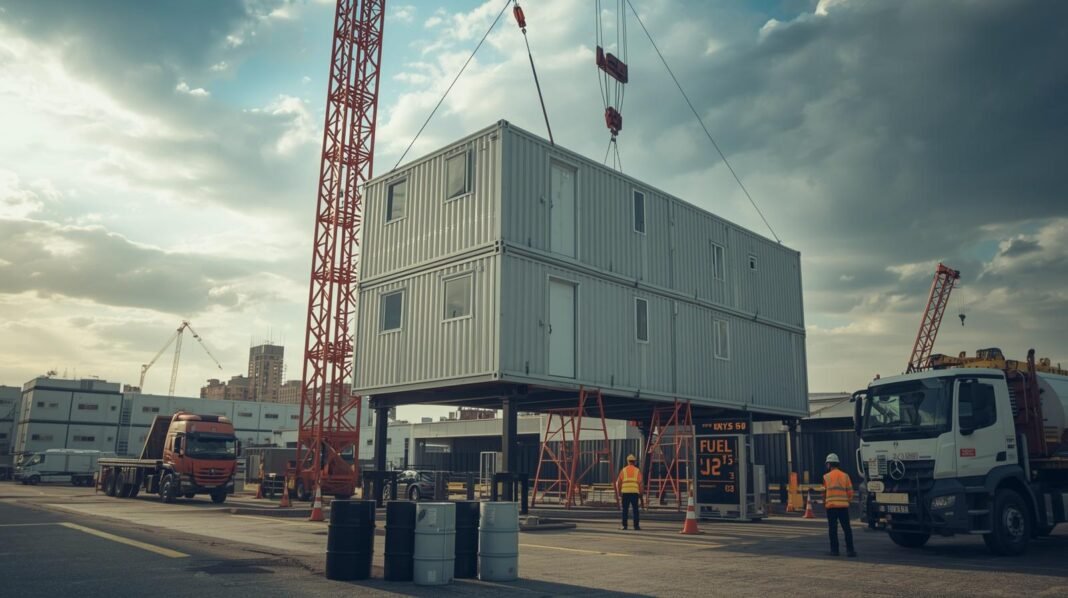
Structural components, wall panels, entire room modules — even fully finished sections with plumbing and electrical work pre-installed — are manufactured in a controlled factory environment, then transported to the site for assembly.
This fundamental shift in where work happens changes the energy profile of construction significantly, in several ways.
First, factory manufacturing runs primarily on grid electricity, not diesel. Precision tools, assembly lines, overhead cranes, and climate control systems in a factory are powered by the electrical grid — which, unlike a remote construction site, can draw on a diversified energy mix that includes renewables.
A fuel crisis that sends diesel to record highs has a far muted effect on factory operating costs.
Second, the number of site vehicle movements collapses. Rather than dozens of separate deliveries arriving on separate trucks over months, a modular build may require only a handful of crane placements to assemble what a traditional build would have needed hundreds of truck trips to construct.
One analysis of prefabricated staircase systems found that 108 standard truckloads were reduced to just 36 — a two-thirds reduction in transport fuel — for a single project component.
Multiply that across an entire modular building, and the fuel savings from transport alone become substantial.
Third, the site timeline shrinks dramatically. McKinsey & Company estimates that modular construction can cut overall project schedules by 20% to 50%, because factory work and site foundation preparation happen simultaneously rather than sequentially.
Fewer weeks on site means fewer machine hours, fewer equipment hire days, and less diesel burned by site machinery.
The Numbers: Cost Savings That Look Even Better in a High-Fuel Environment
Even before the current fuel crisis, the cost case for modular construction was solidifying. Prefab homes average around $87 per square foot compared to $166 for conventional site-built construction — roughly half the cost.
For commercial projects, modular approaches can reduce total construction costs by up to 20%, according to McKinsey research, while delivering labour cost savings of between 16% and 25%, according to the McGraw-Hill Construction report on prefabrication and modular methods.
When fuel is cheap, these savings are significant but not always decisive enough to overcome the inertia of the industry’s preference for conventional methods.
When fuel is expensive, the calculus shifts. The parts of the cost equation that modular construction removes or reduces — site diesel consumption, multiple truck deliveries, extended equipment hire — are precisely the parts that inflate most aggressively when energy prices spike.
In practical terms, a contractor running a traditional site build in March 2026 is absorbing diesel price increases across every machine-hour, every delivery, and every worker commute.
A contractor running a modular project is largely shielded from those same increases, because most of the value-add work is happening in a factory that does not run on diesel.
The global market has noticed. The prefabricated buildings sector was valued at $146.47 billion in 2024 and is projected to reach $208 billion by 2030, growing at a compound annual rate of over 6%.
In the United States specifically, the Modular Building Institute projects the domestic market to reach $25.4 billion by 2029.
That growth trajectory pre-dated the 2026 oil shock; analysts expect the current crisis to accelerate adoption further.
Modular construction does not eliminate exposure to energy costs — but it relocates that exposure to where energy is cheaper, more stable, and increasingly renewable.
The Honest Limitations: Where Modular Loses Ground
A balanced assessment requires acknowledging where modular and prefab construction does not automatically win on fuel economics — and there are real constraints worth understanding.
Transportation from factory to site is modular construction’s most significant fuel vulnerability.
Unlike traditional builds where materials arrive in small, flexible batches, modular construction requires moving large, heavy, and often oversized loads — full room modules, structural panels, volumetric units — from the manufacturing facility to the construction site.
The cost of this transport scales directly with fuel prices and, critically, with distance. Modular economics deteriorate when the nearest factory is hundreds of kilometres from the job site.
This is why the location of manufacturing matters enormously. For project teams in regions with well-established modular manufacturing capacity — parts of the UK, North America’s Midwest and Pacific Coast, much of Japan and Scandinavia — the transport cost is manageable and the net fuel advantage remains.
For projects in more remote locations, or in regions where the modular manufacturing sector is still underdeveloped, the transport premium can erode much of the fuel saving benefit.
There is also a distinction between project types. Highly repetitive builds — apartment blocks, hotels, student accommodation, healthcare facilities, schools — lend themselves naturally to modular methods because the design repetition allows for optimised factory production runs.
One-off bespoke structures, complex irregular geometries, or projects with unusual site constraints may offer fewer opportunities for modular delivery, limiting the potential fuel savings.
What This Means for Project Teams Right Now
For developers, contractors, and quantity surveyors currently reviewing project pipelines in the context of $110 oil, there are several practical implications worth acting on immediately.
Any project at the design or early planning stage is worth re-evaluating for modular or hybrid prefab delivery.
Even partial adoption — prefabricated structural frames, pre-assembled MEP (mechanical, electrical, and plumbing) modules, or pre-finished bathroom pods — can meaningfully reduce the site diesel footprint and the number of deliveries required.
Fuel contingencies built into conventional construction contracts need urgent revision. The standard allowances for fuel cost escalation that most estimators used six months ago are no longer adequate.
Contracts for site-based projects being tendered right now should include explicit fuel escalation clauses tied to a published index, giving both parties a fair mechanism to handle costs that neither can fully predict.
For clients choosing between delivery methods on upcoming projects, the total cost comparison needs to include a realistic fuel price assumption for the duration of construction, not the pre-crisis figure.
When you model project costs at $110-per-barrel oil, the modular option’s relative advantage widens considerably compared to what traditional apples-to-apples cost comparisons showed at $75 oil.
Finally, for construction businesses looking beyond the current crisis, this moment presents a genuine strategic signal.
Geopolitical instability, climate policy, and long-term energy transition all point in the same direction: the era of cheap, predictable diesel for site operations is over.
Businesses that begin building modular delivery capability now — through partnerships, training, or investment in off-site capacity — are positioning themselves for a competitive advantage that will compound over the next decade.
The Verdict
Modular and prefabricated construction are not a perfect shield against energy price volatility.
Transportation costs mean they are not immune. Design constraints mean they are not always applicable. And the modular manufacturing sector in many markets is not yet at the scale needed to absorb a sudden surge in demand.
But in a high-fuel environment, modular builds are structurally better positioned than conventional site construction in almost every dimension that matters: less diesel consumed per square metre delivered, fewer vehicle movements, shorter site timelines, and a manufacturing process anchored to grid electricity rather than diesel. These advantages were real before the Iran-US crisis pushed oil past $110.
They are considerably more valuable now.
For any project team asking whether to take modular more seriously in 2026, the fuel price alone has already given you the answer.
Also Read
Best Car Insurance Companies in America Ranked by Claims Satisfaction
U.S. Imposes Heavy Duties on Indian Solar Imports in Major Trade Move

