
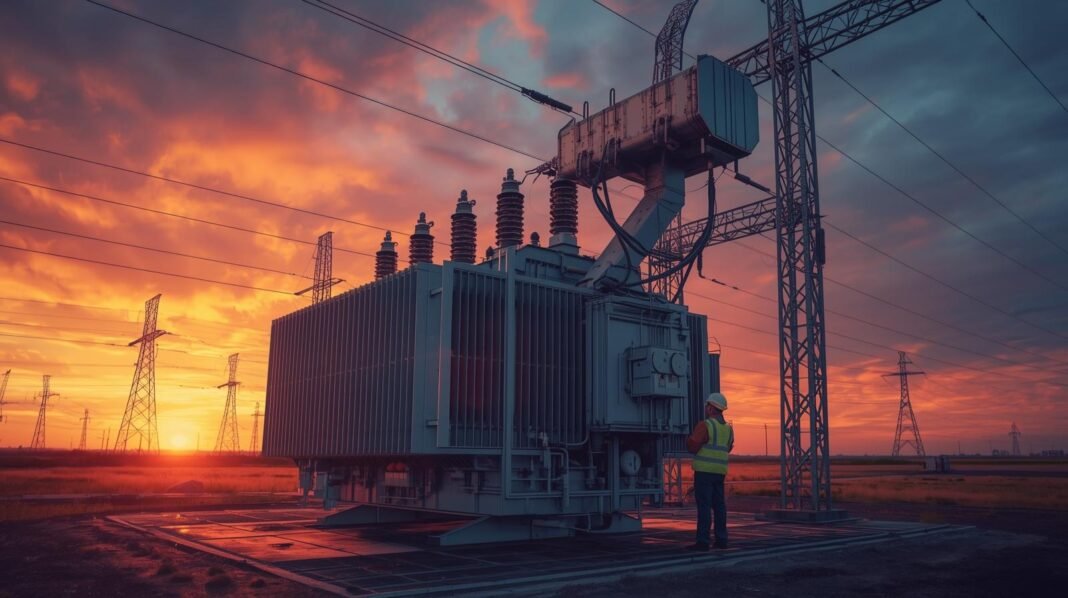
Electric transformers are the silent workhorses of global energy infrastructure.
From the moment electricity is generated at a power plant to the point it lights a home, powers a factory, or charges an electric vehicle, it passes through multiple transformers—each stepping voltage up or down to optimize transmission efficiency and ensure safe end-use delivery.
As the world undergoes the most significant energy transition in its history, the importance of transformer technology has never been greater.
Global electricity demand is surging on multiple fronts simultaneously.
The rapid proliferation of electric vehicles, the explosive growth of data centers driven by artificial intelligence and cloud computing, the scaling of renewable energy capacity, and the broader electrification of industries previously reliant on fossil fuels are all placing extraordinary pressure on power infrastructure.
The International Energy Agency projects that global electricity demand will grow by more than 50% between 2020 and 2050, requiring massive investment in transmission and distribution infrastructure—including hundreds of thousands of new transformers.
In this landscape, transformer manufacturers occupy a uniquely strategic position. They produce the critical equipment that makes large-scale power grids possible, enabling the integration of offshore wind farms, utility-scale solar installations, and cross-border energy interconnections.
The following profiles highlight the world’s most influential transformer manufacturers heading into 2026, along with the trends shaping the industry’s future.
World’s Leading Electric Transformer Manufacturers
1. Hitachi Energy (Switzerland / Japan)
Formed from the 2020 acquisition of ABB’s Power Grids division by Hitachi, Hitachi Energy has rapidly emerged as one of the world’s foremost power technology companies.
Headquartered in Zurich, Switzerland, the company brings together Hitachi’s digital expertise with a century-long legacy of power engineering.
Transformer Technologies: Power transformers, HVDC converter transformers, phase-shifting transformers, traction transformers, dry-type distribution transformers, and special application transformers.
Key Markets: Utilities, grid operators, industrial facilities, rail and transit systems, offshore wind, and data centers across 90+ countries.
Notable Innovations: Hitachi Energy’s TXpert digital transformer ecosystem integrates sensors and IoT connectivity for real-time health monitoring, predictive maintenance, and lifecycle management—a significant step toward truly intelligent substations.
The company is also a world leader in HVDC transmission systems, which are critical for long-distance power delivery and renewable energy integration.
2. Siemens Energy (Germany)
Spun off from Siemens AG in 2020, Siemens Energy is one of the world’s largest energy technology companies, with transformer manufacturing forming a cornerstone of its portfolio. Headquartered in Munich, Germany, the company serves utilities and industrial clients across the globe.
Transformer Technologies: Power transformers up to 1,200 kV, generator step-up transformers, autotransformers, shunt reactors, dry-type transformers, and instrument transformers.
Key Markets: Transmission and distribution utilities, renewable energy developers, oil and gas, and industrial manufacturers in Europe, the Americas, the Middle East, and Asia.
Notable Innovations: Siemens Energy has been advancing eco-efficient transformer design using natural ester and synthetic ester insulating fluids as environmentally friendly alternatives to mineral oil. The company is also investing heavily in digital substation solutions and smart grid technologies.
3. GE Vernova (United States)
Following GE’s strategic reorganization, GE Vernova—the energy-focused successor entity—carries forward General Electric’s storied transformer manufacturing legacy.
With roots stretching back to Thomas Edison’s era, GE’s power equipment business has long set global benchmarks for large-scale transformer technology.
Transformer Technologies: Extra-high-voltage (EHV) power transformers, generator step-up units, distribution transformers, dry-type transformers, and HVDC transformers.
Key Markets: Electric utilities, nuclear and thermal generation plants, offshore wind, industrial facilities, and grid operators in North America, Latin America, and Asia Pacific.
Notable Innovations: GE Vernova has focused on expanding its transformer production capacity in response to surging US grid infrastructure demand. The company has also pioneered the use of advanced insulation materials and digital monitoring systems to extend transformer lifespan and improve grid resilience.
4. ABB (Switzerland)
Though ABB divested its Power Grids division to Hitachi, the Swiss-Swedish multinational retains a significant presence in the transformer market through its electrification and motion businesses.
ABB’s distribution transformer segment continues to serve industrial and commercial clients worldwide.
Transformer Technologies: Distribution transformers, dry-type transformers, cast resin transformers, and special transformers for industrial applications.
Key Markets: Commercial buildings, industrial plants, data centers, mining, marine applications, and urban distribution grids.
Notable Innovations: ABB has pioneered energy-efficient transformer designs and smart monitoring technologies. Its cast resin transformers are widely deployed in fire-sensitive environments such as high-rise buildings, hospitals, and tunnels.
5. Schneider Electric (France)
Schneider Electric, headquartered in Rueil-Malmaison, France, is a global leader in energy management and automation. The company’s transformer division specializes in medium-voltage distribution solutions, making it a dominant player in commercial and industrial power distribution.
Transformer Technologies: Medium-voltage dry-type and oil-immersed distribution transformers, cast resin transformers, and pad-mounted transformers.
Key Markets: Commercial buildings, data centers, industrial facilities, utilities, and smart city projects across more than 100 countries.
Notable Innovations: Schneider Electric has integrated digital monitoring and asset management capabilities into its transformer products, aligned with its EcoStruxure platform—an IoT-enabled architecture for energy management. The company is also a champion of circular economy principles in transformer design.
6. Mitsubishi Electric (Japan)
Mitsubishi Electric Corporation, headquartered in Tokyo, is one of Japan’s premier electrical equipment manufacturers with deep expertise in high-voltage power transformers. The company serves some of the world’s most demanding grid environments.
Transformer Technologies: Ultra-high-voltage (UHV) power transformers, HVDC transformers, gas-insulated transformers, generator step-up transformers, and large shunt reactors.
Key Markets: National grid operators, generation companies, and large industrial users in Japan, Southeast Asia, the Middle East, and North America.
Notable Innovations: Mitsubishi Electric has developed gas-insulated power transformers that offer significantly reduced footprint—critical for urban substations where space is at a premium. The company has also advanced SF6-free insulation technologies to reduce environmental impact.
7. Toshiba Energy Systems & Solutions (Japan)
Toshiba Energy Systems & Solutions Corporation is a Tokyo-based provider of large-scale energy infrastructure solutions, with transformer manufacturing forming a key component of its power systems business.
Transformer Technologies: Power transformers for thermal, nuclear, hydro, and renewable energy; HVDC transformers; station transformers; and large autotransformers.
Key Markets: Electric power companies, nuclear power operators, and large industrial enterprises in Japan and internationally.
Notable Innovations: Toshiba has a long-standing specialization in transformers for nuclear power stations, where reliability standards are extraordinarily high. The company has also invested in advanced insulation monitoring technologies for early fault detection in critical infrastructure.
8. HD Hyundai Electric (South Korea)
HD Hyundai Electric, part of the HD Hyundai conglomerate and headquartered in Ulsan, South Korea, has rapidly expanded its global footprint in power transformers. The company has emerged as a leading supplier for the North American and European markets.
Transformer Technologies: Large power transformers, extra-high-voltage transformers, distribution transformers, and dry-type transformers.
Key Markets: US utilities, European grid operators, Middle Eastern utilities, and Korean industrial conglomerates.
Notable Innovations: HD Hyundai Electric has invested substantially in expanding US manufacturing capacity to serve the growing American grid modernization market. The company is also a leader in smart transformer technologies with remote diagnostics and condition monitoring capabilities.
9. TBEA Co., Ltd. (China)
TBEA, headquartered in Changji, Xinjiang, China, is one of the world’s largest transformer manufacturers by output volume. The company has played a pivotal role in China’s massive grid expansion and increasingly competes on the international stage.
Transformer Technologies: Ultra-high-voltage (UHV AC and DC) transformers, HVDC converter transformers, power transformers, and distribution transformers.
Key Markets: China’s State Grid Corporation, global HVDC project developers, and utilities in Asia, Africa, and the Middle East.
Notable Innovations: TBEA is a global leader in UHV transformer technology, having supplied critical equipment for China’s long-distance UHV transmission corridors—among the most technically demanding power infrastructure projects in the world. The company has exported transformer technology to over 50 countries.
10. WEG S.A. (Brazil)
WEG, headquartered in Jaraguá do Sul, Brazil, is Latin America’s largest electrical equipment manufacturer and a growing force in the global transformer market. The company has diversified from its motors and drives origins into a comprehensive power infrastructure provider.
Transformer Technologies: Distribution transformers, power transformers, dry-type transformers, and special transformers for renewable energy applications.
Key Markets: Latin America, North America, Africa, and Europe—with particular strength in industrial, utility, and renewable energy segments.
Notable Innovations: WEG has capitalized on the growth of wind and solar energy in Brazil and internationally, developing transformer solutions optimized for renewable generation. The company has also expanded manufacturing operations in the United States to serve growing North American demand.
Major Trends Shaping the Global Transformer Industry
Renewable Energy Integration
The accelerating global transition to wind and solar power is reshaping transformer demand.
Offshore wind farms require specialized high-voltage submarine cable interfaces; utility-scale solar plants need medium-voltage transformers optimized for inverter outputs; and grid-scale battery storage systems require transformers with specific load profiles.
These applications are driving innovation in transformer design and spurring demand for products with higher efficiency ratings and enhanced durability.
Grid Modernization and Expansion
Aging power infrastructure in North America and Europe is driving a significant upgrade cycle, while rapid urbanization and electrification in Asia, Africa, and Latin America are fueling greenfield grid construction.
Governments and utilities are committing to multi-decade capital investment programs that will require enormous quantities of transformers at all voltage levels.
Smart Grids and Digital Monitoring
The integration of digital sensors, IoT connectivity, and artificial intelligence into transformer management is one of the most consequential trends in the industry.
Smart transformers equipped with real-time monitoring capabilities allow utilities to detect developing faults, optimize loading, extend equipment lifespan, and reduce costly unplanned outages.
This digital transformation is blurring the line between hardware manufacturers and technology companies.
Data Centers and AI Infrastructure
The explosive growth of artificial intelligence, cloud computing, and digital services is creating surging electricity demand from data centers.
Major technology companies are committing to build tens of gigawatts of new data center capacity through the late 2020s, each requiring substantial transformer infrastructure.
This trend is creating new, high-value demand for both distribution and power transformers—often with demanding specifications for power quality and continuity.
HVDC Transmission
High-voltage direct current (HVDC) technology is becoming increasingly central to global grid strategy, enabling efficient power transmission over thousands of kilometers and facilitating cross-border interconnections.
HVDC converter transformers are among the most technically demanding products in the industry, and manufacturers with proven capabilities in this segment are well-positioned for long-term growth.
Growing Transformer Demand in Africa
Africa represents one of the most significant emerging markets for transformer manufacturers.
The continent is home to 1.4 billion people, yet hundreds of millions lack access to reliable electricity—a gap that governments, development banks, and private investors are increasingly committed to closing.
Across the continent, major infrastructure programs are driving unprecedented demand for transformers at all voltage levels.
Sub-Saharan Africa’s renewable energy boom is a major driver. Countries including South Africa, Kenya, Morocco, Ethiopia, and Egypt are developing gigawatt-scale solar and wind projects, all requiring substantial transformer infrastructure.
South Africa’s Renewable Energy Independent Power Producer Procurement Programme (REIPPPP) has attracted billions in international investment and created significant transformer supply requirements.
Similarly, Egypt’s Benban Solar Park—one of the world’s largest—required extensive transformer networks to connect to the national grid.
Grid interconnection projects across the continent are also gathering momentum. Initiatives such as the Eastern Africa Power Pool and the WAPP (West African Power Pool) aim to connect national grids across multiple countries, creating demand for high-voltage transmission transformers and HVDC equipment.
The African Development Bank’s investment programs in energy infrastructure are accelerating these projects.
Urban electrification programs in Nigeria, the Democratic Republic of Congo, Tanzania, and other high-population nations are generating strong demand for distribution transformers, as cities expand their grid coverage to rapidly growing urban populations.
International manufacturers including Siemens Energy, Hitachi Energy, and ABB are active in the region, while Chinese manufacturers such as TBEA have also established a significant presence through infrastructure development agreements.
- South Africa: Grid upgrades and renewable energy integration driving major transformer procurement
- Egypt & North Africa: Solar megaprojects and grid modernization creating sustained demand
- East Africa: Power pool interconnection projects requiring high-voltage transmission transformers
- West Africa: Urban electrification and industrial expansion fueling distribution transformer growth
- Sub-Saharan region: International development finance supporting rural electrification programs
A Strategic Industry for the Energy Future
Electric transformer manufacturing is no longer merely a component of the broader electrical equipment industry—it has become a strategic sector in its own right.
As governments worldwide pursue energy security, decarbonization, and grid resilience, the ability to produce, supply, and maintain high-quality transformer infrastructure has taken on geopolitical as well as commercial significance.
Supply chain constraints that emerged in the early 2020s have prompted utilities and governments in the United States, Europe, and elsewhere to actively seek to diversify transformer supply and, in some cases, incentivize domestic manufacturing through policy mechanisms.
Lead times for large power transformers—historically 12 to 18 months—have stretched significantly in some markets, underlining the strategic importance of manufacturing capacity.
The companies profiled in this article represent the vanguard of global transformer manufacturing: organizations that have combined deep engineering expertise with digital innovation to serve the needs of an increasingly complex global power system.
As the energy transition accelerates and electricity infrastructure investment reaches historic levels, these manufacturers will play an indispensable role in powering the world’s sustainable energy future.
For engineers, utilities, infrastructure investors, and energy professionals, understanding the capabilities and innovations of these leading manufacturers is essential to navigating the rapidly evolving power equipment market and making informed procurement, investment, and planning decisions in the years ahead.
Also Read
Top Transformer Manufacturers in South Africa Supporting Power Infrastructure
7 Unbeatable Temporary Power Rental Solutions for Manufacturing Plant Emergencies

