

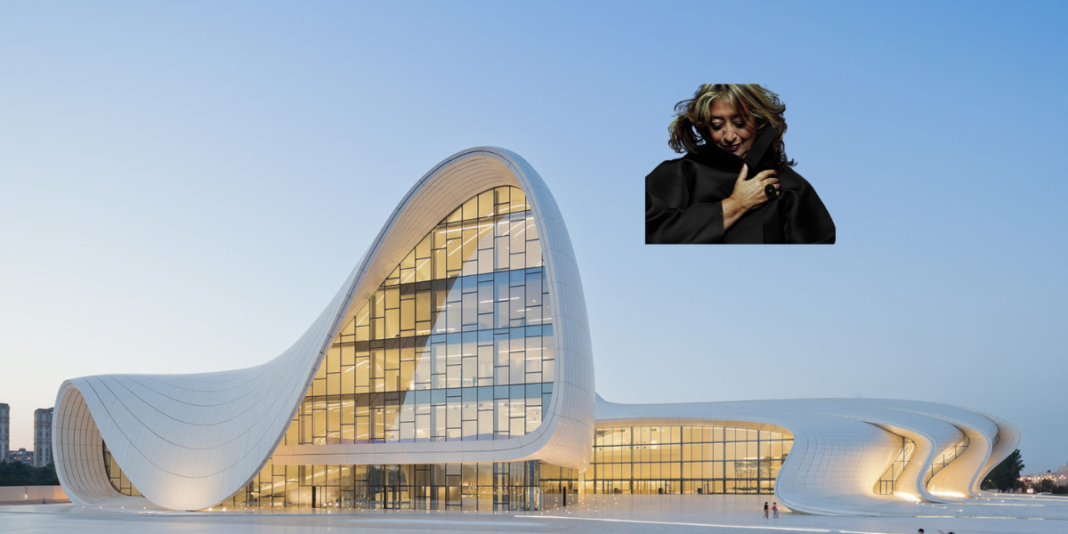
When Ethiopian Prime Minister Abiy Ahmed Ali laid the cornerstone for Bishoftu International Airport on January 10, 2026, the world witnessed the beginning of what promises to be Africa’s most ambitious aviation infrastructure project.
Behind this groundbreaking $12.5 billion mega-airport stands Zaha Hadid Architects, a firm that has spent over four decades redefining the boundaries of contemporary architecture.
The Legacy of a Pioneering Visionary
Zaha Hadid Architects didn’t emerge overnight as a global architectural powerhouse. The London-based firm was founded in 1979 by the late Dame Zaha Hadid, an Iraqi-British architect whose revolutionary vision would forever change the architectural landscape.
In 2004, Hadid became the first woman to win the Pritzker Architecture Prize, often called architecture’s highest honor.

What set Hadid apart wasn’t just her gender-breaking achievements but her fearless approach to design. For years, critics dismissed her work as mere fantasy, labeling her a “paper architect” whose drawings were too radical to ever become reality.
Yet Hadid persevered, and her first completed structure, the Vitra Fire Station in Germany in 1993, silenced the skeptics. The building’s sharp, angular concrete forms demonstrated that her vision could indeed transcend the page.
Hadid’s architectural philosophy centered on fluid, dynamic forms that challenged conventional geometry.
She famously stated her intention to avoid 90-degree angles, instead embracing curves, swoops, and undulating surfaces that appeared to defy gravity. Her education in mathematics at the American University of Beirut profoundly influenced her approach, allowing her to blend mathematical precision with artistic expression in unprecedented ways.
A Global Architecture Powerhouse
Today, Zaha Hadid Architects operates as one of the world’s most influential design firms, boasting over 400 staff members from 55 nations working across 44 countries.
Since Hadid’s untimely death in 2016 from a heart attack at age 65, the firm has been led by Patrik Schumacher, who joined Hadid in 1988 and served as her creative partner for nearly three decades.
Schumacher, who holds degrees in philosophy, mathematics, and architecture, has been instrumental in developing what he calls “parametricism”—the use of advanced computational design techniques that have become ZHA’s signature approach.
Under his leadership, the firm has continued to push architectural boundaries while honoring Hadid’s legacy of innovation.
The firm’s portfolio reads like a greatest-hits album of 21st-century architecture. Their iconic projects include the shell-like Heydar Aliyev Center in Baku, Azerbaijan, which stands in deliberate contrast to the rigid Soviet architecture surrounding it.
There’s the Guangzhou Opera House in China, resembling smooth river pebbles on the Pearl River’s banks.
Beijing Daxing International Airport, completed in 2014, became the largest airport terminal in the world, featuring a distinctive starfish-shaped design that handles millions of passengers annually.
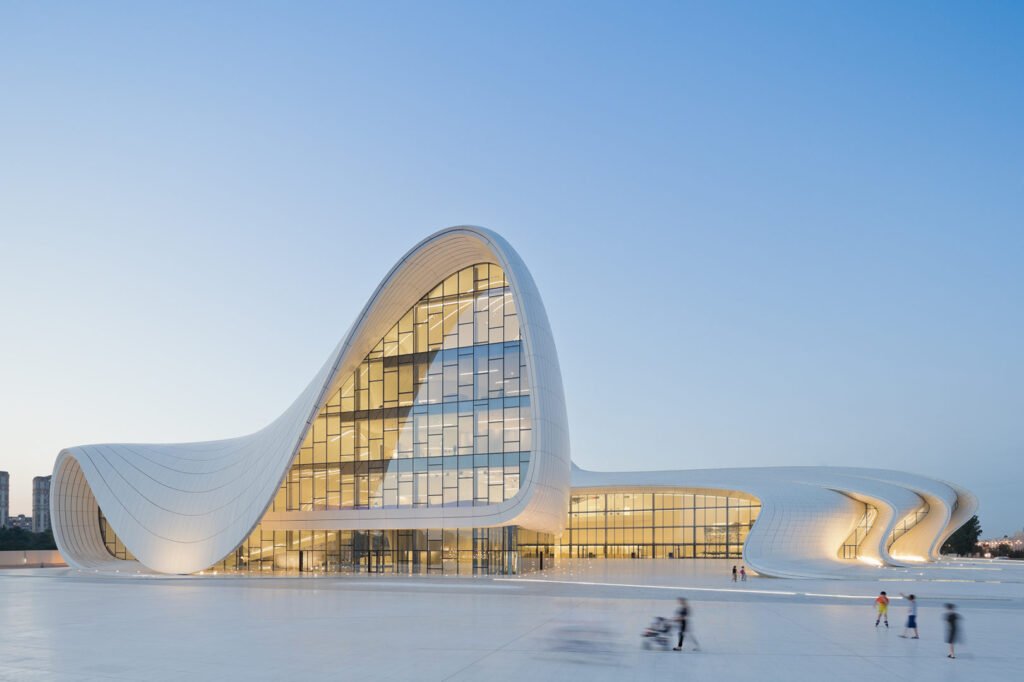
Other notable works include London’s Aquatics Centre, built for the 2012 Olympics with its wave-inspired undulating roof, and the Antwerp Port House in Belgium, where a diamond-shaped glass structure appears to float atop a renovated historic fire station.
Each project demonstrates ZHA’s ability to merge cutting-edge technology with contextual sensitivity and environmental consciousness.
Ethiopia’s Gateway to the Future: Bishoftu International Airport
The Bishoftu International Airport represents perhaps ZHA’s most ambitious aviation project to date.
Located approximately 40 kilometers southeast of Addis Ababa in the city of Bishoftu, this mega-airport is designed to transform Ethiopia into Africa’s premier aviation hub, connecting the continent to Asia, the Middle East, and beyond.
The scale is staggering. Phase One is designed to serve 60 million passengers annually, with subsequent phases expanding capacity to 110 million passengers yearly—more than four times the capacity of Ethiopia’s current main airport at Bole.
The completed complex will feature four runways and parking for 270 aircraft, cementing its position as Africa’s largest airport.
What makes Bishoftu particularly remarkable is its design philosophy. Cristiano Ceccato de Sabata, ZHA’s Director of Aviation, describes it as “a visionary project for Ethiopia and Africa as a whole,” noting that airports serve as bridges that connect people and transcend national divides.
Design Inspired by Ethiopia’s Natural Landscape
ZHA’s design draws profound inspiration from Ethiopia’s geography, particularly the Great Rift Valley that passes near Bishoftu.
The terminal’s layout centers on a central circulation spine modeled after this geological marvel, connecting terminal facilities and aircraft piers while reducing transfer distances for the millions of transit passengers expected annually.
This thoughtful design addresses a critical operational reality: up to 80 percent of passengers are expected to transit between destinations without leaving the airport.
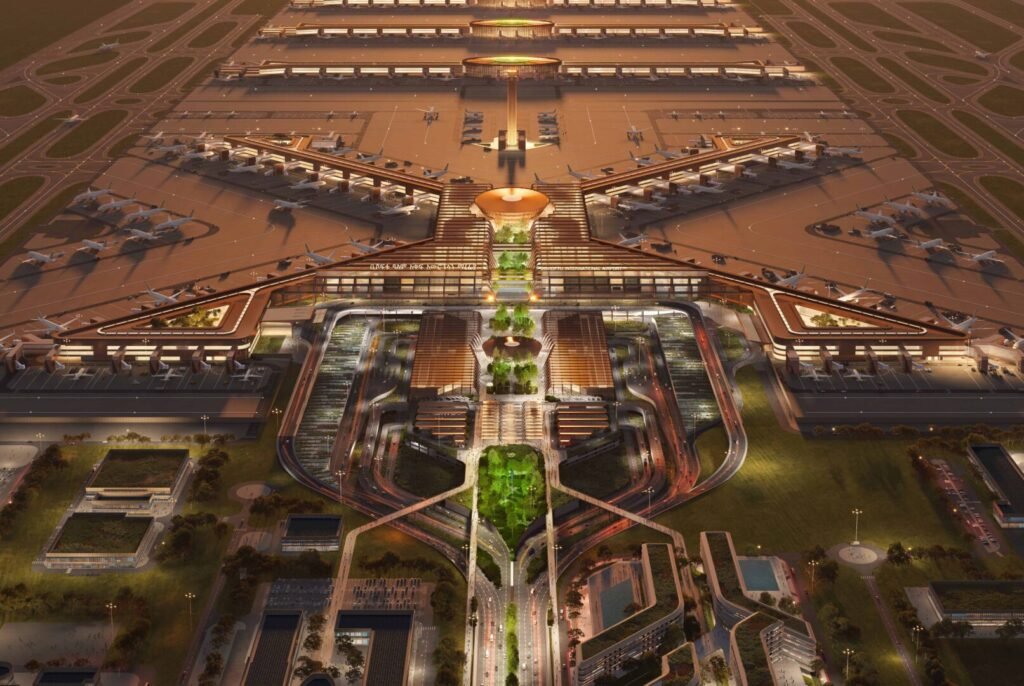
To serve these travelers, the terminal incorporates extensive amenities including a 350-room airside hotel, diverse dining and entertainment facilities, and outdoor gardens and courtyards that provide respite during layovers.
The interior design celebrates Ethiopia’s cultural diversity. Each of the airport’s piers features unique material palettes and color schemes reflecting different regions of the country, creating a journey through Ethiopian heritage as passengers move through the terminal.
Engineering Excellence Meets Environmental Responsibility
Beyond its aesthetic ambition, Bishoftu demonstrates ZHA’s commitment to sustainable design.
The airport site sits nearly 400 meters lower in elevation than the existing Bole International Airport, a strategic choice that significantly impacts aircraft performance.
This lower altitude, combined with longer runways, enables aircraft to take off with higher maximum payloads while using less fuel—a crucial advantage for Ethiopian Airlines’ expansion into longer-range, nonstop routes.
The terminal building itself incorporates natural ventilation and integrated solar shading, responding intelligently to Ethiopia’s temperate subtropical highland climate.
The project targets LEED Gold certification, with water management systems redirecting stormwater from runways and rooftops into wetlands and bioswales, supporting both reuse and local biodiversity.
Construction materials, including concrete and steel, are being manufactured locally in Bishoftu, supporting the regional economy while reducing the project’s carbon footprint. This commitment to local sourcing aligns with ZHA’s increasingly holistic approach to sustainable architecture.
A Symbol of Africa’s Ambitions
The decision to entrust this transformative project to Zaha Hadid Architects speaks volumes about Ethiopia’s ambitions and ZHA’s global reputation.
Ethiopian Airlines, already Africa’s largest carrier, is positioning itself—and by extension, Ethiopia—as the continent’s gateway to the world.
Prime Minister Abiy Ahmed Ali described Bishoftu as “the largest aviation infrastructure project in Africa’s history,” noting that the current main airport will reach capacity limits within the next two to three years.
Bishoftu represents not just expanded capacity but a fundamental reimagining of what African infrastructure can achieve.
The project also includes an integrated Airport City with mixed-use buildings designed to serve a local population of approximately 80,000 people.
This urban planning component demonstrates ZHA’s understanding that airports aren’t isolated structures but catalysts for broader economic and social development.
The ZHA Difference: Where Innovation Meets Human Experience
What distinguishes Zaha Hadid Architects from other global firms isn’t merely their technological prowess or striking aesthetics—it’s their ability to create spaces that prioritize human experience while pushing the boundaries of what’s possible.
The firm’s design process relies heavily on parametric design tools and computational methods, allowing them to create complex geometries that would have been impossible to construct just decades ago. Yet technology serves the vision, not the reverse.
Every curve, every flowing form in a ZHA building serves a purpose: improving circulation, enhancing natural light, creating memorable experiences, or responding to cultural context.
At Bishoftu, this philosophy manifests in spaces designed to reduce the stress of transit. The intuitive wayfinding system, inspired by the Rift Valley’s natural geometry, helps passengers navigate efficiently.
The inclusion of outdoor courtyards and gardens acknowledges that even in the most technologically advanced airports, people need moments of calm and connection to nature.
The Future Takes Flight
With an initial opening targeted for 2030, Bishoftu International Airport will stand as a testament to what visionary architecture can achieve when paired with ambitious national goals and world-class expertise.
The first phase will include two independently operating Code 4E parallel runways and a 660,000-square-meter terminal—just the beginning of a multi-decade development that will reshape African aviation.
For Zaha Hadid Architects, Bishoftu represents another milestone in a journey that began in a small London studio over 40 years ago.
From Zaha Hadid’s early struggles to see her designs realized, through her groundbreaking achievements as the first female Pritzker laureate, to Patrik Schumacher’s continued stewardship of her legacy, ZHA has consistently demonstrated that architecture can be both functionally brilliant and emotionally transformative.

As Africa’s economies grow and connectivity becomes ever more crucial to global commerce and culture, Bishoftu International Airport—and the firm behind it—will play a pivotal role in shaping the continent’s future.
It’s a future that Zaha Hadid herself might have imagined: one where barriers dissolve, where form and function dance together, and where architecture serves as a bridge between nations, cultures, and aspirations.
In the end, Zaha Hadid Architects isn’t just designing an airport. They’re crafting a symbol of possibility, proving once again that with vision, expertise, and unwavering commitment to innovation, the impossible becomes inevitable.
Also Read
M&S’s £340m DIRFT Warehouse: The Rail Freight Gambit That Could Reshape British Grocery Logistics
R1.35 Billion Marriott Edition Hotel: Cape Town’s Ultra-Luxury Construction Milestone

- Africa’s Water Reuse Opportunity: Building the Infrastructure for a Water-Secure Future - September 28, 2026
- Why Water Reuse Is Becoming a Business Imperative for African Industry - September 28, 2026
- Africa’s Water Reuse Opportunity: Why Treatment Plants Must Be Designed as Complete Systems - September 22, 2026
