

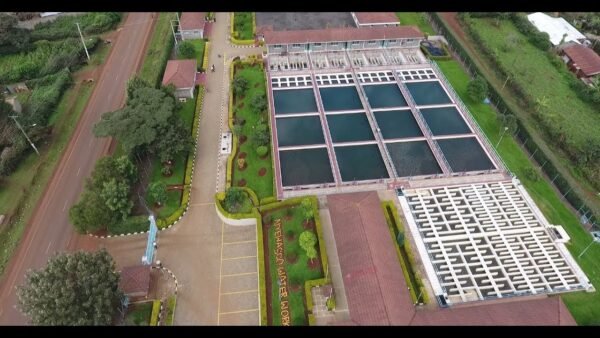
Turn on a tap in a home in Nyeri and the water that comes out is the final product of a long and carefully managed journey.
Before reaching consumers, raw water must be abstracted from its source, conveyed to a treatment plant, screened, chemically treated, clarified, filtered and disinfected.
It then moves through storage tanks, pipelines, pumps and meters before finally reaching homes, businesses and institutions.
For consumers, most of this infrastructure is invisible. Behind the tap, however, is a complex system in which treatment processes, laboratory testing, pumping, storage, distribution and environmental management all have to work together.
We first examined this process with Nyeri Water and Sanitation Company Limited (NYEWASCO) in 2020. Six years later, the utility provides a useful Kenyan example of how municipal water treatment and distribution continue to evolve.
NYEWASCO currently reports 99% water coverage, 100% meter coverage, 100% drinking-water quality and non-revenue water of 16.79%, while its website indicates a 24-hour water supply.
The company also says it has maintained the number-one performance ranking among Kenyan water service providers for 16 years.
Where the journey begins: the water source
Every municipal water-treatment system begins with a source of raw water. Depending on the location, this may be a river, lake, reservoir, dam, spring or groundwater source, but the quality of that water can change considerably with rainfall, drought, erosion and activity within the surrounding catchment.
For NYEWASCO, the Chania River and its catchment are particularly important.
The company has identified dependence on a single major water source as a strategic challenge, making protection of the catchment and development of additional water-security measures important to its long-term plans.
This highlights the difference between water treatment and water security. A treatment plant can remove contaminants from water, but it cannot create an unlimited supply of raw water.
In May 2020, heavy rainfall, flooding and landslides upstream caused high turbidity and clogging at NYEWASCO’s Ihwa intake, temporarily affecting operations at the Kamakwa Water Treatment Plant.
The incident demonstrates how conditions in a catchment can directly affect the operation of a treatment plant. Protecting the source is therefore part of the wider water-treatment challenge.
Abstraction and screening
Once raw water is available, it has to be collected and transported to the treatment works. Intakes are designed to withdraw water while limiting the amount of unwanted material entering the system, while pumps and pipelines move the water towards the treatment plant.
Where terrain permits, gravity can also be used to reduce the energy required to move water.
The first major physical treatment stage is screening. Surface water can contain leaves, branches, vegetation, plastics, stones and other debris, some of which can damage pumps or block pipes. Large screens intercept this material while allowing the water to continue through the intake.
The screens themselves have to be inspected and cleaned regularly because accumulated debris can restrict water flow.
Although screening is relatively simple compared with the treatment stages that follow, it protects expensive mechanical equipment and helps prevent operational problems further downstream.
Related Articles
- How PVC Pipes Are Manufactured: Extrusion, Cooling, and Quality Control
- Megapipes HDPE culvert for new road that is set to give Ogiek Community easier access to essential services
- Kenya’s Narok County Installs Weholite Pipes for Its Sanitation System
- Tackling Non-Revenue Water with HDPE Pipes
- Firm Plans Construction of HDPE Pipes Factory in Kenya
Coagulation and flocculation
After screening, the water can still contain large quantities of very small suspended particles that will not readily settle under gravity. Coagulation is used to destabilise these particles by adding a treatment chemical known as a coagulant.
Aluminium sulphate and ferric salts are among the coagulants commonly used in conventional treatment, although the choice and dosage depend on the characteristics of the raw water.
Chemical dosing has to be carefully controlled because raw-water conditions can change. NYEWASCO identifies optimisation of water-treatment chemical use through accurate water analysis and administration of chemical solutions among its achievements.
Following coagulation, the water undergoes flocculation. The water is mixed more slowly so that destabilised particles collide and combine into larger particles known as flocs.
The mixing has to be carefully controlled because excessive turbulence can break developing flocs apart, while insufficient mixing may prevent them from growing sufficiently.
Coagulation and flocculation therefore perform different but complementary roles. Coagulation destabilises the particles, while flocculation encourages them to come together into particles large enough to be removed during clarification.
Sedimentation and clarification
Once the flocs have formed, the water moves into a clarification or sedimentation stage. Here, gravity does most of the work, allowing the heavier floc particles to settle towards the bottom of a treatment basin while clearer water moves onwards.
The settled material becomes sludge or treatment residuals and has to be collected and removed. Mechanical equipment can direct the accumulated solids towards collection points, while the clarified water continues towards filtration.
Sedimentation is important because it removes a substantial proportion of suspended material before filtration.
Effective clarification reduces the solids burden on the filters, allowing them to operate for longer before cleaning or backwashing becomes necessary.
Filtration provides another barrier
Clarification does not remove every remaining particle, which is why filtration provides another important treatment barrier.
Water can pass through beds containing materials such as sand, anthracite, gravel or combinations of filter media, with remaining suspended particles becoming trapped within the media.
Some treatment systems also use granular activated carbon where adsorption is required to address particular organic compounds or taste and odour problems.
The configuration depends on the quality of the raw water and the treatment objectives of the plant.
Filters eventually become loaded with the material they remove and must be cleaned. Backwashing reverses the normal flow through the filter to loosen and remove accumulated material, creating another residual stream that must be managed by the treatment plant.
Disinfection protects the finished water
Even after filtration, microorganisms may remain in the water. Disinfection is therefore an essential final treatment barrier, with municipal systems using technologies such as chlorine-based disinfectants, ultraviolet light and ozone.
Chlorine remains widely used because a residual can continue protecting water as it travels through the distribution network. The challenge is to achieve effective disinfection while avoiding unnecessary chemical use and maintaining acceptable taste and odour.
This requires laboratory testing and operational monitoring. NYEWASCO’s water-quality and meter-calibration laboratory is accredited to ISO/IEC 17025:2017, while the company also maintains ISO 9001:2015 certification.
The laboratory’s role demonstrates that water treatment depends not only on physical infrastructure but also on the ability to continuously verify water quality.
Storage and distribution
Once treated and disinfected, water can be stored before entering the distribution network. Storage tanks and reservoirs allow the utility to balance variations between production and consumption while also providing reserves during maintenance, equipment failures and other disruptions.
NYEWASCO’s network includes facilities such as the Mathari twin tank and Tetu tank. The company has continued to inspect and improve these facilities, including work intended to improve monitoring of water flows.
Distribution is the final engineering challenge. Treated water must travel through pipelines, reservoirs, pumps, valves and meters before reaching consumers, and maintaining this network is a major undertaking because infrastructure deteriorates and leaks can occur underground.
Why non-revenue water matters
Not all water entering a distribution network is ultimately billed to a customer. Some is physically lost through leaking pipes, while other losses can result from inaccurate meters, illegal connections or unbilled consumption.
These losses are collectively described as non-revenue water, or NRW.
NYEWASCO has made NRW reduction a major operational priority and currently reports NRW below 16% alongside a 100% metering ratio.
Its approach includes leak-detection equipment, meter management and continued network improvements.
The importance of reducing NRW extends beyond financial performance. Water lost through a leaking pipe has already consumed treatment chemicals, electricity, labour and infrastructure capacity.
Reducing leakage can therefore increase the proportion of treated water reaching customers without requiring the utility to produce an equivalent additional volume.
NYEWASCO has also been replacing sections of ageing infrastructure, including the use of HDPE pipes. The company says the newer pipes can reduce leakage by providing stronger pipework and fewer joints.
Water treatment is an energy and chemical challenge
Producing drinking water involves much more than operating treatment equipment.
Utilities must manage the cost of chemicals, electricity, maintenance, laboratory testing, labour and infrastructure, while pumping can consume significant amounts of energy where water has to be moved over long distances or elevations.
NYEWASCO identifies rising water-production costs, including chemicals and energy, among its operational challenges.
These costs are closely connected to the efficiency of the entire water-supply system: raw-water quality can influence treatment requirements, accurate dosing can limit chemical wastage and efficient pumping can reduce electricity consumption.
Distribution losses add another layer to the equation. When treated water disappears through a leaking pipe, the utility has already spent money to abstract, pump, treat and disinfect it.
This is why treatment efficiency, energy management and NRW reduction need to be considered together rather than as separate operational issues.
Technology is changing water management
Modern water utilities are increasingly using data to understand and manage their networks.
NYEWASCO has highlighted technologies including smart meters, acoustic leak-detection equipment, GIS integration and real-time monitoring as part of its approach to water-loss management and climate resilience.
Acoustic equipment can help identify underground leaks before they become major failures, while smart meters provide more accurate information about consumption. GIS technology can help utilities map their assets and understand how different parts of a distribution network interact.
NYEWASCO also implemented an enterprise resource planning system in 2021 and lists digitalisation alongside treatment-chemical optimisation, 100% metering and NRW reduction among its operational achievements.
Protecting the catchment
Water treatment does not really begin when raw water enters the plant. It begins in the catchment, where forest cover, land use, soil erosion and rainfall patterns influence the quality and quantity of water entering rivers.
NYEWASCO has incorporated catchment conservation and tree planting into its environmental strategy. These initiatives are intended to support the long-term availability and quality of the company’s water sources while helping build resilience against climate variability.
Protecting the catchment can also reduce pressure on the treatment plant. Increased erosion, for example, can raise sediment levels in raw water, potentially increasing the treatment burden.
For this reason, environmental protection and water-treatment efficiency are increasingly viewed as parts of the same infrastructure challenge.
Securing water for the future
NYEWASCO’s current performance is notable, but the company also identifies challenges that could affect future service delivery.
These include dependence on a single water source, ageing infrastructure, environmental degradation, vandalism and illegal connections, as well as rising production costs.
Its reviewed strategic plan targets 100% water coverage and 50% sewered sanitation coverage across a service area of approximately 324 square kilometres and a population of about 235,000.
Meeting those ambitions will require continued investment in water sources, treatment capacity, storage, pipelines, pumping systems and digital infrastructure.
The future challenge is therefore not simply producing more treated water. It is securing the raw-water source, improving treatment efficiency, reducing losses, maintaining ageing infrastructure and ensuring that the network can continue serving a growing population.
From raw water to the tap
The journey can be summarised as catchment, intake, screening, coagulation, flocculation, sedimentation, filtration, disinfection, storage and distribution.
Each stage performs a different function, but none operates independently.
The quality of the water entering the treatment plant affects treatment requirements, while the condition of the distribution network determines how much of the finished water ultimately reaches consumers.
NYEWASCO’s experience demonstrates that a modern municipal water utility is much more than a treatment plant.
It combines water-resource management, civil and mechanical engineering, chemical treatment, laboratory science, pumping and storage infrastructure, digital monitoring and customer management into one interconnected system.
Since we first examined municipal water treatment with NYEWASCO in 2020, the fundamental principles have remained largely unchanged.
What has changed is the scale of the challenge facing utilities, which must now manage water security, climate variability, energy and chemical costs, ageing infrastructure, water losses and growing demand at the same time.
For the consumer, the entire system may be reduced to the simple act of turning on a tap.
For the engineers, laboratory staff, technicians and operators responsible for making that possible, however, the journey begins many kilometres upstream and continues through every stage until the water finally reaches the customer.
Also Read
- Mega Machines: Meet the Biggest Wheel Loaders Ever Built
- How They Were Built: Inside the Burj Khalifa
- How They Were Built: Engineering Christ the Redeemer

- SODECA Highlights Industrial Ventilation Technology at Mega Clima Expo Kenya 2026 - October 14, 2026
- How They Were Built: Inside the Engineering of the Lesotho Highlands Water Project - October 11, 2026
- Africa’s Water Reuse Opportunity: Building the Infrastructure for a Water-Secure Future - September 28, 2026