
At a Glance
- Energy projects remain the region’s largest infrastructure investments.
- Transport corridors are boosting regional trade and mineral exports.
- Urban mega developments continue attracting private investment.
- Ports and airports are expanding Southern Africa’s logistics capacity.
- South Africa and Angola lead the region’s mega-project pipeline.
Southern Africa’s construction sites tell a more interesting story in 2026 than the headline growth numbers suggest.
The African Development Bank’s latest African Economic Outlook puts regional growth at a subdued 2.1%, weighed down by soft mining output and expensive energy — yet cranes are still turning at a scale that few parts of the continent can match.
Coal units are being switched on in Mpumalanga, dam walls are rising on the Kwanza River, LNG workers are streaming back into Cabo Delgado, and a century-old railway is once again hauling copper to the Atlantic.
The gap between macro pessimism and construction-site optimism is, in itself, one of the defining stories of the region right now.
Four forces are shaping where the money goes. The first is energy security: after a decade defined by load-shedding, South Africa’s two giant coal stations have finally been finished, while hydropower is being scaled up from Angola to Malawi.
The second is logistics corridors — the scramble to get copper, cobalt and platinum out of landlocked mines and onto ships as quickly as competitors can.
The third is mining itself, particularly platinum group metals and critical minerals feeding the global energy transition. The fourth is urban expansion and aviation, visible in Johannesburg’s private “smart city” boom and Angola’s brand-new aviation gateway.
These are not vanity projects. The World Bank, AfDB and Africa Finance Corporation all frame this pipeline as the difference between countries that merely export raw commodities and countries that build the industrial base to process and move them competitively.
For engineering, procurement and construction (EPC) firms, equipment suppliers and financiers, Southern Africa in 2026 is one of the more active — if still complicated — infrastructure markets on the continent.
📋 Project Snapshot (2026)
| Project | Country | Investment | Status |
|---|---|---|---|
| Kusile Power Station | South Africa | ~US$8bn | ✔ Complete |
| Medupi Power Station | South Africa | ~US$8bn+ | Operational |
| Caculo Cabaça | Angola | US$4.5–5.2bn | Under construction |
| Agostinho Neto Airport | Angola | US$2–3bn | Operational |
| Waterfall City | South Africa | R100bn+ | Expanding |
| Lobito Corridor | Angola–DRC–Zambia | US$1.5bn+ | Expansion underway |
| Karo Platinum | Zimbabwe | US$4.2bn | Under construction |
| Walvis Bay Port | Namibia | US$126m+ | Operational |
| Mpatamanga Hydro | Malawi | US$1.5bn | Pre-construction |
| Mozambique LNG | Mozambique | US$20–24.5bn | Construction resumed |
The Top 10 Projects
1. Kusile Power Station, South Africa
Overview: Kusile is Eskom’s 4,800MW, six-unit coal-fired station in Mpumalanga, built alongside its sister plant Medupi as the backbone of South Africa’s “New Build Programme.”
Latest progress: After 15 years of delays, corruption findings and cost blowouts, Kusile’s sixth and final unit was synchronised to the grid in March 2025 and reached full commercial operation on 29 September 2025. President Cyril Ramaphosa visited the plant in April 2026 to mark the milestone, noting the station’s energy availability factor had climbed to around 74%, occasionally reaching 90%. Combined with Medupi, the two stations now supply 9,600MW.
Investment: Original budgets of roughly R79–81 billion for each plant ballooned; Eskom has previously reported cumulative spend north of R145–147 billion on Kusile alone, financed partly through a $2.5 billion China Development Bank loan.
Developers: Eskom (state utility) as owner; Chinese contractor Dongfang Electric and other international and local firms on the boiler and turbine packages; financing from the China Development Bank, export credit agencies and commercial lenders.
Why it matters: Kusile’s completion is central to ending years of rolling blackouts and restoring investor confidence in South Africa’s grid — a precondition for reviving manufacturing and mining growth.
Challenges: The plant remains, on a lifetime-cost basis, one of the most expensive coal stations ever built, and its flue-gas desulphurisation retrofit debate (see Medupi below) still hangs over its environmental compliance.
What’s next: Focus shifts to reliability and cost recovery over the plant’s 50-year design life, alongside Eskom’s broader push into renewables.
2. Medupi Power Station, South Africa
Overview: Medupi, in Limpopo, is Kusile’s twin — another 4,800MW coal station and, on paper, the world’s largest dry-cooled power plant.
Latest progress: Medupi has been fully operational since 2021, but 2026’s real story is regulatory: Eskom released a draft cost-benefit analysis in February on whether to install flue-gas desulphurisation (FGD) “scrubber” technology, a World Bank loan condition. The report, estimating FGD costs at roughly R383 billion, was delayed past its original deadline and is now due to reach Environment Minister Willie Aucamp in April 2026 for a final decision.
Investment: Eskom has previously disclosed spend of well over R126 billion on the build; the FGD retrofit alone could add tens of billions more, funded through tariffs if approved.
Developers: Eskom, with the New Development Bank and World Bank among past financiers of pollution-control components (the New Development Bank cancelled a $480 million FGD loan in 2024 after delays).
Why it matters: The FGD decision will determine whether Eskom prioritises air-quality compliance and health outcomes — researchers estimate significant annual premature deaths linked to Medupi’s emissions — over tariff relief.
Challenges: Balancing public health, cost recovery and coal’s still-dominant 80% share of South Africa’s electricity mix.
What’s next: A ministerial ruling on FGD is expected in 2026, shaping Eskom’s long-term environmental compliance strategy.
3. Caculo Cabaça Hydropower Project, Angola
Overview: A 2,172MW run-of-river hydropower scheme on the Kwanza River, set to become Angola’s single largest power source, surpassing the Laúca station.
Latest progress: Construction, which began in 2017, has passed several milestones, including completion of critical tailrace tunnels in 2025. President João Lourenço has reiterated that dam construction should finish in 2026, with the first turbine generating power by October 2026 and full commissioning targeted for 2028.
Investment: Estimated at $4.5–5.2 billion, co-financed by China (civil works, via China Gezhouba Group) and Germany (electromechanical equipment, including Voith Hydro turbines).
Developers: Angola’s Ministry of Energy and Water (MINEA) as owner; China Gezhouba Group as main contractor and operator.
Why it matters: The plant is intended to feed the Southern African Power Pool, supporting Angola’s stated goal of lifting national generation capacity from 6.4GW to 9GW by 2027 alongside the planned Baynes hydropower scheme.
Challenges: Tunnel excavation complexity has caused localised delays, and officials acknowledge some infrastructure will need “readjustments” to meet contractual deadlines.
What’s next: First-turbine commissioning in late 2026, ahead of full four-turbine operation by 2028.
4. Dr António Agostinho Neto International Airport, Angola
Overview: A $2.1–3 billion, 15-million-passenger-capacity airport near Luanda, built to replace the congested Quatro de Fevereiro Airport as Angola’s main gateway.
Latest progress: Since national carrier TAAG completed its transfer of international and domestic operations in October 2025, the airport has ramped toward full capacity, recording around 19 daily departures by January 2026.
It earned IATA Gold Standard certification, and in January 2026 Angola named a consortium led by Corporacion America Airports and Portugal’s Mota-Engil as the 20-year operating concessionaire.
Investment: Reported at roughly $2.1–3 billion, built primarily by Chinese state contractors, including Aviation Industry Corp of China.
Developers: Government of Angola; operating concession now held by Corporacion America Airports/Mota-Engil.
Why it matters: The airport is positioned as a future sub-Saharan aviation hub, with long-term ambitions to handle up to 65 million passengers annually, supporting tourism and trade diversification away from oil.
Challenges: Only one of two runways was in active use as of late 2025, and traffic is still ramping from a low base as airlines migrate routes.
What’s next: Full operator transition and further airline route additions through 2026–2027.
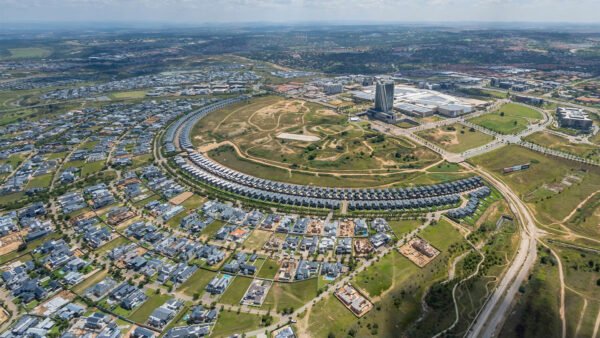
5. Waterfall City, South Africa
Overview: Waterfall City is one of Africa’s largest privately funded mixed-use urban developments, strategically located in Midrand between Johannesburg and Pretoria.
Developed over more than two decades through a partnership involving the Waterfall City Landowners and multiple private-sector developers, the precinct integrates commercial offices, logistics facilities, retail centres, residential communities, healthcare, education and hospitality within a single master-planned environment.
Latest progress: Waterfall City retained its Best Masterplan Africa title at the 2026 International Property Awards.
Attacq’s FY2026 update reported the completion of the Vantage hyperscale data centre and a new residential apartment phase, while construction continues on the Gateway East mixed-use precinct, additional logistics facilities and new commercial developments. Plans for a R750 million conference centre and hotel were also announced in 2026, reflecting continued investor confidence in the precinct.
Investment: The wider development represents a cumulative investment estimated at more than R100 billion, making it one of South Africa’s most significant privately funded urban projects. Attacq’s investment portfolio within Waterfall City alone is valued at approximately R14.3 billion.
Development partners: Waterfall City has been developed by multiple organisations under a shared master plan.
Attacq has played a leading role in commercial office, retail and logistics developments, while Century Property Developments delivered the Waterfall Equestrian Estate, Waterfall Country Estate, Waterfall Country Village Estate, Waterfall Hills Mature Lifestyle Estate and Waterfall Valley Mature Lifestyle Estate.
Balwin Properties is developing the Polofields Waterfall, Kikuyu Waterfall and Munyaka residential estates, while Calgro M3 developed the affordable housing-focused Waterfall View estate.
The Waterfall City Landowners have also delivered key social infrastructure, including Netcare Waterfall City Hospital, Reddam House Waterfall, Curro schools, STADIO, a heliport, retail centres and supporting infrastructure.
Why it matters: Waterfall City demonstrates how coordinated private-sector investment can deliver an integrated urban district combining employment, housing, logistics, education, healthcare and retail.
Unlike many large-scale developments driven by a single developer, Waterfall City has evolved through the coordinated contributions of multiple developers and landowners under a long-term master plan.
Residential communities began taking shape from the mid-2000s, before the precinct’s major commercial expansion accelerated in the following decade, illustrating a phased approach to city building.
Challenges: Continued growth depends on sustaining demand for premium office, logistics and residential space while expanding supporting infrastructure. As with other large mixed-use developments, balancing long-term investment with changing property market conditions remains an ongoing priority for developers.
What’s next: Development is expected to continue through 2027 and beyond, with Gateway East, additional logistics facilities, hospitality projects and new residential phases forming the next stage of Waterfall City’s expansion. As more commercial and community infrastructure comes online, the precinct is expected to further strengthen its position as one of South Africa’s leading mixed-use urban developments.
Revised section under “Private capital with its own discipline: Waterfall City and Tatu City”
Waterfall City in South Africa and Tatu City in Kenya illustrate how privately financed urban developments can reshape metropolitan growth through long-term, phased investment. Rather than relying on a single developer, Waterfall City has evolved through the coordinated efforts of the Waterfall City Landowners and multiple private-sector developers, delivering residential estates, schools, healthcare facilities, retail centres, commercial offices, logistics infrastructure and hospitality projects under a shared master plan. Residential development began in the mid-2000s, with commercial expansion accelerating in the following decade, creating a balanced mixed-use precinct that continues to attract investment. Together with Kenya’s Tatu City, the project demonstrates how patient private capital can support the development of integrated urban environments while reducing reliance on public-sector funding.
6. Lobito Corridor Railway, Angola–DRC–Zambia
Overview: A roughly 1,300km rail corridor linking the copper- and cobalt-rich DRC and Zambian Copperbelt to the Atlantic port of Lobito in Angola — one of Africa’s most closely watched critical-minerals logistics projects.
Latest progress: The Angola–DRC section, the historic Benguela line, is operating commercially under a 30-year concession to Lobito Atlantic Railway (backed by Trafigura, Mota-Engil and Vecturis), with new copper and cobalt shipments moving in early 2026.
The Zambia “greenfield” extension has progressed from feasibility studies into the engineering, procurement and construction (EPC) stage, with the Africa Finance Corporation expecting to conclude its EPC contractor selection process in mid-2026.
Investment: The Zambia leg alone is estimated at around $1 billion, with the AFC mobilising roughly half of that; total corridor-linked investment, including the earlier Chinese-funded rehabilitation, runs well into the billions.
Developers: Africa Finance Corporation as lead developer of the Zambia extension; Lobito Atlantic Railway consortium on the Angola–DRC concession; supported by the US, EU, African Development Bank and SADC’s Lobito Corridor Transit Transportation Facilitation Agency.
Why it matters: The corridor cuts freight transit times from the copperbelt dramatically and is central to Western and African efforts to build alternative critical-minerals supply chains.
Challenges: Financing the Zambia greenfield section, coordinating three governments’ regulations, and ensuring mining output (some of it affected by 2025 seismic disruption at the Kamoa-Kakula mine) keeps pace with new rail capacity.
What’s next: EPC contractor appointment for the Zambia leg in 2026, with an extension completion date targeted around 2029.
7. Karo Platinum Project, Zimbabwe
Overview: A $4.2 billion integrated open-pit and, later, underground platinum-group-metals mine on Zimbabwe’s Great Dyke, developed by Karo Mining Holdings, a subsidiary of Cyprus-based Tharisa Plc.
Latest progress: Tharisa’s second-quarter FY2026 report (period to March 2026) confirmed open-pit surface clearing had begun and mining-contractor mobilisation was complete, with infrastructure and funding work continuing. Government ministers toured the site in early 2026, describing construction as “advanced.”
Investment: Total capital expenditure of roughly $4.2 billion for the integrated complex, including a 300MW solar plant to power operations and feed Zimbabwe’s grid.
Developers: Tharisa Plc/Karo Mining Holdings, with local Zimbabwean contractors making up the majority of the roughly 15-strong contractor base.
Why it matters: Karo could become Zimbabwe’s second-biggest PGM producer, adding an estimated 190,000 oz/year in initial output and potentially lifting national GDP growth by around two percentage points.
Challenges: Full project financing was, as of mid-2026, still being finalised, and the timeline has already slipped from an original 2024–2025 first-ore target.
What’s next: First ore in the mill is now targeted for the second half of 2027.
8. Port of Walvis Bay Expansion, Namibia
Overview: Namibia’s principal deep-water port is being progressively modernised to position the country as a logistics gateway for landlocked Botswana, Zambia and the DRC, and to serve a fast-growing offshore oil and gas sector.
Latest progress: Terminal Investment Namibia, which holds a 25-year container-terminal concession secured in 2024, received a first batch of new rubber-tyred gantry cranes in 2026 under a financing deal with Standard Bank Namibia and RMB Namibia.
Namport is simultaneously advancing a separate quay-wall expansion at the nearby Port of Lüderitz to support offshore oil logistics.
Investment: The current container-terminal modernisation is valued at roughly $126.5 million; a long-discussed “North Port”/SADC Gateway bulk-handling expansion remains a larger, multi-billion-dollar ambition tied to future oil, gas and mineral export volumes.
Developers: Namibian Ports Authority (Namport) as landlord; Terminal Investment Namibia as concessionaire; Standard Bank Namibia and RMB Namibia as financiers.
Why it matters: With bp and other majors expanding offshore exploration in the Orange and Walvis basins, port capacity is becoming a bottleneck risk for Namibia’s entire energy strategy.
Challenges: Balancing container-terminal upgrades against the much larger capital requirements of bulk and energy-logistics infrastructure still in the planning stage.
What’s next: Continued equipment rollout at Walvis Bay through 2026, alongside Lüderitz quay-wall works targeted to begin delivering capacity from 2027.
9. Mpatamanga Hydropower Project, Malawi
Overview: A 358MW, two-dam hydropower scheme on the Shire River, designed to become Malawi’s largest power facility and a major boost to a country where roughly 12% of the population has access to electricity.
Latest progress: As of April 2026, feasibility studies were complete and financing negotiations were in their final stages, according to project general manager Antoine Gerboud. Enabling works, including a new bridge across the Shire River, were already visible on site, with full construction expected to begin between late 2026 and early 2027.
Investment: Total project cost, including financing during construction, is expected to exceed $1.5 billion — potentially Malawi’s largest-ever foreign direct investment. The World Bank approved a $350 million grant toward the project in 2025.
Developers: EDF and SN Malawi BV (backed by TotalEnergies, British International Investment and Norfund) through project company Mpatamanga Hydro Power Limited, alongside Malawi’s state utilities EGENCO and ESCOM and the International Finance Corporation.
Why it matters: The project could push Malawi’s generation capacity beyond 1,000MW and expand electricity access from roughly 12% to over 30% of the population, directly targeting chronic power shortages.
Challenges: Financial close is still pending, environmental and resettlement issues linked to a Ramsar-listed biodiversity area require management, and the four-to-five-year construction timeline leaves limited room for further slippage against a 2030 commissioning target.
What’s next: Financial close and transmission-line tender awards in 2026, ahead of construction start.
10. Mozambique LNG (Area 1), Mozambique
Overview: TotalEnergies’ roughly $20 billion onshore and offshore LNG development in Cabo Delgado, targeting about 13 million tonnes per annum of export capacity from the offshore Golfinho and Atum fields.
Latest progress: After a nearly five-year suspension following a 2021 insurgent attack near the site, the consortium lifted its force majeure declaration in November 2025 and formally announced a full restart of onshore and offshore activities on 29 January 2026, in a joint appearance by TotalEnergies CEO Patrick Pouyanné and Mozambican President Daniel Chapo. More than 4,000 workers, over 3,000 of them Mozambican, have since been remobilised.
Investment: Original FID stood near $20 billion in 2019; TotalEnergies has flagged roughly $4.5 billion in additional costs tied to the shutdown, pushing total investment above $24 billion. The US Export-Import Bank approved $4.7 billion in financing in 2025.
Developers: TotalEnergies (operator), with partners including Mitsui, Mozambique’s state ENH, India’s ONGC Videsh, Bharat Petroleum and PTTEP; security support from Mozambican, Rwandan and SADC forces.
Why it matters: As one of Africa’s largest single foreign investments, the project is central to Mozambique’s fiscal outlook and to diversifying global LNG supply as demand grows.
Challenges: Residual insurgent activity persists in parts of Cabo Delgado, and the project’s economics now depend on sustained security cooperation holding through years of further construction.
What’s next: Continued onshore and offshore construction toward a targeted first-LNG date in 2029.
Where Is Southern Africa Investing Most?
Laid side by side, the ten projects reveal a clear hierarchy. Energy dominates by both count and capital: five of the ten projects — Kusile, Medupi, Caculo Cabaça, Mpatamanga and Mozambique LNG — sit in the power and gas sector, reflecting a region still working through chronic electricity shortfalls even as it eyes gas-export revenue.
Logistics and rail (Lobito) and mining (Karo Platinum) are increasingly treated as a single investment thesis, since neither critical minerals nor platinum group metals are worth much without a corridor to move them.
Ports (Walvis Bay) and airports (Luanda) represent smaller absolute capital outlays but disproportionate strategic importance, as gateways that determine whether the bigger energy and mining bets pay off.
Urban development (Waterfall City) stands apart as the one major project funded almost entirely by private capital rather than state balance sheets or development finance institutions — a model regional governments are increasingly keen to replicate given fiscal constraints flagged by the AfDB.
The 2026 African Economic Outlook, published by the African Development Bank in May, frames this pattern directly: it notes that Southern Africa’s growth is being held back by weak mining and agricultural output and high energy costs, while calling for far greater private and institutional capital mobilisation, noting that under 3% of the roughly $4 trillion managed by African pension funds, insurers and sovereign wealth funds currently flows into infrastructure.
South Africa’s own 2026 Budget underscored the same theme domestically, naming infrastructure the fastest-growing category of public spending and establishing a new Infrastructure Finance and Implementation Support Agency to crowd in private investment.
The Africa Finance Corporation’s 2026 State of Africa’s Infrastructure Report goes further, arguing that the priority is no longer simply adding generation capacity but integrating energy, transmission and logistics into coherent systems capable of supporting industrial-scale production — precisely the shift visible in projects like Lobito and Mpatamanga, which are being designed around specific mining and export use-cases rather than generic capacity targets.
Industry Impact
The pipeline offers substantial, if geographically scattered, opportunities. EPC contractors and civil engineering firms are needed across the hydropower and rail projects, particularly for dam construction, tunnel excavation and rail track-laying.
Equipment manufacturers — turbine suppliers, gantry crane makers, and rail rolling-stock providers — have clear near-term demand from Caculo Cabaça, Mpatamanga and the Lobito extension.
Concrete suppliers and steel fabricators will find sustained work in Angola’s dam programme and Zimbabwe’s platinum complex, while surveying and geotechnical firms remain essential to de-risking projects still in feasibility, such as Mpatamanga.
Power transmission specialists are in particular demand given how many of these projects depend on new transmission lines to connect remote generation sites to national grids.
Consulting engineers and logistics companies, meanwhile, are positioned to benefit from the broader corridor-integration push described by the AFC — work that extends well beyond any single project’s construction phase into decades of operations and maintenance.
Also Read
- Africa’s Smart Cities in 2026: Which Mega Projects Are Actually Being Built?
- Top Data Centre Projects Under Construction in the U.S

With years of experience covering infrastructure projects, equipment, and engineering solutions, Yvonne brings in-depth analysis and practical insights to contractors, engineers, and industry stakeholders.
She is passionate about highlighting sustainable construction practices and the latest advancements that drive efficiency and safety on worksites.
- Why America’s Grid Expansion Is Creating a New Construction Boom - July 31, 2026
- U.S. Housing Starts Surge 19% in June, Signalling Strong Construction Activity Despite Decline in Building Permits - July 23, 2026
- 10 Benefits of Smart Buildings: How Intelligent Buildings Are Transforming Commercial Real Estate - July 21, 2026