
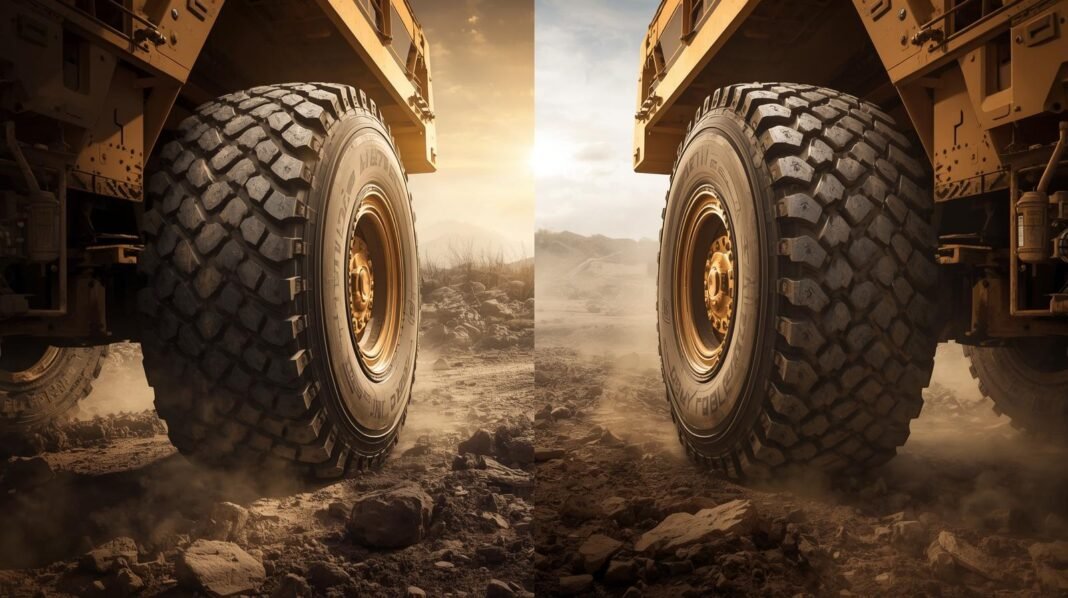
Choosing the right tires for your off-the-road (OTR) equipment isn’t just about getting from point A to point B. It’s about maximizing uptime, controlling costs, and ensuring your fleet operates safely and efficiently.
For mining and construction operations, the decision between radial and bias-ply OTR tires can significantly impact your bottom line.
Both tire types have their place in heavy industry, but understanding their fundamental differences will help you make the best choice for your specific application. Let’s break down everything you need to know about radial versus bias OTR tires.
Understanding OTR Tire Construction
Before diving into the comparison, it’s essential to understand how these tires are built.
Bias-ply tires feature multiple layers of rubber-coated nylon or polyester cords that crisscross at angles typically between 30 and 40 degrees from the tire’s centerline.
Each layer, or ply, alternates its angle, creating a crisscross pattern that provides strength and rigidity. This construction method has been around for decades and remains popular in certain applications.
Radial tires are constructed with cord plies that run perpendicular to the direction of travel, extending from bead to bead across the tire.
Steel belts beneath the tread provide additional reinforcement. This design allows the sidewall and tread to function independently, offering distinct performance characteristics.
Performance Comparison: Where Each Tire Type Excels
Heat Dissipation and Tire Life
Radial tires generate less heat during operation because their flexible sidewalls reduce internal friction.
This translates to longer tire life, particularly in applications involving high speeds or sustained operation. In mining operations where haul trucks travel long distances at relatively higher speeds, radials can outlast bias tires by 30 to 50 percent.
Bias tires, with their stiffer construction, generate more heat under similar conditions. However, in applications with shorter travel distances and lower speeds, this disadvantage becomes less significant.
Load Carrying Capacity
Bias-ply tires excel in their ability to carry heavy loads at lower speeds. Their rigid sidewall construction distributes weight more evenly across the tire footprint, making them ideal for equipment that prioritizes load capacity over speed.
For stationary or slow-moving equipment like cranes or port handlers, bias tires often provide the necessary support without the premium cost of radials.
Radial tires also handle heavy loads exceptionally well but shine when equipment needs to move those loads efficiently over distance.
The flexible sidewall allows for better weight distribution during movement, reducing soil compaction and improving stability.
Traction and Stability
The flexible sidewall of radial tires creates a larger, more consistent contact patch with the ground.
This results in superior traction on various surfaces and better stability during operation. The independent movement of the tread and sidewall allows radials to maintain ground contact even on uneven terrain.
Bias tires provide excellent traction in specific conditions, particularly in soft or muddy terrain where their stiffer construction prevents excessive sidewall flex that could reduce control.
Ride Comfort and Equipment Wear
Radial tires absorb shocks and vibrations more effectively than bias tires, thanks to their flexible sidewalls.
This improved ride quality isn’t just about operator comfort—it reduces stress on equipment components, potentially extending the life of axles, suspensions, and other mechanical parts.
The rigid construction of bias tires transmits more shock and vibration to the equipment, which can accelerate wear on mechanical components over time.
Cut and Impact Resistance
Bias-ply tires are renowned for their toughness in harsh conditions. The multiple overlapping plies create a robust shield against cuts, punctures, and impacts from sharp rocks or debris.
In applications where tire damage from rough terrain is a primary concern, bias tires often prove more durable.
While radial tires have improved significantly in cut resistance, their thinner sidewalls can be more vulnerable to damage in extremely harsh conditions.
However, modern radial designs with reinforced sidewalls have narrowed this gap considerably.
Cost Considerations: Initial Investment vs. Long-Term Value
The upfront cost difference between radial and bias OTR tires can be substantial. Radial tires typically cost 25 to 50 percent more than comparable bias tires, which can represent a significant capital investment for a fleet.
However, the total cost of ownership tells a different story. Radial tires often provide better value over their lifespan due to several factors:
Longer tread life means fewer tire replacements and less downtime for tire changes. In operations where equipment utilization is critical, this advantage can be substantial.
Improved fuel efficiency results from lower rolling resistance. The flexible sidewalls of radial tires require less energy to rotate, which can reduce fuel consumption by 10 to 15 percent compared to bias tires in similar applications.
Reduced equipment maintenance stems from the improved shock absorption and smoother ride, potentially lowering maintenance costs for other equipment components.
Higher retreadability makes radial tires excellent candidates for multiple retreads, further extending their economic life.
For operations focused purely on initial capital costs or where tire life expectancy is limited by damage rather than wear, bias tires may offer better financial sense.
Application-Specific Recommendations
Underground Mining
Underground mining operations often favor bias tires due to the challenging environment. Sharp rocks, limited speed requirements, and the need for maximum cut resistance make the rugged construction of bias-ply tires advantageous. The lower initial cost also helps when tire damage rates are high.
Surface Mining and Long-Haul Operations
Large surface mines with haul trucks traveling several miles per trip typically benefit most from radial tires.
The improved heat dissipation, longer tire life, and fuel savings justify the higher initial investment. Major mining operations have reported significant cost savings after transitioning to radial tires for their haul truck fleets.
Construction Sites
Construction applications vary widely, making the choice more complex. For equipment that moves frequently between job sites or operates primarily on improved surfaces, radial tires offer clear advantages.
For equipment that remains stationary or operates in particularly harsh conditions with sharp debris, bias tires may be more practical.
Earthmoving and Grading
Scrapers, graders, and similar equipment that operate at moderate speeds over varied terrain often perform best with radial tires. The improved traction and stability enhance productivity, while the longer tire life reduces total operating costs.
Load and Carry Equipment
Wheel loaders and articulated dump trucks used in load-and-carry applications can benefit from either tire type depending on specific conditions. Short-cycle operations in confined spaces may favor bias tires, while longer travel distances or higher speeds suggest radials.
Making the Right Choice for Your Fleet
Several factors should guide your tire selection decision:
Operating speed and distance are perhaps the most critical factors. Higher speeds and longer distances strongly favor radial tires, while lower speeds and shorter distances reduce the radial advantage.
Surface conditions matter significantly. Well-maintained haul roads suit radial tires, while extremely rocky or debris-filled terrain may require the toughness of bias construction.
Load requirements should be matched to tire specifications. Both tire types handle heavy loads, but the application determines which performs better.
Budget constraints must balance initial costs against lifetime value. While radials cost more upfront, their longer life and efficiency gains often provide better return on investment.
Maintenance capabilities factor into the equation. Radials typically require more precise inflation pressure management and may need specialized mounting equipment.
Tire damage rates in your operation influence the decision. If tires typically fail from cuts and impacts before wearing out, the extended tread life of radials becomes less relevant.
The Bottom Line
Neither radial nor bias OTR tires are universally superior—the best choice depends entirely on your specific application and operating conditions.
Radial tires generally provide the best total cost of ownership for operations involving moderate to high speeds, longer travel distances, and relatively smooth surfaces.
Their superior heat dissipation, longer tread life, and fuel efficiency make them the preferred choice for many modern mining and construction operations.
Bias-ply tires remain the practical choice for low-speed applications, extremely harsh conditions where cut resistance is paramount, or situations where initial cost is the primary consideration.
They continue to serve reliably in countless operations worldwide.
Many fleet managers find that a mixed approach works best, using radial tires where their advantages are most pronounced and bias tires where their strengths align with operational needs.
This strategic approach optimizes both performance and costs across diverse equipment types and applications.
By carefully evaluating your specific operating conditions, equipment usage patterns, and financial priorities, you can select the tire type that delivers the best combination of performance, safety, and value for your mining or construction fleet.
Also Read

- U.S. Senators Push for Tariff Probe into Construction Equipment Imports from Mexico - March 30, 2026
- Top Smart Safety Shoes to Watch in 2026 - March 29, 2026
- SASSA Payment Dates for April 2026: What Every Beneficiary Needs to Know - March 29, 2026
