
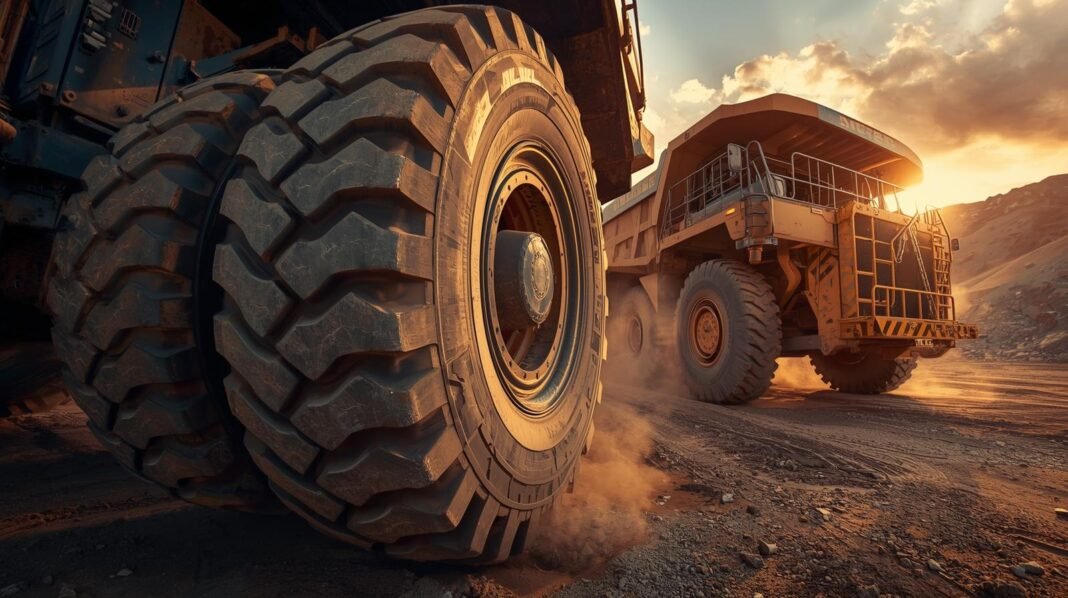
Mining operations across Africa face some of the most challenging terrain conditions in the world.
From the copper belt of Zambia to the gold mines of Ghana and the platinum reserves of South Africa, selecting the right off-the-road (OTR) tires can mean the difference between profitable operations and costly downtime.
This comprehensive guide will help you navigate the critical decisions involved in choosing OTR tires for Africa’s demanding mining environments.
What Are OTR Tires and Why Are They Critical for African Mining?
Off-the-road (OTR) tires are specialized heavy-duty tires designed for vehicles that operate in mining, construction, and industrial applications.
Unlike regular truck tires, OTR tires are engineered to withstand extreme loads, sharp rocks, corrosive materials, and punishing terrain that would quickly destroy conventional tires.
In African mining operations, OTR tires represent one of the largest operating expenses, often accounting for 15-25% of total operating costs per ton of material moved. A single large mining truck tire can cost between $40,000 and $60,000, making tire selection a decision with significant financial implications.
What Unique Challenges Do African Mining Sites Present?
African mining sites present a distinct combination of challenges that demand careful tire selection:
Extreme Temperature Variations: Many African mining regions experience dramatic temperature swings, from scorching daytime heat exceeding 40°C (104°F) to surprisingly cool nights.
The Kalahari Desert mining operations in Botswana, for instance, can see temperature variations of 30°C within a 24-hour period. These fluctuations cause tire compounds to expand and contract, accelerating wear and potentially causing structural failures.
Abrasive Terrain: African geology often features highly abrasive rock formations. The ironstone in West African mines, laterite soils common across the continent, and sharp quartz found in gold-bearing regions all contribute to accelerated tread wear.
Mines in regions like the Bushveld Complex in South Africa deal with particularly aggressive rock that can reduce tire life by 30-40% compared to softer materials.
Infrastructure Limitations: Remote mining locations often lack immediate access to tire service facilities, specialized equipment, or replacement inventory.
A breakdown in a remote Tanzanian or Guinean mining site might require tire replacements to be transported hundreds of kilometers over poor roads, resulting in extended downtime.
Haul Road Conditions: Many African mining operations, particularly smaller or newer sites, have less developed haul road infrastructure compared to established Australian or North American mines.
Poorly maintained roads with excessive gradients, sharp turns, and inadequate drainage accelerate tire wear and increase the risk of damage.
How Do You Determine the Right Tire Size and Load Rating?
Selecting the appropriate tire size and load rating requires a systematic assessment of your equipment and operational parameters.
Start by consulting your equipment manufacturer’s specifications. Each piece of mining equipment has recommended tire sizes based on the machine’s weight, load capacity, and operational design.
Never deviate from these recommendations without engineering analysis, as undersized tires can lead to catastrophic failures.
Calculate your actual working loads, not just theoretical capacity. In African mining operations, trucks are sometimes overloaded due to production pressures or inaccurate payload monitoring systems.
A tire rated for 50 tons that regularly carries 55 tons will experience dramatically shortened service life and increased failure risk.
Consider the star rating system, which indicates a tire’s load-carrying capacity at specific speeds.
A higher star rating allows for heavier loads but comes at a premium cost. Match your star rating to your actual operational needs rather than automatically selecting the highest rating available.
What Tread Patterns Work Best for Different African Mining Conditions?
Tread pattern selection directly impacts traction, wear rate, heat dissipation, and cut resistance. Understanding the relationship between tread design and your specific application is essential.
E-3/L-3 Rock Service Tires feature deep, aggressive tread patterns designed for maximum cut and wear resistance. These tires excel in African hard rock mining operations where sharp rocks and abrasive materials dominate.
The thick tread compounds and robust casing construction provide excellent protection against punctures and cuts. However, they generate more heat and offer less traction in soft or muddy conditions. Consider E-3 tires for operations in granite, ironstone, or other hard rock formations common in Southern and West African mines.
E-4/L-4 Deep Tread Tires offer the deepest tread depth available, providing maximum tread life in highly abrasive conditions.
These tires work well in African surface mines with particularly aggressive materials, delivering potentially 20-30% longer service life than E-3 tires. The trade-off is higher initial cost and greater heat generation, making them better suited for shorter haul cycles with adequate cooling time.
E-2/L-2 Traction Tires feature widely spaced, open tread patterns that excel in soft, muddy, or loose conditions. During Africa’s rainy seasons, many mining operations experience significant ground softening.
Mines in equatorial regions of the Democratic Republic of Congo, Guinea, or Sierra Leone may benefit from E-2 tires during wet seasons, as they provide superior traction and self-cleaning properties in mud and clay.
Smooth or E-7/L-5 Tires work best for paved or well-maintained hard-surface haul roads. While less common in African mining applications, some larger, more established operations with excellent road infrastructure can benefit from smooth tires’ lower rolling resistance, reduced heat generation, and excellent wear characteristics on smooth surfaces.
How Important Is Tire Compound Selection for African Conditions?
The rubber compound formulation significantly affects tire performance in Africa’s challenging environment. Modern OTR tires use sophisticated compound blends designed for specific operating conditions.
Heat-resistant compounds are crucial for African mining. High ambient temperatures combined with heavy loads and potentially long haul cycles generate substantial heat within tires.
Excessive heat is the primary cause of premature tire failure, causing tread separation, casing damage, and blowouts. Look for compounds specifically engineered for hot climates with enhanced heat dissipation properties.
Cut-resistant compounds incorporate higher percentages of natural rubber and specialized additives that resist tearing and cutting when tires encounter sharp rocks. In African hard rock operations, cut-resistant compounds can extend tire life by 15-25% compared to standard formulations.
Ozone-resistant compounds matter in high-altitude African mining operations and regions with intense UV exposure. Ozone and UV radiation attack rubber, causing surface cracking and compound degradation. Mines on South Africa’s Highveld or in the Ethiopian highlands should prioritize tires with enhanced ozone resistance.
What Role Does Tire Pressure Management Play?
Proper tire pressure management is perhaps the most critical yet most commonly neglected aspect of OTR tire performance in African mining operations.
Under-inflation generates excessive heat, accelerates wear, reduces load capacity, and dramatically increases failure risk.
Even a 10% reduction in recommended pressure can cut tire life by 20-30%. Over-inflation reduces the tire’s footprint, concentrating loads on a smaller contact area, which accelerates wear and reduces traction.
Implement systematic pressure checking protocols at least once per shift. Temperature variations in African mining regions mean tire pressures fluctuate throughout the day.
Check pressures when tires are cool, preferably before the first shift, and adjust according to manufacturer specifications and ambient conditions.
Consider tire pressure monitoring systems (TPMS) for larger fleets. While representing a significant investment, TPMS technology pays for itself by preventing premature failures, optimizing tire life, and improving operator safety.
These systems are particularly valuable in remote African operations where tire service resources are limited.
Adjust pressures for different applications when possible. Tires operating primarily in soft ground conditions may benefit from slightly reduced pressures to increase flotation and traction, while hard surface operations may require pressures at the upper end of specifications to minimize heat generation and wear.
How Can Haul Road Maintenance Extend Tire Life?
Haul road conditions directly impact tire longevity, yet many African mining operations underestimate the return on investment from proper road maintenance.
Well-maintained roads can double tire life compared to poor roads. Sharp rocks, potholes, excessive crown, improper drainage, and steep grades all contribute to accelerated tire wear and increased damage risk. The cost of haul road maintenance is typically far less than the tire cost savings it generates.
Implement regular road grading to maintain smooth, even surfaces. Remove sharp rocks and debris that can cut or puncture tires. Pay particular attention to loading and dumping areas where tire damage most commonly occurs.
Ensure adequate road width for your equipment. Roads that are too narrow force operators to position wheels too close to road edges, increasing the risk of sidewall damage from rocks and reducing maneuverability. As a general rule, haul roads should be at least 3.5 times the width of your largest vehicle.
Control road grade and rolling resistance. Steep grades increase loads on tires, generate additional heat, and accelerate wear. Where possible, design haul roads with maximum grades of 8-10%. Also consider rolling resistance, as poorly compacted or excessively loose road surfaces force tires to work harder, generating additional heat and wear.
Implement effective drainage systems. Standing water and muddy conditions, particularly common during African rainy seasons, accelerate tire wear and create traction problems. Proper road crown, drainage ditches, and culverts prevent water accumulation and maintain road integrity.
What Maintenance Practices Maximize OTR Tire Performance?
Systematic tire maintenance programs separate successful African mining operations from those plagued by tire-related downtime and costs.
Conduct daily visual inspections before each shift. Operators should be trained to identify cuts, cracks, embedded objects, unusual wear patterns, and pressure loss. Early detection of problems prevents minor issues from becoming major failures.
Implement regular tire removal and inspection programs. Depending on operating conditions, tires should be demounted every 500-1000 hours for detailed inspection of sidewalls, beads, and inner casing conditions that aren’t visible during external inspections.
Establish tire rotation programs to equalize wear across all positions. Different wheel positions experience different wear patterns, with steer tires typically wearing faster than drive or trailing tires. Systematic rotation extends overall tire life by ensuring all tires wear evenly.
Maintain detailed tire records tracking hours of service, repairs, removal reasons, and failure analysis. This data reveals patterns, identifies problems with specific tire brands or types, and helps optimize tire selection and maintenance programs. Many African mining operations lack systematic record-keeping, losing valuable insights that could reduce tire costs.
Train operators on tire-friendly driving practices. Excessive speed, sharp turns, rapid acceleration and braking, and hitting obstacles all reduce tire life. Operator behavior significantly impacts tire performance, making training and accountability essential program components.
Which Tire Brands and Suppliers Are Most Reliable for African Mining?
Brand selection involves balancing performance, availability, cost, and service support. Several manufacturers have established strong reputations in African mining applications.
Michelin offers premium OTR tires known for longevity and performance in demanding applications. Their XMINE series is specifically designed for mining applications, with excellent cut and heat resistance.
Michelin maintains service networks in major African mining regions and offers comprehensive tire management programs. The higher initial cost is often offset by longer service life and lower cost per hour.
Bridgestone produces high-quality OTR tires with strong performance characteristics across various mining applications.
Their VMTP and VRPS series are popular in African operations, offering good balance between cost and performance. Bridgestone has expanded its African presence significantly, improving parts and service availability.
Goodyear manufactures a comprehensive range of OTR tires suitable for African mining conditions. Their RM-4B+ and RL-4K models perform well in rock service applications. Goodyear’s established African distribution network provides reasonable support in most major mining regions.
Triangle, Double Coin, and other Chinese manufacturers offer budget-friendly alternatives that have gained market share in African mining.
While initial costs are significantly lower than premium brands, performance and longevity vary considerably. These brands can be cost-effective for operations with excellent tire management programs and well-maintained haul roads but may prove more expensive in harsh conditions where premature failures negate initial savings.
Consider total cost of ownership rather than just purchase price. A premium tire that lasts 6,000 hours costs less per hour than a budget tire lasting 3,000 hours, even if the initial price is 50% higher.
Factor in downtime costs, replacement logistics, and operational disruptions when evaluating tire economics.
Evaluate supplier service capabilities. In remote African locations, supplier support becomes critically important. Can the supplier provide on-site technical assistance? Do they maintain adequate inventory in-country? Can they deliver replacement tires promptly? These factors often justify premium pricing from suppliers with robust African support infrastructure.
How Do You Implement an Effective Tire Management Program?
Comprehensive tire management programs generate substantial cost savings and operational improvements for African mining operations.
Establish clear accountability for tire performance. Designate a tire manager or team responsible for tire procurement, maintenance, record-keeping, and performance analysis. This focused responsibility ensures tire management receives adequate attention rather than being treated as an afterthought.
Implement tire management software to track individual tire performance from purchase through end-of-life. Modern systems track hours of service, repairs, movements between positions and equipment, failure analysis, and cost per hour. This data enables informed decisions about tire selection, rotation schedules, and retirement criteria.
Develop key performance indicators (KPIs) for tire operations. Track metrics such as average tire life in hours, cost per hour, premature removal rate, failure causes, and cost per ton of material hauled. Compare performance against industry benchmarks and your own historical data to identify improvement opportunities.
Consider tire management contracts with major suppliers. Many tire manufacturers offer comprehensive management programs where they assume responsibility for tire performance in exchange for long-term supply agreements.
These programs can be particularly valuable for African operations lacking in-house tire expertise, as suppliers provide technical support, inventory management, and performance guarantees.
Invest in proper tire handling and service equipment. Quality tire handling equipment prevents damage during mounting and dismounting operations. Nitrogen inflation systems, proper bead seating equipment, and adequate lifting capacity are essential for safe, effective tire service.
What Emerging Technologies Are Improving OTR Tire Performance?
Technological advances are enhancing OTR tire performance and management capabilities, with particular relevance for African mining operations.
Tire pressure and temperature monitoring systems (TPMS) provide real-time data on tire conditions, alerting operators and maintenance personnel to problems before failures occur.
These systems are particularly valuable in remote African operations where traditional manual monitoring may be inconsistent. Modern TPMS technology has become increasingly affordable and reliable, making it accessible for mid-sized operations.
Ultrasonic tire inspection technology enables non-destructive evaluation of internal tire conditions, detecting hidden damage and predicting failures before they occur. This technology helps maximize tire utilization while minimizing unexpected failures, which is especially valuable when replacement tires may be days or weeks away.
Advanced rubber compounds incorporating new polymers and additives continue improving heat resistance, cut resistance, and overall durability. Manufacturers are developing compounds specifically optimized for high-temperature, abrasive conditions common in African mining.
Tire retreading technology has advanced significantly, offering cost-effective life extension for suitable tires.
While retreading requires careful assessment of casing condition and appropriate application selection, properly retreaded tires can provide 70-80% of new tire performance at 40-50% of the cost. This is particularly attractive for African operations managing tire budgets and long supply chains.
Conclusion: Making the Right Choice for Your Operation
Selecting the right OTR tires for African mining sites requires careful analysis of your specific operational conditions, equipment requirements, and budget constraints. There is no universal “best” tire—only the best tire for your particular application.
Start by thoroughly assessing your operating conditions, including material type, haul distances, ambient temperatures, road conditions, and load profiles. Use this information to match tire specifications—size, load rating, tread pattern, and compound—to your requirements.
Balance initial cost against total cost of ownership. Premium tires with higher purchase prices often deliver lower cost per hour through extended service life, especially in demanding African conditions.
However, budget tires can be cost-effective when supported by excellent tire management and favorable operating conditions.
Prioritize supplier support and service capabilities. In remote African locations, reliable supplier support, adequate inventory, and responsive technical assistance often justify premium pricing over budget alternatives with limited support infrastructure.
Implement comprehensive tire management programs with clear accountability, systematic maintenance, detailed record-keeping, and operator training. Even the best tires will underperform without proper management.
Finally, continuously monitor and analyze tire performance. Mining conditions change, equipment evolves, and tire technology advances. Regular performance reviews ensure your tire program adapts to changing circumstances and incorporates beneficial innovations.
By taking a systematic, data-driven approach to OTR tire selection and management, African mining operations can significantly reduce tire costs, minimize downtime, and improve overall operational efficiency in some of the world’s most challenging mining environments.
Frequently Asked Questions About OTR Mining Tires
Which tyre is best for mining?
The best tire for mining depends entirely on your specific operating conditions rather than a single “best” option for all applications. For hard rock mining with sharp, abrasive materials common in African operations, E-3 or L-3 rock service tires offer the best combination of cut resistance and durability.
These feature deep tread patterns with thick rubber compounds that protect against punctures and cuts from sharp rocks.
For extremely abrasive conditions where tread wear is the primary concern, E-4 or L-4 deep tread tires provide the longest service life, though at higher initial cost.
If your operation deals with soft, muddy terrain during rainy seasons, E-2 or L-2 traction tires with their open, self-cleaning tread patterns perform better.
Among manufacturers, Michelin’s XMINE series, Bridgestone’s VMTP line, and Goodyear’s RM-4B+ models are all proven performers in African mining.
Premium brands typically deliver better performance in demanding conditions, but the “best” tire ultimately balances performance requirements, operating conditions, and total cost of ownership for your specific application.
What is the load index of OTR tires?
OTR tires use a star rating system rather than the load index system used on passenger and light truck tires.
The star rating indicates the tire’s load-carrying capacity at specific operating speeds and appears as one, two, or three stars on the tire sidewall.
A one-star rating means the tire can carry its rated load at speeds up to 10 km/h (6 mph). A two-star rating indicates the tire handles its rated load at speeds up to 16 km/h (10 mph).
A three-star rating certifies the tire for its rated load at speeds up to 40 km/h (25 mph). Most mining haul trucks in African operations use two-star or three-star rated tires depending on their haul cycle speeds.
The actual load capacity is specified separately in the tire’s technical specifications, typically expressed in kilograms or pounds per tire. For example, a large mining truck tire might be rated to carry 50,000-60,000 kg per tire at its specified star rating.
Always match your tire’s star rating and load capacity to your actual operating loads and speeds. Exceeding these ratings, even occasionally, dramatically increases failure risk and reduces tire life. In African mining where replacement tires may take weeks to arrive, selecting the appropriate load rating from the start is critical.
What is the strongest tyre brand?
Determining the “strongest” tire brand requires defining what strength means in your context, as different manufacturers excel in different performance areas.
Michelin is widely regarded as producing the most durable, longest-lasting OTR tires in demanding mining applications.
Their XMINE series consistently delivers exceptional service life in abrasive African conditions, with some operations reporting 20-30% longer life compared to competitors. Michelin’s advanced compound technology and robust casing construction make them particularly strong in terms of cut resistance and overall durability, though they command premium pricing.
Bridgestone offers excellent strength in heavy-load applications, with their radial tire technology providing superior load distribution and heat dissipation. Their tires perform exceptionally well in high-temperature African environments where heat management is critical.
Goodyear produces tires with strong all-around performance, particularly excelling in rock service applications with their reinforced sidewall construction that resists impact damage from large rocks.
However, “strength” in tire performance isn’t just about the brand—it’s about matching the right tire to your application.
A premium Michelin tire used incorrectly will underperform a properly selected budget tire. The strongest tire brand for your operation is the one that delivers the best combination of durability, performance, and value in your specific operating conditions, with adequate local support infrastructure.
For most demanding African hard rock mining operations, Michelin, Bridgestone, and Goodyear represent the strongest choices, with selection depending on your specific priorities and budget.
How to read OTR tire size?
OTR tire sizes use a different marking system than passenger tires, and understanding how to read these markings is essential for proper tire selection and replacement.
The most common OTR size format is: Width-Rim Diameter or Width/Aspect Ratio-Rim Diameter
For example, a tire marked 40.00R57 breaks down as follows:
- 40.00 is the section width in inches (measured from sidewall to sidewall)
- R indicates radial construction (B would indicate bias construction)
- 57 is the rim diameter in inches
Another common format includes the aspect ratio: 875/65R29
- 875 is the section width in millimeters
- 65 is the aspect ratio (the sidewall height as a percentage of the width)
- R indicates radial construction
- 29 is the rim diameter in inches
Additional markings provide critical information:
- Star rating (★, ★★, or ★★★) indicates load capacity at different speeds
- Load index numbers specify maximum load capacity
- Tread designation (E-3, E-4, L-3, etc.) indicates the tread pattern type
- Ply rating shows casing strength and construction
For example, a complete tire designation might read: 40.00R57 E-4 ★★★, meaning it’s a 40-inch wide radial tire for a 57-inch rim, with E-4 deep tread pattern, rated for its maximum load at speeds up to 40 km/h.
Always consult your equipment manufacturer’s specifications to ensure you’re selecting tires with the correct size, load rating, and star rating for your specific machine.
Using incorrect sizes can lead to premature failure, safety issues, and equipment damage—problems that are particularly costly in remote African mining locations.
Also Read
Cone Crushers vs. Impact Crushers: Which Is Better for Basalt Aggregates?

- U.S. Senators Push for Tariff Probe into Construction Equipment Imports from Mexico - March 30, 2026
- Top Smart Safety Shoes to Watch in 2026 - March 29, 2026
- SASSA Payment Dates for April 2026: What Every Beneficiary Needs to Know - March 29, 2026
