
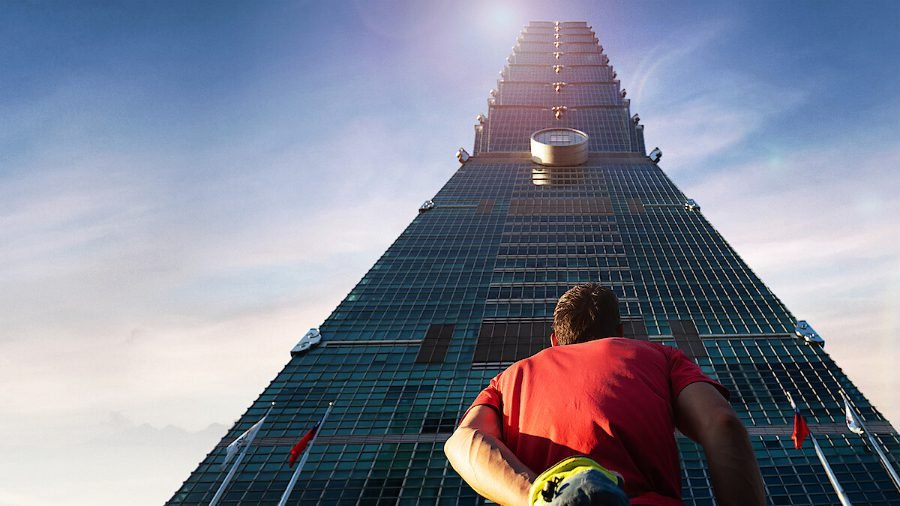
When Alex Honnold stepped onto the façade of Taipei 101 on January 25, 2026, millions watched live on Netflix as the legendary free soloist began his most ambitious urban climb yet.
The same climber who conquered El Capitan’s sheer granite face was now tackling a different vertical challenge—a 1,667-foot skyscraper that once held the title of world’s tallest building.
Completing the ascent in just over 90 minutes without ropes or safety equipment, Honnold’s climb offered more than spectacle.
It provided an unexpected lens through which to examine the extraordinary engineering innovations that make modern supertall structures possible.
The Vertical Challenge: Natural Rock Meets Engineered Precision
Free soloing a skyscraper presents challenges fundamentally different from climbing natural rock formations.
Where El Capitan offers cracks, ledges, and natural features sculpted over millennia, Taipei 101’s exterior represents something else entirely: a testament to human precision engineering where every surface, every protrusion, and every material has been deliberately chosen and placed with millimeter accuracy.
As Honnold described it, the difficulty wasn’t in solving complex movement sequences like on rock. Instead, it was the repetitive nature—performing the same three moves over and over across 101 floors.
His route up the building inadvertently traced a map of contemporary construction innovation, where each handhold and foothold corresponded to deliberate architectural and engineering decisions made to help the structure withstand typhoons, earthquakes, and the physics of supporting immense weight at dizzying heights.
Façade Engineering: Beauty Meets Functionality
Modern skyscraper façades serve multiple critical functions simultaneously, and Taipei 101 exemplifies this multi-purpose design philosophy.
The building’s distinctive segmented appearance—eight sections of eight floors each, inspired by Chinese numerology and bamboo stalks—isn’t merely aesthetic.
This stepped configuration provides structural advantages, reducing wind loads as the building tapers skyward.
For Honnold, these façade features became the physical interface between human ambition and architectural design.
The curtain wall systems wrapping today’s tallest buildings employ advanced materials like low-emissivity glass, aluminum composite panels, and in Taipei 101’s case, sections where Honnold had to smear his climbing shoes directly against glass—a technique requiring trust in friction rather than solid edges.
These materials must balance competing demands: lightweight enough to minimize structural load, yet strong enough to withstand the extreme weather events that become more severe at altitude.
Taipei 101’s double-pane glass units aren’t just windows—they’re precision-engineered components that reduce heat transfer, manage thermal expansion, and contribute to the building’s overall wind resistance.
The metal framework supporting these panels creates the subtle geometry that Honnold navigated during his ascent, highlighting how façade design has evolved from simple cladding to an integrated system of environmental control, structural support, and architectural expression.
Materials Science: Reaching Higher Through Innovation
The race to build taller requires continuous innovation in materials science, and Taipei 101 marked a significant milestone in high-strength concrete technology when it was completed in 2004.
The building’s foundations and core utilize concrete with compressive strengths exceeding 10,000 psi—roughly twice the strength of standard structural concrete used in conventional buildings.
This ultra-high-performance concrete contains specialized additives and aggregate combinations that weren’t economically viable just decades earlier.
Silica fume, fly ash, and superplasticizers work together to create a material that can support enormous loads while minimizing the cross-sectional area of columns and walls, freeing up valuable floor space while maintaining structural integrity.
The steel frame that supplements the concrete core represents another engineering frontier.
High-strength steel alloys, some custom-developed for supertall construction, provide the necessary tensile strength to resist wind-induced swaying and seismic forces.
These materials undergo rigorous testing and quality control processes that ensure consistency across thousands of tons of fabricated components—creating the repetitive, reliable surface features that Honnold could trust during his ascent.
The Damper That Defies Nature
Perhaps the most impressive engineering innovation within Taipei 101 is invisible from the exterior but crucial to the building’s survival: the massive tuned mass damper suspended between the 87th and 92nd floors.
This 728-ton steel pendulum counteracts building movement caused by wind and earthquakes, representing a sophisticated application of dynamic engineering principles.
The damper’s existence underscores a fundamental challenge in supertall construction: buildings of this height must be designed to move.
Rigid structures would crack and fail under the dynamic loads imposed by weather and seismic activity.
Instead, engineers design controlled flexibility into these towers, using systems like tuned mass dampers to manage oscillation within acceptable parameters.
For anyone attempting to climb such a structure, this designed movement presents unique challenges.
As Honnold noted about reaching the summit spire, it was “very windy” and he had to consciously think “don’t fall off the spire.” The building isn’t static—it’s a living organism that responds to environmental forces, shifting subtly but constantly.
Foundation Innovation: Anchoring Giants
The most critical innovations in supertall construction often happen underground, where the public never sees them.
Taipei 101’s foundations extend 262 feet below ground, anchored by 380 concrete piles driven into bedrock.
This subterranean structure must transfer the building’s 700,000-ton weight plus dynamic loads from wind and earthquakes safely into the earth.
Engineers employed advanced geotechnical analysis and foundation design techniques, including deep soil investigation, seismic hazard analysis, and computer modeling of soil-structure interaction.
The foundation system essentially creates an artificial bedrock platform capable of supporting loads that would crush normal soil—a particular challenge in Taiwan, which sits in an active seismic zone.
This below-ground work represents a significant portion of construction costs and timeline for supertall buildings, yet it remains largely unappreciated. Without these innovations in foundation engineering, the dramatic towers that define modern skylines would simply be impossible.
Precision Construction and Quality Control
Honnold’s climb inadvertently highlighted the extraordinary precision required in modern high-rise construction.
The repetitive nature of his ascent—the same three moves floor after floor—was only possible because of the consistency in the building’s construction.
Every panel, every connection point, every structural element aligns with tolerances measured in millimeters across hundreds of vertical feet.
This precision requires advanced surveying techniques, computer-aided design and manufacturing, and rigorous quality control protocols.
Modern construction sites for supertall buildings employ laser-guided positioning systems, building information modeling, and real-time structural monitoring to ensure reality matches design specifications.
Even minor deviations can compound across dozens of floors, potentially creating structural vulnerabilities or compromising performance—or in this case, making a climb like Honnold’s impossible.
Weather and Environmental Considerations
The postponement of Honnold’s climb from January 23 to January 25 due to rain underscores another critical aspect of skyscraper design: how these structures interact with weather. The façade materials must perform in all conditions—rain, heat, humidity, and wind.
Interestingly, as climbing expert Noah Kane noted, Taiwan’s high humidity might have actually helped Honnold’s climb on the glass and metal surfaces, providing better friction than a dry environment would.
This speaks to the complex material science behind façade design, where different surfaces perform differently under varying environmental conditions.
Looking Upward: The Future of Vertical Construction
As cities continue to grow vertically, the innovations pioneered in buildings like Taipei 101 continue evolving.
New materials like carbon fiber reinforced polymers, advanced damping systems, and bio-inspired structural designs point toward future supertall towers that may dwarf today’s giants.
Sustainable construction practices are also reshaping skyscraper design. Energy-efficient building envelopes, integrated renewable energy systems, and advanced HVAC technologies are becoming standard features rather than luxury additions.
The next generation of supertall buildings will need to justify their environmental footprint through superior performance and minimal energy consumption.
The Human Element
Honnold’s climb of Taipei 101, completed in just 1 hour, 31 minutes, and 43 seconds, served as a powerful reminder that for all our technological advancement, human courage and capability remain at the heart of our relationship with these structures.
His reaction upon reaching the summit captured this perfectly: “What a view! It’s incredible! What a beautiful day!”
The same determination that drives climbers to ascend impossible faces motivates engineers to push the boundaries of what’s buildable.
These vertical cities represent more than engineering achievement—they embody human ambition, our desire to rise above limitations, and our capacity for innovation when confronted with challenges.
As Honnold himself reflected on the experience, “You spend so long thinking about it and imagining that it’s possible, but then to actually do it always feels different.”
The same could be said for the engineers and builders who designed and constructed Taipei 101.
Each handhold Honnold found told a story of material science, structural engineering, and architectural vision working in concert to create something that would have been unimaginable to previous generations.
As we continue building upward, we build upon foundations—both literal and figurative—laid by those who refused to accept that reaching higher was impossible.
Also Read
How Web3 Can Revolutionize Construction Equipment Leasing
Benefits of Using a Construction Estimating Software for Your Construction Projects

