
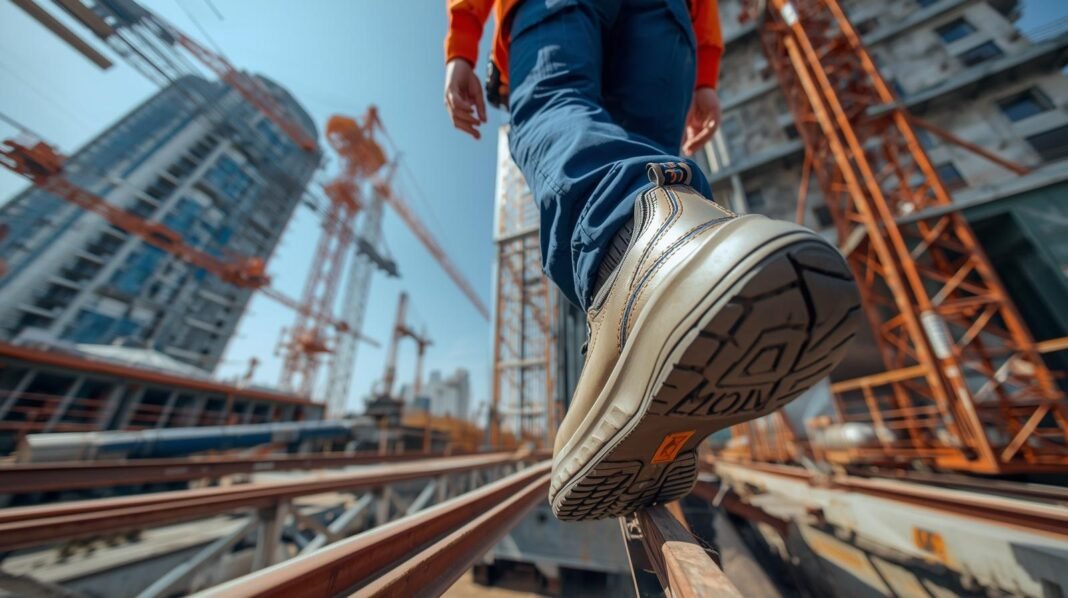
Construction sites remain among the most dangerous working environments on the planet.
In 2024, the U.S. Bureau of Labor Statistics recorded 1,032 fatalities in construction and extraction alone — and of those deaths, 370 were the result of falls, slips, and trips.
Over a decade-long window, the industry has averaged approximately 300 fatal and 20,000 nonfatal fall-related injuries every single year, according to data from CPWR — The Center for Construction Research and Training.
The human cost is staggering. Construction workers represent nearly one in five of all workplace deaths in the United States — yet they account for close to half of all fatal falls across the entire economy.
The financial toll compounds the tragedy: fatal construction injuries are estimated to cost the U.S. economy $5 billion annually in healthcare, lost income, and reduced productivity, while the total bill for workers’ compensation claims from nonfatal falls alone reaches $2.5 billion per year.
For decades, the response to this crisis has focused on harnesses, guardrails, and better fall-arrest systems.
Protective footwear, though mandatory on virtually every commercial site, has largely remained a passive piece of equipment — something that protects the foot from what falls on it, rather than preventing the worker from falling in the first place. That is now changing, rapidly.
A new generation of smart safety shoes — integrating sensors, GPS tracking, accelerometers, IoT connectivity, and real-time alert systems — is beginning to transform the role of footwear from passive protection to active safety management.
This article examines that transformation: what the technology can do, who is building it, and what it means for the future of construction site safety.
2. The Anatomy of Traditional Safety Footwear
Before examining where safety footwear is heading, it is worth appreciating how far it has already travelled. The modern construction safety boot is an engineering achievement in its own right, designed to counter a wide range of site hazards simultaneously.
Steel-toe caps — and increasingly, composite-toe alternatives made from fibreglass, Kevlar, or carbon fibre — shield the foot from falling objects and compression injuries. Midsole plates, typically steel or composite, block puncture from nails and rebar.
Slip-resistant outsoles with deep, aggressive lug patterns reduce the risk of traction loss on wet concrete, mud, or oily surfaces.
Ankle-height and above-ankle constructions provide lateral support that reduces the likelihood of twisting injuries. Electrical hazard ratings protect workers from live circuits, while metatarsal guards extend coverage across the vulnerable top of the foot.
The global industrial safety footwear market now reflects this widespread demand. Valued at approximately $11.6 billion in 2024, the sector is projected to grow to over $26 billion by 2032, driven by tightening workplace safety regulations, expanding industrial activity in emerging markets, and growing awareness of occupational hazard costs.
Construction and manufacturing sectors alone account for more than 40 per cent of total safety footwear demand worldwide.
Yet for all its material sophistication, the traditional safety boot is fundamentally reactive. It absorbs impact; it does not prevent it.
It protects against a hazard that has already arrived. The most dangerous moments on a construction site — a worker losing balance, approaching a restricted zone unaware, suffering a sudden health episode far from colleagues — are largely invisible to the boot.
That limitation is precisely what smart safety footwear aims to overcome.
3. The Smart Boot Revolution: Emerging Technology in Safety Footwear
The term ‘smart safety shoe’ covers a rapidly evolving category of connected personal protective equipment.
At its core, the technology involves embedding electronic components — sensors, communication modules, positioning systems, and power units — into footwear construction without compromising the core protective functions that safety standards demand.
According to the European Agency for Safety and Health at Work (EU-OSHA), smart PPE “promises a higher level of protection and more comfort through the use of enhanced materials or electronics components,” combining traditional protective function with components such as RF modules, sensors, detectors, data transfer modules, and batteries.
In the footwear category, several distinct innovations are now reaching the market.
Fall Detection and Man-Down Alerting
French PPE manufacturer Intellinium has developed smart safety shoes equipped with an embedded accelerometer and motion sensor system.
The footwear includes what Intellinium describes as a Smart Man-Down feature: the shoe detects when its wearer has fallen or remained stationary for an abnormally long period. It first vibrates to prompt the worker to confirm they are safe.
If the worker does not respond within a set time window, an automatic distress alert is transmitted to a monitoring centre or to designated colleagues.
The system also allows a worker in immediate danger to trigger an alert manually — with a single toe tap — at a moment when their hands may be occupied or injured.
GPS Geolocation and Geofencing
Location-aware smart boots use embedded GPS or wireless beacon technology to track a worker’s real-time position across the site.
This data serves multiple purposes simultaneously: it enables site managers to monitor workforce distribution in real time, reconstruct incident timelines after an accident, and set virtual safety perimeters — geofences — around dangerous zones such as crane swing radii, excavation edges, or live electrical areas.
When a worker crosses a defined boundary, both the shoe and the site manager receive an instant alert.
Impact-Detecting and Pressure-Sensing Soles
Pressure and impact sensors embedded in insoles or midsoles can capture granular data about how a worker moves throughout a shift.
Gait analysis algorithms process this data to detect early signs of fatigue — the subtle shuffling, altered stride, and weight-shift changes that often precede a slip or fall.
Research from the construction industry has confirmed that worker fatigue is a significant contributing factor in site accidents, and that these physiological warning signs can appear well before an incident occurs.
Connectivity and IoT Integration
Smart safety shoes do not operate in isolation. They connect — via Bluetooth, RFID, or low-power wide-area networks — to broader site safety management platforms.
These IoT ecosystems aggregate data from footwear alongside inputs from smart helmets, wearable vital sign monitors, environmental gas detectors, and AI-powered surveillance cameras, feeding everything into centralised dashboards where safety managers can monitor site-wide conditions in real time.
Machine learning models then process the combined data stream to detect emerging risk patterns that no single sensor could identify alone.
4. Real-World Benefits: From Incident Response to Prevention
The shift from passive to active safety footwear carries concrete operational benefits that extend well beyond any individual piece of technology.
Faster Emergency Response
On large or complex construction sites, a fallen worker may go undetected for a dangerously long time. Smart footwear with automatic man-down detection eliminates this risk.
The moment a fall is confirmed — or the moment a worker fails to respond to a check-in prompt — an alert is dispatched with the worker’s precise GPS coordinates.
Emergency response teams can reach the scene faster, with accurate location data, at the moment it matters most.
This capability is especially critical in lone worker scenarios, where a colleague cannot raise the alarm.
Proactive Hazard Prevention
The more transformative benefit is not in responding to incidents, but in preventing them. Safety managers using integrated IoT platforms can identify patterns that would be invisible through traditional observation.
If workers in a particular zone consistently show elevated fatigue indicators between 10 a.m. and noon — a period data confirms carries the highest rate of fatal falls — management can adjust work schedules, introduce mandatory rest periods, or modify task assignments before any incident occurs. T
his shift from reactive to predictive safety management is the central promise of connected PPE.
Integration with Safety Management Systems
Smart footwear data flows directly into enterprise health, safety, and environment (HSE) platforms, generating automated incident reports, populating compliance documentation, and providing data trails that satisfy increasingly stringent regulatory reporting requirements.
For contractors working across multiple sites, cloud-based aggregation of footwear and wearable data enables corporate safety teams to benchmark performance, identify underperforming sites, and allocate resources to where the risk is highest.
The Business Case
The economics increasingly support investment. OSHA data suggests that construction companies save between $4 and $6 for every $1 invested in safety programmes.
Smart PPE that demonstrably reduces incident rates, cuts workers’ compensation claims, and lowers regulatory fine exposure can deliver a return on investment that makes the technology financially compelling — not merely ethically desirable.
5. Industry Adoption: Who Is Wearing Smart Boots?
The adoption of smart safety footwear is still in its early stages globally, but the momentum is building across multiple regions and industry segments.
Europe has been the most active early-mover market. France, in particular, has seen significant development activity, driven by companies like Intellinium and supported by the EU’s progressive PPE Directive framework, which creates regulatory pressure for innovation in worker protection.
The European industrial safety footwear market currently holds approximately 33 per cent of global market share, and European manufacturers have been quickest to commercialise connected footwear at scale.
In North America, smart safety footwear is gaining traction primarily through the broader wearable technology push in high-value construction projects — data centres, offshore infrastructure, and large-scale civil engineering contracts.
OSHA’s ongoing emphasis on fall protection compliance, and the growing uptake of site-wide IoT monitoring platforms, creates natural integration points for smart footwear.
Large general contractors and specialist subcontractors in sectors like oil and gas — where lone worker risk is acute — have been among the earliest adopters.
In the Asia-Pacific region, which holds approximately 30 per cent of global safety footwear market share, adoption is being driven by rapid industrialisation, growing regulatory sophistication, and significant investment in megaproject construction.
Countries including Singapore, Japan, and Australia have developed national occupational safety frameworks that actively incentivise technology adoption on construction sites.
Across the Middle East and Africa, construction booms in Saudi Arabia, the UAE, and South Africa are drawing major contractors who bring their global HSE standards — and increasingly their connected PPE programmes — to projects in these markets.
As infrastructure investment in sub-Saharan Africa accelerates, the region’s share of smart PPE adoption is expected to grow.
The broader connected PPE wearable market is also generating complementary products that smart footwear works alongside: smart helmets with embedded impact sensors and environmental monitors; IoT-connected vests that track proximity to heavy machinery; wristband vital-sign monitors.
The result is an emerging ecosystem of connected worker technology, of which smart boots are one important node.
6. Future Outlook: The Fully Connected Construction Worker
The trajectory of smart safety footwear points toward a future in which every piece of PPE a construction worker wears forms part of an integrated, intelligent safety system — and the worker themselves becomes a node in a live digital twin of the construction site.
Predictive Analytics at Scale
As datasets from smart footwear accumulate across thousands of workers and hundreds of sites, machine learning models will become increasingly capable of identifying the specific combinations of environmental, physiological, and behavioural factors that precede accidents.
Predictive safety engines will move beyond flagging individual at-risk workers to generating site-level risk scores that update in real time, enabling dynamic safety interventions that did not previously exist.
Full IoT Ecosystem Integration
Smart footwear will increasingly communicate not just with safety management platforms but with site machinery and infrastructure directly.
A boot detecting that a worker has entered a crane exclusion zone may, in future architectures, automatically signal the crane operator’s cabin or trigger a speed reduction in nearby autonomous equipment.
The construction site will, in this sense, become a responsive environment that actively adjusts to worker behaviour and risk signals.
Material Innovation
The physical construction of smart safety footwear will continue to improve. Today’s challenges — battery life, sensor durability in harsh site conditions, weight, cost — are all active areas of research.
Energy harvesting technology, which converts the kinetic energy of walking into electrical power for onboard sensors, may eventually eliminate the need for regular charging.
Advances in flexible electronics will enable more sophisticated sensor arrays to be embedded into footwear without compromising comfort or structural integrity.
Regulatory Mandates
As the technology matures and costs fall, it is likely that smart safety footwear will transition from an innovation premium to a regulatory baseline for high-risk projects.
Just as OSHA’s fall protection standards progressively raised the bar for harnesses and guardrails, future amendments to PPE directives in the EU and occupational safety regulations in North America are expected to begin incorporating minimum connected-monitoring requirements for workers in the highest-risk roles.
Sustainability
The global industrial safety footwear market is also responding to sustainability pressures. Manufacturers are increasingly offering footwear constructed from recycled materials and biodegradable components.
As smart footwear scales, the challenge of managing electronic waste from embedded components will require circular economy design principles — modular electronics that can be removed and repaired without discarding the entire boot.
7. The Boot as a Safety System
Construction fatalities are not random. They follow patterns — of time, location, fatigue, distraction, and inadequate protection — that data can identify, and that technology can address.
For decades, the construction industry has understood this about helmets, harnesses, and guardrails. Smart safety footwear extends that logic to the ground itself.
The global industrial safety footwear market, already valued at nearly $12 billion in 2024, is on a growth trajectory that reflects both regulatory pressure and genuine industry appetite for solutions that reduce the human and financial cost of site accidents.
Partner Opportunity
Are You a Safety Gear or Smart Footwear Brand?
Get featured in our next issue and reach thousands of construction professionals actively seeking innovative safety solutions. Boost your visibility and connect with the right audience.
Within that market, the smart footwear segment — integrating sensors, GPS, IoT connectivity, and AI-powered analytics — represents its most dynamic and consequential frontier.
The steel-toe boot was, for its era, a significant step forward. It absorbed energy, prevented trauma, and saved countless feet from crushing injury.
The smart safety shoe is something more ambitious: a platform for real-time safety intelligence, a tool for proactive intervention, and a link in a connected safety ecosystem that treats every worker as a monitored, protected node in a live site-wide network.
For the construction worker who pulls on their boots each morning before walking onto a live site, the technology changing fastest may not be the crane, the BIM model, or the autonomous excavator. It may be what is already on their feet.
Key Statistics at a Glance
- 1,032 — Construction and extraction worker fatalities recorded in the U.S. in 2024 (BLS)
- 370 — Fatal falls, slips, and trips among construction workers in 2024 (BLS)
- ~20,000 — Nonfatal fall-related construction injuries per year (CPWR)
- $11.6B — Global industrial safety footwear market value in 2024
- $26B — Projected market value by 2032 (10.6% CAGR)
- $4–$6 — Saved for every $1 invested in construction safety programmes (OSHA)
- 2% — Projected CAGR of global industrial safety shoes market through 2034
Source: BLS, CPWR, OSHA, Industry Reports 2024
Also Read
Roof Safety: Essential Gear and Practices for Roofers
Safety and Handling Tips for Working with Aluminum Oxide Abrasives

- How Smart Safety Shoes Are Revolutionizing Construction Site Safety - March 28, 2026
- 10 Common AC Problems and How to Fix Them Before Summer Hits - March 26, 2026
- How Komatsu Is Building the Future of Autonomous Mining in Africa in 2026 - March 25, 2026
