
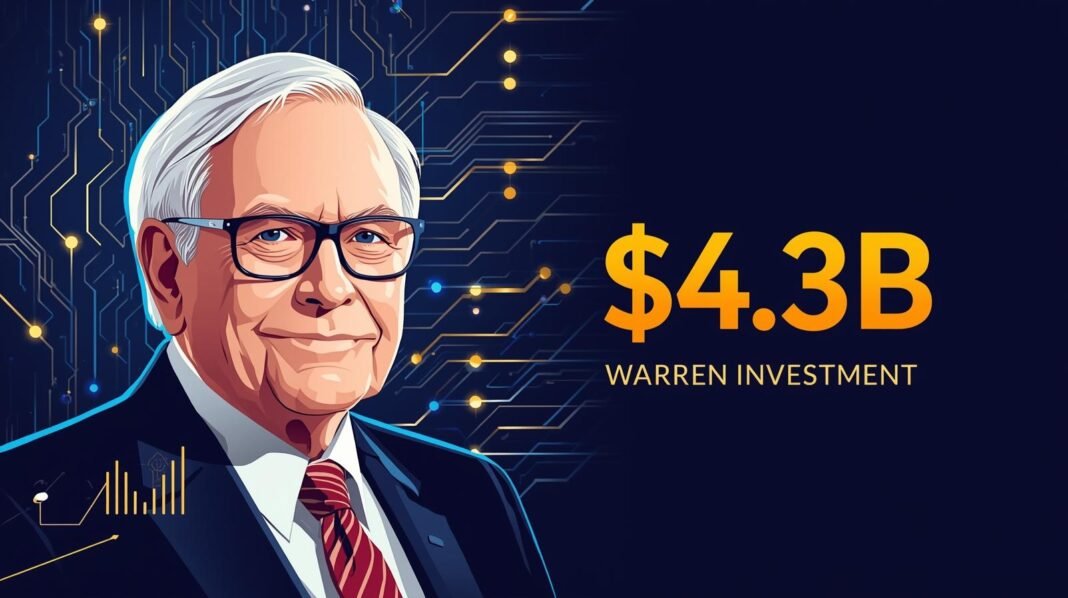
For decades, Warren Buffett stayed clear of technology investments, famously stating he only invested in businesses he understood.
But in a striking reversal disclosed on November 14, 2025, that caught Wall Street by surprise, Berkshire Hathaway has taken a substantial position in Alphabet, Google’s parent company, accumulating approximately 17.8 million shares valued at $4.3 billion as of September 30, 2025.
This move marks a significant shift for the Oracle of Omaha, who once publicly admitted he “blew it” by not investing in Google despite witnessing firsthand its revolutionary advertising potential. The question on every investor’s mind: What changed?
A Confession of Regret Comes Full Circle
Warren Buffett’s relationship with Google is a story of missed opportunity that haunted him for years.
In 2018, the legendary investor revealed his regret about passing on Google’s early growth, despite having unique insight into its business model.
Berkshire’s auto insurance subsidiary, Geico, was among Google’s earliest advertising customers, paying approximately ten dollars every time someone clicked on their ads. This firsthand experience gave Buffett a front-row seat to Google’s extraordinary margins and business potential.
“I had seen the product work, and I knew the kind of margins they had,” Buffett acknowledged in past interviews, explaining his hesitation: “I didn’t know enough about technology to know whether this really was the one that would stop the competitive race.”
Charlie Munger, Berkshire’s late vice chairman, echoed this sentiment, openly wishing the company had purchased Google stock years ago. Now, more than two decades after Google’s founding, Berkshire has finally made its move.
What Makes Alphabet Different Now?
Alphabet’s transformation into Berkshire’s tenth-largest equity holding didn’t happen by chance. Several compelling factors appear to have influenced this decision:
AI-Driven Cloud Revolution
The artificial intelligence boom has fundamentally altered Alphabet’s business trajectory, particularly its Google Cloud division.
Throughout 2025, Google Cloud has maintained impressive growth momentum, with the division representing one of the company’s fastest-growing segments.
This exceptional growth stems from enterprise adoption of AI solutions, including advanced infrastructure and generative AI tools.
Companies worldwide are leveraging Google’s AI initiatives like Gemini 2.0 and advancements in generative AI across its core products.
CEO Sundar Pichai has emphasized that Google Cloud continues to demonstrate strong momentum, with the platform’s AI products gaining widespread adoption among enterprise clients. The company has maintained its trajectory of signing significant multi-billion dollar deals throughout 2025.
Financial Performance That Speaks Buffett’s Language
Alphabet’s third-quarter results delivered the kind of numbers that align with Buffett’s investment philosophy:
- Consolidated revenue reached $88.3 billion, marking a 15% year-over-year increase
- Operating income jumped 34% as margins expanded by 4.5 percentage points
- Earnings per share hit $2.12, soundly beating analyst expectations of $1.85
- YouTube advertising and subscription revenue surpassed $50 billion over the past four quarters
These figures demonstrate the kind of sustainable competitive advantage and profitability that traditionally attracts Buffett’s attention.
Strong Moats in Multiple Businesses
Alphabet possesses several characteristics that fit Berkshire’s classic investment criteria:
Dominant Market Position: Google Search maintains overwhelming dominance in the search engine market, processing billions of queries daily and commanding the lion’s share of search advertising revenue.
Multiple Revenue Streams: Beyond search advertising, Alphabet generates substantial income from YouTube, Google Cloud, hardware sales, and subscription services, reducing dependency on any single business line.
Cash Generation Machine: The company held approximately $108 billion in cash reserves as of early 2024, providing substantial flexibility for innovation and shareholder returns.
Network Effects: Google’s ecosystem—spanning search, Android, Chrome, Maps, and YouTube—creates powerful network effects that become more valuable as more users and businesses participate.
The Apple Connection: A Pattern Emerges
Berkshire’s Alphabet investment becomes more intriguing when viewed alongside the firm’s evolving Apple position. Throughout 2024, Buffett aggressively trimmed Berkshire’s Apple holdings, reducing the position by approximately two-thirds.
At the end of the first quarter of 2024, Berkshire held 789 million Apple shares. By year-end, that number had plummeted to 300 million shares. The company continued this selling pattern into the third quarter, reducing its Apple stake by another 15% to $60.7 billion.
This simultaneous sell-down of Apple while building a position in Alphabet suggests a deliberate rebalancing of Berkshire’s technology exposure rather than a wholesale retreat from the sector.
Buffett may be seeking better value propositions or responding to portfolio concentration concerns, as Apple previously represented roughly half of Berkshire’s equity holdings.
Who Actually Made the Call?
While headlines trumpet “Warren Buffett buys Alphabet,” the reality may be more nuanced. At 95 years old and preparing to step down as CEO at year’s end, Buffett has entrusted significant investment authority to two portfolio managers: Ted Weschler and Todd Combs.
These managers have demonstrated greater comfort with technology investments than Buffett historically showed. One of them initiated Berkshire’s Amazon position in 2019, which remains in the portfolio at approximately $2.2 billion.
Market analysts suggest either Weschler or Combs likely spearheaded the Alphabet investment, viewing Google’s parent company as a consumer-facing brand with technology underpinnings—similar to how Buffett rationalized the Apple investment as a consumer products company rather than a pure technology play.
Alphabet’s Stock Performance and Valuation
Timing appears favorable for Berkshire’s entry into Alphabet. The stock has delivered impressive returns in 2024, rallying 46% as artificial intelligence momentum drove investor enthusiasm for the company’s cloud capabilities and AI integration across its product suite.
Despite this strong performance, Alphabet trades at relatively reasonable valuations compared to other megacap technology companies:
- Forward price-to-earnings ratio around 22-23
- PEG ratio (price-to-earnings-growth) of approximately 1.3, suggesting reasonable pricing relative to growth expectations
- Lower valuation multiples than peers like Microsoft, Apple, and Nvidia
These metrics suggest Alphabet offers a compelling value proposition even after significant price appreciation, potentially explaining Berkshire’s willingness to establish a position.
Strategic Implications for Investors
Berkshire Hathaway’s $4.3 billion Alphabet investment sends several important signals to the investment community:
Technology Is No Longer Off-Limits
Buffett’s historical technology aversion has clearly evolved. Between Apple, Amazon, and now Alphabet, Berkshire demonstrates that technology companies with strong competitive positions, predictable cash flows, and reasonable valuations fit within its investment framework.
AI Represents Real Business Transformation
The emphasis on Alphabet’s AI-driven cloud growth validates that artificial intelligence is delivering tangible business results rather than remaining speculative technology.
Enterprise adoption of AI tools is accelerating, creating substantial revenue opportunities for infrastructure providers.
Diversification Beyond Apple
As Berkshire reduces its concentrated Apple position, the firm is exploring other quality technology investments. This diversification strategy reduces single-stock risk while maintaining exposure to the secular growth trends reshaping business and consumer behavior.
Value Can Be Found in Growth
Alphabet’s combination of robust growth (particularly in Cloud) and reasonable valuation demonstrates that growth and value aren’t mutually exclusive. Companies delivering strong financial performance while trading at moderate multiples represent attractive opportunities.
Looking Ahead: What This Means for Alphabet
Berkshire’s investment provides validation for Alphabet’s strategic direction and could influence other institutional investors’ perceptions of the company. While $4.3 billion represents a relatively small position for Berkshire (about 2% of its $257 billion equity portfolio), the psychological impact carries weight.
Several factors could drive Alphabet’s continued performance:
AI Monetization: Successfully converting AI capabilities into revenue through cloud services, advertising enhancements, and new product offerings will determine long-term value creation.
Regulatory Challenges: Ongoing antitrust investigations and potential remedies could impact Alphabet’s business model, particularly around search and advertising dominance.
Cloud Market Share Gains: Google Cloud trails Amazon Web Services and Microsoft Azure in market share, presenting both challenges and opportunities for expansion.
Capital Allocation: How Alphabet deploys its substantial cash reserves—whether through acquisitions, share buybacks, dividends, or infrastructure investment—will influence shareholder returns.
The Buffett Lesson: Admit Mistakes and Adapt
Perhaps the most important takeaway from Berkshire’s Alphabet investment isn’t about the company itself but rather about investing philosophy. Warren Buffett’s willingness to publicly acknowledge his Google regret and eventually invest in Alphabet (albeit years later) demonstrates intellectual honesty and adaptability.
Great investors don’t avoid mistakes—they learn from them. Buffett’s technology evolution from complete avoidance to significant holdings in Apple, Amazon, and Alphabet shows that even legendary investors must adapt their frameworks as business models evolve and understanding deepens.
For individual investors, this provides a valuable template: remain open to changing your mind when circumstances change or when you’ve developed better understanding of industries you previously avoided.
Conclusion: A New Chapter for Berkshire and Big Tech
Warren Buffett’s journey from technology skeptic to Alphabet shareholder represents more than a single investment decision.
It symbolizes the inevitable convergence of traditional value investing principles with modern technology companies that have matured into dominant, cash-generating enterprises.
Alphabet’s $4.3 billion position in Berkshire’s portfolio may grow or shrink depending on performance and valuation, but its inclusion marks a definitive statement: technology companies with strong competitive positions, robust cash generation, and reasonable valuations deserve consideration from even the most traditional value investors.
As Buffett prepares to hand the reins to successor Greg Abel, Berkshire’s technology investments—including this significant Alphabet stake—will test whether these positions represent enduring value or market-timing challenges.
One thing remains certain: the Oracle of Omaha has finally answered the question of whether he’ll ever own Google. Better late than never.
Also Read
Nvidia Corporation (NVDA): AI Strength vs. Market Volatility
Bitcoin vs Tech Giants: Can Crypto Outpace Nvidia by 2030?

- U.S. Senators Push for Tariff Probe into Construction Equipment Imports from Mexico - March 30, 2026
- Top Smart Safety Shoes to Watch in 2026 - March 29, 2026
- SASSA Payment Dates for April 2026: What Every Beneficiary Needs to Know - March 29, 2026
