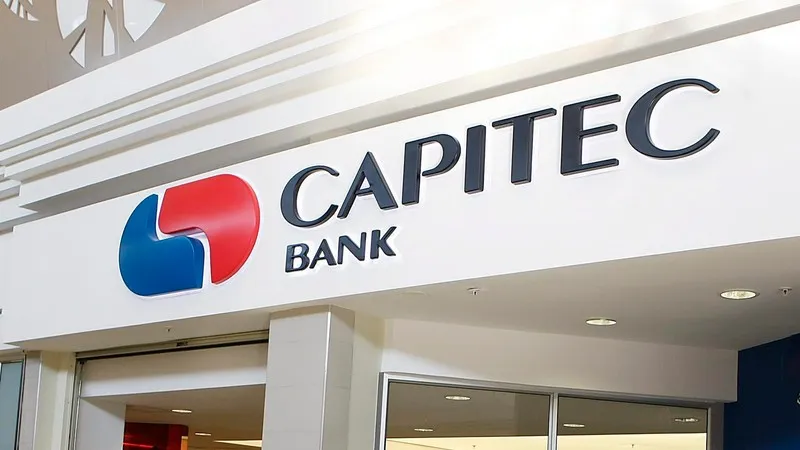
Capitec Bank just did what many thought improbable: it vaulted past FirstRand to become Africa’s most valuable bank by market capitalization, closing around R424 billion and edging out its larger-by-assets rivals.
The shift follows a steady outperformance in 2025 and comes barely a month after Graham Lee took over as CEO—underscoring a leadership handover with momentum rather than disruption.
Crucially, this is market value, not balance-sheet size. By total assets, Capitec remains smaller than the big incumbents; but markets are paying for growth, quality of earnings, and brand power.
What Capitec Is Doing Right
1) Relentless Simplicity as a Business Model
From its earliest days, Capitec stripped banking to first principles: simple products, transparent pricing, and speed.
That proposition landed especially well with mass-market customers who were underserved by legacy fee structures and complex bundles.
Over time, simplicity became a moat—lower service friction means higher usage, better retention, and powerful word-of-mouth.
The market’s willingness to assign a premium multiple to Capitec reflects confidence that this operating philosophy is repeatable and scalable across product lines.
2) Scale in Customers, Not Branches
Capitec is South Africa’s biggest bank by customer numbers, a scale advantage that compounds digitally: every incremental feature ships to a very large base at near-zero marginal distribution cost.
That’s how a smaller-by-assets bank can still deliver outsized earnings momentum and keep cost-to-serve low.
New leadership continuity—Graham Lee succeeding Gerrie Fourie—helps preserve the culture that built this engine.
3) Disciplined Risk + Mix Shift in Earnings
Markets once tagged Capitec as “just unsecured lending.” That’s outdated. Over the past few years, the bank has broadened revenue mix—payments, transactional banking, and cross-sell—so earnings are less cyclical and less singularly exposed to credit.
When credit cycles tighten, banks that earn more from transactions and fees typically protect margins better. Capitec’s re-rating suggests investors believe its loss-management discipline and underwriting data have matured in step with growth.
4) Digital First, but Human Where It Matters
Capitec’s mobile experience is fast and clean, and its branch footprint is designed for throughput, not prestige.
The result is a hybrid service model that converts digital engagement into deposit stickiness while keeping physical costs in check.
That combination is hard for incumbents—often constrained by legacy tech stacks and branch networks—to copy quickly without transitional pain.
5) Brand Strength That Converts to P&L
In 2025 brand league tables recognized Capitec as one of the fastest-growing and strongest banking brands in South Africa (AAA+ strength score).
Brand strength isn’t vanity; it lowers acquisition cost, improves conversion, and softens price sensitivity—all of which lift lifetime value and justify richer valuation multiples.
6) Execution Through a Leadership Transition
Leadership changes can stall momentum; instead, Capitec’s didn’t. The handover to Graham Lee coincided with continued share-price outperformance versus the bank index in 2025, reinforcing the market’s view that Capitec’s playbook is institutional, not personality-driven.
Why the Market Crown Moved Now
Share-price delta: In 2025, Capitec’s stock outpaced the FTSE/JSE Africa Banks Index, while FirstRand lagged—narrowing and then flipping the market-cap gap.
Narrative strength: “Smallest by assets, largest by value” is a compelling, media-friendly storyline that attracts incremental buy-side attention and retail flows—often self-reinforcing in the short run.
Confidence in earnings durability: Investors appear to be pricing in sustained ROE via transaction scale and cross-sell rather than a one-off credit boom.
What Could Keep Capitec on Top
1. Deepening Payments Ecosystem
Every extra tap, debit, or transfer on Capitec rails lifts fee income and embeds the app at the center of a user’s financial life. Expect more merchant acceptance, QR rails, and small-business tools that lock in both sides of the network.
2. Credit with Granular Controls
Doubling down on data-driven underwriting—dynamic limits, behavioral scoring, and early-warning systems—can keep credit costs in check even if employment or household credit quality wobbles.
3. SME & Ecosystem Finance
Selective expansion into SME working-capital products and invoice finance (delivered digitally, priced by risk in real time) can diversify yield without ballooning asset-side complexity.
4. Insurance & Wealth Lite
Low-friction micro-insurance, savings pods, and goal-based wealth tools are natural add-ons inside the app, lifting non-interest revenue and daily engagement.
5. Brand-Led Cost of Funds Advantage
A trusted consumer brand can attract sticky, low-cost deposits, protecting margins if policy rates fall or competition for deposits intensifies.
What Could Knock the Crown Off
Credit Cycle Turn: A macro slowdown or unemployment spike could pressure unsecured portfolios; vigilance on vintage-level loss rates is key.
Competitive Imitation: New digital entrants and incumbent refreshes (including recent challenger bank launches) may compress fees and raise acquisition costs.
Regulatory/Conduct Risks: Pricing transparency and collections practices are always under the microscope; missteps can be brand and valuation negative.
Multiple Risk: If investors rotate from growth to value defensives, a multiple de-rating could shrink market-cap leadership even without operational slippage.
Context: Value ≠ Size
Capitec’s market-cap win is clear. But by total assets, FirstRand and Standard Bank remain much larger institutions with diversified regional books and wholesale franchises. The distinction matters for risk capacity, cross-border payments, and institutional services. The takeaway: Capitec leads on perceived earnings quality and growth, not on balance-sheet heft.
The Bottom Line
Capitec’s rise to the top is less about a single quarter and more about a decade-plus of compounding advantages: simplicity, digital distribution at scale, brand trust, and disciplined credit. The market is rewarding a bank that turned accessibility into profitability—and did so with operational rigor. Whether it keeps the crown will depend on two things it can control—execution and product velocity—and one it can’t: the credit cycle.
Also Read
NVIDIA’s Q2 2025 Earnings: A Deep Dive into AI Leadership and Geopolitical Challenges
Oklo (OKLO) Shares Edge Higher Amid Analyst Optimism and Market Buzz

- Top Smart Safety Shoes to Watch in 2026 - March 29, 2026
- From Hard Hat to Smart Hat: How Wearables Are Rewiring Workplace Safety - March 28, 2026
- How Much Does Emergency AC Repair Cost in the US IN 2026? - March 26, 2026
